Guru Nanak Dwaar Marg (Pali Gurdwara Sahib)
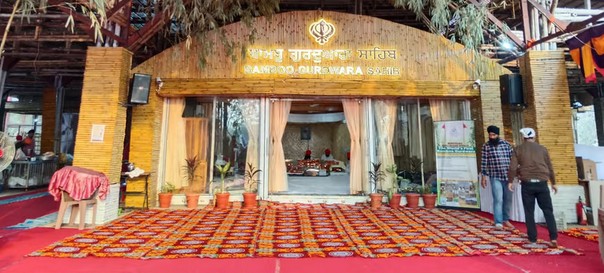
The creation of Gurdwara Guru Nanak Dwaar in Pali is, fundamentally, an answer to the collective, generational Ardas (humble supplication) of this isolated Deccan sangat. For years, local families preserved their traditions in small domestic spaces, praying continuously for a dedicated home for the Shabad Guru where they could gather, cook Langar, and pass down their heritage to their children. This spiritual longing coalesced into reality when a generous piece of land in the lush, hilly environs of Gondale, Pali, was donated to the community.
The Bamboo Sanctuary in the Sahyadris: Historical, Theological, and Ecological Reflections on Gurdwara Guru Nanak Dwaar, Pali
To traverse the rugged terrain of the Konkan division in Maharashtra is to walk through a landscape deeply saturated with the memory of Maratha Swarajya, defensive warfare, and the revolutionary spirit of Chhatrapati Shivaji Maharaj. Yet, as a Sikh historian, navigating the dense forests and basaltic cliffs of Raigad reveals a fascinating new chapter in our spiritual cartography. Tucked away in the serene, rolling foothills of Gondale, near the historical town of Pali in the Raigad district, a unique spiritual sanctuary has emerged that bridges the martial, defensive heritage of the Deccan with the timeless, universal peace of the Sikh faith. Gurdwara Guru Nanak Dwaar, widely celebrated as the world's first fully sustainable Bamboo Gurdwara Sahib, represents a remarkable synthesis of ecological theology, historical preservation, and minority empowerment. It stands as a physical manifestation of a community's resilient faith, rising majestically against the backdrop of the ancient Sarasgad and Sudhagad forts to write a new chapter of Sikh history in Western India.
The Historical Context of the Sikh Presence in Maharashtra
To understand the profound significance of establishing a grand Gurughar in the Raigad district, we must first trace the historical footprint of Sikhism within the wider Deccan region. Traditionally, the institutional heart of the Sikh community in Maharashtra has been anchored in the east, on the sacred banks of the Godavari River in Nanded. It was there, at Takhat Sachkhand Sri Hazur Sahib, that the tenth Guru, Guru Gobind Singh Ji, spent his final earthly days, infused the community with sovereign temporal authority, and declared the Sri Guru Granth Sahib Ji as the eternal living Guru of the Sikhs in 1708. While Nanded grew into a massive metropolitan hub of Sikh pilgrimage over the centuries, the western coast and the rugged hinterlands of the Konkan remained a historical vacuum for institutional Sikh spaces. Despite this institutional absence, scattered pockets of Sikhs, particularly the Sikhligar Sikh community, have populated these regions for generations, keeping the flame of Sikhi alive under highly challenging circumstances.
The Sikhligar Sikhs hold an incredibly proud yet often marginalized position within Sikh history. Historically, they were the master blacksmiths, armorers, and weapon-makers of the Khalsa panth, forging the swords, shields, daggers, and chainmail that defended the faith against Mughal oppression. Following the fall of the Sikh Empire and the onset of British colonial rule, the demand for traditional weaponry collapsed, and the Sikhligar community was pushed into severe economic precarity, forced to live as nomadic or semi-nomadic artisans. Scattered across the rural expanses of Maharashtra, including Raigad, these families maintained an unshakeable devotion to the Gurus despite being geographically and culturally isolated from the mainstream Panth. The lack of localized Gurdwaras in the Raigad district meant that these devotees were historically forced to travel up to seventy kilometers—often spending four to five hours in grueling, expensive travel—simply to perform darshan of the Guru Granth Sahib Ji, leaving them spiritually isolated and vulnerable to cultural erosion.
The Power of Ardas and the Genesis of the Pali Sanctuary
The creation of Gurdwara Guru Nanak Dwaar in Pali is, fundamentally, an answer to the collective, generational Ardas (humble supplication) of this isolated Deccan sangat. For years, local families preserved their traditions in small domestic spaces, praying continuously for a dedicated home for the Shabad Guru where they could gather, cook Langar, and pass down their heritage to their children. This spiritual longing coalesced into reality when a generous piece of land in the lush, hilly environs of Gondale, Pali, was donated to the community. This specific location is highly symbolic; Pali is historically famous for the ancient Ballaleshwar Temple, one of the eight revered Ashtavinayak temples of Lord Ganesha, and is flanked by towering forts that once guarded the trade routes connecting the inland Deccan plateau to the coastal ports of the Konkan. Placing a Gurdwara in this multi-faith, historical landscape immediately established it as a hub for interfaith harmony and cultural synthesis.
Rather than constructing a conventional structure of brick, steel, and concrete—which would have scarred the pristine, ecologically sensitive landscape of the Western Ghats—the community made a revolutionary decision: they resolved to build the world's first fully sustainable Bamboo Gurdwara Sahib. This decision was guided by a profound understanding of the ecological challenges of our era, as well as a desire to build a sanctuary that was structurally and spiritually in harmony with its natural surroundings. Bamboo, often referred to as "vegetable steel," possesses a higher tensile strength than structural steel because its fibers run axially, and it is highly elastic, making it remarkably resilient in the earthquake-prone and heavy-monsoon environment of the Sahyadri mountains. Furthermore, its natural silicate acid and water content give it an extraordinary resistance to fire, rendering it a highly durable, cost-effective, and carbon-negative building material that perfectly preserves the natural beauty of the Pali hills.
The Theology of Ecology: Nature in the Sikh Worldview
For a Sikh historian, the construction of a Bamboo Gurdwara is not merely an innovative architectural experiment; it is a deep, material realization of the ecological theology embedded in the core of Sikh scripture. In the closing hymn of the Japji Sahib, Guru Nanak Dev Ji famously proclaims: "Pavan Guru Pani Pita, Mata Dharat Mahat" (Air is the Teacher, Water is the Father, and the Great Earth is the Mother of all). The Gurus did not view nature as an object to be dominated, exploited, or paved over; they viewed the natural world as a divine mirror reflecting the Creator's light. Throughout the Guru Granth Sahib, the beauty of the forest, the falling of the rain, and the growth of vegetation are used as metaphors for spiritual awakening. By eschewing heavy, carbon-intensive concrete in favor of sustainably harvested bamboo, Gurdwara Guru Nanak Dwaar directly honors this theological mandate, proving that sacred spaces can be constructed in a way that heals, rather than hurts, the Great Mother Earth.
This ecological approach represents a critical intervention in the history of modern Gurdwara architecture. In the post-partition era, much of the traditional, organic architecture of historical shrines was replaced with massive, uniform marble structures, which, while majestic, often detached the shrines from their local ecosystems and demanded immense resource extraction. The Pali Gurdwara represents a return to an older, more localized tradition of building, wherein the sacred space is structurally integrated into the local biosphere. The project sources its seasoned bamboo from Northeast India and Indonesia, creating a global network of sustainable craftsmanship. By standing as a monument of organic beauty, the Gurdwara invites pilgrims to experience the divine not within a sterile, artificial monument, but within the vibrant, living ecosystem of the Western Ghats.
Architectural Design and the Dual Parkash Maryada
The architectural layout of Gurdwara Guru Nanak Dwaar is a beautiful blend of traditional Sikh motifs and modern, sustainable engineering. The first phase of the complex features a spacious Darbar Hall built using a twenty-five-foot-high cube structure cladded entirely in 360-degree seasoned bamboo. The crowning glory of the sanctuary is a magnificent bamboo dome (Gumbad) measuring 110 feet by 110 feet, designed to mimic the traditional ribbed domes of historical Sikh temples but constructed entirely of flexible, lightweight bamboo staves. Inside the Darbar Hall, the natural texture of the bamboo creates a warm, acoustic-rich, and meditative atmosphere, where the sound of the Gurbani Kirtan resonates with a unique, organic depth. The complex also features five en-suite rooms for travelers, a state-of-the-art, open-plan stainless steel Langar kitchen, and a spacious Langar hall designed to serve free, nutritious meals to hundreds of visitors daily, regardless of their caste, creed, or social standing.
Beyond its physical architecture, the Gurdwara is historically significant for its preservation of the unique Maryada (traditional code of conduct) of the southern Sikh Takhats. In keeping with the centuries-old traditions of Takhat Sachkhand Sri Hazur Sahib in Nanded, Takhat Sri Patna Sahib in Bihar, and historical Nihang Chhaunis (warrior encampments), the Bamboo Gurdwara Sahib performs the dual Parkash (ceremonial seating) of both the **Sri Guru Granth Sahib Ji** and the **Sri Dasam Granth Sahib Ji**. This dual Parkash represents the complete, undivided heritage of the Sikh panth—where the serene, meditative, and universal spiritual wisdom of the Adi Granth is set side-by-side with the heroic, defensive, and martial compositions of the tenth Guru, Guru Gobind Singh Ji. This traditional practice, preserved in the deep south, is brought to life in Raigad, offering pilgrims a rare and profound experience of the full spectrum of historical Sikh liturgy and sovereign identity.
A Chronological Overview of the Sacred Site's Evolution
The journey of this historic site from a distant dream in the hearts of the local sangat to a globally recognized beacon of sustainable faith is captured in the key milestones of its development:
| Year/Phase | Development Milestone | Socio-Religious Significance |
|---|---|---|
| Prior to 2023 | Generational Isolation | Local Sikhligar and Punjabi families in Raigad endure a 60–70 km journey to access the nearest Gurughar. |
| Late 2023 | Land Donation in Gondale | A three-acre plot of pristine land in the Pali hills is donated, sparking the vision for a sustainable sanctuary. |
| January 2024 | Inaugural Pali Jodh Mela | The annual festival begins with the Mahaan Akhand Hazuri Darbar, featuring a Jatha of 40 Singhs from Nanded. |
| 2024–2025 | Phase 1 Bamboo Construction | Development of the 110ft x 110ft Bamboo Dome, Darbar Hall, and the state-of-the-art, eco-friendly Langar kitchen. |
| Post-2025 Vision | Holistic Educational Expansion | Establishment of a Gurbani Learning Center, an Ayurvedic Hospital, an International School, and the National Sikh Museum. |
The Annual Pali Jodh Mela and the Revival of Tanti Saaz Kirtan
The cultural life of Gurdwara Guru Nanak Dwaar is anchored by the annual **Pali Jodh Mela**, a grand socio-religious gathering that has rapidly become one of the most vibrant Sikh festivals in Western India. The centerpiece of this celebration is the *Mahaan Akhand Hazuri Darbar*, which is conducted with the special blessings of the venerable Sant Baba Kulwant Singh Ji of Sri Hazur Sahib, Nanded. For this momentous occasion, a Jatha of forty highly trained Singhs from Nanded makes the journey to Pali to conduct continuous, uninterrupted recitations (Akhand Paths) of the Sri Guru Granth Sahib Ji, Sri Dasam Granth Sahib Ji, and the Sri Sarab Loh Granth Sahib Ji, alongside the early morning prayers of Japji Sahib and Jaap Sahib. This intense spiritual concentration transforms the quiet hills of Raigad into a powerhouse of divine vibration, drawing thousands of devotees from Mumbai, Pune, and across India.
Central to these celebrations is the revival of **Tanti Saaz Kirtan**—the performance of sacred Gurbani hymns using historical stringed instruments like the Rabab, Saranda, Dilruba, and Taus, as opposed to the modern harmonium. Led by the renowned Nihaal Kirtani Jatha, under the guidance of Bhai Bachittar Singh Nihal, this musical propagation is designed to connect the younger generation with the authentic, classical raags in which the Guru Granth Sahib was composed. By employing these ancient instruments, the Jatha creates a deeply soulful, meditative experience that transports listeners back to the courts of the Gurus, demonstrating that true spiritual preservation involves restoring both the physical materials of our shrines and the classical traditions of our sacred music.
A Blueprint for the Future: Education, Healing, and Empowerment
As we look to the future, the ultimate vision for Gurdwara Guru Nanak Dwaar extends far beyond the walls of its beautiful bamboo Darbar Hall. It is envisioned as a holistic, self-sufficient ecosystem designed to uplift the local community intellectually, physically, and spiritually. The complex will house a scholarship-based Gurbani Learning Center, offering free, high-quality training for aspiring Granthis, Gianis, and Ragis to become well-educated ambassadors of Sikh history and theology. To ensure a balanced and robust upbringing, the center will offer multi-lingual academic classes alongside free fitness, self-defense, and traditional Sikh martial arts (Gatka) classes, empowering young boys and girls with the physical discipline and moral courage required to face the challenges of the modern world.
Furthermore, the three-acre campus will eventually incorporate a natural Ayurvedic healing hospital, an international school, and a comprehensive National Sikh Museum. The Ayurvedic hospital will merge the ancient Indian science of life with the healing solace of Gurbani, providing free or highly subsidized healthcare to the local tribal and rural populations of Raigad. The National Sikh Museum will serve as an invaluable repository of information, educating visitors of all faiths about the rich, multi-centurial history of Sikhism, its relationship with the Maratha Empire, and the immense contributions of the Sikhligar community to India's freedom struggle. Through these diverse initiatives, the world's first Bamboo Gurdwara is reclaiming the true, historical purpose of the Gurughar: not simply as a temple for passive worship, but as a sovereign, dynamic sanctuary dedicated to the absolute welfare of all humanity—the timeless ideal of Sarbat Da Bhalla.
Location & contact
Gondale, Pali, Raigad, Maharashtra 410205
- Phone: +44 7817 558 294, +91 7347 608 508
- Email: Contact@BambooGurdwaraSahib.in
- Map: Open in Google Maps
- Website: Visit website
- Associated Gurus: Guru Gobind Singh Ji
