Historical Turning Points · Origins & Gurus · Guru Nanak Dev Ji
1469 Birth of Guru Nanak Dev Ji
Born in Talwandi (Nankana Sahib), the first Guru introduced a message of One God and the equality of all humanity.
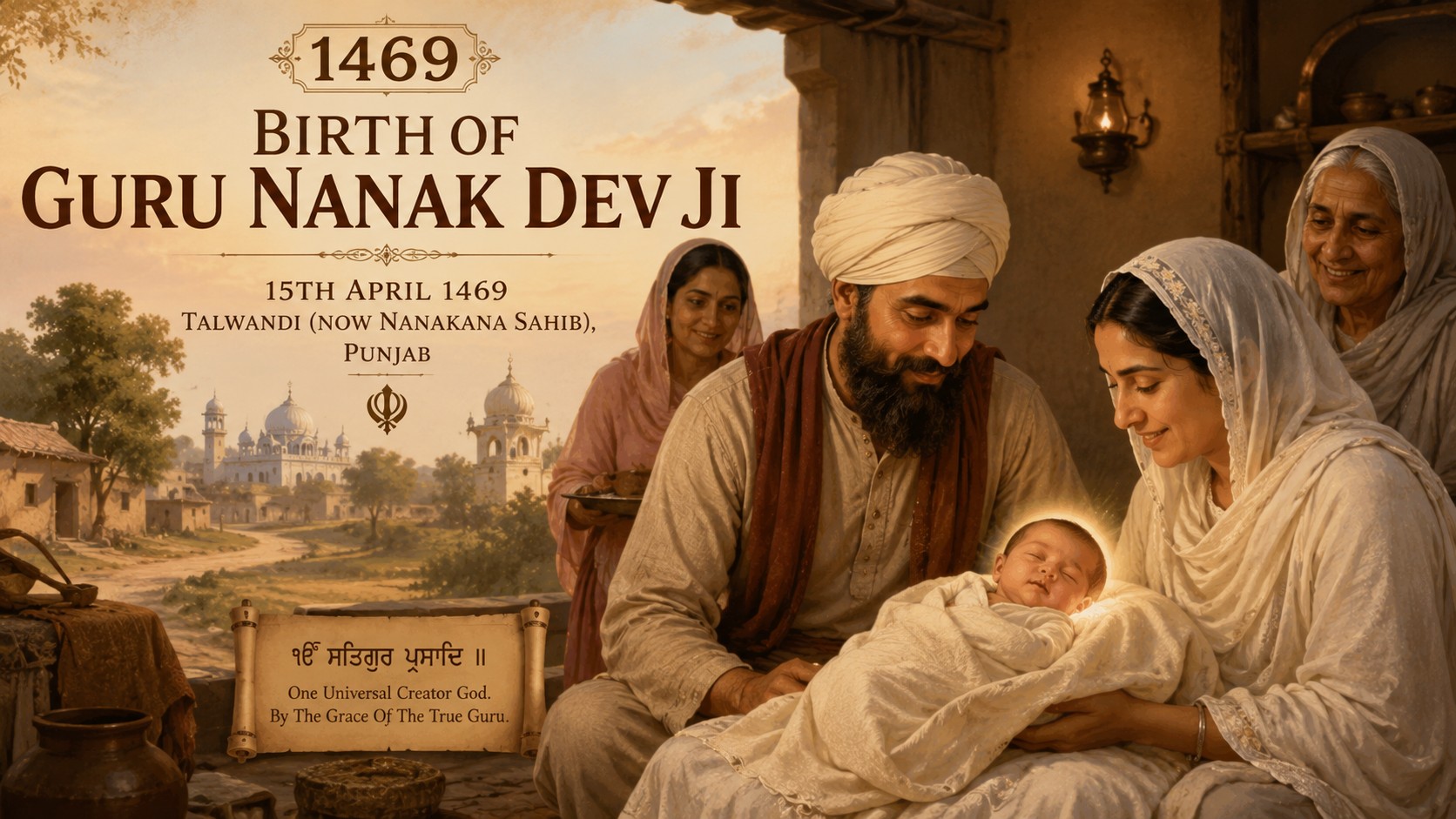
Birth of Guru Nanak Dev Ji and the Beginning of Sikhism: The Emergence of a Universal Message of One God and Human Equality
The birth of Guru Nanak Dev Ji in 1469 marks one of the most significant turning points in the religious, social, and cultural history of South Asia. Revered as the founder of Sikhism and the first of the ten Sikh Gurus, Guru Nanak emerged during a period of profound social division, political uncertainty, and religious tension. His teachings challenged entrenched hierarchies, questioned empty ritualism, and offered a revolutionary vision centered on the oneness of God, the unity of humanity, honest living, compassion, and social justice. More than five centuries later, his message continues to inspire millions across the world. The story of Guru Nanak's birth and the origins of Sikhism is not merely the story of a religious founder; it is the story of a spiritual reformer whose ideas transformed societies and laid the foundation for one of the world's youngest major religions.
As a Sikh historian, one must approach Guru Nanak's life not only as a sequence of historical events but as the beginning of a remarkable spiritual movement that reshaped the religious landscape of Punjab and eventually spread across every inhabited continent. The values introduced by Guru Nanak transcended geographical, cultural, and religious boundaries. His message appealed to farmers and merchants, kings and laborers, Hindus and Muslims, men and women, rich and poor alike. At a time when society was deeply fragmented, Guru Nanak articulated a vision of universal brotherhood rooted in devotion to one Creator and respect for the dignity of every human being.
The Historical World into Which Guru Nanak Was Born
To understand the significance of Guru Nanak's birth, it is essential to appreciate the historical context of fifteenth-century Punjab. The region occupied a strategic location connecting Central Asia, the Indian subcontinent, and the Middle East. Punjab had witnessed centuries of cultural interaction, trade, migration, and conquest. Diverse religious traditions flourished there, including Hinduism, Islam, Sufism, Nath yogic traditions, and various local spiritual movements.
Despite this diversity, society was marked by significant inequalities. The caste system imposed rigid social hierarchies that limited opportunities and reinforced discrimination. Religious divisions often fostered mistrust and conflict. Access to education and spiritual knowledge was frequently restricted to privileged groups. Many religious practices had become heavily ritualized, with external observances often overshadowing ethical conduct and genuine spiritual understanding.
Politically, northern India was governed by the Delhi Sultanate under the Lodi dynasty. While urban centers experienced commercial growth, many rural populations faced economic hardships and social constraints. In this environment of complexity and contradiction, Guru Nanak's teachings would emerge as a powerful call for spiritual renewal and social transformation.
The Birth of Guru Nanak at Talwandi
Guru Nanak Dev Ji was born on 15 April 1469 according to many historical calculations, though his birth anniversary is traditionally celebrated in accordance with the lunar calendar and often falls in November. He was born in the village of Talwandi Rai Bhoe, located in present-day Pakistan. Today, the town is known as Nankana Sahib and stands as one of the holiest sites in Sikhism.
His father, Mehta Kalu, served as a local revenue official, while his mother, Mata Tripta, was known for her kindness and devotion. Guru Nanak also had an elder sister, Bibi Nanaki, who would become one of the earliest individuals to recognize his extraordinary spiritual qualities. Sikh tradition often describes Bibi Nanaki as Guru Nanak's first disciple, highlighting the deep bond they shared throughout their lives.
Stories surrounding Guru Nanak's birth emphasize the sense of wonder that accompanied his arrival. While historians approach such narratives with careful analysis, these traditions reflect the profound impact that Guru Nanak would later have on his followers. From an early age, he displayed remarkable intelligence, curiosity, compassion, and a tendency to question conventional assumptions.
Childhood and Early Signs of Spiritual Insight
Accounts of Guru Nanak's childhood reveal a young boy who consistently demonstrated an unusual depth of thought. Unlike many children of his age, he showed limited interest in material pursuits and often engaged in contemplation about the nature of existence, truth, and the Creator. Teachers reportedly found him exceptionally intelligent yet unwilling to accept ideas simply because they were traditionally accepted.
Several well-known narratives describe Guru Nanak challenging superficial understandings of education and religion. Rather than focusing solely on memorization or ritual observance, he sought deeper meanings and ethical principles. These stories illustrate an important theme that would define his later teachings: genuine spirituality requires understanding, reflection, and inner transformation rather than mechanical adherence to customs.
Guru Nanak's early experiences also exposed him to diverse religious traditions. Growing up in Punjab allowed him to interact with Hindus, Muslims, and practitioners of various spiritual paths. This exposure contributed to his broad perspective and helped shape his vision of a universal spiritual message that transcended sectarian boundaries.
The Spiritual Awakening and Divine Mission
One of the most pivotal moments in Guru Nanak's life occurred during his early adulthood while living in Sultanpur Lodhi. There, he worked in the service of Daulat Khan Lodi and maintained a household with his wife, Mata Sulakhni, and their children. Despite fulfilling worldly responsibilities, Guru Nanak remained deeply engaged in spiritual reflection.
According to Sikh tradition, a profound spiritual experience transformed the course of his life. After disappearing for three days while bathing in a river, Guru Nanak emerged with a new sense of purpose and a powerful message. His declaration that there was "no Hindu, no Muslim" did not deny the existence of these communities but emphasized a deeper spiritual truth: all human beings are creations of the same Divine Reality and should not be divided by labels that foster hostility and separation.
This experience marked the beginning of his public mission. Guru Nanak dedicated himself to sharing a vision centered on the unity of God, the equality of humanity, and the importance of living a truthful and compassionate life. His message would eventually become the foundation of Sikhism.
The Concept of One God
At the heart of Guru Nanak's teachings was the belief in one universal Creator. This concept is expressed in the opening words of the Sikh scripture, beginning with Ik Onkar, meaning "One Supreme Reality." For Guru Nanak, God was not confined to any single community, language, nation, or religious tradition. The Divine was eternal, formless, omnipresent, and accessible to all people.
This understanding challenged narrow interpretations of religion and encouraged individuals to focus on spiritual connection rather than external distinctions. Guru Nanak taught that the Creator could be remembered through meditation, prayer, ethical living, and service to others. He emphasized that sincere devotion was more important than elaborate rituals or ceremonial displays.
The idea of one God also provided the foundation for human equality. If all people originated from the same Creator, then no individual or group could claim inherent superiority over others. This principle would become one of the defining characteristics of Sikh thought.
The Radical Message of Human Equality
Perhaps no aspect of Guru Nanak's teachings was more socially transformative than his insistence on the equality of all human beings. In a society deeply divided by caste, class, gender, and religious identity, this message carried revolutionary implications. Guru Nanak rejected the notion that birth determined a person's worth. Instead, he emphasized that character, actions, and devotion were the true measures of an individual.
He spoke out against caste discrimination and challenged systems that marginalized people based on social status. His teachings welcomed individuals from all backgrounds into a shared spiritual community. Rich and poor, men and women, farmers and nobles, Hindus and Muslims were all encouraged to participate equally in the pursuit of truth.
Guru Nanak also advocated for the dignity and rights of women. He questioned social attitudes that treated women as inferior and highlighted their essential role in human life and society. His teachings promoted respect, inclusion, and fairness at a time when such ideas were far from universally accepted.
The Four Great Journeys: Spreading the Message
After his spiritual awakening, Guru Nanak embarked on extensive journeys known as Udasis. These travels took him across vast regions of South Asia, Tibet, Sri Lanka, the Arabian Peninsula, and Central Asia. Accompanied primarily by his faithful companion Bhai Mardana, Guru Nanak engaged with people from diverse cultural, religious, and social backgrounds.
During these journeys, he visited temples, mosques, pilgrimage centers, marketplaces, villages, and royal courts. Rather than condemning individuals, he challenged harmful practices and encouraged deeper spiritual understanding. Through dialogue, poetry, music, and personal example, he communicated his message of divine unity and human equality.
The journeys played a crucial role in spreading his teachings and establishing a network of followers. They also demonstrated the universal nature of his message, which transcended geographical and cultural boundaries.
The Foundation of Sikhism
Although Guru Nanak did not initially set out to create a separate religion in the modern sense, his teachings gradually gave rise to a distinct spiritual tradition. His followers became known as Sikhs, a term derived from the Punjabi word meaning disciple or learner. Sikhism emerged as a path centered on devotion to one God, ethical living, community service, and the pursuit of spiritual wisdom.
The foundation of Sikhism rested upon several core principles. These included Naam Japna, the remembrance of God; Kirat Karni, earning an honest livelihood; and Vand Chakna, sharing one's resources with others. Together, these principles encouraged individuals to integrate spirituality into everyday life.
Unlike traditions that emphasized withdrawal from society, Guru Nanak promoted active engagement with the world. He demonstrated that spiritual growth could occur within family life, work, and community involvement. This practical approach appealed to a wide range of people and contributed to the growth of the Sikh community.
Kartarpur and the Institutionalization of Sikh Values
In the later years of his life, Guru Nanak established Kartarpur on the banks of the Ravi River. This settlement became the first organized Sikh community and served as a living embodiment of his teachings. At Kartarpur, the institutions of Sangat and Langar were formalized.
Sangat brought people together in congregational worship and collective learning, while Langar provided free communal meals open to everyone regardless of background. These institutions translated spiritual ideals into practical social practices. By encouraging people to sit together and share food, Guru Nanak directly challenged caste barriers and promoted equality.
Kartarpur became a model of community life grounded in devotion, service, honest labor, and mutual respect. Its influence continues to shape Sikh institutions around the world.
The Succession and Continuity of the Sikh Mission
Before his passing in 1539, Guru Nanak ensured the continuity of his mission by appointing Bhai Lehna as his successor. Renamed Guru Angad Dev Ji, he became the Second Sikh Guru and carried forward the teachings and institutions established by Guru Nanak.
This succession was significant because it was based on merit and devotion rather than hereditary privilege. By selecting the individual who best embodied his values, Guru Nanak established a tradition of leadership grounded in spiritual excellence. This principle helped preserve the integrity of the Sikh community and guided its development through subsequent generations of Gurus.
The continuity provided by the Gurus allowed Sikhism to evolve into a vibrant and enduring religious tradition while remaining faithful to its founding vision.
The Global Legacy of Guru Nanak
Today, Guru Nanak's influence extends far beyond Punjab. Sikh communities can be found in nearly every corner of the world, and the principles he articulated continue to inspire people of diverse backgrounds. The Sikh commitment to community service, social justice, equality, and interfaith understanding reflects the enduring relevance of his teachings.
Institutions such as Langar have gained international recognition for their ability to provide food and support to people regardless of religion, nationality, or social status. Sikh humanitarian efforts during natural disasters, public crises, and humanitarian emergencies embody the values first taught by Guru Nanak more than five centuries ago.
His vision of one humanity under one Creator remains a powerful antidote to division, prejudice, and inequality. In an increasingly interconnected yet often polarized world, Guru Nanak's message continues to offer guidance and hope.
Conclusion
The birth of Guru Nanak Dev Ji in Talwandi in 1469 marked the beginning of a transformative spiritual movement that would become Sikhism. Through his teachings on the oneness of God, the equality of all humanity, honest living, and selfless service, Guru Nanak challenged social injustices and offered a universal vision of spiritual truth. His travels, institutions, and leadership laid the foundations for a community committed to compassion, justice, and human dignity. More than five centuries later, the values he introduced continue to shape the lives of millions around the globe. The story of Guru Nanak's birth is therefore not only the story of a remarkable individual but also the story of the emergence of a timeless message that continues to resonate across cultures, nations, and generations.
Frequently Asked Questions (FAQ)
1. When was Guru Nanak Dev Ji born?
Guru Nanak Dev Ji was born in 1469 in Talwandi, which is now known as Nankana Sahib in Pakistan.
2. Why is Guru Nanak important in Sikh history?
He is the founder of Sikhism and the first of the ten Sikh Gurus.
3. What was Guru Nanak's central teaching?
His central teaching emphasized belief in one God and the equality of all human beings.
4. What does Ik Onkar mean?
Ik Onkar means "One Supreme Reality" and expresses the Sikh belief in one universal Creator.
5. Who were Guru Nanak's parents?
His parents were Mehta Kalu and Mata Tripta.
6. What is Nankana Sahib?
Nankana Sahib is the modern name of Guru Nanak's birthplace and one of the holiest sites in Sikhism.
7. What were Guru Nanak's major journeys called?
His extensive missionary travels are known as the Udasis.
8. What institutions did Guru Nanak establish?
He established the foundations of Sangat (congregation) and Langar (community kitchen), which became central Sikh institutions.
9. How did Guru Nanak challenge the caste system?
He taught that all human beings are equal before God and rejected social hierarchies based on birth.
10. What is Guru Nanak's lasting legacy?
His lasting legacy is the establishment of Sikhism and a universal message of equality, service, compassion, and devotion to one God.