Historical Turning Points · Origins & Gurus
1522 Guru Nanak established Kartarpur, the first Sikh settlement
Guru Nanak established the first Sikh settlement on the banks of the Ravi River, formalizing the core institutions of Sangat (congregation) and Langar (community kitchen) to dismantle caste barriers.
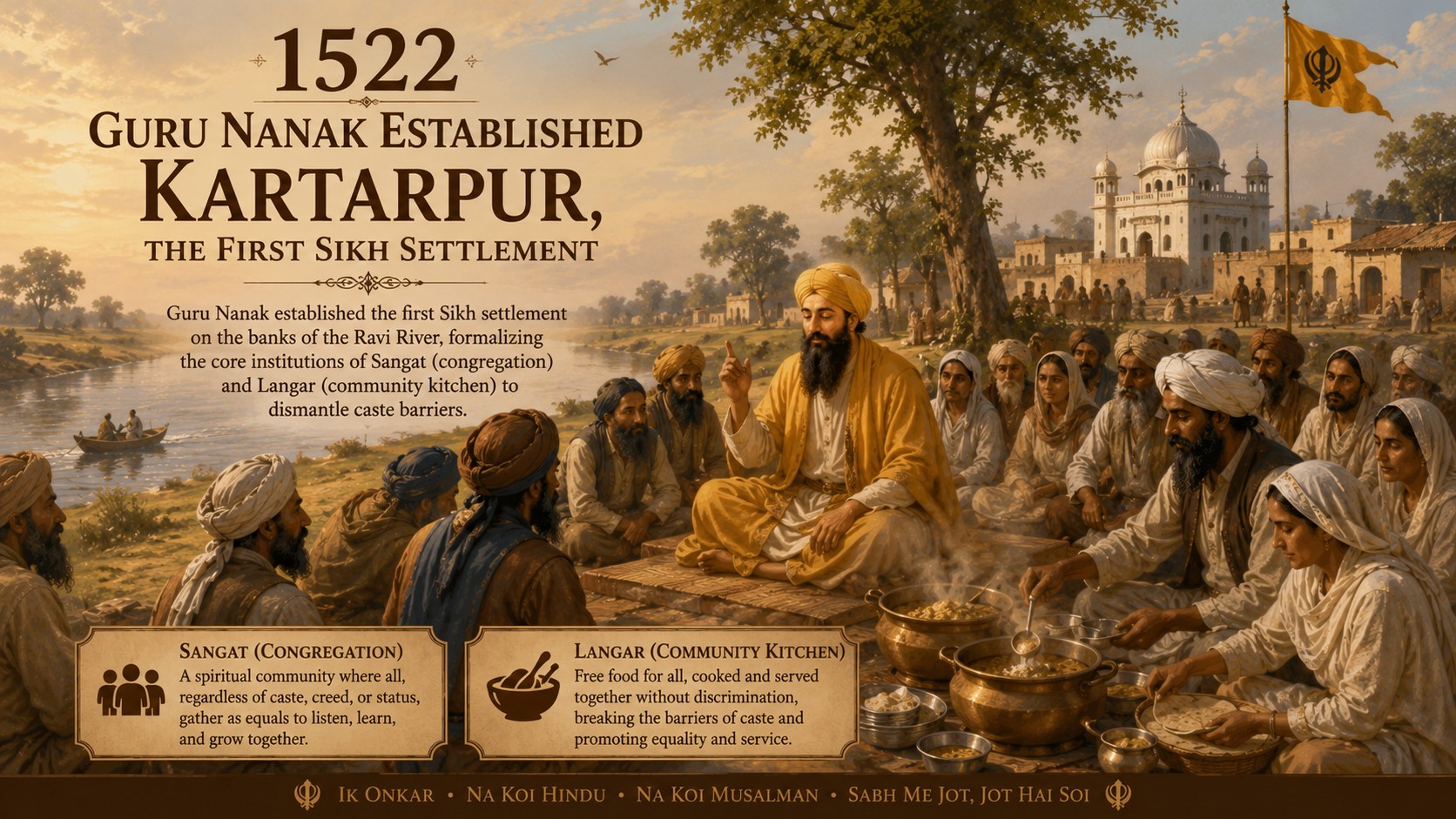
1522 CE Kartarpur: Guru Nanak Establishes the First Sikh Settlement and the Revolutionary Institutions of Sangat and Langar
The establishment of Kartarpur in 1522 CE stands as one of the most transformative moments in Sikh history. While Guru Nanak's extensive travels across South Asia, Central Asia, and the Middle East are widely celebrated for spreading his spiritual message, it was at Kartarpur on the banks of the Ravi River that his vision took concrete institutional form. Here, the founder of Sikhism created not merely a settlement but a living model of a new social, spiritual, and ethical order. Kartarpur became the first organized Sikh community, a place where the teachings of Guru Nanak were translated from philosophical principles into everyday practice. It was within this settlement that the institutions of Sangat (holy congregation) and Langar (community kitchen) emerged as foundational pillars of Sikh life. These institutions challenged deeply entrenched social hierarchies, rejected caste discrimination, promoted equality, and established a framework for community life that continues to define Sikhism more than five centuries later.
As a Sikh historian, one cannot overstate the significance of Kartarpur. The settlement represented a turning point in the evolution of Guru Nanak's mission. During his travels, he had engaged with kings and peasants, ascetics and householders, Hindus and Muslims, scholars and laborers. He had witnessed social inequality, religious divisions, economic exploitation, and ritualistic practices that often obscured genuine spirituality. Kartarpur became the place where he offered an alternative vision. Rather than retreating into isolation or establishing a monastic order, Guru Nanak created a vibrant community rooted in labor, devotion, service, and equality. The institutions founded there became the blueprint for Sikh society and continue to shape Sikh identity around the world.
The Historical Context of Early Sixteenth-Century Punjab
To appreciate the revolutionary nature of Kartarpur, it is important to understand the world into which it emerged. Early sixteenth-century Punjab was a region characterized by political instability, social stratification, and religious diversity. The area lay at the crossroads of major trade routes and frequently experienced military invasions and political upheavals. The Lodi Sultanate ruled much of northern India, but its authority was increasingly challenged. Only a few years after the establishment of Kartarpur, Babur's invasions would reshape the political landscape and pave the way for the Mughal Empire.
Society was deeply divided along lines of caste, occupation, wealth, and social status. Religious communities often coexisted but remained separated by doctrinal differences and social customs. Access to religious knowledge was frequently controlled by elites, while ordinary people struggled under systems that reinforced inequality and exclusion. Ritual practices often emphasized external observance rather than inner transformation. Women faced significant restrictions in many areas of life, and marginalized groups frequently encountered discrimination and limited opportunities.
Guru Nanak had spent decades observing these conditions firsthand during his travels. His teachings challenged both social injustice and spiritual superficiality. He emphasized the oneness of humanity under one Creator, the equality of all individuals, honest labor, remembrance of God, and service to others. Kartarpur became the practical expression of these principles.
Why Guru Nanak Chose Kartarpur
After completing extensive journeys known as Udasis, Guru Nanak settled in the region that would become Kartarpur. Located near the Ravi River, the site offered fertile agricultural land and access to local communities. Yet the significance of Kartarpur extended far beyond geography. The settlement's name itself means "City of the Creator," reflecting Guru Nanak's vision of a community centered on divine awareness and ethical living.
Rather than withdrawing from society, Guru Nanak embraced the life of a householder. This decision carried profound implications. In many spiritual traditions of the time, renunciation and asceticism were viewed as ideal paths toward enlightenment. Guru Nanak rejected the notion that spiritual realization required abandoning family life or productive work. At Kartarpur, he demonstrated that one could remain engaged in worldly responsibilities while pursuing a deeply spiritual existence.
The settlement embodied a holistic vision of life. Agriculture, worship, community service, education, and social interaction were integrated into a unified framework. Spirituality was not confined to temples or rituals but infused everyday activities. By cultivating the land and participating in communal life, residents practiced values that reflected Guru Nanak's teachings.
Kartarpur as the First Sikh Community
Kartarpur occupies a unique place in history as the first organized Sikh community. While Guru Nanak had already attracted followers during his travels, Kartarpur provided a stable environment in which those teachings could be practiced collectively. People from diverse backgrounds gathered there to learn, work, worship, and serve together.
The community included farmers, artisans, merchants, laborers, and seekers from different social backgrounds. Significantly, individuals were welcomed regardless of caste, ethnicity, occupation, or prior religious affiliation. This inclusivity represented a direct challenge to prevailing social norms. In a society where hierarchy often determined social interactions, Kartarpur fostered a culture of equality and mutual respect.
The settlement functioned as both a spiritual center and a social experiment. It demonstrated that a community could operate according to principles of justice, compassion, and shared responsibility. The success of Kartarpur inspired future generations and provided the institutional foundation upon which subsequent Sikh Gurus would build.
The Institution of Sangat: A New Model of Community
One of Guru Nanak's most enduring contributions at Kartarpur was the formalization of the institution of Sangat. The term refers to a congregation of individuals gathered in the remembrance of God and the pursuit of spiritual growth. While communal worship existed in other traditions, the Sikh concept of Sangat carried distinctive characteristics that reflected Guru Nanak's vision.
Within the Sangat, all participants were regarded as equals. Social distinctions that dominated wider society were deliberately set aside. Wealth, caste, gender, and status did not determine an individual's worth or spiritual standing. The congregation became a space where people could learn from one another, engage in collective worship, and strengthen their commitment to ethical living.
Sangat also fostered accountability and mutual support. Spiritual development was not viewed as an isolated endeavor but as a communal journey. Members encouraged one another to practice honesty, humility, compassion, and devotion. Through shared participation, individuals developed a sense of belonging and collective identity that transcended traditional social divisions.
The institution proved remarkably resilient and adaptable. Today, Sikh congregations around the world continue to embody the principles first established at Kartarpur. Whether in Punjab, North America, Europe, Africa, or Australia, the concept of Sangat remains central to Sikh religious and community life.
The Revolutionary Institution of Langar
If Sangat represented spiritual equality, Langar represented social equality in action. The institution of Langar, formalized at Kartarpur, became one of the most revolutionary innovations in religious history. At a time when caste restrictions governed dining practices and social interaction, Guru Nanak established a communal kitchen where everyone would eat together regardless of background.
The implications of this practice were profound. In many communities, sharing food was closely tied to notions of purity and hierarchy. Members of higher castes often refused to dine with those considered socially inferior. Guru Nanak directly challenged these assumptions by requiring participants to sit together and share the same meal. The act of eating collectively became a powerful statement of human equality.
Langar was sustained through voluntary service and collective contribution. Individuals donated food, labor, and resources according to their ability. Cooking, serving, and cleaning were performed as acts of devotion rather than status. This emphasis on selfless service reinforced the principle that all forms of honest labor possessed dignity and value.
Beyond addressing caste discrimination, Langar also provided practical support for those in need. Travelers, laborers, and the poor could receive nourishment without fear of exclusion or humiliation. In this way, Langar combined spiritual ideals with tangible social welfare, demonstrating Guru Nanak's commitment to both personal transformation and communal responsibility.
Dismantling the Caste System
One of the most remarkable achievements of Kartarpur was its challenge to the caste system. Although caste distinctions were deeply embedded in the social fabric of the time, Guru Nanak consistently rejected the notion that human beings could be ranked according to birth. His teachings emphasized that all people were created by the same divine source and possessed equal spiritual potential.
Kartarpur translated this principle into daily practice. Members of different castes worked together, worshipped together, and ate together. These activities directly confronted social norms that had persisted for centuries. While broader society continued to uphold hierarchical structures, Kartarpur offered an alternative model grounded in equality and mutual respect.
The importance of this challenge cannot be overstated. Guru Nanak's approach addressed not only social discrimination but also the psychological attitudes that sustained it. By encouraging individuals to recognize the divine presence within every human being, he sought to transform both external behavior and internal consciousness.
The legacy of this effort remains visible in Sikh institutions today. Although social inequalities continue to exist in many societies, the ideals established at Kartarpur continue to inspire efforts toward inclusion, justice, and human dignity.
Work, Worship, and Service
Kartarpur embodied three interconnected principles that would become central to Sikh life: Naam Japna (remembering God), Kirat Karni (earning an honest living), and Vand Chakna (sharing with others). These principles were not abstract doctrines but practical guidelines integrated into daily life.
Residents engaged in productive labor, particularly agriculture, while maintaining a strong focus on spiritual practice. Honest work was viewed as an expression of integrity and responsibility rather than a distraction from religious life. At the same time, individuals were encouraged to share their resources with those in need. This culture of generosity strengthened social bonds and reduced economic disparities within the community.
The integration of work, worship, and service distinguished Kartarpur from many contemporary religious movements. Rather than separating spiritual pursuits from worldly responsibilities, Guru Nanak demonstrated that ethical living required engagement with both. This holistic approach remains a defining feature of Sikh philosophy.
The Succession of Guru Angad and the Future of the Community
Kartarpur also played a crucial role in ensuring the continuity of Guru Nanak's mission. As the community matured, the question of leadership became increasingly important. Guru Nanak eventually chose Bhai Lehna as his successor, renaming him Guru Angad. This decision reflected spiritual merit rather than hereditary privilege and reinforced the principle that leadership should be based on character and devotion.
The succession established a precedent that would guide the Sikh tradition for generations. Guru Angad inherited not only spiritual authority but also the institutions and community structures developed at Kartarpur. Under subsequent Gurus, these foundations would expand into a dynamic and growing religious community.
The orderly transition demonstrated the strength of the institutions Guru Nanak had created. Because the community was built upon shared values rather than personal charisma alone, it could continue to flourish beyond the lifetime of its founder.
Kartarpur's Enduring Legacy
The influence of Kartarpur extends far beyond its historical moment. The institutions of Sangat and Langar established there continue to define Sikh life around the globe. Every gurdwara today reflects the principles first formalized at Kartarpur. Congregational worship, communal meals, voluntary service, and the rejection of social hierarchy remain central features of Sikh practice.
Kartarpur also serves as a symbol of Guru Nanak's broader vision for humanity. It demonstrated that spiritual teachings could be translated into practical institutions capable of transforming society. Rather than merely criticizing injustice, Guru Nanak created a functioning alternative that embodied equality, compassion, and shared responsibility.
In an era still marked by social divisions, economic inequality, and discrimination, the lessons of Kartarpur remain remarkably relevant. The settlement's emphasis on human dignity, communal service, and spiritual equality continues to inspire people of diverse backgrounds around the world.
Conclusion
The establishment of Kartarpur in 1522 CE was far more than the founding of a settlement. It represented the birth of a new social and spiritual order that challenged entrenched hierarchies and offered a practical vision of equality and justice. Through the institutions of Sangat and Langar, Guru Nanak created mechanisms that fostered community, dismantled caste barriers, encouraged service, and affirmed the dignity of every human being. Kartarpur became the first Sikh community and the foundation upon which the Sikh tradition would grow. More than five centuries later, its influence remains visible wherever Sikhs gather in congregation, share a meal in Langar, and work together in service to humanity. The story of Kartarpur is therefore not merely a chapter in Sikh history but a timeless example of how spiritual ideals can transform society through compassionate action and inclusive institutions.
Frequently Asked Questions (FAQ)
1. What is Kartarpur?
Kartarpur was the first Sikh settlement established by Guru Nanak on the banks of the Ravi River around 1522 CE.
2. Why is Kartarpur important in Sikh history?
It was the first organized Sikh community and the place where Guru Nanak formalized the institutions of Sangat and Langar.
3. What does the name Kartarpur mean?
Kartarpur means "City of the Creator," reflecting Guru Nanak's vision of a community centered on divine awareness.
4. What is Sangat?
Sangat refers to the Sikh congregation, where individuals gather for worship, learning, and spiritual growth as equals.
5. What is Langar?
Langar is the Sikh community kitchen that provides free meals to all people regardless of caste, religion, gender, or social status.
6. How did Langar challenge the caste system?
By requiring people from all backgrounds to sit together and share the same meal, Langar directly challenged caste-based social segregation.
7. Why did Guru Nanak settle at Kartarpur after his travels?
He sought to create a living community where his teachings could be practiced collectively through work, worship, and service.
8. What principles guided life at Kartarpur?
The community emphasized remembrance of God, honest labor, sharing with others, equality, and selfless service.
9. Who succeeded Guru Nanak at Kartarpur?
Guru Angad Dev Ji, formerly known as Bhai Lehna, was chosen by Guru Nanak as his successor.
10. How does Kartarpur influence Sikh communities today?
The institutions and values established at Kartarpur continue to shape every gurdwara and remain central to Sikh religious and community life worldwide.