Historical Turning Points · Origins & Gurus
1539 Guruship Succession to Guru Angad Dev ji
Guru Angad was appointed the second Guru, establishing the institutional practice of succession based on merit and devotion rather than heredity. He also standardized the Gurmukhi script to make scriptures accessible to the common person.
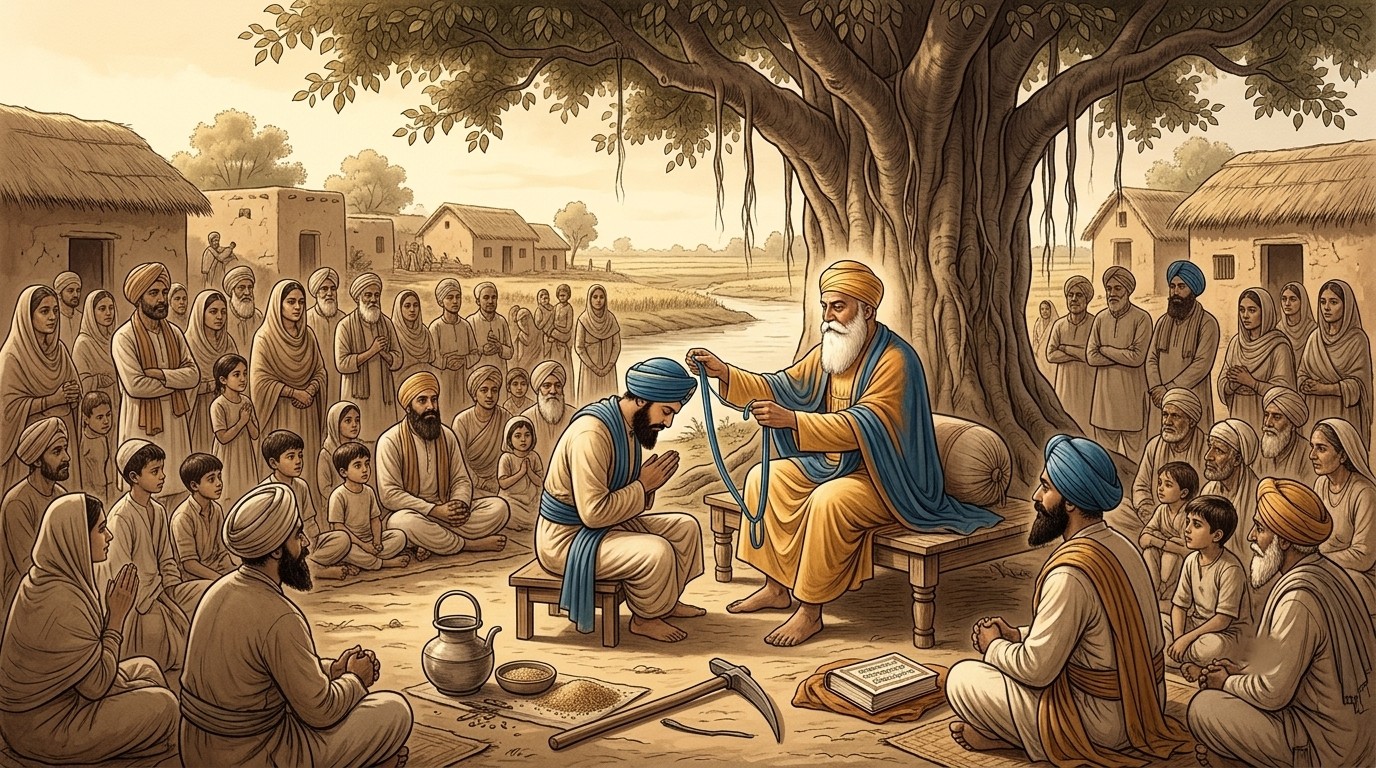
1539 CE Guruship Succession: Guru Angad Dev Ji, the Triumph of Merit Over Heredity, and the Standardization of Gurmukhi
The year 1539 CE marks one of the most consequential turning points in Sikh history. It was the year in which Guru Nanak Dev Ji, the founder of Sikhism, passed the mantle of spiritual leadership to Bhai Lehna, who thereafter became known as Guru Angad Dev Ji, the Second Sikh Guru. This transition was not merely a change in leadership; it established a foundational principle that would shape the Sikh tradition for centuries. At a time when spiritual authority in South Asia was often inherited through bloodlines, family privilege, royal patronage, or caste status, Guru Nanak introduced a revolutionary model of succession based upon devotion, humility, service, spiritual excellence, and merit. The appointment of Guru Angad demonstrated that leadership within the Sikh community would not be determined by birth but by one's capacity to embody and advance the teachings of the Guru. This principle became one of the defining characteristics of the Sikh tradition and ensured that spiritual authority remained rooted in values rather than lineage.
Beyond the question of succession, Guru Angad Dev Ji's leadership profoundly influenced the development of Sikh identity and institutions. Among his most enduring achievements was the standardization and promotion of the Gurmukhi script, which made sacred teachings accessible to ordinary people. In an era when literacy was often restricted to privileged groups and religious knowledge was frequently controlled by elite classes, Guru Angad's efforts democratized learning and enabled the teachings of Guru Nanak to reach wider audiences. His contributions laid the foundation for Sikh scripture, education, community organization, and cultural development. The story of Guru Angad Dev Ji is therefore not simply one of succession but one of institutional consolidation, educational reform, and spiritual continuity.
The Historical Setting: Kartarpur and the Growth of the Sikh Community
To understand the significance of the 1539 succession, one must first appreciate the circumstances surrounding the Sikh community during Guru Nanak's final years. After decades of extensive travel across South Asia and beyond, Guru Nanak had established Kartarpur on the banks of the Ravi River. Kartarpur became the first organized Sikh settlement and served as a living example of his teachings. Here, people from diverse backgrounds gathered to participate in Sangat, the congregation of believers, and Langar, the communal kitchen that promoted equality by requiring all individuals to sit and eat together regardless of caste, wealth, or social status.
As the community grew, the question of future leadership became increasingly important. Guru Nanak's teachings had attracted followers from many regions, and the institutions he established required guidance and continuity. The Sikh movement was evolving from a circle of disciples into a structured community with growing influence. A clear succession was essential to preserving the integrity of the teachings and ensuring that the principles established at Kartarpur would endure.
In many religious traditions, succession often became a source of division and conflict. Leadership disputes could fragment communities and dilute spiritual teachings. Guru Nanak recognized this challenge and sought to establish a model that would safeguard the future of the Sikh Panth. His decision would become one of the most important acts of his life.
Who Was Bhai Lehna?
Before becoming Guru Angad Dev Ji, Bhai Lehna was a devoted seeker born in 1504 in the village of Matte di Sarai, now located in present-day Punjab, India. Raised in a Hindu family, he was known for his religious devotion and initially followed traditions associated with the worship of the Goddess Durga. Like many spiritual seekers of his time, he was deeply interested in questions of faith, morality, and divine truth.
According to Sikh tradition, Bhai Lehna's life changed dramatically when he encountered the hymns of Guru Nanak. Deeply moved by their message, he traveled to Kartarpur to meet the Guru. What followed was not merely a meeting between teacher and student but the beginning of a profound spiritual transformation. Bhai Lehna became one of Guru Nanak's most dedicated disciples, embracing the Guru's teachings with exceptional sincerity and commitment.
His devotion was not expressed through intellectual debate or public recognition but through humble service. He participated fully in community life, performed tasks without seeking praise, and consistently demonstrated obedience, compassion, and selflessness. Over time, Guru Nanak recognized in him qualities that reflected the deepest principles of Sikh spirituality.
The Principle of Merit Over Heredity
One of the most revolutionary aspects of Guru Nanak's decision was his rejection of hereditary succession. Guru Nanak had sons of his own, and according to prevailing social norms, many observers expected leadership to pass to a family member. Throughout much of South Asian society, religious authority, property, and social status were commonly inherited through family lines. Such expectations were deeply ingrained and rarely questioned.
Guru Nanak challenged these assumptions. Rather than selecting a successor based on biological relationship, he chose the individual who had most fully internalized and embodied his teachings. Bhai Lehna's humility, dedication, and spiritual maturity made him the ideal candidate. By appointing him as Guru Angad, Guru Nanak established a principle that leadership should be earned through character and service rather than inherited through birth.
This decision carried profound implications. It reinforced the Sikh rejection of caste privilege and hereditary entitlement. It demonstrated that spiritual authority could emerge from any background and that genuine leadership required moral and spiritual excellence. The principle became a cornerstone of Sikh institutional development and influenced subsequent Guru successions.
The Ceremony of Succession
Sikh historical traditions describe the succession as a deeply symbolic event. Guru Nanak publicly acknowledged Bhai Lehna as his successor and bestowed upon him the name Angad, meaning "part of my own limb" or "a part of myself." This name conveyed the continuity of spiritual authority between the First and Second Gurus. Guru Angad was not presented as a replacement but as the living continuation of the same divine mission.
The ceremony emphasized the transmission of spiritual responsibility rather than worldly power. Guru Nanak entrusted Guru Angad with the task of preserving and expanding the Sikh community while remaining faithful to its founding principles. The public nature of the succession helped ensure clarity and minimize disputes, providing stability during a critical period of transition.
The significance of this event cannot be overstated. It established the institution of Guruship as a continuous spiritual lineage rooted in merit and divine guidance. Future successions would follow the same principle, allowing the Sikh community to maintain unity and coherence across generations.
Guru Angad Dev Ji's Vision for the Sikh Community
Upon assuming leadership, Guru Angad Dev Ji faced the challenge of guiding a growing community while preserving the essence of Guru Nanak's teachings. Rather than introducing dramatic changes, he focused on strengthening existing institutions and deepening the community's foundations. His leadership emphasized continuity, discipline, education, and collective responsibility.
Guru Angad encouraged the expansion of Sangat and Langar, ensuring that these institutions remained central to Sikh life. He promoted physical fitness, community service, and moral discipline, recognizing that spiritual growth required both inner devotion and practical action. His approach reflected a balanced understanding of human development in which spiritual, intellectual, physical, and social dimensions were interconnected.
Through careful stewardship, Guru Angad transformed the Sikh community from a movement centered primarily around its founder into a sustainable institution capable of enduring beyond individual leaders.
The Standardization of Gurmukhi
Among Guru Angad Dev Ji's most important contributions was the standardization and promotion of the Gurmukhi script. Although forms of the script existed in Punjab prior to his leadership, Guru Angad refined and standardized it for use within the Sikh community. This achievement would have far-reaching consequences for Sikh religious, literary, and cultural development.
At the time, literacy was often concentrated among elite groups who controlled access to religious texts and educational resources. Sacred knowledge was frequently mediated through specialized languages and scripts that were inaccessible to ordinary people. Guru Angad recognized that widespread literacy was essential for preserving Guru Nanak's teachings and empowering the community.
By promoting Gurmukhi as a standardized script, he created a practical means through which people could read, write, and study spiritual teachings directly. This democratization of knowledge reflected the broader Sikh commitment to equality and inclusion. Access to sacred wisdom would no longer depend upon social status or privileged education.
Preserving Guru Nanak's Teachings
The standardization of Gurmukhi played a crucial role in preserving the hymns and teachings of Guru Nanak. Oral transmission remained important, but written records provided greater consistency and protection against distortion. Guru Angad encouraged the collection and recording of sacred compositions, helping ensure that future generations would receive authentic teachings.
This effort laid the groundwork for the eventual compilation of Sikh scripture. The preservation of hymns in a standardized script enabled the development of a rich literary tradition and facilitated the transmission of spiritual knowledge across expanding Sikh communities.
Without Guru Angad's contributions, many of the teachings that form the foundation of Sikhism might have faced greater challenges in preservation and dissemination. His work safeguarded the intellectual and spiritual heritage of the Sikh tradition.
Education and Literacy for the Common People
Guru Angad's promotion of Gurmukhi was closely connected to his broader commitment to education. He encouraged the establishment of learning centers where children and adults could acquire literacy skills. Education was viewed not as a privilege reserved for elites but as a valuable resource that should be available to all members of the community.
This emphasis on literacy empowered individuals to engage directly with spiritual teachings and participate more fully in community life. It reduced dependence on intermediaries and fostered a culture of learning and inquiry. The educational initiatives introduced during Guru Angad's leadership contributed to the development of an informed and engaged Sikh community.
The long-term effects of this emphasis on education are evident throughout Sikh history. Sikhs developed strong traditions of scholarship, literacy, and intellectual engagement that continue to influence the community today.
The Strengthening of Langar and Community Service
Guru Angad Dev Ji also strengthened the institution of Langar, which had been established by Guru Nanak. He recognized that communal meals were not merely acts of charity but powerful instruments for social transformation. By bringing people together across caste and class divisions, Langar reinforced the principle of human equality.
Under his leadership, the practice expanded and became increasingly organized. Service within the Langar remained voluntary and egalitarian. Cooking, serving, and cleaning were regarded as honorable forms of devotion. These activities cultivated humility and encouraged participants to place community welfare above personal status.
The continued development of Langar helped solidify its role as one of the most distinctive and enduring institutions within Sikhism. Today, millions of people benefit from Langar services worldwide, reflecting the vision first nurtured by Guru Nanak and strengthened by Guru Angad.
Physical Development and Moral Discipline
Guru Angad also encouraged physical well-being as part of a balanced spiritual life. Historical traditions describe his support for wrestling arenas and physical training. This emphasis reflected the belief that the human body should be respected and maintained as a vehicle for service and spiritual practice.
Physical fitness was not pursued for vanity or competition alone but as part of a disciplined lifestyle. Strength, resilience, and self-control complemented spiritual growth and ethical conduct. This holistic understanding of human development would later influence broader Sikh traditions emphasizing courage, preparedness, and service.
The integration of physical and spiritual development demonstrated Guru Angad's practical approach to leadership and his commitment to nurturing well-rounded individuals.
The Legacy of Guru Angad Dev Ji
The contributions of Guru Angad Dev Ji extended far beyond his years as the Second Guru. By accepting the responsibility entrusted to him by Guru Nanak and faithfully advancing the community's development, he ensured the continuity of the Sikh mission during a critical period. His leadership demonstrated that succession based on merit could provide stability and legitimacy while preserving spiritual integrity.
The standardization of Gurmukhi transformed Sikh education, literature, and scripture. His efforts made religious knowledge accessible to ordinary people and fostered a culture of learning that continues to enrich Sikh communities worldwide. Through his support for Sangat, Langar, education, and community service, he strengthened the institutions that remain central to Sikh identity.
Perhaps most importantly, Guru Angad embodied the principle that true leadership is rooted in humility and service. His life serves as a reminder that spiritual authority is earned through devotion, character, and commitment to the welfare of others.
Conclusion
The year 1539 CE represents a defining moment in Sikh history. Through the appointment of Guru Angad Dev Ji as the Second Guru, Guru Nanak established a revolutionary model of succession based on merit, devotion, and spiritual excellence rather than hereditary privilege. This decision ensured the continuity of the Sikh tradition and reinforced its commitment to equality and justice. Guru Angad's leadership strengthened the institutions of the Sikh community while his standardization of the Gurmukhi script democratized access to knowledge and preserved the teachings of the Gurus for future generations. His contributions shaped the development of Sikhism in profound ways, laying foundations that continue to influence Sikh religious, educational, and cultural life more than five centuries later.
Frequently Asked Questions (FAQ)
1. Who was Guru Angad Dev Ji?
Guru Angad Dev Ji was the Second Sikh Guru and the successor chosen by Guru Nanak Dev Ji in 1539 CE.
2. What was Guru Angad's original name?
His original name was Bhai Lehna before Guru Nanak renamed him Guru Angad.
3. Why was Guru Angad chosen as successor?
He was chosen because of his exceptional devotion, humility, service, and commitment to Guru Nanak's teachings.
4. Why is the succession of 1539 historically important?
It established the Sikh principle that leadership should be based on merit and spiritual excellence rather than hereditary privilege.
5. Did Guru Nanak's sons become Sikh Gurus?
No. Guru Nanak selected Bhai Lehna instead, demonstrating that spiritual leadership would not be inherited through family lineage.
6. What is Gurmukhi?
Gurmukhi is the script standardized and promoted by Guru Angad Dev Ji for recording Sikh teachings and Punjabi literature.
7. Why was Gurmukhi important?
It made religious teachings more accessible to ordinary people and helped preserve Sikh scripture accurately.
8. How did Guru Angad promote education?
He encouraged literacy, established learning opportunities, and promoted the use of Gurmukhi among the Sikh community.
9. What role did Guru Angad play in developing Langar?
He strengthened and expanded the institution of Langar, reinforcing principles of equality, service, and communal responsibility.
10. What is Guru Angad Dev Ji's lasting legacy?
His legacy includes establishing merit-based succession, standardizing Gurmukhi, promoting education, strengthening Sikh institutions, and ensuring the continuity of Guru Nanak's mission.