Historical Turning Points · Origins & Gurus · Guru Arjan Dev Ji
1604 Adi Granth: The Compilation of the Living Word
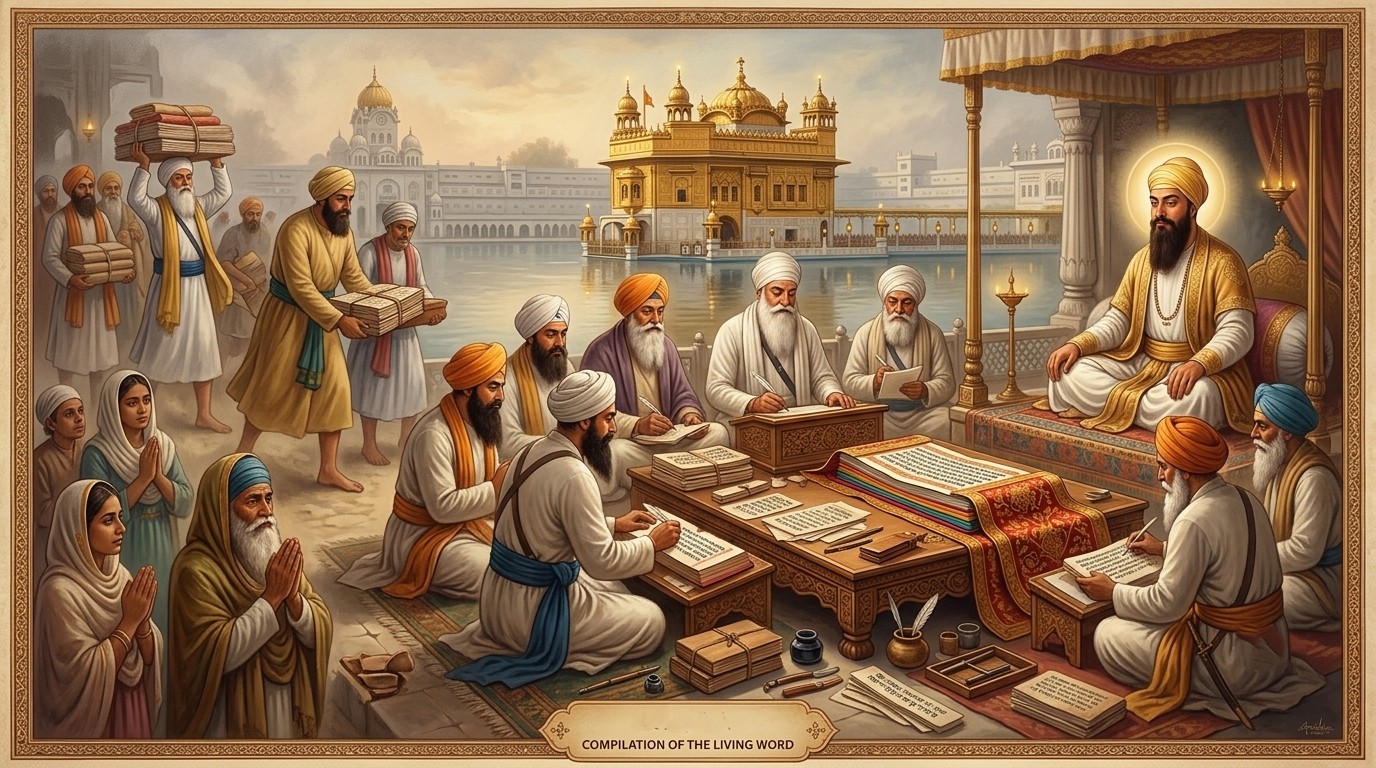
Guru Arjan Dev ji spent years collecting the hymns of the previous Gurus along with verses from Hindu Bhagats and Muslim Sufis. He sat in a secluded grove to compile the Adi Granth, ensuring that the poor, the outcasts, and the seekers of all faiths found their voice in the Sikh scripture. The Adi Granth, the first official anthology of the Sikh hymns, and enshrined it in the Harimandir Sahib (Golden Temple)
The Crisis of Authenticity: The Imperative for a Sovereign Scripture
To understand the monumental undertaking that was the compilation of the Adi Granth in 1604, a historian must first reconstruct the volatile socio-religious landscape of late sixteenth-century Punjab. Under the first four spiritual sovereigns of the Sikh Panth, the divine word—known as Gurbani—had spread primarily through oral recitation, hand-written codices, and the devotional singing (Kirtan) of the congregation. However, as the Sikh movement rapidly expanded from a localized community into a transnational spiritual commonwealth, it began to attract the hostile attention of both the Mughal state and internal schismatic factions. Foremost among these internal threats was the faction led by Baba Prithi Chand, the eldest brother of Guru Arjan Dev Ji, and his son Baba Meharban. Having been bypassed for the Guruship, Prithi Chand and his followers sought to undermine the authority of the fifth Guru by composing their own verses under the pseudonym "Nanak." This counterfeit literature began to circulate among the unsuspecting congregations, threating to dilute the theological purity of the Sikh path with elements of Puranic mythology, physical asceticism, and worldly compromise. Guru Arjan Dev Ji, possessing an acute historical consciousness and deep spiritual foresight, recognized that without a centralized, authenticated, and immutable scripture, the nascent Sikh community risked being re-absorbed into the vast ocean of Indian religious syncretism or fractured by rival claimants to the Guruship.
The compilation of the Adi Granth was therefore not merely an editorial exercise; it was a radical act of spiritual and political sovereignty. By consolidating the authentic revelations of the Gurus into a single, unalterable volume, Guru Arjan Dev Ji was drawing a permanent, theological boundary that distinguished the Sikh Panth from both the orthodox Hindu and Islamic traditions. The Guru sought to create a repository of the Living Word—the Sabad—which would serve as the ultimate, democratic authority for the community, eventually superseding even the physical line of human Gurus. This project required a systematic, continent-spanning effort to gather the genuine compositions of the first four Gurus, verify their authenticity through rigorous theological analysis, and organize them into an unprecedented musical and structural framework that could resist any future attempts at alteration or forgery. It was a project that would define the identity of the Khalsa centuries before its formal manifestation, providing the spiritual and intellectual armaments necessary to survive the impending imperial onslaught.
Sourcing the Divine Fragments: The Retrieval of the Goindwal Pothis
The first practical hurdle in this epic compilation was the physical gathering of the scriptural records of the prior Gurus. While Guru Arjan Dev Ji possessed a significant portion of Gurbani within his own family archives, a substantial collection of the primary manuscripts—compiled during the Guruship of Guru Amar Das Ji—lay in the custody of Baba Mohan Ji, the third Guru's eldest son. Baba Mohan Ji lived in voluntary, deep meditative isolation in the upper chamber of his house in Goindwal, refusing to meet anyone or engage with the external world. He guarded these invaluable manuscripts, historically known as the Goindwal Pothis (or Baba Mohan Ji Pothis), with fierce possessiveness, viewing them as a sacred family inheritance rather than the collective property of the Panth. Recognizing the indispensable nature of these Pothis, Guru Arjan Dev Ji first dispatched Bhai Gurdas Ji and then Baba Buddha Ji to Goindwal to request their release. However, both of these towering figures returned to Amritsar empty-handed, having been unable to draw Baba Mohan Ji out of his ecstatic trance or pierce his stubborn defense.
Undeterred, Guru Arjan Dev Ji decided to undertake the journey to Goindwal himself, demonstrating the profound humility that characterized his Guruship. Arriving outside Baba Mohan Ji's residence, the Guru sat in the dusty street below the window of the upper chamber and began to play the Saranda, singing a beautiful, mystical hymn that praised "Mohan" (a dual-meaning word in Gurbani that simultaneously refers to the attractive, formless Divine and respectfully addresses Baba Mohan Ji himself). The divine vibration of the music and the genuine humility of the Guru’s voice penetrated Baba Mohan Ji's spiritual isolation. He opened his window, looked down upon the Guru, and descended from his chamber, confessing that his pride had been shattered by the Guru's selfless devotion. Baba Mohan Ji reverently handed over the Goindwal Pothis to Guru Arjan Dev Ji, who carried them back to Amritsar in a grand, respectful procession, with the Guru walking barefoot behind the palanquin carrying the sacred manuscripts. This historic retrieval was augmented by sending emissaries across the Indian subcontinent to collect authentic copies of the compositions of previous Gurus, as well as the verses of regional Bhakti and Sufi saints, establishing a massive textual archive at the pool of Ramsar.
The Encampment at Ramsar: The Collaborative Alchemy of Scribes
In the hot summer of 1603, Guru Arjan Dev Ji established a secluded, serene scribing encampment on the banks of the Ramsar Sarovar, a tranquil pool located on the southeastern outskirts of Amritsar. This site was specifically chosen for its natural isolation and spiritual peace, far removed from the bustling commercial activity of the newly founded city of Ramdaspur. Under the cool, refreshing shade of giant Ber trees, the Guru set up his temporary headquarters, inviting Bhai Gurdas Ji—the premier intellectual, theologian, and master calligrapher of the early Sikh Panth—to serve as the primary scribe for the entire project. The collaboration between Guru Arjan Dev Ji and Bhai Gurdas Ji was a rare meeting of minds; the Guru dictated the divine verses from his inner state of revelation, while Bhai Gurdas Ji, utilizing his unmatched command of linguistics, poetic meters, and administrative precision, transcribed the words onto handmade Kashmiri paper using specialized iron-gall ink.
The daily routine at Ramsar was characterized by absolute spiritual discipline and rigorous academic scrutiny. Guru Arjan Dev Ji acted as the supreme editor-in-chief, reviewing every single folio, verifying the authenticity of every vowel mark, and systematically filtering out the spurious compositions submitted by rival factions. The historical records tell us that the Guru sat on a raised platform, surrounded by the various pothis, while Bhai Gurdas Ji sat below him, transcribing the text with tireless focus. The process of dictation, transcription, and proofreading was incredibly demanding, extending over a period of nearly a year and a half. The physical labor was balanced by continuous spiritual discourses and devotional singing, transforming the camp at Ramsar into a living academy of theology and music. Through this collaborative alchemy, the chaotic, fragmented manuscripts of regional saints and the divine verses of the Gurus were systematically forged into a cohesive, unassailable monument of written revelation.
The Architectural Marvel: Musical and Editorial Rigor
For a modern historian, the structural organization of the Adi Granth is a marvel of medieval information architecture, displaying a level of mathematical and musical precision that was centuries ahead of its time. Guru Arjan Dev Ji did not compile the hymns chronologically, nor did he arrange them alphabetically; instead, he chose Raga—the classical Indian system of musical measures—as the primary organizing principle. The entire scripture was divided into thirty-one major Ragas, with each Raga representing a specific emotional landscape, time of day, and seasonal mood. This was a calculated theological decision: the Guru wished to ensure that the reader would not merely analyze the text intellectually, but experience the spiritual vibration of the Word through the emotional conduit of music. Within each Raga, the compositions were arranged in a strict, descending hierarchical order based on the author, starting with Guru Nanak Dev Ji, followed by Guru Angad Dev Ji, Guru Amar Das Ji, Guru Ram Das Ji, and Guru Arjan Dev Ji, followed by the compositions of the Bhagats (saints) and Bhatts (bards).
Furthermore, Guru Arjan Dev Ji implemented an ingenious, foolproof numbering system for every line, verse, hymn, and section. This system was designed specifically to prevent any future copyists from inserting interpolations, removing verses, or altering the text without disrupting the mathematical symmetry of the entire volume. The Guru also rejected several compositions submitted by prominent mystics of the era—including the Sufi saint Shah Hussain, and the Bhakti poets Peelo, Kahna, and Chhajju—because their verses deviated from the core principles of Gurmat. For example, Kahna’s verse asserting personal divinity ("I am He") was rejected for its egoism, while Peelo’s pessimistic views on women and Shah Hussain’s extreme escapism were deemed incompatible with the householder's path of active spiritual engagement. This rigorous screening process established a standard of theological purity that made the Adi Granth an absolute, uncompromised reflection of Guru Nanak's original revelation.
The Structural and Theological Division of the Adi Granth
To systematically understand the complex editorial framework and the inclusive, pluralistic nature of the scripture compiled by Guru Arjan Dev Ji at Ramsar, let us examine the structural division of the Adi Granth:
| Scriptural Division | Authors & Contributors | Theological & Structural Characteristics |
| Liturgical Prayers (Banis) | Guru Nanak Dev Ji, Guru Ram Das Ji, Guru Arjan Dev Ji. | Contains the foundational daily prayers of the Sikh: Japji Sahib, Sodar Rehras, and Sohila, serving as the prologue. |
| The Raga Section (Core Body) | Five Sikh Gurus, 15 Bhagats (Kabir, Ravidas, Namdev, Farid, etc.), 11 Bhatts, and 3 Gursikhs. | Divided into 31 classical Ragas. Organised by poetic forms (Shabads, Ashtpadis, Chhants, Vars) with strict mathematical numbering. |
| The Epilogue (Mundavani & Raagmala) | Guru Arjan Dev Ji. | The seal of completion (Mundavani) expressing gratitude, followed by a compilation of musical measures (Raagmala). |
The Coronation of the Word: The Installation at Sri Harmandir Sahib (1604)
On August 16, 1604, the compilation of the Adi Granth reached its historic culmination. The massive, completed manuscript was carried in a grand, reverent procession from the Ramsar Sarovar to the newly constructed Sri Harmandir Sahib, the spiritual center of the Sikh world. Guru Arjan Dev Ji, demonstrating his absolute humility and surrender to the written word, carried the heavy volume on his head, walking barefoot through the streets of Ramdaspur. Beside him walked Bhai Gurdas Ji, waving the ceremonial fly-whisk (Chaur Sahib) over the scripture, while Baba Buddha Ji walked ahead, carrying the ceremonial staff. The path was lined with thousands of ecstatic Sikhs who showered the procession with flowers, their voices joining in the thunderous chanting of the divine hymns.
Upon reaching the sanctum sanctorum of the Harmandir Sahib, the Adi Granth was formally installed on a raised, decorated throne (Manji Sahib) in the center of the temple. Baba Buddha Ji was appointed by the Guru as the very first Head Granthi (chief custodian and high priest) of the temple, a testament to his centennial service and spiritual maturity. The first divine command (Hukamnama) read from the opened scripture was the historic verse: "Santa ke karaj aap khaloiya, har kamm karavan aaiya raam" (The Creator has stood up to resolve the affairs of the saints; the Lord has come to complete their tasks). In a final, profound act of theological definition, Guru Arjan Dev Ji ordered that the physical Guru would henceforth sit on a lower level of the floor, while the Adi Granth alone would occupy the elevated throne. At night, the scripture was carried with royal honors to a separate room (the Kotha Sahib) to rest on a clean bed, while Guru Arjan Dev Ji slept on the floor beside it, establishing an eternal protocol of respect that is followed in every Gurdwara across the world today.
The Inclusive Sanctuary: The Radical Theology of the Bhagat Bani
One of the most revolutionary aspects of the Adi Granth compiled by Guru Arjan Dev Ji was its radical, unapologetic inclusivity. In an era deeply fractured by caste divisions, religious hatred, and social segregation, the Guru did not confine the scripture to the compositions of the Sikh Gurus alone. Instead, he gave equal, sovereign status to the verses of fifteen Bhagats (saints) hailing from diverse religious, geographical, and social backgrounds. The Adi Granth thus became a physical sanctuary where the voices of Bhagat Kabir (a Muslim weaver), Bhagat Ravidas (a low-caste leatherworker), Bhagat Namdev (a calico printer), Bhagat Sain (a barber), and Baba Farid (a Muslim Sufi saint of the Chishti order) were elevated to the exact same divine authority as the words of Guru Nanak Dev Ji.
For a historian, this inclusion is a staggering subversion of medieval social hierarchies. By placing the compositions of a low-caste Shudra or a Muslim Sufi on the same page as those of the Gurus, and requiring all Sikhs to bow before the entire volume without discrimination, Guru Arjan Dev Ji declared that the direct experience of the Divine is completely independent of caste, class, gender, or formal religious identity. The Bhagat Bani in the Adi Granth is not a patronizing compromise; it is a theological assertion that the light of the Creator shines equally within all pure souls. This pluralism was a devastating blow to the Brahmanical monopoly on scriptural truth and the exclusive salvation claims of the orthodox Islamic clergy, establishing the Sikh scripture as the world's first truly universal, interfaith holy book.
The Imperial Backlash: Political Shockwaves and Martyrdom
The successful compilation and rising influence of the Adi Granth did not go unnoticed by the political authorities in Delhi and Lahore. The Naqshbandi faction of orthodox Islam, led by Shaikh Ahmad Sirhindi, viewed the rapid growth of this inclusive, parallel spiritual commonwealth with intense hostility. They poisoned the ears of the newly crowned Mughal Emperor Jahangir, claiming that the Adi Granth contained verses that denigrated both Hinduism and Islam. Jahangir, who was highly insecure in his grip on power and sought the political support of the orthodox Islamic clergy, recorded his paranoia regarding the Guru in his personal memoirs, the Tuzuk-i-Jahangiri, writing that the Guru "had captured many of the simple-hearted Hindus, and even of the ignorant and foolish followers of Islam, by his ways and manners."
When the complaints reached the imperial court, Jahangir summoned Guru Arjan Dev Ji to Lahore, ordering him to either delete the allegedly offensive passages from the Adi Granth or insert verses in praise of the Prophet Muhammad. The Guru firmly refused to alter a single letter of the compiled scripture, declaring that the Granth was a divine revelation that belonged to no single man, and that he would rather sacrifice his life than compromise the integrity of the Living Word. This refusal sealed his fate. In May 1606, Guru Arjan Dev Ji was subjected to brutal, systematic torture in the heat of Lahore, eventually entering the River Ravi and merging his soul into the eternal light of the Creator. The martyrdom of the Fifth Sovereign was thus directly tied to the defense of the Adi Granth, proving that the scripture was not merely a book, but a sovereign entity for which the Gurus were prepared to pay the ultimate price.
The Living Legacy: The Sabad as the Eternal Anchor for Modern Seekers
My beloved young friends and scholars, as we reflect on this historic epic from our past, we must ask ourselves: what does the compilation of the Adi Granth mean for us today? In our hyper-digital, chaotic modern world—a world filled with information overload, fake news, synthetic identities, and superficial validation—the Adi Granth stands as the ultimate, unshakeable anchor of raw truth. Guru Arjan Dev Ji did not leave us to wander through the wilderness of speculative philosophies or rely on fallible human intermediaries. He handed us a complete, mathematically precise, and musically vibrating manual for the liberation of the human soul. The Granth is not a historical artifact to be locked away in a glass case; it is a living, breathing sovereign that addresses us directly in our moments of anxiety, grief, and confusion.
When Guru Gobind Singh Ji formally ended the line of physical Gurus in 1708, he bestowed the eternal sovereignty of the Guruship upon this very scripture, declaring: "Sabh Sikhan ko hukam hai, Guru manyo Granth" (All Sikhs are commanded to accept the Granth as their Guru). The Adi Granth became the Guru Granth Sahib, the living voice of the Divine. By anchoring our lives in the teachings of Gurbani, by reading the verses with correct pronunciation (Santhya), and by actively implementing its radical values of equality, selfless service, and fearlessness in our daily actions, we honor the blood of Guru Arjan Dev Ji. Let us throw off the modern "veils" of distraction and superficiality, dive deep into the ocean of the Sabad, and let the revolutionary light of the Guru's compiled word guide our steps forever.
Frequently Asked Questions
1. What is the historical difference between the "Adi Granth" and the "Guru Granth Sahib"?
The "Adi Granth" refers to the original compilation of the Sikh scripture completed by Guru Arjan Dev Ji in 1604. The "Guru Granth Sahib" is the definitive, expanded version prepared by Guru Gobind Singh Ji in 1705-1706 at Damdama Sahib, which included the compositions of the ninth sovereign, Guru Tegh Bahadur Ji, and was formally declared the eternal, living Guru of the Sikhs in 1708.
2. Why was the compilation of the Adi Granth necessary during Guru Arjan Dev Ji's era?
The compilation was necessary to protect the theological purity of the Sikh path from counterfeit verses being composed and distributed by rival schismatic factions, such as Prithi Chand and Meharban. It also served to consolidate the scattered manuscripts of the prior Gurus and define a distinct, sovereign scriptural identity for the rapidly growing Sikh Panth.
3. Who was the primary scribe of the Adi Granth, and where was it written?
The primary scribe was Bhai Gurdas Ji, a highly educated scholar, calligrapher, and close associate of the Gurus. The compilation was dictated by Guru Arjan Dev Ji and transcribed by Bhai Gurdas Ji at a quiet, secluded encampment on the banks of the Ramsar Sarovar in Amritsar between 1603 and 1604.
4. What was the "Goindwal Pothis," and how did the Guru retrieve them?
The Goindwal Pothis were early scriptural manuscripts compiled during the Guruship of Guru Amar Das Ji, which were in the possession of his eldest son, Baba Mohan Ji. Guru Arjan Dev Ji personally traveled to Goindwal, sat in the street below Baba Mohan Ji’s window, and sang a deeply humble, mystical hymn on the Saranda, which moved Baba Mohan Ji to willingly hand over the sacred manuscripts.
5. What unique organizing principle did Guru Arjan Dev Ji use for the Adi Granth?
Guru Arjan Dev Ji organized the scripture based on the classical Indian musical system of Ragas. The Adi Granth is divided into thirty-one major Raga sections, with each Raga corresponding to a specific time of day, season, and emotional mood, ensuring that the reader experiences the texts on both an intellectual and vibrational level.
6. Why did Guru Arjan Dev Ji reject certain verses submitted by contemporary poets and mystics?
The Guru rejected compositions by poets like Shah Hussain, Kahna, Peelo, and Chhajju because their verses deviated from the core principles of Gurmat. For example, Kahna’s verses promoted egoistic self-deification, Peelo’s verses expressed misogynistic and pessimistic views, and Shah Hussain’s verses advocated for extreme, ascetic isolation from society.
7. Who was appointed the first Head Granthi of the Golden Temple, and what is the significance of this role?
Baba Buddha Ji, the venerable patriarch who had served the first six Sikh Gurus, was appointed the first Head Granthi of Sri Harmandir Sahib in 1604. He was responsible for the daily care, reading, and public exposition of the scripture, establishing the liturgical and respectful protocols that are followed in Gurdwaras globally today.
8. What was the first divine command (Hukamnama) read from the Adi Granth upon its installation?
The first Hukamnama read by Baba Buddha Ji on August 16, 1604, was the encouraging verse from Guru Arjan Dev Ji: "Santa ke karaj aap khaloiya, har kamm karavan aaiya raam" (The Creator has stood up to resolve the affairs of the saints; the Lord has come to complete their tasks), signaling divine approval of the project.
9. How does the inclusion of the "Bhagat Bani" reflect the social philosophy of Sikhism?
The inclusion of the Bhagat Bani (the compositions of fifteen non-Sikh saints like Kabir, Ravidas, and Farid) on equal footing with the Gurus’ hymns was a radical, direct blow to the caste system. It proved that spiritual liberation is open to all of humanity, completely independent of caste, class, gender, or formal religious affiliation.
10. Why did the compilation of the Adi Granth lead to the martyrdom of Guru Arjan Dev Ji?
The rising influence of the sovereign scripture and the growth of the Sikh Panth angered the orthodox Mughal clergy, who falsely claimed the Granth contained anti-Hindu and anti-Islamic verses. When Emperor Jahangir ordered the Guru to alter the text, Guru Arjan Dev Ji chose to undergo brutal martyrdom in 1606 rather than allow a single letter of the sacred compiled word to be changed.
The Guru spent years collecting the hymns of the previous Gurus along with verses from Hindu Bhagats and Muslim Sufis. He sat in a secluded grove to compile the Adi Granth, ensuring that the poor, the outcasts, and the seekers of all faiths found their voice in the Sikh scripture.
- When
- 1604
- Where
- Ramsar Sahib, Amritsar