Historical Turning Points · Origins & Gurus
1630s–1640s Mughal Treaties & Clashes
Under Guru Hargobind, Sikhs fought their first defensive battles against the Mughal Empire. While specific localized skirmishes occurred, the era established strategic warfare and tactical treaties to secure the right to self-defense.
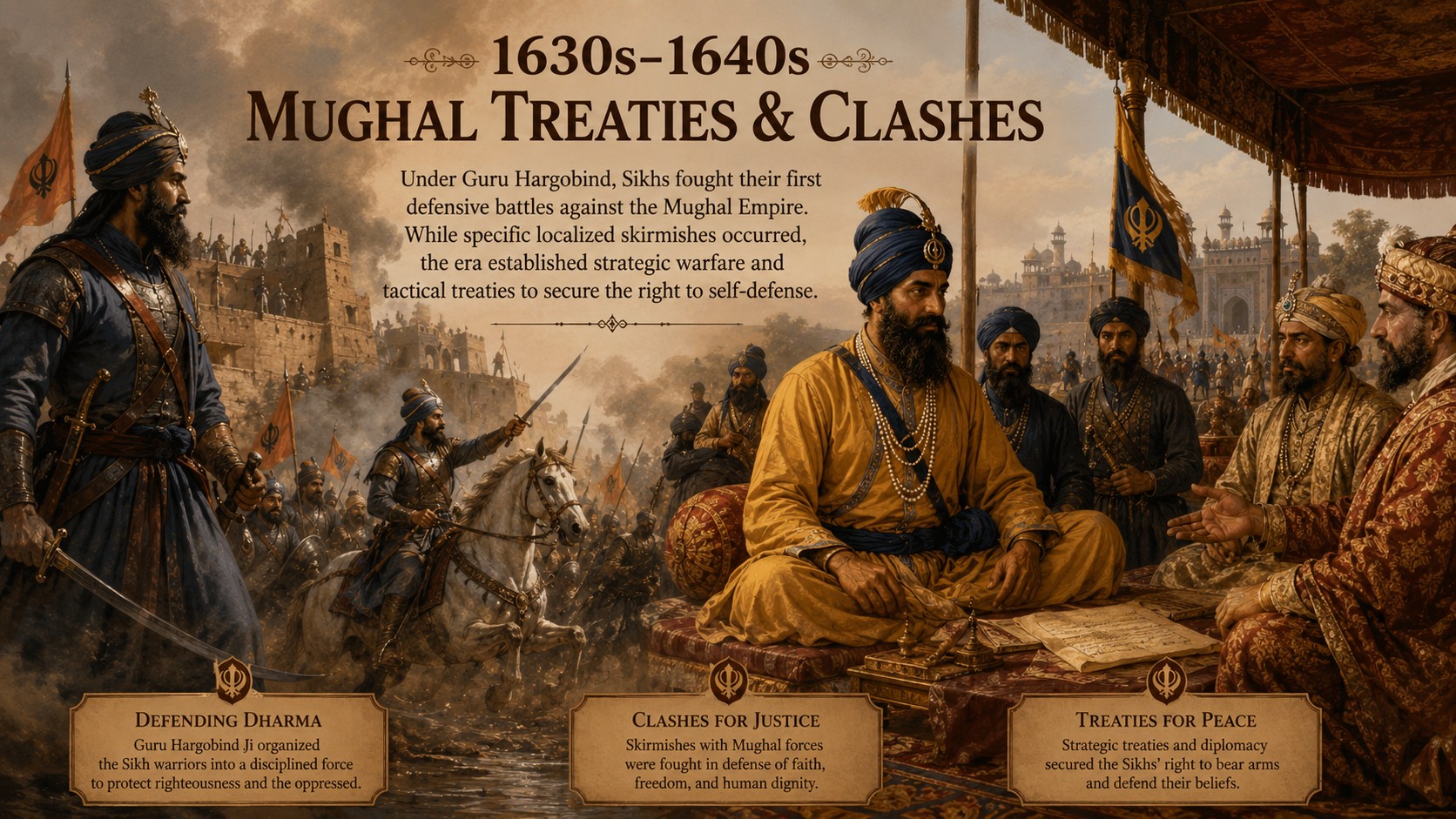
1630s–1640s CE: Mughal Treaties and Clashes Under Guru Hargobind Sahib Ji – The Birth of Sikh Defensive Warfare and the Right to Self-Defense
The decades of the 1630s and 1640s occupy a pivotal position in Sikh history. These years marked the first sustained military confrontations between the Sikh community and the Mughal Empire under the leadership of Guru Hargobind Sahib Ji, the Sixth Guru of the Sikhs. While earlier Sikh history had largely focused on spiritual development, institution building, social reform, and the cultivation of a distinct religious identity, the events of this period introduced a new dimension to the evolution of the Panth. The Sikh community found itself compelled to confront political realities that demanded not only spiritual resilience but also physical preparedness. The clashes, skirmishes, strategic retreats, tactical victories, and occasional accommodations with Mughal authorities established principles that would shape Sikh political and military thought for generations. Most importantly, this era laid the foundation for the Sikh understanding of the right and responsibility of self-defense against injustice.
As a Sikh historian, it is important to emphasize that the military engagements of Guru Hargobind Sahib Ji were fundamentally defensive in nature. They did not emerge from ambitions of conquest, territorial expansion, or imperial domination. Rather, they arose from a commitment to protect religious freedom, communal autonomy, and human dignity. The martyrdom of Guru Arjan Dev Ji in 1606 had profoundly transformed Sikh consciousness. The execution of the Fifth Guru under Mughal authority demonstrated that spiritual communities could become vulnerable to political persecution. Guru Hargobind Sahib Ji responded not by abandoning the spiritual mission of Sikhism but by broadening it. He taught that devotion to God and the defense of justice were inseparable responsibilities. The conflicts of the 1630s and 1640s became the practical testing ground for these principles.
The Legacy of Guru Arjan Dev Ji's Martyrdom
To understand the clashes of the 1630s and 1640s, one must begin with the consequences of Guru Arjan Dev Ji's martyrdom. His execution in 1606 represented a watershed moment in Sikh history. The Sikh community recognized that moral truth alone could not always shield believers from political oppression. The Panth faced a new reality in which the preservation of spiritual values required the ability to defend them.
Guru Hargobind Sahib Ji inherited this challenge as the Sixth Guru. Upon assuming leadership, he initiated significant reforms that reflected the changing circumstances of the Sikh community. He adopted two swords representing Miri and Piri, temporal and spiritual authority, and emphasized that Sikhs must cultivate both spiritual discipline and worldly responsibility. This doctrine would become the philosophical foundation for Sikh engagement with questions of governance, justice, and self-defense.
The creation of the Akal Takht in 1609 further institutionalized this vision. The Akal Takht provided a center for temporal leadership and symbolized the Panth's growing political consciousness. These developments laid the groundwork for the military engagements that would emerge in the following decades.
The Political Climate of the Mughal Empire
The Mughal Empire during the reigns of Jahangir and Shah Jahan was one of the most powerful political entities in the world. It governed vast territories and commanded immense military resources. Yet beneath its strength lay persistent challenges. Succession disputes, regional rivalries, economic pressures, and concerns regarding local autonomy frequently created tensions between imperial authorities and emerging communities.
The Sikh Panth's continued growth attracted increasing attention from Mughal officials. The Guru's expanding influence, the loyalty of Sikh followers, and the development of independent institutions occasionally generated suspicion among local authorities. Not every Mughal official viewed the Sikh community negatively, and relations varied across regions and periods. Nevertheless, misunderstandings and political anxieties often contributed to conflict.
The resulting confrontations were not always part of a coordinated imperial campaign. Many arose from local disputes, administrative actions, or tensions involving regional officials. Yet collectively they helped define the relationship between the Sikh community and Mughal power during this formative era.
The Emergence of Sikh Martial Organization
Guru Hargobind Sahib Ji recognized that the Sikh community required practical means of self-protection. He encouraged physical training, horsemanship, and the development of martial skills. Sikhs were taught that spiritual discipline should be accompanied by courage and readiness to defend the weak.
This transformation did not represent a departure from Sikh spirituality. Rather, it reflected an expanded understanding of ethical responsibility. A Sikh was expected to remain humble, compassionate, and devoted to God while also possessing the ability to resist oppression. The Guru's emphasis on martial preparedness aimed to ensure that the community would never again be entirely vulnerable to persecution.
The development of armed capability was carefully balanced with spiritual values. Force was not glorified, nor was warfare pursued for personal gain. The use of arms was justified only in the service of justice and the protection of others. This principle became a defining characteristic of Sikh military ethics.
The Early Defensive Battles
During the 1630s, several confrontations occurred between Sikh forces and Mughal authorities. These engagements varied in scale and significance, ranging from localized skirmishes to larger military encounters. While historical sources differ in their details, the broader pattern is clear: the Sikh community increasingly found itself defending its autonomy and security against hostile actions.
One of the most notable aspects of these early battles was the leadership style demonstrated by Guru Hargobind Sahib Ji. He combined strategic caution with remarkable courage. Rather than seeking direct confrontation whenever possible, he often employed tactical flexibility, choosing battles carefully and avoiding unnecessary losses. This approach reflected both military wisdom and ethical restraint.
The Sikh forces were typically smaller and less equipped than imperial armies. Success therefore depended upon mobility, discipline, local knowledge, and strong leadership. These experiences contributed significantly to the development of Sikh military traditions.
The Battle of Amritsar and Its Significance
Among the important engagements associated with this era was the Battle of Amritsar. Although historical accounts vary regarding specific details, the conflict demonstrated the growing capacity of the Sikh community to defend itself effectively. The battle revealed that Sikh forces, despite limited resources, could successfully resist larger opponents when guided by strong leadership and strategic planning.
The significance of such encounters extended beyond immediate military outcomes. They strengthened communal confidence and reinforced the belief that justice could be defended through disciplined action. At the same time, these victories did not encourage ambitions of conquest. Instead, they confirmed the viability of self-defense as a legitimate and necessary component of Sikh life.
The memory of these battles became part of the collective heritage of the Panth, inspiring future generations during subsequent periods of struggle.
Strategic Retreats and Tactical Adaptation
One of the most overlooked aspects of Guru Hargobind Sahib Ji's military leadership was his willingness to employ strategic retreats when circumstances required. Popular narratives often celebrate battlefield victories, but effective leadership also involves knowing when to avoid unnecessary confrontation.
Guru Hargobind demonstrated a sophisticated understanding of military realities. He recognized that preserving the community's long-term strength was often more important than winning a particular engagement. Strategic movement, relocation, and tactical flexibility allowed the Sikh community to survive and adapt despite facing a far more powerful adversary.
These experiences taught valuable lessons regarding resilience and pragmatism. The Panth learned that courage does not require recklessness and that wisdom is an essential component of effective leadership.
Treaties, Negotiations, and Political Accommodation
Although remembered primarily for military clashes, the 1630s and 1640s were also characterized by periods of negotiation and accommodation. Relations between the Sikh community and Mughal authorities were not uniformly hostile. At various times, local understandings and informal agreements helped reduce tensions and create opportunities for coexistence.
These arrangements reflected Guru Hargobind Sahib Ji's pragmatic approach to leadership. He understood that warfare was not an end in itself. Whenever possible, peaceful solutions were preferable. Negotiation, diplomacy, and mutual accommodation could often achieve objectives more effectively than prolonged conflict.
The existence of such treaties demonstrates that the Sikh response to political challenges was multifaceted. Military preparedness was balanced by a willingness to pursue dialogue and peaceful resolution whenever circumstances allowed.
The Concept of Just Self-Defense
Perhaps the most enduring contribution of this era was the development of a distinct Sikh understanding of self-defense. Guru Hargobind Sahib Ji taught that defending oneself and protecting others from injustice could be a moral obligation. However, the use of force had to remain disciplined, proportionate, and guided by ethical principles.
This perspective differed significantly from both passive acceptance of oppression and aggressive militarism. The Sikh approach sought a middle path grounded in justice. Violence was never celebrated for its own sake, nor was submission to tyranny considered virtuous. Instead, Sikhs were encouraged to resist wrongdoing while maintaining compassion and moral integrity.
This principle would later influence the creation of the Khalsa under Guru Gobind Singh Ji and become a cornerstone of Sikh identity.
The Impact on Sikh Institutions
The experiences of the 1630s and 1640s strengthened Sikh institutions and reinforced communal cohesion. The Akal Takht emerged as an increasingly important center of leadership and decision-making. The doctrines of Miri and Piri became more deeply integrated into everyday Sikh consciousness.
The community also developed stronger networks of communication, mutual support, and collective responsibility. These institutional developments enabled the Panth to respond more effectively to future challenges and contributed to its long-term survival.
Importantly, the military dimension of Sikh life never displaced its spiritual foundations. Worship, service, community kitchens, scriptural study, and ethical conduct remained central priorities. The Panth's growing capacity for self-defense complemented rather than replaced its spiritual mission.
The Influence on Later Sikh History
The lessons learned during Guru Hargobind Sahib Ji's era profoundly influenced subsequent generations. Later Gurus inherited a community that had developed both spiritual depth and practical resilience. The defensive battles of the 1630s and 1640s provided valuable experience that would prove essential during later periods of persecution and resistance.
The saint-soldier ideal, which reached full expression under Guru Gobind Singh Ji and the Khalsa, can be traced directly to the precedents established during this period. The belief that faith and courage must coexist became deeply embedded in Sikh culture.
Furthermore, the emphasis on self-defense and justice helped shape Sikh political thought. The Panth increasingly understood itself as a community with both spiritual responsibilities and temporal obligations. This dual awareness would eventually contribute to the emergence of Sikh sovereignty in later centuries.
Guru Hargobind Sahib Ji as Statesman and Strategist
Historical discussions often focus on Guru Hargobind Sahib Ji as a warrior, but he was equally a statesman, institution-builder, and strategist. His leadership combined spiritual wisdom with political insight. He understood that communities require both ideals and practical mechanisms for protecting those ideals.
His ability to balance military preparedness with diplomatic engagement demonstrated remarkable foresight. Rather than embracing extremism in either direction, he charted a path that preserved the moral foundations of Sikhism while adapting to changing realities.
This balanced approach remains one of the most important aspects of his legacy. It illustrates how principled leadership can navigate complex challenges without sacrificing core values.
The Enduring Legacy of the 1630s–1640s
The clashes and treaties of the 1630s and 1640s represent far more than a series of historical events. They marked the emergence of a new phase in Sikh history characterized by greater confidence, institutional maturity, and political awareness. The Sikh community learned that devotion to God must be accompanied by a willingness to defend justice and protect the vulnerable.
The era also demonstrated that ethical principles can guide military and political action. Through careful leadership, strategic adaptation, and unwavering commitment to righteousness, Guru Hargobind Sahib Ji established precedents that would shape the Panth for centuries.
Today, these events continue to inspire Sikhs around the world. They remind believers that courage and compassion are not opposing virtues but complementary expressions of a life dedicated to truth and service.
Conclusion
The 1630s and 1640s were among the most formative decades in Sikh history. Under the leadership of Guru Hargobind Sahib Ji, the Sikh community fought its first defensive battles against Mughal forces while simultaneously developing institutions, doctrines, and strategies that would ensure its long-term survival. These conflicts were not wars of conquest but struggles to preserve dignity, autonomy, and religious freedom. Through a combination of military preparedness, tactical flexibility, diplomatic engagement, and spiritual discipline, Guru Hargobind established a model of leadership that transformed the Panth. The era's legacy can be seen in the doctrines of Miri and Piri, the saint-soldier ideal, the concept of just self-defense, and the enduring commitment of Sikhs to justice and human rights. The clashes and treaties of this period were not merely episodes of conflict; they were foundational chapters in the evolution of Sikh sovereignty, resilience, and identity.
Frequently Asked Questions (FAQ)
1. Why did Sikhs begin fighting defensive battles during Guru Hargobind Sahib Ji's time?
The battles emerged as a response to political pressures and the need to protect the Sikh community following the martyrdom of Guru Arjan Dev Ji.
2. Were these battles offensive wars of expansion?
No. The engagements were primarily defensive and aimed at preserving religious freedom, community autonomy, and justice.
3. What was the doctrine of Miri and Piri?
Miri and Piri represented the integration of temporal authority and spiritual authority within Sikh leadership and community life.
4. Did Guru Hargobind Sahib Ji encourage militarization?
He encouraged preparedness for self-defense while maintaining strong spiritual and ethical foundations.
5. What role did the Akal Takht play during this era?
The Akal Takht served as the center of temporal leadership, community deliberation, and the articulation of Sikh sovereignty.
6. Were there treaties between Sikhs and Mughal authorities?
Yes. Alongside military clashes, periods of negotiation and accommodation helped manage tensions and preserve stability.
7. What military lessons did the Sikhs learn during this period?
They learned the importance of mobility, discipline, strategic planning, tactical flexibility, and community unity.
8. How did these events influence later Sikh history?
They laid the foundations for the saint-soldier ideal, the Khalsa tradition, and later Sikh political development.
9. What was Guru Hargobind Sahib Ji's approach to conflict?
He combined courage with restraint, using force only when necessary and pursuing peaceful solutions whenever possible.
10. Why is this era important today?
It established enduring Sikh principles regarding justice, self-defense, leadership, resilience, and the protection of human dignity.