Historical Turning Points · Origins & Gurus
1700–1704 Battles of Anandpur & Chamkaur
The Khalsa fought a series of intense conflicts against combined Mughal and Hill state forces, culminating in the tragic sacrifice of the Guru's four sons and the evacuation of Anandpur.
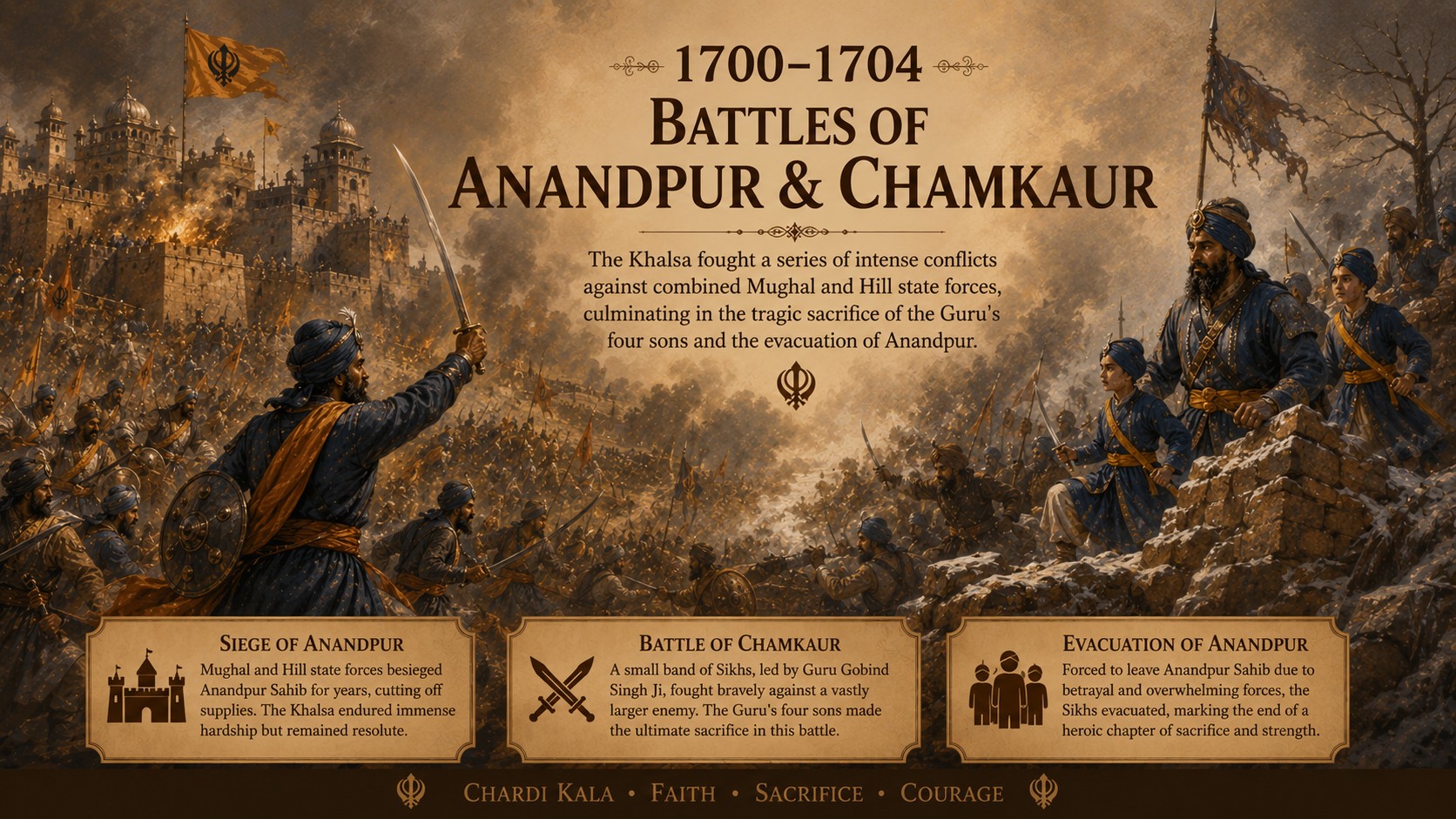
1700–1704 CE: The Battles of Anandpur and Chamkaur – The Crucible of the Khalsa and the Supreme Sacrifices of the House of Guru Gobind Singh Ji
The years between 1700 and 1704 CE represent one of the most dramatic, painful, and transformative chapters in Sikh history. During this brief but extraordinary period, the newly established Khalsa faced relentless military pressure from a coalition of Mughal imperial forces and the Hill Rajas of the Shivalik region. The battles fought around Anandpur Sahib, the prolonged sieges, the hardships endured by the Sikh community, the evacuation of the sacred city, and the heroic stand at Chamkaur collectively forged the identity of the Khalsa in fire and sacrifice. These events were not merely military engagements. They were profound tests of faith, courage, leadership, and commitment to principles. The struggles of Anandpur and Chamkaur demonstrated the practical meaning of the saint-soldier ideal established by Guru Gobind Singh Ji and transformed the Sikh Panth into a community prepared to endure immense suffering in the defense of justice, freedom, and spiritual sovereignty.
As a Sikh historian, it is impossible to discuss this era without recognizing its emotional depth. The conflicts culminated in the sacrifice of all four sons of Guru Gobind Singh Ji, known collectively as the Sahibzade. Two elder sons attained martyrdom on the battlefield of Chamkaur, while the two younger sons were executed at Sirhind after refusing to abandon their faith. The Guru himself endured the loss of his family, the destruction of Anandpur, and the betrayal of sworn promises by his adversaries. Yet despite these overwhelming hardships, he remained unwavering in his commitment to righteousness. The events of these years became foundational to Sikh memory and continue to inspire Sikhs throughout the world as examples of courage under the most difficult circumstances imaginable.
The Creation of the Khalsa and Rising Tensions
The origins of the conflicts at Anandpur can be traced directly to the creation of the Khalsa on Vaisakhi in 1699. Through the establishment of the Khalsa, Guru Gobind Singh Ji sought to create a disciplined community of spiritually committed and morally courageous individuals dedicated to defending justice and resisting oppression. The initiation ceremony of Amrit, the adoption of a distinct identity, and the emphasis on equality transformed the Sikh community into a more organized and self-conscious force.
The rapid growth of the Khalsa attracted followers from diverse social backgrounds. Individuals from different castes, regions, and professions joined the Panth and embraced a common identity rooted in faith and shared responsibility. This growing influence altered regional political dynamics. Some local rulers viewed the increasing strength of the Sikh community with concern, particularly as the Khalsa rejected traditional hierarchies and demonstrated remarkable unity.
The Hill Rajas who governed territories surrounding Anandpur Sahib had complex relationships with Guru Gobind Singh Ji. At times cooperation existed, while at other moments tensions emerged. As the Khalsa expanded and its influence increased, several regional rulers began viewing the Guru's growing authority as a challenge to their own political position. These concerns eventually contributed to military confrontations.
Anandpur Sahib: The Center of the Khalsa
Anandpur Sahib occupied a central place in the vision of Guru Gobind Singh Ji. Founded by Guru Tegh Bahadur Ji and developed under the Tenth Guru, the city became a spiritual, educational, and military center for the Sikh community. It served as the birthplace of the Khalsa and functioned as the heart of Sikh life during a critical period of transformation.
The city's strategic location among the hills provided certain defensive advantages, but it also placed Anandpur in close proximity to numerous regional powers. As tensions increased, the city became the focus of repeated military campaigns. The defense of Anandpur was not simply a matter of protecting territory. For the Khalsa, the city symbolized spiritual freedom, communal independence, and the realization of Guru Gobind Singh Ji's vision.
Every effort to defend Anandpur carried significance far beyond military considerations. The city's preservation represented the preservation of a way of life rooted in faith, equality, and resistance to injustice.
The Early Battles Around Anandpur
Beginning around 1700, a series of military engagements took place between Sikh forces and combinations of Hill state and Mughal troops. These confrontations varied in scale and intensity, but together they revealed the growing determination of the Khalsa to defend itself against external pressures.
The Sikh warriors fighting under Guru Gobind Singh Ji often faced opponents who enjoyed numerical superiority and greater resources. Nevertheless, the Khalsa repeatedly demonstrated remarkable discipline, courage, and tactical skill. The Guru's leadership inspired extraordinary devotion among his followers, many of whom willingly risked their lives in defense of the Panth.
These battles also highlighted the emergence of a distinctive Sikh military ethos. Victory was not pursued for conquest or personal gain. Instead, military action was viewed as a necessary response to aggression and a means of protecting justice. This understanding reflected the principles inherited from Guru Hargobind Sahib Ji and further developed under Guru Gobind Singh Ji.
The Prolonged Siege of Anandpur
The most significant phase of the conflict came with the prolonged siege of Anandpur. Combined forces from the Mughal administration and several Hill states surrounded the city, seeking to isolate the Sikhs and force their submission. The siege lasted for many months and imposed severe hardships upon the inhabitants.
Food supplies became increasingly scarce. Resources dwindled. Families faced hunger and uncertainty. Yet despite these difficulties, the morale of the Khalsa remained remarkably strong. The community drew strength from its faith, its shared identity, and its trust in Guru Gobind Singh Ji's leadership.
The siege represented not merely a military challenge but also a psychological test. The adversaries hoped that deprivation would accomplish what battlefield engagements had failed to achieve. Instead, the suffering endured during the siege strengthened the resolve of many Sikhs and reinforced their commitment to the principles of the Khalsa.
Promises of Safe Passage and the Evacuation of Anandpur
As the siege continued, negotiations took place between Guru Gobind Singh Ji and the besieging forces. Historical traditions recount that solemn assurances and oaths were offered, guaranteeing safe passage if the Sikhs agreed to evacuate Anandpur. These promises were reportedly made under sacred affirmations intended to assure their sincerity.
Faced with worsening conditions and concerned for the welfare of his followers, Guru Gobind Singh Ji eventually agreed to leave the city. The evacuation of Anandpur became one of the most heartbreaking moments in Sikh history. The city that had witnessed the birth of the Khalsa and served as the center of Sikh life was abandoned under conditions of immense uncertainty.
For many Sikhs, leaving Anandpur was emotionally devastating. Yet the departure demonstrated the Guru's willingness to place the survival of the community above attachment to physical locations. The spirit of the Khalsa, he understood, could not be confined to any single city.
The Crossing of the Sarsa River
Shortly after leaving Anandpur, the Sikh column encountered grave difficulties near the Sarsa River. Adverse conditions, confusion, and military pressure contributed to chaos during the crossing. Families became separated. Valuable manuscripts and possessions were lost. The Sikh community, already weakened by the siege, faced one of the most traumatic moments in its history.
The crossing resulted in the separation of Guru Gobind Singh Ji from several members of his family. This fragmentation would have profound consequences in the days that followed. Yet even amid confusion and loss, acts of courage, loyalty, and sacrifice emerged that would become legendary within Sikh tradition.
The events at the Sarsa illustrated the harsh realities of the struggle facing the Khalsa. The conflict had moved beyond conventional military engagements and entered a phase marked by profound personal sacrifice.
The Battle of Chamkaur
Following the separation at the Sarsa, Guru Gobind Singh Ji and a small group of Sikhs reached Chamkaur, where they took refuge in a fortified structure commonly known as the Garhi of Chamkaur. There they faced an enormous hostile force composed of Mughal and allied troops.
The Battle of Chamkaur ranks among the most extraordinary defensive actions in military history. Vastly outnumbered, the Sikhs refused to surrender. Instead, they prepared to make a stand that would embody the highest ideals of the Khalsa.
Throughout the battle, small groups of Sikh warriors emerged from the fortification to engage enemy forces. Each knew that survival was unlikely. Yet they advanced with courage, viewing their sacrifice as an offering in the cause of righteousness. Their actions demonstrated the practical realization of the saint-soldier ideal established by Guru Gobind Singh Ji.
The Martyrdom of Sahibzada Ajit Singh Ji
Among the most moving episodes of the Battle of Chamkaur was the martyrdom of Sahibzada Ajit Singh Ji, the Guru's eldest son. Still in his youth, Ajit Singh Ji requested permission to enter the battlefield. Guru Gobind Singh Ji granted his request, recognizing both his courage and his commitment to duty.
Ajit Singh Ji fought with extraordinary valor. Despite overwhelming odds, he demonstrated the qualities expected of a Khalsa warrior: fearlessness, discipline, and unwavering devotion to righteousness. His martyrdom became a defining symbol of youthful courage and sacrifice.
The loss of his eldest son would have caused immense grief to any father. Yet Guru Gobind Singh Ji remained steadfast, placing the needs of the Panth and the demands of principle above personal sorrow.
The Martyrdom of Sahibzada Jujhar Singh Ji
Following the martyrdom of Ajit Singh Ji, Sahibzada Jujhar Singh Ji, the Guru's second eldest son, sought permission to join the battle. Though younger in age, he displayed remarkable determination and spiritual maturity.
Guru Gobind Singh Ji allowed him to proceed, and Jujhar Singh Ji entered combat with the same courage that had characterized his elder brother. His sacrifice further demonstrated the extraordinary commitment of the Guru's family to the ideals of the Khalsa.
The martyrdoms of Ajit Singh Ji and Jujhar Singh Ji transformed the Battle of Chamkaur into far more than a military engagement. It became a sacred narrative of faith, duty, and self-sacrifice that continues to inspire Sikhs worldwide.
The Escape of Guru Gobind Singh Ji
As the battle continued, surviving Sikhs urged Guru Gobind Singh Ji to leave Chamkaur in order to preserve the leadership of the Panth. Recognizing the importance of ensuring the community's future, the Guru eventually departed under difficult circumstances.
This decision reflected strategic wisdom rather than retreat. The survival of Guru Gobind Singh Ji was essential for the continued guidance of the Sikh community. His departure ensured that the struggle for justice and freedom would continue beyond the immediate battlefield.
The events of Chamkaur demonstrated that leadership sometimes requires survival as much as sacrifice. Through his continued presence, the Guru would guide the Panth through subsequent challenges and prepare it for future responsibilities.
The Martyrdom of the Younger Sahibzade
The tragedies of this period did not end at Chamkaur. Sahibzada Zorawar Singh Ji and Sahibzada Fateh Singh Ji, the Guru's younger sons, were captured and taken to Sirhind. There they faced demands to abandon their faith and accept conversion.
Despite their young age, both Sahibzade displayed extraordinary courage. They refused to compromise their beliefs and remained steadfast in their commitment to Sikh principles. As a result, they were sentenced to death.
The martyrdom of the younger Sahibzade stands as one of the most poignant episodes in Sikh history. Their courage demonstrated that spiritual conviction is not determined by age but by the strength of one's principles and faith.
The Transformation of the Khalsa
The years between 1700 and 1704 transformed the Khalsa forever. The hardships endured during the siege of Anandpur, the sacrifices at Chamkaur, and the martyrdoms of the Sahibzade deepened the community's sense of identity and purpose.
The Khalsa emerged from these trials with a stronger commitment to justice, freedom, and collective responsibility. The experiences of this era reinforced the understanding that the defense of righteousness often requires sacrifice. Yet they also demonstrated that moral victories can endure long after military circumstances have changed.
The memory of Anandpur and Chamkaur became a source of strength for future generations facing persecution and adversity. The sacrifices made during these years provided a powerful example of resilience rooted in faith.
The Enduring Legacy of Anandpur and Chamkaur
More than three centuries later, the battles of Anandpur and Chamkaur remain central to Sikh historical consciousness. They represent the testing ground of the Khalsa and the fulfillment of the ideals proclaimed in 1699. The courage of the Guru, the sacrifices of the Sahibzade, and the devotion of countless Sikhs continue to inspire believers around the world.
These events remind Sikhs that faith involves responsibility as well as devotion. They demonstrate that commitment to justice may require personal sacrifice but that such sacrifices can shape history and inspire future generations.
The legacy of Anandpur and Chamkaur remains one of courage without hatred, resistance without oppression, and unwavering fidelity to truth.
Conclusion
The period from 1700 to 1704 CE stands as one of the most consequential chapters in Sikh history. Through the sieges and battles of Anandpur Sahib, the evacuation of the city, the crossing of the Sarsa River, the heroic defense at Chamkaur, and the martyrdoms of all four Sahibzade, the Khalsa was tested in ways few communities have ever experienced. Under the leadership of Guru Gobind Singh Ji, the Sikh Panth endured immense suffering yet emerged spiritually stronger and more united. These events transformed the Khalsa into a community defined by courage, sacrifice, and commitment to justice. The memory of Anandpur and Chamkaur continues to illuminate Sikh history as a testament to the power of faith, resilience, and moral conviction in the face of overwhelming adversity.
Frequently Asked Questions (FAQ)
1. Why were the Battles of Anandpur fought?
The battles arose from growing tensions between the Khalsa and a coalition of Mughal and Hill state forces concerned about the increasing influence of Guru Gobind Singh Ji and the Sikh community.
2. What was Anandpur Sahib's significance?
Anandpur Sahib was the birthplace of the Khalsa and the primary center of Sikh spiritual, social, and military activity during Guru Gobind Singh Ji's leadership.
3. What happened during the siege of Anandpur?
The city was surrounded for many months, leading to severe shortages of food and resources while the Sikhs resisted repeated pressure to surrender.
4. Why did Guru Gobind Singh Ji leave Anandpur?
After receiving assurances of safe passage and considering the suffering of the community, he agreed to evacuate the city.
5. What occurred at the Sarsa River?
The Sikh community became scattered during the crossing, resulting in the separation of families and the loss of important possessions and manuscripts.
6. What was the Battle of Chamkaur?
It was a heroic defensive battle in which Guru Gobind Singh Ji and a small group of Sikhs faced a vastly larger enemy force.
7. Who were Sahibzada Ajit Singh Ji and Sahibzada Jujhar Singh Ji?
They were the two elder sons of Guru Gobind Singh Ji who attained martyrdom while fighting at Chamkaur.
8. What happened to the younger Sahibzade?
Sahibzada Zorawar Singh Ji and Sahibzada Fateh Singh Ji were captured at Sirhind and martyred after refusing to abandon their faith.
9. How did these events affect the Khalsa?
The sacrifices strengthened the Khalsa's identity, unity, and commitment to justice, freedom, and spiritual principles.
10. Why are Anandpur and Chamkaur remembered today?
They symbolize extraordinary courage, sacrifice, resilience, and the enduring values of the Sikh faith.