Historical Turning Points · Empire & Struggle
1708–1716 Banda Singh Bahadur
Following the passing of Guru Gobind Singh in 1708 CE, the Sikh community entered a turbulent yet highly resilient phase. Under the military campaign of Banda Singh Bahadur (1708–1716 CE), Sikhs waged aggressive guerrilla warfare against Mughal tyranny. Sikh forces captured Sirhind, establishing the first Khalsa rule and issuing coins in the name of the Gurus.
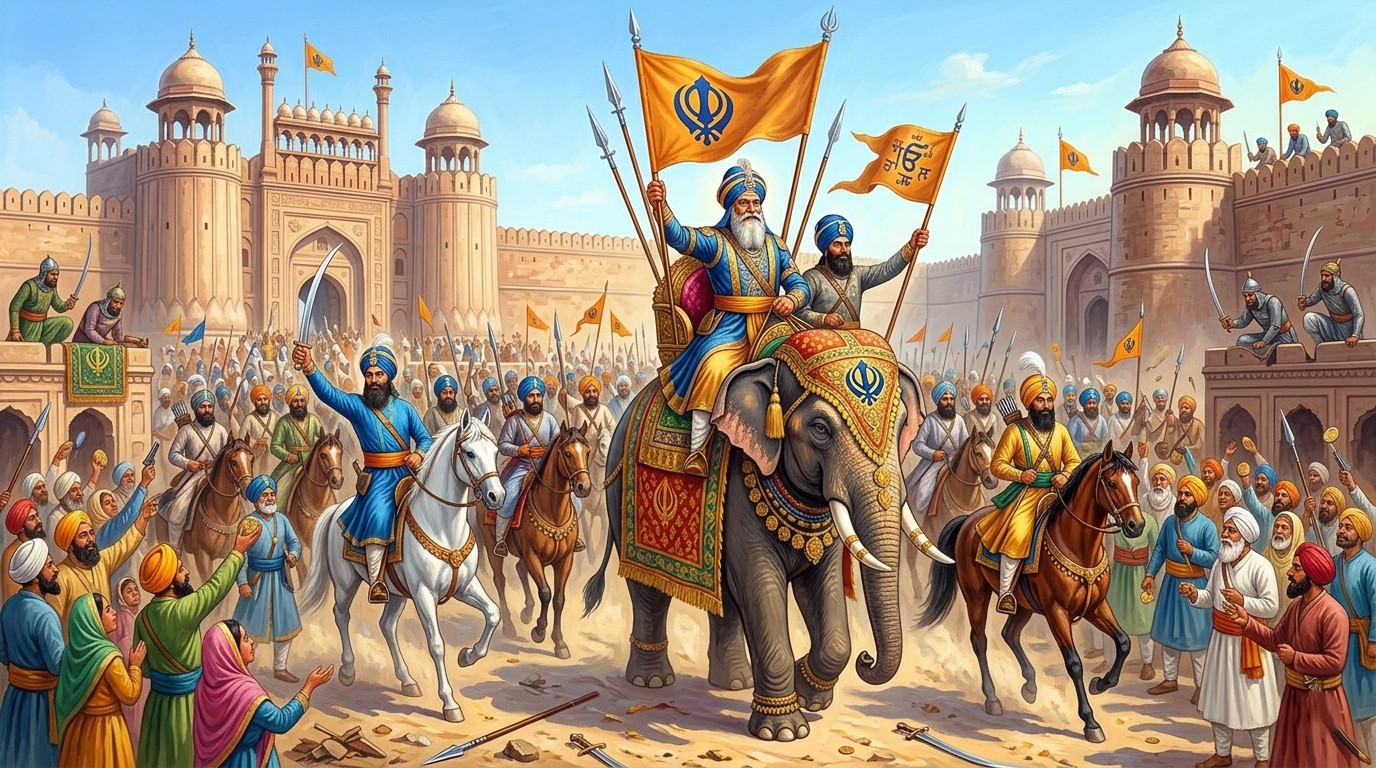
Banda Singh Bahadur (1708–1716 CE): The Warrior-Saint Who Established the First Khalsa Rule
The years immediately following the passing of Guru Gobind Singh Ji in 1708 marked one of the most turbulent yet transformative periods in Sikh history. The Sikh community had endured immense suffering during the final years of the Tenth Guru's life. The sieges of Anandpur Sahib, the martyrdom of the four Sahibzade, the sacrifices of countless Sikhs, and the continuous hostility of Mughal authorities had tested the Panth to its limits. Yet from these trials emerged a remarkable leader whose brief but revolutionary career would permanently alter the course of Sikh history. That leader was Banda Singh Bahadur, a warrior-saint whose military genius, unwavering devotion, and commitment to justice enabled the Sikhs to challenge Mughal authority and establish the first sovereign Khalsa rule. Between 1708 and 1716, Banda Singh Bahadur led a series of extraordinary campaigns that transformed the Sikhs from a persecuted community into a political and military force capable of governing territory, implementing social reforms, and inspiring future generations to pursue freedom and justice.
As a Sikh historian, one must view Banda Singh Bahadur not merely as a military commander but as a pivotal bridge between the era of the Gurus and the later rise of Sikh sovereignty under the Misls and Maharaja Ranjit Singh. His campaigns represented the first major attempt to translate the spiritual and social vision of the Gurus into practical governance. Although his rule lasted only a few years and ended in martyrdom, the impact of his achievements far exceeded the duration of his political authority. Banda Singh Bahadur demonstrated that the Khalsa was capable not only of resisting oppression but also of building an alternative social order founded upon justice, equality, and the dignity of ordinary people.
Early Life: From Lachman Dev to Madho Das Bairagi
Banda Singh Bahadur was born in 1670 as Lachman Dev in the Jammu region. Historical traditions describe him as possessing exceptional physical abilities and a strong personality from an early age. During his youth, he developed skills in horsemanship, hunting, and martial activities. Yet a series of experiences gradually led him away from worldly pursuits and toward spiritual inquiry.
Eventually, Lachman Dev adopted the life of an ascetic and became known as Madho Das Bairagi. He traveled extensively across India, studying spiritual disciplines and establishing a reputation as a religious recluse. Settling at Nanded in the Deccan, he maintained an ascetic establishment and attracted followers. At this stage of his life, he appeared far removed from the political and military struggles unfolding in northern India. Yet destiny would soon place him at the center of one of the most significant movements in Sikh history.
The transformation from Madho Das Bairagi to Banda Singh Bahadur illustrates one of the most remarkable personal journeys in Indian history. It demonstrates how spiritual conviction and historical circumstances can combine to reshape an individual's purpose and legacy.
The Historic Meeting with Guru Gobind Singh Ji
The defining moment of Banda Singh Bahadur's life occurred in 1708 when he encountered Guru Gobind Singh Ji at Nanded. By this time, the Guru had endured immense personal and communal losses. Yet he remained committed to ensuring the future of the Khalsa and preparing it for the challenges ahead.
Sikh tradition recounts that the meeting between Guru Gobind Singh Ji and Madho Das was transformative. The ascetic recognized the extraordinary spiritual authority of the Guru and submitted himself completely to his guidance. Guru Gobind Singh Ji initiated him into the Khalsa and gave him a new mission. Madho Das became Banda Singh Bahadur, a devoted servant of the Panth tasked with confronting injustice and defending the oppressed.
The Guru entrusted Banda Singh Bahadur with a small group of dedicated Sikhs, letters addressed to Sikh communities across northern India, and a clear mandate to challenge tyranny. This commission carried profound significance. Banda was not merely receiving military instructions. He was becoming the instrument through which the Khalsa would begin a new phase of its historical journey.
The Political Situation After 1708
When Banda Singh Bahadur began his mission, northern India remained firmly under Mughal control. Although the empire possessed immense resources, it faced growing strains caused by administrative challenges, regional unrest, and military commitments across vast territories. Local officials often exercised considerable power, and abuses of authority were not uncommon.
For the Sikhs, the memory of recent persecutions remained vivid. The execution of Guru Tegh Bahadur Ji, the martyrdom of the Sahibzade, and the repeated military campaigns against Guru Gobind Singh Ji had created a strong desire for justice. Many Sikhs viewed Banda Singh Bahadur's mission as both a continuation of the Guru's vision and an opportunity to confront those responsible for oppression.
The political environment was therefore highly volatile. While the Mughal state remained powerful, growing dissatisfaction among various communities created opportunities for resistance movements. Banda Singh Bahadur skillfully harnessed these conditions and transformed scattered grievances into a coordinated struggle.
The Rise of the Khalsa Army
As Banda Singh Bahadur moved northward, Sikhs from diverse regions rallied to his cause. The letters sent by Guru Gobind Singh Ji encouraged members of the Khalsa to join the campaign, and many responded enthusiastically. Farmers, artisans, traders, former soldiers, and ordinary villagers became part of a growing movement united by faith and a commitment to justice.
Unlike traditional armies composed primarily of professional warriors, Banda Singh Bahadur's forces reflected the egalitarian ideals of the Khalsa. Men from different social backgrounds fought side by side as equals. The movement drew strength not only from military organization but also from shared religious conviction.
This emerging army represented something unprecedented in the region. It combined spiritual motivation with military discipline and social reform. The result was a force capable of inspiring loyalty and sustaining resistance under difficult circumstances.
The Campaign Against Samana
The first major success of Banda Singh Bahadur came with the capture of Samana in 1709. The town held both strategic and symbolic importance. Several officials associated with the persecution of the Sikh Gurus and their followers were connected to the area, making it a significant target.
The victory at Samana electrified the Sikh community. For the first time since the passing of Guru Gobind Singh Ji, the Khalsa had achieved a major military success against representatives of Mughal authority. The triumph demonstrated that organized resistance could yield tangible results.
Beyond its immediate military significance, the capture of Samana provided resources, morale, and momentum for future campaigns. It signaled the beginning of a broader movement that would challenge established political structures throughout the region.
Expanding the Campaign and Building Momentum
Following the victory at Samana, Banda Singh Bahadur continued his offensive operations with remarkable energy. Town after town fell under Sikh control as local populations responded to promises of justice and reform. The movement expanded rapidly, drawing support from those who had long suffered under exploitative conditions.
Banda demonstrated considerable strategic skill. He understood the importance of mobility, surprise, and local support. Rather than relying solely on conventional warfare, Sikh forces employed tactics that allowed them to exploit weaknesses in larger enemy formations.
The success of these campaigns reflected not only military effectiveness but also the appeal of the social vision promoted by the Khalsa. Many communities viewed the Sikhs as liberators rather than conquerors, contributing to the movement's rapid growth.
The Capture of Sirhind
The most famous and consequential achievement of Banda Singh Bahadur's career was the capture of Sirhind in 1710. Sirhind held immense symbolic significance within Sikh memory because its governor, Wazir Khan, was associated with the execution of the younger Sahibzade, Sahibzada Zorawar Singh Ji and Sahibzada Fateh Singh Ji.
The campaign against Sirhind was therefore motivated by both strategic and emotional considerations. When Sikh forces defeated the Mughal defenders and captured the city, the event resonated deeply throughout the Panth. Many Sikhs regarded the victory as an act of justice and a vindication of the sacrifices endured by the Guru's family.
The fall of Sirhind represented a turning point in Sikh history. For the first time, the Khalsa controlled a major administrative center and possessed the opportunity to implement its vision of governance.
The Establishment of the First Khalsa Rule
Following the conquest of Sirhind, Banda Singh Bahadur established what is widely regarded as the first Khalsa state. Although its territorial extent and duration were limited, its historical significance was immense. The Khalsa had moved beyond resistance and entered the realm of governance.
This new political order reflected principles rooted in Sikh teachings. Banda sought to create a society characterized by greater fairness and reduced exploitation. His administration challenged entrenched power structures and emphasized the rights of ordinary people.
The establishment of Khalsa rule demonstrated that Sikh ideals could serve as the foundation for practical governance. It provided an early model that would influence later developments in Sikh political thought.
Land Reforms and Social Justice
One of Banda Singh Bahadur's most revolutionary achievements involved land reform. Historical accounts indicate that he redistributed land to cultivators and reduced the power of large landlords who had traditionally dominated rural society.
These measures carried profound implications. For generations, many peasants had labored under systems that concentrated wealth and authority in the hands of a privileged few. Banda's policies challenged these arrangements and sought to empower those who worked the land.
The reforms reflected core Sikh values concerning equality and human dignity. They demonstrated that political authority could be used not merely to maintain order but also to promote social justice.
The Issuance of Sikh Coinage
Among the clearest symbols of sovereignty is the issuance of coinage. Banda Singh Bahadur understood this principle and authorized the minting of coins in the name of the Sikh Gurus. This act carried enormous political and ideological significance.
The coins did not celebrate Banda's personal authority. Instead, they honored Guru Nanak Dev Ji and Guru Gobind Singh Ji, emphasizing that the source of legitimacy lay in the spiritual mission of the Gurus rather than individual ambition.
Through this decision, Banda reinforced the principle that Sikh political power existed to serve higher ideals. The coinage became a powerful statement of independence and identity.
Mughal Counteroffensives
The rapid rise of Banda Singh Bahadur inevitably provoked a strong response from the Mughal Empire. Alarmed by the loss of territory and the growing influence of the Khalsa, imperial authorities launched major military campaigns to suppress the movement.
The Sikhs faced enormous challenges. Their resources remained limited compared to those of the empire, and they were often forced to operate under difficult conditions. Nevertheless, Banda continued to demonstrate remarkable resilience and leadership.
Throughout these campaigns, Sikh forces relied heavily on mobility, local support, and guerrilla tactics. These methods allowed them to survive against opponents possessing superior numbers and resources.
Guerrilla Warfare and Sikh Resilience
The campaigns of Banda Singh Bahadur established patterns of resistance that would characterize Sikh military activity for decades. Rather than depending solely on conventional battles, Sikh forces utilized flexible tactics designed to offset their disadvantages.
This approach reflected both necessity and innovation. The Sikhs learned to exploit terrain, conduct rapid movements, and maintain operational flexibility. These methods enabled them to survive periods of intense pressure and continue challenging Mughal authority.
The experience gained during Banda's campaigns contributed significantly to the military traditions that later sustained the Misls and eventually supported the rise of the Sikh Empire.
The Siege of Gurdas Nangal
By 1715, Mughal forces had intensified their efforts against Banda Singh Bahadur. He and his followers eventually found themselves surrounded at Gurdas Nangal, where they endured a prolonged siege under extremely difficult conditions.
Food supplies dwindled, hardships increased, and prospects for relief diminished. Yet the defenders continued to resist with extraordinary determination. Their endurance reflected the spiritual strength that had long characterized the Sikh community.
The siege became a final test of Banda's leadership and the commitment of his followers. Even in the face of overwhelming odds, they refused to abandon their principles.
Capture, Martyrdom, and Legacy
In 1716, Banda Singh Bahadur and many of his companions were captured and taken to Delhi. There they faced imprisonment, humiliation, and ultimately execution. Historical accounts emphasize the remarkable courage displayed by Banda and his fellow Sikhs during their final days.
Despite immense suffering, Banda remained steadfast in his faith. His martyrdom transformed him from a military leader into an enduring symbol of resistance, sacrifice, and devotion. The Mughal authorities succeeded in ending his rule, but they failed to extinguish the spirit of the Khalsa.
The death of Banda Singh Bahadur marked the end of one chapter in Sikh history but the beginning of another. His example inspired future generations to continue the struggle for freedom and justice.
The Historical Importance of Banda Singh Bahadur
Banda Singh Bahadur occupies a unique position in Sikh history. He was the first leader to translate the ideals of the Khalsa into a functioning political order. He demonstrated that the Sikh community could govern territory, implement reforms, and challenge powerful empires.
His achievements laid essential foundations for later developments, including the rise of the Sikh Misls and the eventual establishment of the Sikh Empire under Maharaja Ranjit Singh. More importantly, his life illustrated the transformative power of faith combined with action.
Although his rule lasted only a few years, its influence extended across centuries. Banda Singh Bahadur proved that spiritual principles could inspire not only personal devotion but also social and political transformation.
Conclusion
The period between 1708 and 1716 CE stands as one of the most dynamic eras in Sikh history, and Banda Singh Bahadur remains its central figure. From his transformation at Nanded under the guidance of Guru Gobind Singh Ji to his military victories, social reforms, establishment of the first Khalsa state, issuance of Sikh coinage, and ultimate martyrdom, Banda embodied the ideals of courage, justice, and selfless service. He led the Sikhs through a turbulent period of persecution and conflict, demonstrating that the Khalsa was capable not only of resisting tyranny but also of creating a more equitable social order. Though his earthly career ended in 1716, his legacy endured, inspiring future generations and helping pave the way for the eventual rise of Sikh sovereignty across Punjab.
Frequently Asked Questions (FAQ)
1. Who was Banda Singh Bahadur?
Banda Singh Bahadur was a Sikh military leader who led the Khalsa's campaigns against Mughal authority between 1708 and 1716.
2. What was his original name?
He was born as Lachman Dev and later became known as Madho Das Bairagi before joining the Sikh faith.
3. How did Banda Singh Bahadur meet Guru Gobind Singh Ji?
He met Guru Gobind Singh Ji at Nanded in 1708, where he was initiated into the Khalsa and given a mission to fight oppression.
4. What was his first major military victory?
One of his first significant victories was the capture of Samana in 1709.
5. Why was the capture of Sirhind important?
Sirhind was associated with the execution of the younger Sahibzade, making its conquest highly significant for the Sikh community.
6. What was the first Khalsa rule?
It was the political administration established by Banda Singh Bahadur after major Sikh military victories, particularly following the capture of Sirhind.
7. Did Banda Singh Bahadur introduce social reforms?
Yes, he implemented land reforms that benefited cultivators and challenged traditional feudal structures.
8. Why did he issue coins?
The coins symbolized Sikh sovereignty and were issued in the name of the Sikh Gurus rather than in his own name.
9. How was Banda Singh Bahadur captured?
He was captured after a prolonged siege at Gurdas Nangal in 1715 and taken to Delhi.
10. What is Banda Singh Bahadur's legacy?
He established the first Khalsa state, pioneered Sikh political rule, inspired future generations, and became a lasting symbol of courage, justice, and sacrifice.