Historical Turning Points · Origins & Gurus
1708 End of Human Lineage and Eternal Guruship
Before his passing in Nanded, Guru Gobind Singh abolished the lineage of human Gurus. He passed the Guruship permanently to the scripture, establishing Guru Granth Sahib as the eternal, living Guru of the Sikhs.
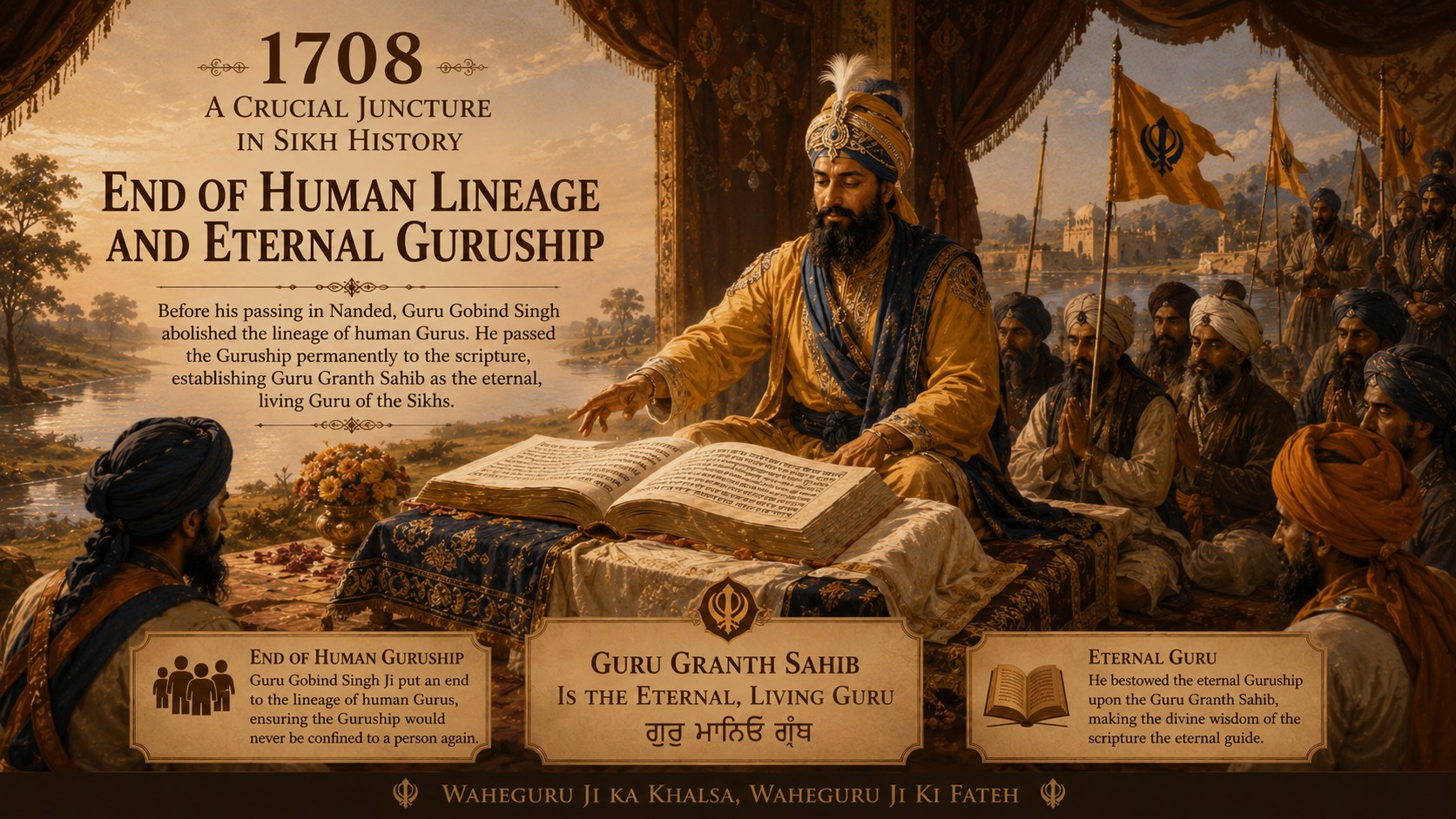
1708 CE: The End of Human Guruship and the Eternal Guruship of Guru Granth Sahib
The year 1708 CE stands as one of the most profound and transformative moments in the entire history of Sikhism. It marked the conclusion of a remarkable lineage of ten human Gurus that had guided the Sikh Panth from its inception under Guru Nanak Dev Ji in the fifteenth century. Yet this moment was not an ending in the ordinary sense. Rather, it represented a carefully planned transition that ensured the continuity, unity, and spiritual integrity of the Sikh community for all future generations. Before his passing at Nanded in the Deccan region of India, Guru Gobind Singh Ji made a revolutionary declaration that permanently altered the structure of Sikh authority. He abolished the institution of a human successor and bestowed eternal Guruship upon the Guru Granth Sahib, the sacred Sikh scripture. Through this act, the Guru established a timeless source of spiritual guidance that would transcend the limitations of individual personalities, hereditary claims, political ambitions, and historical circumstances. For Sikhs, the Guru Granth Sahib became not merely a revered book but the eternal, living Guru whose wisdom and authority would guide the Panth forever.
As a Sikh historian, one cannot overstate the significance of this decision. The transfer of Guruship in 1708 represented the culmination of more than two centuries of spiritual development, institutional evolution, sacrifice, and theological refinement. From Guru Nanak Dev Ji's proclamation of divine unity and human equality to Guru Gobind Singh Ji's creation of the Khalsa, each Guru contributed to a vision of a spiritually empowered community rooted in devotion, justice, and service. The decision to end the line of human Gurus was not made in response to crisis alone. It reflected a profound understanding of history, human nature, and the challenges that future generations would face. By investing authority in scripture rather than an individual, Guru Gobind Singh Ji provided the Sikh Panth with a permanent and universal center of guidance that could not be corrupted by personal ambition or divided by competing claims.
The Legacy of the Ten Gurus
To understand the significance of 1708, one must first appreciate the extraordinary journey of the Sikh Gurus over the preceding two centuries. The Sikh tradition began with Guru Nanak Dev Ji, who challenged social inequalities, rejected empty ritualism, and proclaimed the oneness of God and humanity. His message emphasized devotion, honest living, service, and remembrance of the Divine. More importantly, he established a model of leadership based not on hereditary privilege but on spiritual merit.
This principle became evident when Guru Nanak appointed Guru Angad Dev Ji as his successor. The succession established a precedent that leadership within the Sikh tradition would be determined by spiritual worthiness rather than family lineage. Each subsequent Guru expanded and strengthened the foundations of the Panth. Guru Angad standardized Gurmukhi, Guru Amar Das developed administrative institutions, Guru Ram Das founded Amritsar, Guru Arjan compiled the Adi Granth, Guru Hargobind introduced Miri and Piri, Guru Har Rai expanded charitable work, Guru Har Krishan demonstrated compassion during epidemics, Guru Tegh Bahadur sacrificed his life defending religious freedom, and Guru Gobind Singh created the Khalsa.
By 1708, the Sikh community had evolved into a distinct religious tradition with established institutions, sacred scriptures, and a clear identity. The work of the Gurus had reached a stage of maturity that made a new form of leadership possible.
The Compilation and Significance of the Sikh Scripture
The transfer of Guruship to the Guru Granth Sahib did not occur suddenly or without precedent. The scripture itself had been developing for more than a century. Guru Arjan Dev Ji had compiled the Adi Granth in 1604, collecting the hymns of the preceding Gurus along with compositions from respected saints and devotees from diverse backgrounds. This compilation reflected the Sikh commitment to spiritual truth wherever it could be found.
The inclusion of writings from figures such as Bhagat Kabir, Bhagat Ravidas, Sheikh Farid, and others demonstrated a universal outlook that transcended religious boundaries. The scripture became a repository of divine wisdom expressed through multiple voices yet united by common spiritual themes.
Guru Gobind Singh Ji later ensured the inclusion of the hymns of Guru Tegh Bahadur Ji, creating the form of the scripture recognized today as the Guru Granth Sahib. Through this process, the sacred text became the definitive expression of the teachings and spiritual authority of the Sikh Gurus.
The Challenges Facing the Sikh Community
The years leading up to 1708 were marked by extraordinary challenges. Guru Gobind Singh Ji had witnessed the martyrdom of his father, Guru Tegh Bahadur Ji. He had endured repeated military campaigns, the prolonged sieges of Anandpur, the loss of all four Sahibzade, and the sacrifices of countless Sikhs. The Mughal Empire remained a formidable power, and political uncertainty characterized much of northern India.
Under such conditions, questions concerning leadership carried immense significance. Throughout history, the deaths of charismatic leaders have often led to divisions, succession disputes, and institutional fragmentation. Guru Gobind Singh Ji understood these dangers. He recognized that competing claims to authority could threaten the unity of the Panth and undermine the achievements of the previous Gurus.
Rather than leaving succession open to interpretation, he chose to establish a clear and permanent solution. The authority of the Guru would no longer reside in a human individual but in the revealed wisdom preserved within the Guru Granth Sahib.
Nanded: The Final Chapter of Guru Gobind Singh Ji's Earthly Life
In the final years of his life, Guru Gobind Singh Ji traveled to the Deccan and eventually settled at Nanded. This period was marked by continued spiritual activity, leadership, and reflection. Although he had endured immense personal loss, the Guru remained committed to guiding the Sikh community and ensuring its future.
Nanded became the setting for one of the most consequential declarations in Sikh history. There, Guru Gobind Singh Ji prepared the Panth for a future in which spiritual authority would be exercised through scripture and collective responsibility rather than through a human Guru.
The significance of Nanded extends beyond geography. It represents the place where the Guru completed the institutional framework of Sikhism and ensured its continuity for generations to come.
The Declaration of Eternal Guruship
Before his passing in October 1708, Guru Gobind Singh Ji formally bestowed Guruship upon the Guru Granth Sahib. This act was revolutionary in religious history. Rather than appointing another human successor, he declared that the Guru Granth Sahib would serve as the eternal Guru of the Sikhs.
This declaration carried profound implications. It meant that spiritual authority would no longer depend upon an individual's personality, family lineage, or political influence. Instead, guidance would come directly from the revealed teachings preserved within the scripture.
The decision ensured continuity while simultaneously preventing many of the conflicts that have historically emerged around succession. It established a permanent center of authority that could unite Sikhs across regions, cultures, and generations.
The Meaning of the Guru Granth Sahib as the Living Guru
To outside observers, the concept of a scripture serving as a Guru may appear unusual. Within Sikh theology, however, the Guru Granth Sahib is understood not merely as a collection of writings but as the embodiment of the Guru's spiritual wisdom and presence.
The Guru in Sikh thought is not defined solely by physical form. Rather, the Guru is the source of divine knowledge that illuminates the path toward spiritual realization. Because the teachings of the Gurus are preserved within the Guru Granth Sahib, the scripture functions as the continuing guide for the Sikh community.
For this reason, Sikhs approach the Guru Granth Sahib with profound reverence. It is accorded the respect traditionally given to the human Gurus, reflecting the belief that the Guru's authority continues through the sacred word.
The Relationship Between Guru Granth Sahib and Guru Panth
Alongside the elevation of the Guru Granth Sahib, Guru Gobind Singh Ji also emphasized the importance of the collective Sikh community, often referred to as the Guru Panth. Together, the Guru Granth Sahib and the Guru Panth provide the framework for Sikh life and governance.
The Guru Granth Sahib serves as the source of spiritual authority, while the collective community bears responsibility for implementing those teachings in practical contexts. This relationship reflects a balance between revealed wisdom and communal participation.
Through this model, Sikhism avoids dependence on a centralized priesthood or hereditary leadership. Authority is distributed between scripture and the collective body of believers, creating a unique system of spiritual and institutional governance.
Preserving Unity Across Generations
One of the most important consequences of the 1708 declaration was the preservation of Sikh unity. By establishing a single, permanent Guru for all Sikhs, Guru Gobind Singh Ji minimized the risk of competing claimants and sectarian divisions.
Although differences of interpretation have occasionally emerged within Sikh history, the Guru Granth Sahib remains a universally recognized source of authority across the global Sikh community. Its central role has helped maintain continuity despite geographical dispersion and changing historical circumstances.
The wisdom of Guru Gobind Singh Ji's decision becomes increasingly apparent when viewed across the centuries. The Panth has faced political upheaval, migration, colonialism, partition, and globalization, yet the Guru Granth Sahib has remained a constant source of guidance and unity.
The Universal Message of the Guru Granth Sahib
The elevation of the Guru Granth Sahib also reflects the universal character of Sikh spirituality. The scripture contains teachings that address fundamental questions of human existence, morality, devotion, and social responsibility. Its message transcends specific historical circumstances and speaks to people across cultures and generations.
The Guru Granth Sahib emphasizes the unity of humanity, the rejection of caste discrimination, the importance of honest labor, the value of selfless service, and the remembrance of the Divine. These principles remain as relevant today as they were when first articulated.
By making the Guru Granth Sahib the eternal Guru, Guru Gobind Singh Ji ensured that future generations would have direct access to this timeless wisdom.
The Impact on Sikh Worship and Daily Life
The decision of 1708 profoundly shaped Sikh religious practice. The Guru Granth Sahib became the focal point of worship within Gurdwaras worldwide. Ceremonies, congregational gatherings, and major life events are conducted in its presence.
The practice of seeking guidance through Hukamnama, the reading of a randomly selected passage from the Guru Granth Sahib, reflects the continuing role of the scripture as a living source of direction. Sikhs turn to the Guru Granth Sahib for spiritual insight, ethical guidance, and inspiration.
This relationship ensures that the teachings of the Gurus remain active and relevant within everyday life rather than existing merely as historical artifacts.
The Final Earthly Departure of Guru Gobind Singh Ji
Shortly after bestowing eternal Guruship upon the Guru Granth Sahib, Guru Gobind Singh Ji departed from the physical world. His passing marked the end of the era of human Gurus but not the end of Guruship itself. Through his final declaration, he ensured that the Guru's presence would continue indefinitely.
For Sikhs, this transition is understood not as a loss but as a fulfillment. The Guru's wisdom remained accessible through the Guru Granth Sahib, while the Khalsa continued to carry forward the mission of justice, service, and spiritual devotion.
The Guru's final act demonstrated extraordinary foresight and remains one of the most important institutional decisions in religious history.
The Enduring Legacy of 1708
More than three centuries later, the events of 1708 continue to shape Sikh identity throughout the world. The Guru Granth Sahib remains the spiritual center of Sikh life and the ultimate authority on matters of faith and practice. Its teachings continue to inspire millions of people and provide guidance amid changing historical circumstances.
The decision to end the lineage of human Gurus ensured stability, unity, and continuity. It protected the Panth from succession disputes and reaffirmed the centrality of divine wisdom over individual authority.
For Sikhs, the declaration made at Nanded represents the completion of the Guru's mission and the beginning of a new era in which the eternal Guru would guide the community forever.
Conclusion
The year 1708 CE occupies a unique and sacred place in Sikh history. Through the transfer of Guruship to the Guru Granth Sahib, Guru Gobind Singh Ji completed the institutional evolution of the Sikh faith and established a permanent source of spiritual authority for all generations. This decision ended the lineage of human Gurus while ensuring the continuity of the Guru's wisdom, guidance, and presence. By investing authority in scripture rather than an individual, Guru Gobind Singh Ji safeguarded the unity of the Panth and created a model of leadership rooted in timeless truth. The Guru Granth Sahib became the eternal, living Guru of the Sikhs, embodying the teachings, values, and spiritual vision developed over more than two centuries. Today, the declaration made at Nanded remains one of the most consequential moments in Sikh history, continuing to guide and inspire Sikhs throughout the world.
Frequently Asked Questions (FAQ)
1. What happened in 1708 CE that was so significant for Sikhs?
Guru Gobind Singh Ji ended the line of human Gurus and bestowed eternal Guruship upon the Guru Granth Sahib.
2. Where did Guru Gobind Singh Ji make this declaration?
The declaration was made at Nanded in the Deccan region of India.
3. Why did Guru Gobind Singh Ji not appoint another human Guru?
He sought to establish a permanent source of authority that would prevent succession disputes and preserve the unity of the Sikh community.
4. What is the Guru Granth Sahib?
The Guru Granth Sahib is the sacred scripture of Sikhism containing the teachings of the Sikh Gurus and other revered spiritual figures.
5. What does it mean that the Guru Granth Sahib is the eternal Guru?
It means that the scripture serves as the continuing source of spiritual authority and guidance for Sikhs.
6. Who compiled the original Sikh scripture?
Guru Arjan Dev Ji compiled the Adi Granth in 1604, which later evolved into the Guru Granth Sahib.
7. What is the relationship between Guru Granth Sahib and Guru Panth?
The Guru Granth Sahib provides spiritual authority, while the Guru Panth represents the collective Sikh community responsible for implementing those teachings.
8. How do Sikhs seek guidance from the Guru Granth Sahib?
Sikhs often seek guidance through the Hukamnama, a passage read from the scripture that offers spiritual direction.
9. Why is the Guru Granth Sahib treated with such reverence?
Because Sikhs regard it as the eternal, living Guru and the embodiment of divine wisdom and guidance.
10. How did the 1708 declaration affect Sikh history?
It preserved unity, prevented succession conflicts, established a permanent spiritual authority, and continues to shape Sikh identity worldwide.