Historical Turning Points · Empire & Struggle
1710 Battle of Chappar Chiri
Banda Singh Bahadur led the Khalsa army to a decisive victory against the Mughal Governor Wazir Khan. This victory led to the capture of Sirhind and established the first sovereign Sikh state, which minted coins in the names of Guru Nanak and Guru Gobind Singh
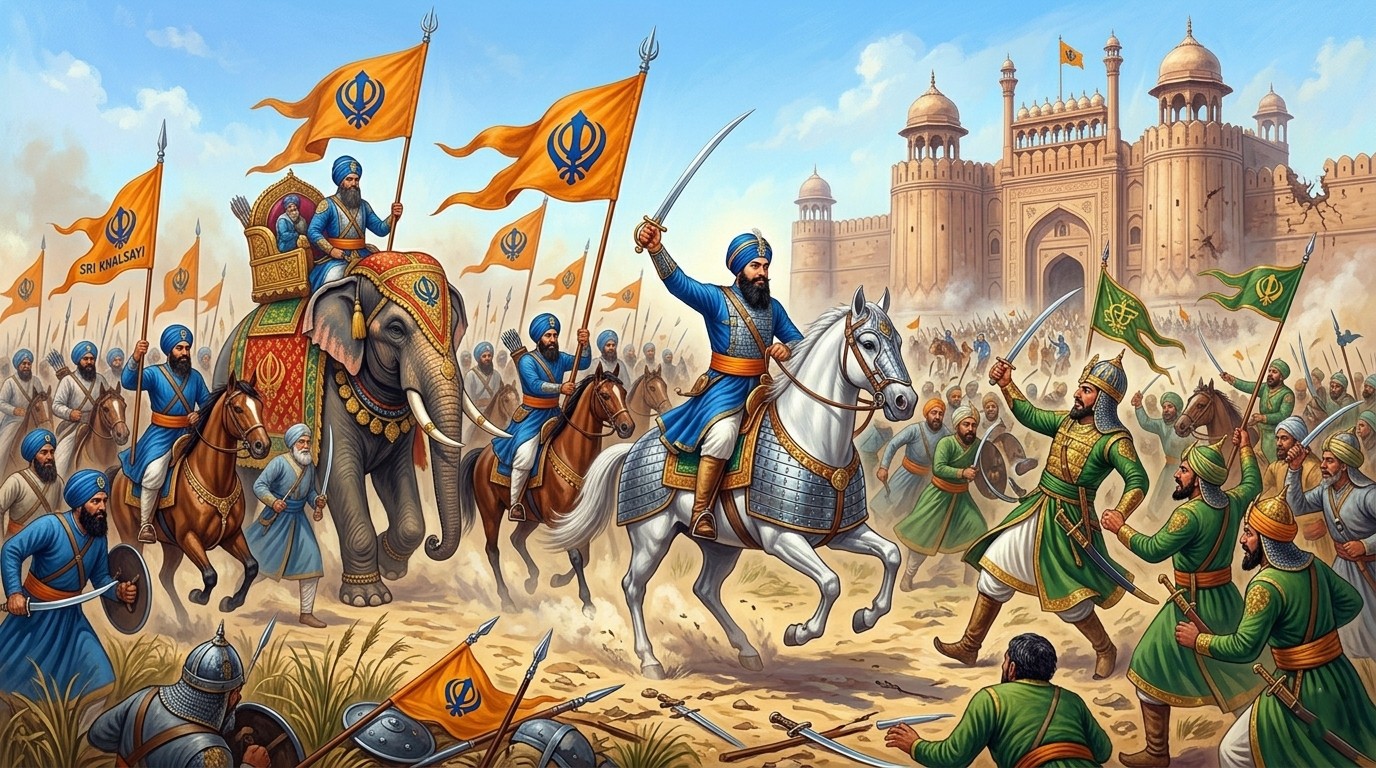
1710 CE: The Battle of Chappar Chiri and the Birth of the First Sovereign Sikh State
The Battle of Chappar Chiri, fought in May 1710, stands among the most decisive and transformative events in Sikh history. More than a military confrontation, it represented the culmination of decades of struggle, sacrifice, persecution, and resistance that had shaped the Sikh community since the martyrdom of Guru Arjan Dev Ji in 1606 and the subsequent militarization of the Panth under Guru Hargobind Sahib Ji. The battle marked the emergence of the Khalsa as a formidable military and political force capable of challenging one of the most powerful empires in the world. Under the leadership of Banda Singh Bahadur, the Sikhs achieved a remarkable victory over the forces of Wazir Khan, the Mughal Governor of Sirhind. This triumph led directly to the capture of Sirhind, the establishment of the first sovereign Sikh state, and the minting of coins in the names of Guru Nanak Dev Ji and Guru Gobind Singh Ji. The events of 1710 demonstrated that the ideals of the Sikh Gurus could be translated into political authority and social transformation, creating a legacy that would influence Sikh history for generations.
As a Sikh historian, it is impossible to view Chappar Chiri merely as a battlefield victory. It was the realization of a vision that had been nurtured through the teachings and sacrifices of the Gurus. The battle carried immense emotional significance because it brought justice against those associated with the execution of the younger Sahibzade, Sahibzada Zorawar Singh Ji and Sahibzada Fateh Singh Ji. At the same time, it signaled the beginning of a new chapter in which the Khalsa moved beyond survival and resistance toward sovereignty and governance. The victory at Chappar Chiri transformed Sikh history and established the foundation upon which future Sikh political institutions would be built.
The Historical Background: From Martyrdom to Resistance
To understand the significance of the Battle of Chappar Chiri, one must first appreciate the historical context that produced it. Throughout the seventeenth century, the Sikh community experienced profound transformations. The execution of Guru Arjan Dev Ji under Mughal authority in 1606 marked the first major martyrdom in Sikh history and encouraged the development of a more assertive approach to self-defense. Guru Hargobind Sahib Ji responded by introducing the doctrine of Miri and Piri, emphasizing the integration of spiritual authority and temporal responsibility.
Subsequent decades witnessed further conflicts between the Sikhs and Mughal authorities. The martyrdom of Guru Tegh Bahadur Ji in 1675 deepened the Sikh commitment to defending religious freedom and resisting oppression. Guru Gobind Singh Ji's creation of the Khalsa in 1699 provided the community with a distinct identity and a disciplined framework for collective action. Yet the years following the creation of the Khalsa were marked by severe hardships, including the sieges of Anandpur Sahib, the martyrdom of the Sahibzade, and the death of Guru Gobind Singh Ji in 1708.
These experiences forged a resilient and determined community. The Sikhs had endured immense suffering, but they had also developed a powerful sense of purpose rooted in faith, justice, and collective responsibility. The Battle of Chappar Chiri emerged from this historical process.
Banda Singh Bahadur and the Guru's Mission
The story of Chappar Chiri cannot be told without understanding the remarkable figure of Banda Singh Bahadur. Originally known as Lachman Dev and later as the ascetic Madho Das Bairagi, he underwent a profound transformation after meeting Guru Gobind Singh Ji at Nanded in 1708. Recognizing his potential, the Guru initiated him into the Khalsa and entrusted him with a mission to confront tyranny and defend the oppressed.
Banda Singh Bahadur embraced this responsibility with extraordinary dedication. Carrying letters from Guru Gobind Singh Ji addressed to Sikh communities throughout northern India, he began organizing military campaigns against Mughal authorities. His early victories, particularly at Samana and other strategic locations, inspired confidence and attracted growing numbers of followers.
What distinguished Banda Singh Bahadur was his ability to combine military leadership with a deep commitment to the ideals of the Gurus. He viewed warfare not as an end in itself but as a means of achieving justice and protecting human dignity. This perspective resonated strongly with the Sikh community and contributed significantly to his success.
The Importance of Sirhind
Among all the targets available to Banda Singh Bahadur, none carried greater symbolic importance than Sirhind. The city occupied a crucial strategic position between Delhi and Lahore and served as an important administrative center within the Mughal Empire. More significantly, Sirhind was governed by Wazir Khan, a figure closely associated in Sikh memory with the execution of the younger Sahibzade.
The martyrdom of Sahibzada Zorawar Singh Ji and Sahibzada Fateh Singh Ji had become one of the most painful episodes in Sikh history. Their refusal to abandon their faith despite their young age inspired generations of Sikhs and deepened the community's commitment to resisting oppression. For many Sikhs, the campaign against Sirhind represented an opportunity to achieve justice for these sacrifices.
Consequently, the struggle against Wazir Khan carried emotional, spiritual, and political dimensions. It was not merely a campaign for territorial conquest but a confrontation with a symbol of persecution and injustice.
The Road to Chappar Chiri
As Banda Singh Bahadur's influence expanded, the Mughal administration became increasingly concerned about the growing strength of the Sikh movement. Wazir Khan recognized the threat posed by the advancing Khalsa forces and began preparing for a major confrontation. Determined to halt the Sikh advance before it reached Sirhind, he assembled a substantial army composed of experienced soldiers and regional allies.
Banda Singh Bahadur, meanwhile, continued gathering support from Sikh communities and sympathetic local populations. His forces consisted of individuals from diverse backgrounds united by faith and a shared commitment to justice. While many lacked the resources and training of professional imperial soldiers, they possessed remarkable motivation and determination.
The stage was thus set for a decisive encounter that would determine the future of the region and the fate of the emerging Sikh movement.
The Battlefield of Chappar Chiri
The battle took place near the village of Chappar Chiri, located close to present-day Mohali in Punjab. The terrain consisted of open plains suitable for large-scale military engagement. Here, the forces of Banda Singh Bahadur and Wazir Khan confronted one another in what would become one of the most important battles in Sikh history.
The opposing armies reflected different military traditions. The Mughal forces possessed greater numbers, extensive experience, and substantial resources. The Sikh army, though comparatively less equipped, was inspired by strong ideological commitment and exceptional leadership.
The battlefield became the arena in which decades of Sikh struggle would culminate. The outcome would determine whether the Khalsa remained a persecuted resistance movement or emerged as a sovereign political force.
The Battle Begins
When the armies met in May 1710, the fighting quickly intensified. The Mughal forces sought to use their numerical superiority and battlefield experience to overwhelm the Sikhs. Wazir Khan expected that the imperial army's resources and organization would prove decisive.
Yet the Khalsa warriors demonstrated extraordinary courage and discipline. Inspired by their faith and motivated by the memory of the Gurus and the Sahibzade, they fought with remarkable determination. Banda Singh Bahadur's leadership played a critical role in maintaining cohesion and directing the Sikh offensive.
The battle soon evolved into a fierce contest of endurance, courage, and tactical skill. Despite facing formidable opposition, the Sikhs refused to yield and continued pressing their attack.
The Death of Wazir Khan
The turning point of the battle came with the death of Wazir Khan. His fall dealt a devastating blow to Mughal morale and disrupted the command structure of the imperial forces. As news of his death spread across the battlefield, confusion and disorder began to undermine the Mughal position.
For the Sikhs, the event carried immense symbolic significance. Wazir Khan had become a powerful symbol of the injustices suffered by the Panth. His defeat represented more than a military success; it signified the triumph of resilience over persecution and justice over oppression.
The collapse of Mughal leadership accelerated the Sikh advance and paved the way for complete victory.
A Decisive Sikh Victory
The Battle of Chappar Chiri ended with a decisive victory for Banda Singh Bahadur and the Khalsa. The Mughal army suffered severe losses, while the Sikhs emerged triumphant despite confronting a more powerful opponent. The victory reverberated throughout northern India and dramatically altered regional political dynamics.
For the Sikh community, the triumph represented vindication after years of hardship and sacrifice. It demonstrated that faith, determination, and collective action could overcome even the most formidable obstacles. The battle also enhanced the prestige of Banda Singh Bahadur and solidified his position as the leading figure in the Sikh struggle.
Most importantly, the victory opened the road to Sirhind and made possible the next stage of Sikh political development.
The Capture of Sirhind
Following their success at Chappar Chiri, Sikh forces advanced toward Sirhind. With Wazir Khan dead and Mughal resistance weakened, the city soon fell under Sikh control. The capture of Sirhind marked one of the most significant achievements in early Sikh history.
The fall of the city carried profound symbolic importance. It represented justice for past persecutions and confirmed the emergence of the Khalsa as a force capable of governing major urban centers. The conquest also provided valuable resources and strategic advantages that strengthened the Sikh position.
For many Sikhs, the capture of Sirhind fulfilled a long-standing aspiration rooted in memory, sacrifice, and faith.
The Establishment of the First Sovereign Sikh State
Perhaps the most enduring consequence of the Battle of Chappar Chiri was the establishment of the first sovereign Sikh state. Under Banda Singh Bahadur's leadership, the Khalsa moved beyond resistance and entered the realm of governance. This development represented a historic milestone in Sikh political evolution.
The new state embodied principles derived from Sikh teachings. Its legitimacy rested not upon dynastic claims or inherited privilege but upon the moral authority of the Gurus and the collective aspirations of the Khalsa. Banda Singh Bahadur sought to create a political order characterized by justice, fairness, and accountability.
Although the state would face immense challenges in subsequent years, its creation demonstrated that Sikh ideals could serve as the foundation for sovereign rule.
The Minting of Sikh Coinage
One of the clearest expressions of sovereignty is the right to issue currency. Recognizing this, Banda Singh Bahadur authorized the minting of coins following the establishment of Khalsa rule. These coins carried extraordinary significance because they were struck not in his own name but in honor of Guru Nanak Dev Ji and Guru Gobind Singh Ji.
This decision reflected the deeply spiritual character of Sikh political authority. Banda did not seek personal glorification. Instead, he emphasized that the source of legitimacy lay in the teachings and mission of the Gurus. The coins proclaimed that Sikh sovereignty derived from spiritual principles rather than individual ambition.
The minting of coinage signaled to both supporters and opponents that a new political reality had emerged in northern India.
Social Reform and Justice
The significance of Banda Singh Bahadur's achievements extended beyond military success. His administration introduced reforms intended to improve the condition of ordinary people, particularly cultivators and peasants. By challenging entrenched systems of privilege, he sought to create a more equitable society.
These reforms reflected core Sikh values concerning equality and human dignity. They demonstrated that political authority could be used to address social injustices rather than merely preserve existing hierarchies.
The emphasis on fairness and empowerment helped distinguish the emerging Sikh state from many contemporary political systems and contributed to its appeal among local populations.
The Legacy of Chappar Chiri
The Battle of Chappar Chiri occupies a unique place in Sikh historical memory. It represents the moment when the sacrifices of previous generations produced tangible political results. The battle demonstrated that the Khalsa could defeat powerful opponents, establish sovereignty, and implement its vision of justice.
The legacy of Chappar Chiri extended far beyond the lifetime of Banda Singh Bahadur. Future Sikh leaders drew inspiration from his achievements, and the ideals embodied by the first Sikh state continued to influence political developments throughout the eighteenth century.
Even after the eventual fall of Banda Singh Bahadur's regime, the memory of Chappar Chiri remained a powerful source of inspiration. It provided proof that the Sikh community could survive persecution, challenge empire, and build institutions grounded in its values.
Conclusion
The Battle of Chappar Chiri in 1710 was far more than a military engagement. It was a defining moment in Sikh history that transformed the Khalsa from a resistance movement into a sovereign political force. Under the leadership of Banda Singh Bahadur, the Sikhs achieved a decisive victory over Wazir Khan, captured Sirhind, established the first Sikh state, and minted coins honoring Guru Nanak Dev Ji and Guru Gobind Singh Ji. The battle embodied decades of sacrifice, resilience, and commitment to justice. It demonstrated the practical power of Sikh ideals and laid the foundation for future expressions of Sikh sovereignty. More than three centuries later, Chappar Chiri continues to be remembered as a symbol of courage, faith, and the enduring pursuit of justice.
Frequently Asked Questions (FAQ)
1. What was the Battle of Chappar Chiri?
The Battle of Chappar Chiri was a major military engagement fought in 1710 between the Khalsa army led by Banda Singh Bahadur and Mughal forces commanded by Wazir Khan.
2. Why is the battle important in Sikh history?
It led to the defeat of Wazir Khan, the capture of Sirhind, and the establishment of the first sovereign Sikh state.
3. Who was Banda Singh Bahadur?
Banda Singh Bahadur was a Sikh military leader commissioned by Guru Gobind Singh Ji to challenge oppression and lead the Khalsa.
4. Who was Wazir Khan?
Wazir Khan was the Mughal Governor of Sirhind and is associated in Sikh tradition with the execution of the younger Sahibzade.
5. When was the Battle of Chappar Chiri fought?
The battle was fought in May 1710.
6. What happened after the Sikh victory?
The Sikhs captured Sirhind and established the first Sikh political administration under Banda Singh Bahadur.
7. Why did Banda Singh Bahadur mint coins?
The coins symbolized Sikh sovereignty and were issued in honor of Guru Nanak Dev Ji and Guru Gobind Singh Ji.
8. Did the battle have symbolic significance?
Yes. Many Sikhs viewed it as an act of justice connected to the martyrdom of the younger Sahibzade.
9. What reforms were introduced after the victory?
Banda Singh Bahadur implemented social and land reforms aimed at improving conditions for cultivators and reducing exploitation.
10. What is the legacy of Chappar Chiri today?
The battle is remembered as a milestone in the rise of Sikh sovereignty and a powerful symbol of courage, justice, and resilience.