Historical Turning Points · Empire & Struggle
1715–1716 Siege of Gurdas Nangal & Martyrdom
After an eight-month-long Mughal siege, Banda Singh Bahadur was captured and brought to Delhi. He, alongside hundreds of his soldiers, refused to convert to Islam and was brutally tortured and executed in June 1716
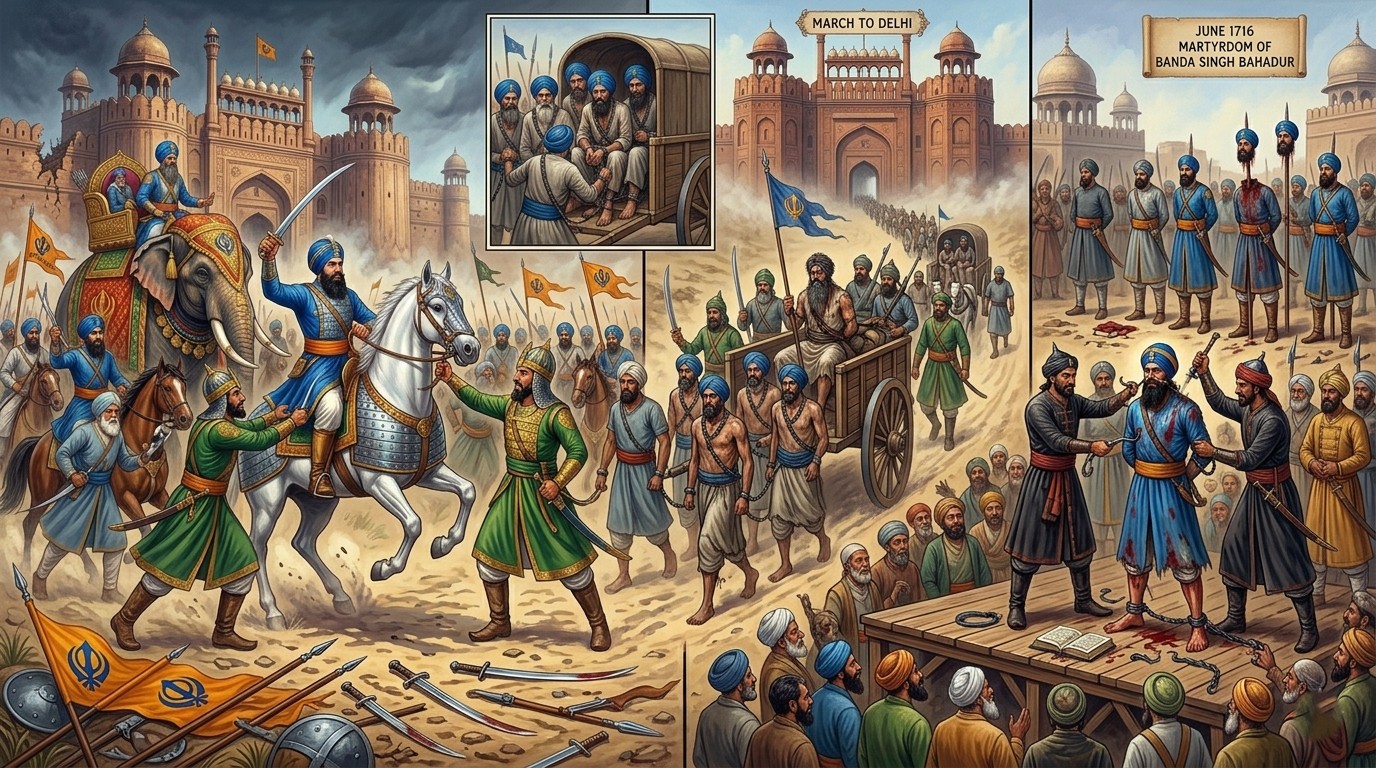
1715–1716 CE: The Siege of Gurdas Nangal and the Martyrdom of Banda Singh Bahadur
The years 1715–1716 occupy a profoundly significant place in Sikh history, representing one of the most dramatic and emotionally powerful chapters in the story of the Khalsa. The Siege of Gurdas Nangal and the subsequent martyrdom of Banda Singh Bahadur marked the culmination of nearly a decade of revolutionary struggle against Mughal authority. Following his remarkable victories, including the capture of Sirhind and the establishment of the first sovereign Sikh state, Banda Singh Bahadur became the foremost target of the Mughal Empire. Determined to crush the growing influence of the Khalsa, the Mughal administration launched massive military campaigns to eliminate Sikh resistance once and for all. What followed was an eight-month siege characterized by starvation, extraordinary endurance, unwavering faith, and ultimately one of the most celebrated martyrdoms in Sikh history. Although the siege ended with the capture of Banda Singh Bahadur and hundreds of his followers, the spirit of the Khalsa emerged stronger than ever. The events of 1715–1716 demonstrated that while armies could conquer territories and rulers could execute leaders, they could not destroy a community whose identity had become rooted in sacrifice, justice, and spiritual conviction.
As a Sikh historian, one cannot view the Siege of Gurdas Nangal merely as a military defeat. In many ways, it became a moral and spiritual victory that transformed Banda Singh Bahadur and his companions into enduring symbols of courage and faith. Their refusal to abandon Sikh principles despite unimaginable suffering elevated them into the ranks of the great martyrs of Sikh history. The events that unfolded during these months reinforced a tradition of resilience that would sustain the Sikh community through decades of persecution and ultimately contribute to the rise of Sikh political power later in the eighteenth century.
The Rise of Banda Singh Bahadur and the Mughal Response
To understand the significance of Gurdas Nangal, it is essential to examine the remarkable rise of Banda Singh Bahadur in the years following his meeting with Guru Gobind Singh Ji in 1708. Commissioned by the Tenth Guru to challenge oppression and defend the downtrodden, Banda Singh Bahadur launched a series of successful military campaigns that dramatically altered the political landscape of northern India. His victories at Samana, Sadhaura, Chappar Chiri, and Sirhind established the Khalsa as a major military force and demonstrated that Mughal authority could be successfully challenged.
The capture of Sirhind in 1710 represented a particularly significant turning point. The city held immense symbolic importance for Sikhs because its governor, Wazir Khan, was associated with the execution of the younger Sahibzade, Sahibzada Zorawar Singh Ji and Sahibzada Fateh Singh Ji. The victory not only delivered justice in the eyes of many Sikhs but also enabled Banda Singh Bahadur to establish the first Sikh state. His administration introduced reforms benefiting cultivators and peasants, redistributed land, and minted coins in the names of Guru Nanak Dev Ji and Guru Gobind Singh Ji.
These achievements alarmed Mughal authorities. The emergence of an independent Sikh political order threatened imperial control and inspired resistance among populations dissatisfied with existing power structures. Consequently, the Mughal Empire resolved to eliminate Banda Singh Bahadur and destroy the movement he had helped create.
The Mughal Campaign Against the Khalsa
Following the initial successes of Banda Singh Bahadur, Mughal forces intensified their efforts to suppress Sikh resistance. Large armies were assembled under experienced commanders, and extensive resources were dedicated to tracking and defeating the Khalsa. The Mughal administration understood that the challenge posed by Banda extended beyond military considerations. His movement carried social, political, and ideological implications that threatened established authority.
Throughout these campaigns, the Sikhs faced overwhelming odds. The empire possessed greater manpower, financial resources, and logistical capabilities. Nevertheless, Banda Singh Bahadur and his followers continued to resist through mobility, determination, and a deep commitment to their faith.
For several years, Sikh forces managed to evade complete destruction despite relentless pressure. However, by 1715, Mughal operations had significantly narrowed the options available to Banda and his companions. The stage was set for a final confrontation.
Retreat to Gurdas Nangal
As Mughal pressure intensified, Banda Singh Bahadur and a substantial group of Sikhs sought refuge at Gurdas Nangal, near Gurdaspur in Punjab. The location offered certain defensive advantages and became the center of the Khalsa's final organized resistance during this phase of the struggle.
Gurdas Nangal was not a grand fortress capable of withstanding prolonged assault indefinitely. Rather, it became a refuge where Banda and his followers prepared to face overwhelming opposition. The Sikhs understood the dangers they confronted, yet they remained committed to their cause.
The decision to make a stand at Gurdas Nangal reflected both strategic necessity and spiritual conviction. The defenders were determined to preserve their honor and principles regardless of the outcome.
The Beginning of the Siege
The Mughal army soon surrounded Gurdas Nangal, initiating a siege that would last approximately eight months. Imperial forces constructed extensive fortifications and blockades designed to prevent the movement of people, supplies, and information. Their objective was straightforward: starve the defenders into submission.
Unlike a battle characterized by rapid maneuvers and dramatic charges, a siege tests endurance, discipline, and psychological resilience. For the Sikhs inside Gurdas Nangal, every day brought new hardships. Food supplies became increasingly scarce, access to fresh resources disappeared, and living conditions deteriorated steadily.
Yet despite these challenges, the defenders maintained remarkable morale. Their faith provided strength during circumstances that would have broken many other communities.
Life Inside the Besieged Enclosure
As the months passed, conditions within Gurdas Nangal became increasingly desperate. Food shortages intensified, and hunger emerged as a constant companion. Historical accounts describe the severe deprivation endured by the defenders as they struggled to survive under conditions of near-total isolation.
Despite the suffering, the Sikhs continued their religious practices and maintained a strong sense of communal solidarity. Prayer, remembrance of the Divine, and commitment to the teachings of the Gurus helped sustain morale during the darkest moments of the siege.
The experience revealed the extraordinary resilience that had become characteristic of the Khalsa. The defenders were not merely fighting for physical survival; they were preserving a way of life grounded in faith, justice, and collective responsibility.
The Spiritual Dimension of Resistance
The Siege of Gurdas Nangal was not solely a military event. It was also a profound spiritual test. The defenders understood that their struggle formed part of a larger historical narrative shaped by the sacrifices of Guru Arjan Dev Ji, Guru Tegh Bahadur Ji, the Sahibzade, and countless other martyrs.
This awareness strengthened their resolve. They viewed suffering not as evidence of failure but as an opportunity to demonstrate fidelity to Sikh principles. Such perspectives transformed the siege from a simple military confrontation into a powerful expression of religious commitment.
For the Sikhs, victory was not defined solely by survival or territorial control. It was measured by the ability to remain true to one's faith regardless of circumstances.
The Collapse of Resistance
Eventually, the relentless pressure of the siege achieved its intended effect. Starvation and exhaustion weakened the defenders to the point where continued resistance became impossible. By late 1715, Mughal forces succeeded in capturing Banda Singh Bahadur and the remaining Sikhs.
The fall of Gurdas Nangal marked the end of a remarkable chapter in early Sikh military history. Yet even in defeat, the conduct of the defenders inspired admiration and respect. They had endured months of suffering without abandoning their principles or surrendering their faith.
The capture of Banda Singh Bahadur represented a significant achievement for the Mughal authorities, but they soon discovered that military victory alone could not extinguish the spirit of the Khalsa.
The Journey to Delhi
Following their capture, Banda Singh Bahadur and hundreds of Sikh prisoners were transported to Delhi. The journey itself served as a public display intended to demonstrate imperial power and discourage future resistance.
Prisoners were paraded through towns and cities under heavy guard. Mughal authorities hoped that such spectacles would undermine Sikh morale and reinforce the consequences of rebellion. Instead, the courage displayed by the captives often inspired observers and strengthened the reputation of the Sikh community.
Throughout the journey, many prisoners remained steadfast in their beliefs despite knowing that death likely awaited them.
Imprisonment and Pressure to Convert
Upon reaching Delhi, Banda Singh Bahadur and his companions were imprisoned. Mughal authorities offered opportunities to save their lives by renouncing Sikhism and accepting Islam. Such offers reflected a common practice in which conversion could serve as an alternative to execution.
For the Sikh prisoners, the choice was clear. Their faith was not a convenience to be abandoned under pressure but a fundamental aspect of their identity. One after another, they refused offers of clemency linked to conversion.
This collective refusal became one of the defining features of the entire episode. The prisoners demonstrated that spiritual conviction could remain unshaken even in the face of certain death.
The Mass Executions of Sikh Prisoners
Historical accounts describe the systematic execution of large numbers of Sikh prisoners in Delhi. Day after day, groups of Sikhs were brought forward and given opportunities to convert. Those who refused were executed.
Observers were often struck by the calmness and courage displayed by the condemned. Rather than pleading for mercy, many accepted death with remarkable composure. Their conduct reflected the ideals of the Khalsa and the long tradition of martyrdom established by earlier Sikh leaders.
The executions were intended to intimidate the Sikh community. Instead, they created powerful examples of faith and sacrifice that would inspire future generations.
The Martyrdom of Banda Singh Bahadur
In June 1716, Banda Singh Bahadur himself faced execution. Historical narratives describe the extreme brutality associated with his final days. Mughal authorities sought not only to kill him but also to break his spirit and compel him to abandon his faith.
Despite enduring unimaginable suffering, Banda Singh Bahadur remained steadfast. He refused to renounce Sikh principles or seek personal advantage at the expense of his beliefs. His conduct during captivity reflected the same courage and commitment that had characterized his military campaigns.
The martyrdom of Banda Singh Bahadur transformed him from a military commander into a permanent symbol of Sikh resilience. His death became one of the defining moments in the history of the Panth.
The Impact on the Sikh Community
The execution of Banda Singh Bahadur and his companions represented a devastating loss for the Sikh community. Many experienced grief, shock, and uncertainty regarding the future. Yet the impact of these events proved very different from what Mughal authorities intended.
Rather than destroying the Sikh movement, the martyrdoms strengthened it. The courage displayed by the prisoners became part of Sikh collective memory and reinforced the community's commitment to its values. Stories of their sacrifices circulated widely, inspiring future generations to continue the struggle for justice and freedom.
The events of 1715–1716 demonstrated that persecution could weaken organizations but often strengthened convictions.
The Rise of the Sikh Misls
Although the death of Banda Singh Bahadur temporarily disrupted organized Sikh political activity, the ideals he championed survived. Over the following decades, Sikh groups reorganized and adapted to changing circumstances.
The emergence of the Sikh Misls in the eighteenth century reflected the enduring vitality of the Khalsa. These confederacies carried forward traditions of resistance, self-governance, and military organization that had been strengthened during Banda's campaigns.
Ultimately, the foundations laid by Banda Singh Bahadur contributed to the rise of Sikh sovereignty under Maharaja Ranjit Singh in the nineteenth century.
The Legacy of Gurdas Nangal
The Siege of Gurdas Nangal occupies a unique place in Sikh historical consciousness. It symbolizes endurance under extreme adversity and demonstrates the power of faith to sustain individuals through unimaginable hardships. The defenders did not achieve military victory, yet their steadfastness ensured that their struggle would be remembered long after the fall of the Mughal Empire.
The events of 1715–1716 also highlight a recurring theme in Sikh history: the transformation of suffering into strength. Time and again, persecution produced not submission but renewed determination. The martyrs of Gurdas Nangal became part of a tradition that continues to inspire Sikhs throughout the world.
Conclusion
The Siege of Gurdas Nangal and the martyrdom of Banda Singh Bahadur in 1715–1716 represent one of the most powerful chapters in Sikh history. Following years of extraordinary achievements, including the establishment of the first sovereign Sikh state, Banda Singh Bahadur and his followers faced overwhelming military pressure from the Mughal Empire. Their eight-month resistance at Gurdas Nangal demonstrated exceptional courage, discipline, and faith. Even after capture, they refused opportunities to save themselves through conversion, choosing instead to remain loyal to their beliefs. The executions carried out in Delhi in 1716 were intended to destroy the Sikh movement but instead strengthened its moral foundation. The sacrifices of Banda Singh Bahadur and his companions became enduring symbols of resilience, inspiring future generations and contributing to the eventual rise of Sikh political power. Their story remains a testament to the enduring strength of conviction, faith, and the pursuit of justice.
Frequently Asked Questions (FAQ)
1. What was the Siege of Gurdas Nangal?
The Siege of Gurdas Nangal was an eight-month Mughal siege of Banda Singh Bahadur and his Sikh followers between 1715 and 1716.
2. Where was Gurdas Nangal located?
Gurdas Nangal was located near Gurdaspur in Punjab.
3. Why did the Mughal Empire target Banda Singh Bahadur?
He had established the first Sikh state and successfully challenged Mughal authority across parts of northern India.
4. How long did the siege last?
The siege lasted approximately eight months, during which the defenders suffered severe starvation and hardship.
5. What happened after the siege ended?
Banda Singh Bahadur and hundreds of Sikhs were captured and taken to Delhi as prisoners.
6. Were the prisoners offered a chance to save their lives?
Historical accounts state that many prisoners were offered clemency if they converted to Islam, but they refused.
7. When was Banda Singh Bahadur executed?
He was executed in June 1716 after enduring imprisonment and torture.
8. Why is Banda Singh Bahadur considered a martyr?
He remained steadfast in his Sikh faith despite extreme suffering and chose death rather than renounce his beliefs.
9. Did the executions end the Sikh movement?
No. The martyrdoms strengthened Sikh identity and inspired future generations to continue the struggle for justice and freedom.
10. What is the historical legacy of the Siege of Gurdas Nangal?
It symbolizes resilience, faith, sacrifice, and the enduring spirit of the Khalsa in the face of overwhelming adversity.