Historical Turning Points · Empire & Struggle
1748 Formation of the Dal Khalsa
Under Nawab Kapur Singh and Jassa Singh Ahluwalia, the fragmented warrior bands merged into a unified standing army. This military coalition paved the way for the 12 Sovereign Misls (confederacies).
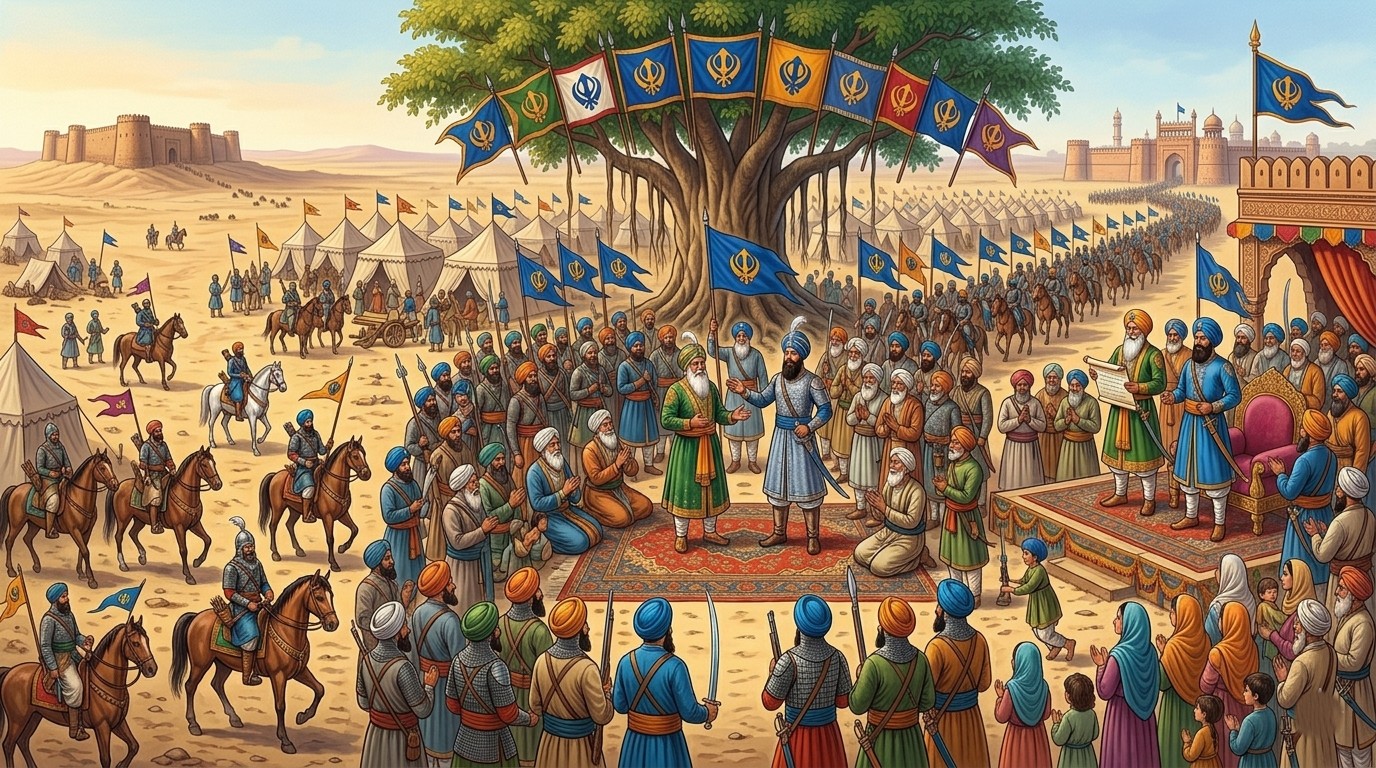
1748 CE: Formation of the Dal Khalsa – The Unification of Sikh Power and the Birth of the Misls
The year 1748 stands as one of the most transformative moments in Sikh history. It marked the formal creation of the Dal Khalsa, a unified military and political organization that brought together previously scattered Sikh warrior bands into a coordinated force capable of confronting some of the most powerful empires of the age. Emerging from decades of persecution, massacres, and relentless attempts at extermination, the Sikhs demonstrated an extraordinary capacity for adaptation and collective action. Under the leadership of Nawab Kapur Singh and the rising influence of Jassa Singh Ahluwalia, the Khalsa Panth evolved from a loosely connected network of resistance groups into a structured military confederation. The formation of the Dal Khalsa not only enhanced Sikh military effectiveness but also laid the foundation for the development of the twelve sovereign Misls, which would eventually dominate Punjab and pave the way for the establishment of the Sikh Empire under Maharaja Ranjit Singh. To understand the significance of 1748 is to understand how a persecuted community transformed itself into a formidable political and military force without abandoning the spiritual principles that defined its identity.
As a Sikh historian, it is impossible to overstate the importance of the Dal Khalsa in the evolution of Sikh sovereignty. The institution represented far more than a military alliance. It embodied the principles of collective leadership, shared responsibility, religious commitment, and democratic consultation that had developed within the Sikh tradition since the time of Guru Nanak Dev Ji. The creation of the Dal Khalsa was not merely a reaction to external threats; it was the culmination of decades of spiritual and organizational development. It reflected the ability of the Khalsa to transform suffering into strength and persecution into unity. The events of 1748 reveal how Sikh institutions evolved to meet historical challenges while remaining rooted in the teachings of the Gurus.
The Legacy of Persecution Before 1748
The formation of the Dal Khalsa cannot be understood without examining the difficult circumstances that preceded it. Following the martyrdom of Banda Singh Bahadur in 1716, the Sikh community entered one of the most challenging periods in its history. Mughal authorities viewed the Sikhs as a significant threat and launched repeated campaigns to suppress them. Rewards were offered for the capture or killing of Sikhs, public executions became common, and many Sikh families were forced to seek refuge in forests, deserts, hills, and remote villages.
The persecution reached devastating levels during events such as the Chhota Ghallughara of 1746, when thousands of Sikhs were killed in the forests and marshes of Kahnuwan. Yet despite immense losses, the community survived. The Khalsa adapted by developing decentralized networks of resistance. Small bands of mounted warriors operated across Punjab, protecting vulnerable populations, maintaining communication between scattered Sikh groups, and preserving religious traditions.
These years of hardship taught the Sikhs valuable lessons about survival, mobility, and cooperation. Although fragmentation offered certain advantages in avoiding detection, it also limited the ability of Sikh forces to undertake large-scale coordinated operations. By the late 1740s, many leaders recognized the need for greater unity and organizational structure.
Nawab Kapur Singh: Architect of Sikh Organization
Among the most influential figures in this period was Nawab Kapur Singh, one of the greatest organizers in Sikh history. His leadership played a crucial role in preserving and strengthening the Sikh community during decades of adversity. Recognizing the importance of discipline and coordination, he worked tirelessly to develop structures that could unite diverse Sikh groups while respecting their autonomy.
Kapur Singh possessed a unique combination of military skill, political wisdom, and spiritual commitment. He understood that the survival of the Panth required more than battlefield courage. It required institutions capable of sustaining collective action across generations. His efforts to organize Sikh forces laid the groundwork for the eventual formation of the Dal Khalsa.
His leadership also reflected a fundamental Sikh principle: authority should serve the community rather than dominate it. The organizational structures he promoted emphasized consultation, cooperation, and shared responsibility rather than centralized autocratic control.
The Rise of Jassa Singh Ahluwalia
Alongside Nawab Kapur Singh emerged another towering figure in Sikh history: Jassa Singh Ahluwalia. Destined to become one of the most respected leaders of the eighteenth century, Jassa Singh combined military excellence with political vision. His courage on the battlefield earned widespread admiration, while his commitment to Sikh ideals made him a unifying presence within the Panth.
Jassa Singh represented a new generation of Sikh leadership shaped by both persecution and resilience. He inherited the legacy of earlier martyrs and warriors while contributing fresh energy to the movement. His involvement in the formation of the Dal Khalsa helped ensure that the institution would possess both military effectiveness and moral legitimacy.
Over time, Jassa Singh Ahluwalia would become one of the most prominent leaders of the Sikh confederacies, but his role in 1748 remains among his most important contributions.
The Gathering at Amritsar
The city of Amritsar occupied a central place in Sikh religious and political life. Even during periods of persecution, Sikhs sought opportunities to gather at the sacred city, particularly during major religious festivals. These assemblies provided occasions for worship, consultation, and collective decision-making.
In 1748, a significant gathering took place at Amritsar during the festival of Vaisakhi. Leaders from various Sikh groups assembled to discuss the challenges facing the community and consider strategies for the future. The meeting reflected the long-standing Sikh tradition of collective deliberation known as the Sarbat Khalsa.
The discussions held during this gathering would lead to one of the most consequential decisions in Sikh history: the formal creation of the Dal Khalsa.
The Creation of the Dal Khalsa
The Dal Khalsa emerged as a unified military organization designed to coordinate the activities of previously independent Sikh warrior bands. Rather than eliminating local leadership, the new structure provided a framework through which diverse groups could cooperate effectively while retaining their individual identities.
The term "Dal" referred to an armed force or army, while "Khalsa" emphasized the sacred collective established by Guru Gobind Singh Ji in 1699. Together, the name reflected the institution's dual character as both a military and spiritual organization.
The creation of the Dal Khalsa represented a major step forward in Sikh state-building. It transformed scattered resistance into organized power and demonstrated the capacity of the Sikh community to develop sophisticated institutions under extremely difficult circumstances.
The Division into Budha Dal and Taruna Dal
One of the key organizational innovations associated with the Dal Khalsa was its division into two major components: the Budha Dal and the Taruna Dal. This arrangement reflected practical considerations as well as respect for experience and youth.
The Budha Dal, or Elder Army, consisted largely of experienced veterans responsible for safeguarding religious institutions, preserving traditions, and providing guidance. Their wisdom and knowledge made them invaluable custodians of Sikh heritage.
The Taruna Dal, or Young Army, consisted primarily of younger warriors who undertook active military operations. Their mobility, energy, and fighting capabilities enabled the Sikhs to respond effectively to external threats. Together, the two divisions created a balanced structure that combined experience with dynamism.
The Importance of Collective Leadership
One of the most remarkable features of the Dal Khalsa was its commitment to collective leadership. Unlike many contemporary political systems that concentrated authority in a single ruler, Sikh institutions emphasized consultation and shared decision-making.
Major decisions were often discussed collectively, and leaders derived legitimacy from the confidence of the community rather than hereditary privilege alone. This approach reflected principles established by the Gurus and reinforced the sense of collective ownership within the Panth.
The emphasis on collective leadership helped prevent internal divisions and strengthened unity during periods of crisis.
Military Transformation and Strategic Innovation
The formation of the Dal Khalsa significantly enhanced Sikh military capabilities. Coordinated planning, improved communication, and greater resource sharing allowed Sikh forces to operate more effectively across Punjab. The new structure facilitated large-scale campaigns while preserving the flexibility that had enabled the Sikhs to survive years of persecution.
Sikh commanders developed innovative tactics that emphasized mobility, intelligence gathering, rapid movement, and strategic adaptation. These methods proved highly effective against larger but less flexible opponents. The experience gained through years of resistance informed a military culture characterized by discipline, courage, and initiative.
The Dal Khalsa thus became not only a symbol of unity but also a highly effective instrument of military power.
The Emergence of the Twelve Misls
Perhaps the most significant long-term consequence of the Dal Khalsa was the emergence of the twelve Misls. These confederacies represented semi-autonomous political and military units that operated within a broader framework of Sikh cooperation.
The Misls included prominent groups such as the Ahluwalia, Bhangi, Ramgarhia, Sukerchakia, Kanheya, Nakai, and others. Each developed its own leadership, territory, and military resources while maintaining connections to the larger Sikh community.
This arrangement combined local autonomy with collective identity. It enabled the Sikhs to expand their influence across Punjab while avoiding excessive centralization.
The Role of the Sarbat Khalsa
The Sarbat Khalsa remained a crucial institution even after the formation of the Dal Khalsa and the Misls. Representatives from across the Sikh community gathered periodically at Amritsar to discuss major issues and adopt resolutions known as Gurmatas.
These assemblies reinforced unity and provided mechanisms for resolving disputes. They demonstrated that military power remained accountable to collective religious authority.
The relationship between the Dal Khalsa, the Misls, and the Sarbat Khalsa created a unique political culture that blended spiritual values with practical governance.
Resistance Against External Threats
The strengthened organization provided by the Dal Khalsa proved invaluable in confronting external threats. During the mid-eighteenth century, Punjab faced repeated invasions by Ahmad Shah Durrani and other powerful forces. The Sikhs responded with increasing confidence and effectiveness.
Although they sometimes suffered setbacks, their ability to coordinate actions across multiple regions enhanced their resilience. The Dal Khalsa enabled the Sikhs to survive challenges that might otherwise have overwhelmed a fragmented community.
The institution therefore played a critical role in preserving Sikh autonomy during a period of intense instability.
The Path Toward Sovereignty
The creation of the Dal Khalsa marked a turning point in the journey toward Sikh sovereignty. What began as an effort to improve coordination gradually evolved into a broader political transformation. The Misls expanded their influence, established administrative systems, collected revenue, and exercised authority across substantial territories.
Over time, these developments created the conditions necessary for political unification. The eventual rise of Maharaja Ranjit Singh and the establishment of the Sikh Empire owed much to the foundations laid in 1748.
The Dal Khalsa demonstrated that a persecuted religious community could develop the institutions necessary for self-government while remaining faithful to its core values.
The Historical Legacy of the Dal Khalsa
The significance of the Dal Khalsa extends far beyond military history. It represents one of the most successful examples of community organization in South Asian history. The institution enabled the Sikhs to preserve their identity, defend their interests, and create the foundations for future political achievements.
Its legacy can be seen in the continued emphasis on collective decision-making, community service, and shared responsibility within Sikh institutions. The principles that guided the Dal Khalsa remain relevant because they reflect enduring values of unity, resilience, and democratic participation.
The story of 1748 reminds us that effective institutions often emerge from adversity. The Dal Khalsa transformed suffering into strength and fragmentation into cooperation, ensuring the survival and eventual flourishing of the Sikh community.
Conclusion
The formation of the Dal Khalsa in 1748 stands as one of the most important milestones in Sikh history. Under the visionary leadership of Nawab Kapur Singh and Jassa Singh Ahluwalia, the scattered Sikh warrior bands united into a coordinated military and political organization capable of confronting powerful adversaries. This transformation emerged from decades of persecution and reflected the remarkable resilience of the Khalsa. Through innovations such as the Budha Dal, Taruna Dal, collective leadership structures, and the development of the twelve Misls, the Dal Khalsa laid the foundations for Sikh sovereignty across Punjab. More than a military alliance, it represented the institutional maturity of the Sikh Panth and demonstrated how spiritual principles could guide political and military organization. Its legacy ultimately contributed to the rise of the Sikh Empire and remains one of the defining achievements of eighteenth-century Sikh history.
Frequently Asked Questions (FAQ)
1. What was the Dal Khalsa?
The Dal Khalsa was a unified Sikh military organization established in 1748 to coordinate Sikh forces across Punjab.
2. Who played a major role in its formation?
Nawab Kapur Singh and Jassa Singh Ahluwalia were among the key leaders associated with its creation.
3. Why was the Dal Khalsa formed?
It was formed to unite fragmented Sikh warrior bands and improve coordination against external threats.
4. Where was the decision made to create the Dal Khalsa?
The decision emerged from deliberations held at Amritsar during a major Sikh gathering.
5. What were the Budha Dal and Taruna Dal?
They were the two major divisions of the Dal Khalsa, consisting respectively of experienced veterans and younger warriors.
6. What were the Misls?
The Misls were twelve major Sikh confederacies that emerged from the organizational framework created by the Dal Khalsa.
7. Who was Jassa Singh Ahluwalia?
He was a prominent Sikh leader, military commander, and later one of the most influential figures among the Sikh Misls.
8. How did the Dal Khalsa strengthen the Sikh community?
It improved military coordination, fostered unity, enhanced political organization, and strengthened collective identity.
9. Did the Dal Khalsa lead directly to the Sikh Empire?
While not directly creating the Empire, it established the institutions and political structures that made later unification possible.
10. Why is the formation of the Dal Khalsa historically significant?
It transformed the Sikhs from scattered resistance groups into a powerful confederated force that ultimately shaped the future of Punjab.