Historical Turning Points · Empire & Struggle
1762 Battle of Pippli Sahib & Rebuilding
Despite the massacre, the Dal Khalsa retaliated months later, defeating Abdali’s forces, liberating Amritsar, and rebuilding the defiled Harimandir Sahib.
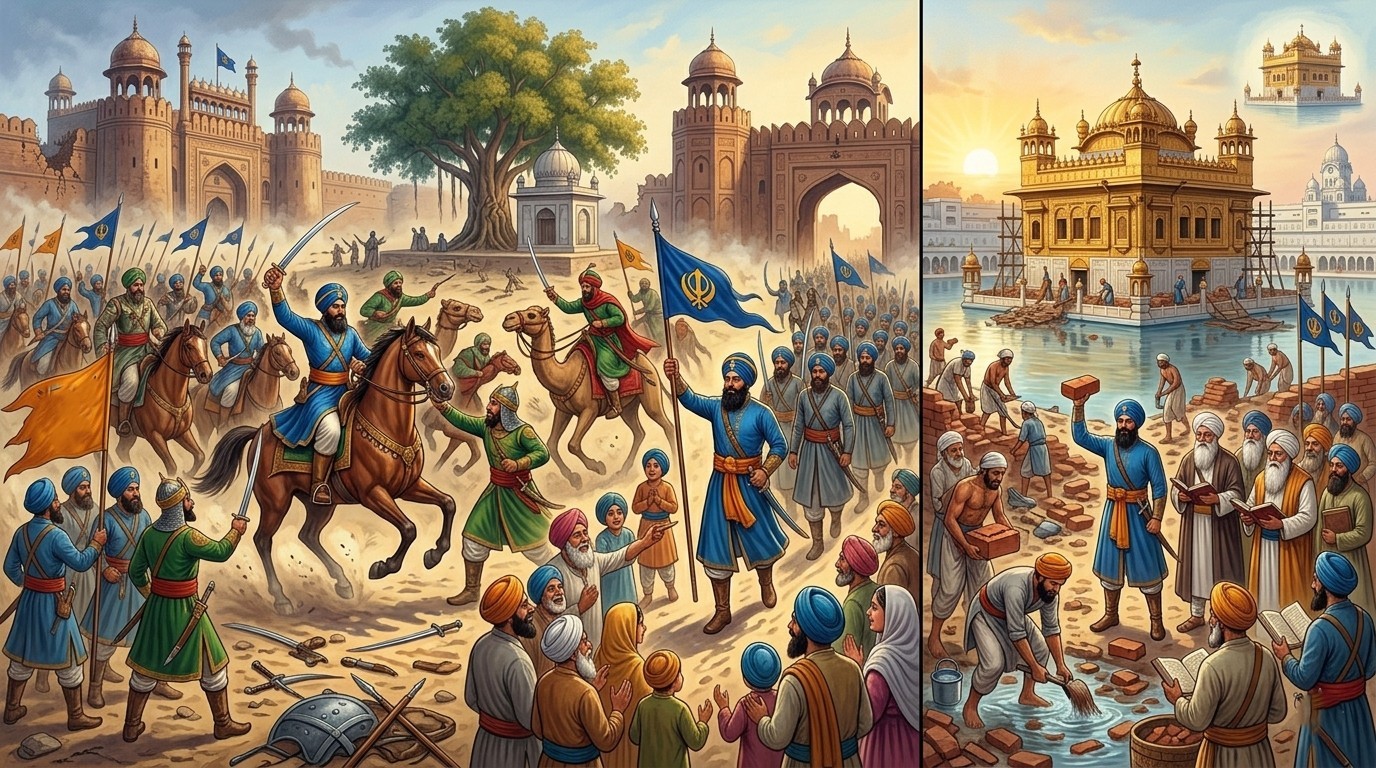
1762 CE: Battle of Pippli Sahib and the Rebuilding of the Harimandir Sahib – The Sikh Resurrection After Catastrophe
The year 1762 occupies a unique and powerful place in Sikh history. It was a year marked not only by unimaginable tragedy but also by extraordinary resilience. Just months after the devastating Vadda Ghallughara, or Great Holocaust, in which tens of thousands of Sikhs were killed by the forces of Ahmad Shah Abdali near Malerkotla, the Sikh nation demonstrated one of the most remarkable recoveries in military and spiritual history. While many observers expected the Khalsa to collapse under the weight of such catastrophic losses, the exact opposite occurred. The Sikhs regrouped, reorganized, and launched a determined campaign of resistance that culminated in the Battle of Pippli Sahib. Their success in confronting Abdali's forces, liberating Amritsar, and rebuilding the desecrated Harimandir Sahib became a defining symbol of Sikh endurance. This episode revealed a fundamental truth about the Sikh Panth: physical destruction could not extinguish a community whose foundations rested upon faith, collective sacrifice, and an unwavering commitment to justice.
As a Sikh historian, one encounters many examples of courage throughout Sikh history, yet the events surrounding the Battle of Pippli Sahib stand apart because they demonstrate the remarkable ability of a people to transform grief into strength. The Vadda Ghallughara had inflicted wounds so severe that many contemporary powers would have expected the Sikhs to disappear as a political force. Entire families had been wiped out, communities shattered, and thousands of experienced warriors lost. Yet within a matter of months, the Khalsa was once again taking the initiative on the battlefield. The rebuilding of the Harimandir Sahib, which had been desecrated by Abdali's forces, further symbolized the Sikh refusal to allow violence to define their future. Instead, they chose renewal, reconstruction, and resistance.
The Shadow of the Vadda Ghallughara
The events leading to the Battle of Pippli Sahib cannot be understood without first appreciating the immense trauma of the Vadda Ghallughara. In February 1762, Ahmad Shah Abdali launched a devastating attack against a large moving Sikh caravan near Malerkotla. The Sikhs were accompanied by women, children, elders, and non-combatants, making the community particularly vulnerable. The resulting massacre claimed the lives of an estimated 20,000 to 35,000 Sikhs in a single day.
The scale of the tragedy was unprecedented. Entire villages lost generations of families. Countless children were orphaned. Many experienced leaders and warriors perished while defending the vulnerable. The massacre represented one of the greatest human catastrophes in Sikh history and left deep emotional scars across Punjab.
Yet what makes this event historically remarkable is not merely the suffering endured but the response that followed. Rather than surrendering to despair, the Sikhs interpreted the tragedy through the lens of their spiritual tradition. The teachings of the Gurus emphasized perseverance, faith, and the defense of righteousness even under the most difficult circumstances. These principles provided the foundation for recovery.
Ahmad Shah Abdali's Campaign Against Sikh Institutions
Following the massacre, Ahmad Shah Abdali sought to consolidate his victory. His objective extended beyond military success. He aimed to undermine the institutions that sustained Sikh identity and unity. Among the most significant targets was the Harimandir Sahib in Amritsar, the spiritual center of the Sikh world.
Abdali understood that the Harimandir Sahib represented far more than a religious structure. It was a symbol of Sikh sovereignty, collective memory, and spiritual authority. By attacking and desecrating the shrine, he hoped to weaken the morale of the Sikh community and demonstrate the futility of resistance.
Historical accounts describe how the sacred complex was damaged and desecrated. The sarovar, or sacred pool, was filled with debris and defiled. Structures associated with the shrine suffered extensive destruction. For many Sikhs, this attack represented not only physical devastation but also an assault on the heart of their collective identity.
The Unbreakable Spirit of the Dal Khalsa
Despite enormous losses, the Dal Khalsa refused to disintegrate. The organizational structures established during previous decades proved remarkably resilient. Leadership remained distributed among various Misls, ensuring that no single defeat could destroy the entire movement.
Surviving leaders quickly began the process of reorganization. Communication networks were restored, scattered groups reunited, and plans formulated for renewed resistance. The determination displayed during this period remains one of the most inspiring aspects of Sikh history.
The Sikhs understood that survival required action. Passive acceptance of defeat would only encourage further aggression. Therefore, even while mourning their dead, they prepared to confront their enemies once again.
The Strategic Importance of Pippli Sahib
The Battle of Pippli Sahib emerged from this broader context of recovery and resistance. Located near Amritsar, the area held strategic importance because it lay within a region critical to Sikh influence and mobility. Control of such locations affected access to key routes, communication networks, and sacred sites.
As Sikh forces regrouped during the months following the Great Holocaust, they increasingly sought opportunities to challenge Afghan authority. The confrontation at Pippli Sahib became one of the most important engagements in this campaign.
The battle demonstrated that the Khalsa remained capable of coordinated military action despite suffering immense casualties earlier in the year.
The Gathering of Sikh Forces
One of the most remarkable aspects of the campaign was the speed with which Sikh forces reassembled. Warriors from different Misls answered the call to action. Many had lost relatives and friends during the Vadda Ghallughara, yet they returned to the battlefield with renewed determination.
The gathering of these forces illustrated the strength of Sikh institutions. Shared religious identity and collective memory created bonds that transcended local loyalties. The Khalsa functioned as a nation united by common values and aspirations.
This unity proved essential in confronting the formidable military power represented by Abdali's forces and their allies.
The Battle of Pippli Sahib
The engagement at Pippli Sahib reflected the tactical strengths that had become characteristic of Sikh warfare. Rather than relying solely upon conventional battlefield formations, Sikh commanders emphasized mobility, intelligence gathering, and rapid maneuver. These methods allowed them to exploit weaknesses in larger enemy formations.
Historical traditions remember the battle as a significant Sikh success. The Khalsa inflicted substantial losses upon opposing forces and demonstrated that Abdali's earlier victory had failed to destroy their military capabilities. The battle also carried immense psychological significance. It shattered perceptions of Sikh weakness and restored confidence within the community.
For many Sikhs, the victory represented more than a military achievement. It symbolized the triumph of resilience over despair and faith over fear.
The Liberation of Amritsar
Following their success, Sikh forces moved to reassert control over Amritsar. The liberation of the city held profound significance because Amritsar occupied a central place in Sikh spiritual and political life. Recovering the city demonstrated that the Khalsa remained committed to defending its sacred institutions regardless of the challenges faced.
The return to Amritsar was an emotional moment for many Sikhs. Survivors who had witnessed destruction and desecration now participated in efforts to restore what had been damaged. The city once again became a center of collective activity, worship, and organization.
The liberation also sent a powerful message to both allies and adversaries. It demonstrated that attempts to suppress the Sikh community had failed.
The Rebuilding of the Harimandir Sahib
Among the most inspiring aspects of this period was the rebuilding of the Harimandir Sahib. Rather than allowing the shrine to remain in ruins, the Sikh community mobilized resources, labor, and expertise to restore the sacred complex.
The reconstruction process carried deep symbolic meaning. Every stone replaced and every structure repaired represented an act of defiance against those who sought to erase Sikh identity. The rebuilding became a collective expression of faith and determination.
The Harimandir Sahib had already endured numerous attacks throughout its history, yet each time it was rebuilt. This pattern reflected a broader truth about Sikh history: destruction was repeatedly met with renewal.
The Spiritual Meaning of Reconstruction
The rebuilding of the Harimandir Sahib was not merely an architectural project. It was a spiritual act rooted in Sikh principles. The shrine represented the values of equality, humility, service, and devotion. Restoring it therefore meant reaffirming those values in the face of violence.
Sikhs from various backgrounds contributed to the effort. The spirit of seva, or selfless service, guided much of the reconstruction work. Individuals offered labor, resources, and support without expectation of personal reward.
This collective effort strengthened communal bonds and reinforced the idea that sacred institutions belonged to the entire Panth rather than any particular group.
The Role of the Misls in Recovery
The Misls played a crucial role in both military and reconstruction efforts. These confederacies provided leadership, manpower, and organizational capacity. Their ability to cooperate despite regional differences demonstrated the effectiveness of the political structures that had evolved within the Sikh community.
Leaders from various Misls recognized that the survival of the Panth required unity. Their collaboration during this period helped lay the foundations for future Sikh expansion across Punjab.
The recovery following the Vadda Ghallughara therefore highlighted the strengths of the decentralized yet interconnected system that characterized eighteenth-century Sikh governance.
Ahmad Shah Abdali's Failure
Although Abdali achieved a devastating military victory during the Great Holocaust, his broader strategic objectives were not realized. He sought to destroy Sikh resistance and undermine Sikh institutions. Instead, the community recovered with remarkable speed and determination.
The liberation of Amritsar and the rebuilding of the Harimandir Sahib demonstrated that the Khalsa remained a vibrant and resilient force. Far from disappearing, the Sikhs continued expanding their influence throughout Punjab.
Abdali's inability to permanently suppress the Sikh movement became increasingly evident in subsequent years as Sikh power continued to grow.
The Long-Term Impact on Sikh Identity
The events of 1762 profoundly shaped Sikh identity. The combination of tragedy and recovery reinforced core values such as courage, perseverance, collective responsibility, and faith. The memory of those who perished during the Vadda Ghallughara inspired future generations to remain steadfast in the face of adversity.
The rebuilding of the Harimandir Sahib became a symbol of spiritual resilience. It demonstrated that physical structures could be destroyed but the ideals they represented could not be extinguished.
This lesson would influence Sikh responses to future challenges and continue to resonate within the community centuries later.
The Road Toward Sovereignty
The recovery achieved in 1762 helped set the stage for later political developments. As the Misls strengthened and expanded their territories, Sikh influence across Punjab increased dramatically. The institutions preserved during this difficult period would eventually contribute to the rise of Maharaja Ranjit Singh and the establishment of the Sikh Empire.
In this sense, the events surrounding Pippli Sahib and the rebuilding of the Harimandir Sahib formed part of a larger historical trajectory leading from persecution to sovereignty.
The resilience displayed in 1762 became one of the foundational stories of Sikh nationhood.
Conclusion
The Battle of Pippli Sahib and the rebuilding of the Harimandir Sahib in 1762 represent one of the most extraordinary chapters in Sikh history. Emerging from the devastation of the Vadda Ghallughara, the Dal Khalsa demonstrated remarkable courage, unity, and determination. By confronting Abdali's forces, liberating Amritsar, and restoring the sacred shrine that had been desecrated, the Sikhs transformed tragedy into renewal. These events revealed the extraordinary resilience of a community whose strength derived not merely from military capability but from spiritual conviction and collective identity. The story of 1762 remains a powerful reminder that even the greatest catastrophes cannot defeat a people committed to faith, justice, and perseverance.
Frequently Asked Questions (FAQ)
1. What was the Battle of Pippli Sahib?
The Battle of Pippli Sahib was a significant Sikh military engagement in 1762 that occurred after the Vadda Ghallughara and demonstrated the recovery of the Dal Khalsa.
2. Why is the battle historically important?
It symbolized the rapid resurgence of Sikh military strength after one of the greatest tragedies in Sikh history.
3. Who was Ahmad Shah Abdali?
Ahmad Shah Abdali, also known as Ahmad Shah Durrani, was the founder of the Durrani Empire and a major adversary of the Sikhs during the eighteenth century.
4. What happened to the Harimandir Sahib in 1762?
The shrine was attacked and desecrated during Abdali's campaign against Sikh institutions.
5. How did the Sikhs respond to the desecration?
They liberated Amritsar and undertook the rebuilding and restoration of the Harimandir Sahib.
6. What role did the Dal Khalsa play?
The Dal Khalsa coordinated Sikh resistance, military recovery, and efforts to reclaim sacred sites.
7. What was the significance of rebuilding the Harimandir Sahib?
It symbolized spiritual resilience, communal unity, and the refusal to surrender Sikh identity.
8. Did the Vadda Ghallughara permanently weaken the Sikhs?
No. Despite devastating losses, the Sikh community recovered rapidly and continued expanding its influence.
9. How did the Misls contribute to recovery?
The Misls provided leadership, manpower, resources, and coordination during military and reconstruction efforts.
10. What legacy did these events leave for future generations?
They reinforced Sikh values of courage, faith, sacrifice, resilience, and collective responsibility, helping shape the future rise of Sikh sovereignty in Punjab.