Historical Turning Points · Empire & Struggle
1783 The Capture of Delhi
Misl forces led by Sardar Baghel Singh and Jassa Singh Ahluwalia marched into Mughal Delhi, capturing the Red Fort. They negotiated a treaty allowing the construction of seven historical Gurudwaras across the capital.
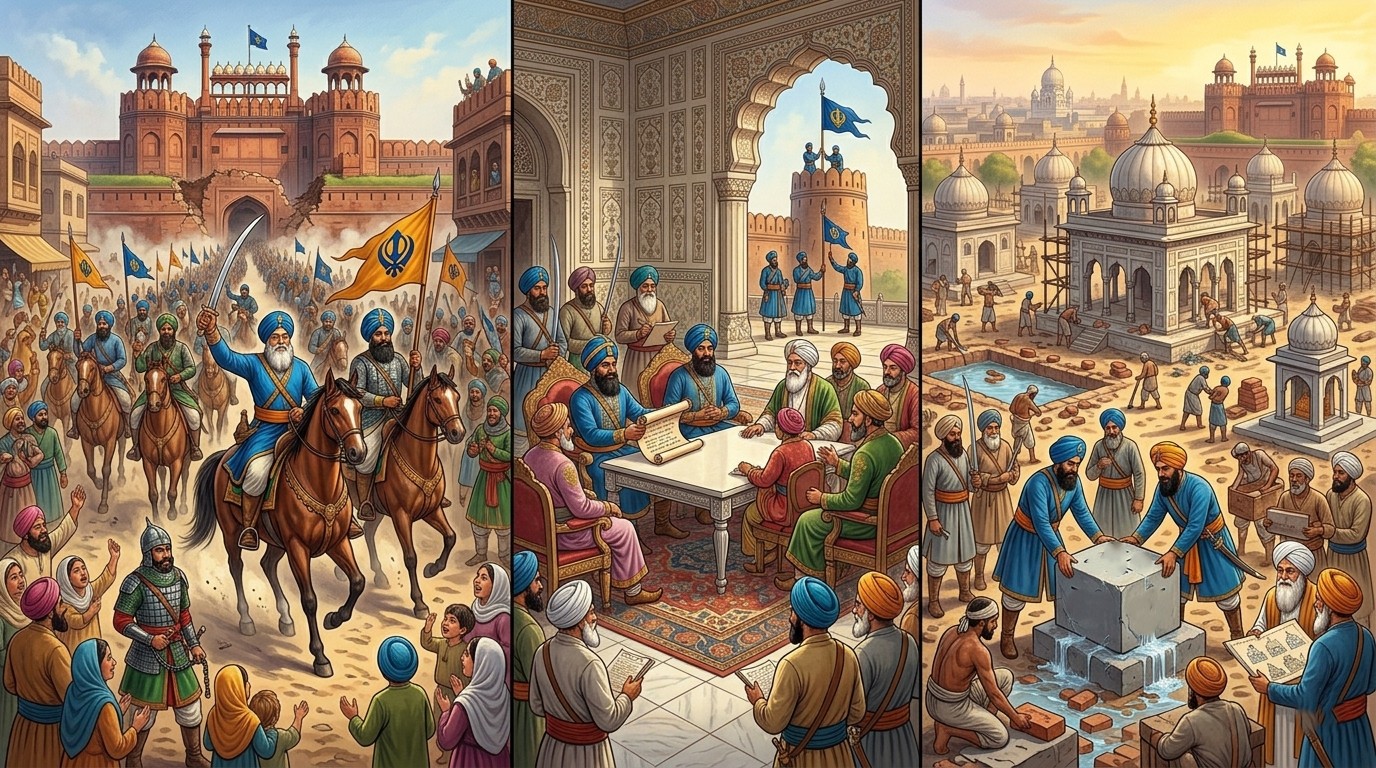
1783 CE: The Capture of Delhi – Sardar Baghel Singh, Jassa Singh Ahluwalia, and the Sikh Entry into the Mughal Capital
The year 1783 stands among the most remarkable milestones in Sikh history. Less than a century after the martyrdom of Guru Tegh Bahadur in Delhi and only decades after repeated campaigns of persecution, massacres, and attempts at extermination, Sikh forces entered the very heart of Mughal power. Under the leadership of Sardar Baghel Singh and with the influence and prestige of Jassa Singh Ahluwalia, Sikh armies marched into Delhi, occupied key areas of the imperial capital, and asserted a level of authority unimaginable to earlier generations. The symbolic significance of this achievement cannot be overstated. For centuries, Delhi had served as the center of political power in northern India. Emperors, governors, and military commanders had ruled vast territories from its palaces and forts. For the Sikhs, whose history had been marked by martyrdoms, forced migrations, and relentless persecution at the hands of Mughal authorities, entering Delhi as a victorious force represented the culmination of generations of sacrifice and struggle.
Yet the capture of Delhi was not simply a military triumph. It was also a profound political and spiritual achievement. Rather than seeking indiscriminate revenge against the city or its inhabitants, Sikh leaders negotiated a treaty that secured recognition of important Sikh historical sites associated with the Gurus and Sikh martyrs. The result was the construction and preservation of seven historic Gurdwaras across Delhi, ensuring that future generations would remember the sacred events connected to the Sikh faith. This episode demonstrated the maturity of Sikh leadership, which combined military success with statesmanship, diplomacy, and a commitment to preserving religious memory. As a Sikh historian, one can view the events of 1783 as a powerful example of how the Khalsa transformed military victory into lasting cultural and spiritual achievement.
The Historical Journey Toward Delhi
The Sikh entry into Delhi in 1783 was not an isolated event but the culmination of nearly three centuries of religious, political, and military evolution. The foundations had been laid by Guru Nanak Dev Ji, whose teachings emphasized spiritual equality, justice, humility, and devotion to one God. Over successive generations, the Sikh community developed institutions capable of sustaining a growing religious movement while confronting increasingly complex political realities.
The martyrdom of Guru Arjan Dev Ji in 1606 and Guru Tegh Bahadur Ji in 1675 transformed Sikh history by demonstrating the willingness of the Gurus to sacrifice their lives for principles of faith and religious freedom. Guru Gobind Singh Ji's creation of the Khalsa in 1699 further strengthened Sikh identity and established a disciplined community prepared to defend righteousness against oppression. The struggles of Banda Singh Bahadur, the years of persecution following his martyrdom, the Chhota Ghallughara of 1746, and the Vadda Ghallughara of 1762 all shaped a generation of Sikhs who understood both suffering and resistance.
By the late eighteenth century, the Sikh Misls had emerged as powerful political and military organizations across Punjab. Their growing strength created the conditions necessary for expansion beyond regional boundaries and ultimately enabled the march toward Delhi.
The Decline of Mughal Authority
The success of the Sikh campaign must also be understood within the broader context of Mughal decline. The Mughal Empire that had once stretched across much of the Indian subcontinent had entered a period of profound weakness. Internal conflicts, economic difficulties, regional rebellions, and repeated foreign invasions had severely undermined imperial authority.
Successive emperors struggled to maintain control over distant provinces. Powerful regional leaders increasingly operated independently, while military effectiveness deteriorated. The invasions of Nadir Shah in 1739 and Ahmad Shah Abdali in subsequent decades further exposed the vulnerability of the empire.
By 1783, the Mughal emperor retained considerable symbolic prestige, but actual power was fragmented. This environment created opportunities for rising regional forces, including the Sikh Misls, to assert their influence.
Sardar Baghel Singh: The Visionary Commander
At the center of the 1783 campaign stood Sardar Baghel Singh, one of the most accomplished military and political leaders of the eighteenth century. A prominent leader of the Karor Singhia Misl, Baghel Singh combined military skill with diplomatic intelligence and administrative competence.
Unlike commanders who viewed warfare solely through the lens of conquest, Baghel Singh understood the importance of political legitimacy and long-term strategic goals. He recognized that military victories could create opportunities for institutional development, cultural preservation, and religious recognition.
His leadership during the Delhi campaign reflected these qualities. The objectives extended beyond battlefield success and included securing permanent recognition of Sikh historical sites associated with the Gurus and major events in Sikh history.
The Influence of Jassa Singh Ahluwalia
Alongside Baghel Singh stood one of the most respected figures in Sikh history: Jassa Singh Ahluwalia. Revered for his leadership, courage, and commitment to the Khalsa, Jassa Singh had become a symbol of Sikh unity during an era characterized by multiple autonomous Misls.
His reputation extended throughout northern India. He had participated in numerous campaigns, guided the Sikh community through periods of crisis, and played a central role in strengthening the Dal Khalsa. His presence lent immense credibility to Sikh political and military initiatives.
The collaboration between Baghel Singh and Jassa Singh Ahluwalia represented a powerful combination of military capability, strategic vision, and moral authority.
The March Toward Delhi
In 1783, Sikh forces advanced toward Delhi with growing confidence. Their movement reflected years of increasing strength and territorial expansion. The campaign demonstrated that the Sikhs were no longer a marginalized community struggling for survival but a major political force capable of influencing events far beyond Punjab.
The advance itself carried immense symbolic significance. For generations, Delhi had been associated with imperial authority and, from a Sikh perspective, with episodes of persecution and martyrdom. The city held profound historical memories, particularly because Guru Tegh Bahadur Ji had been executed there in 1675.
As Sikh forces approached the capital, they carried with them not only military ambitions but also the collective memory of centuries of sacrifice.
The Entry into Delhi
The arrival of Sikh forces in Delhi represented a dramatic shift in the political landscape of northern India. The city that had once served as the center of an empire now witnessed the entry of a community that imperial authorities had repeatedly attempted to suppress.
Sikh forces occupied strategic positions and asserted control over important sections of the city. Historical accounts describe the remarkable sight of Khalsa warriors entering the imperial capital with confidence and discipline.
The event carried profound psychological significance. For Sikhs, it demonstrated that perseverance and faith could overcome even the most formidable obstacles. For contemporaries throughout the region, it signaled the emergence of a new political reality.
The Capture of the Red Fort
Among the most symbolic aspects of the campaign was the Sikh occupation of the Red Fort area. The fort had long served as a visible symbol of Mughal sovereignty and imperial prestige. To establish influence over such a site represented a dramatic reversal of historical fortunes.
While the occupation was not intended to establish permanent Sikh rule over Delhi, it demonstrated the capacity of Sikh forces to project power into the heart of northern India. The achievement reflected decades of military development and organizational growth.
The symbolism resonated deeply within Sikh collective memory because it represented the triumph of a community that had endured extraordinary hardship.
Negotiation Rather Than Destruction
One of the most remarkable features of the 1783 campaign was the decision of Sikh leaders to pursue negotiation rather than indiscriminate retaliation. Given the long history of persecution endured by the Sikh community, some might have expected a campaign of revenge. Instead, Sikh leadership demonstrated political maturity and restraint.
Baghel Singh entered into negotiations with Mughal authorities and secured agreements that recognized Sikh interests and historical claims. This approach reflected the values of justice and responsibility that had long been emphasized within Sikh tradition.
The resulting treaty transformed a military victory into a lasting cultural achievement.
The Treaty and the Seven Historic Gurdwaras
The most enduring outcome of the negotiations was the authorization to construct and preserve Gurdwaras at sites associated with important events in Sikh history. These shrines would ensure that future generations could remember and honor the sacrifices of the Gurus and other Sikh martyrs.
Seven historic Gurdwaras emerged from this effort, each connected to significant moments in Sikh tradition. They included sites associated with Guru Tegh Bahadur Ji's martyrdom, Guru Har Krishan Ji's presence in Delhi, and other key historical events.
The establishment of these Gurdwaras transformed Delhi into an important center of Sikh pilgrimage and memory.
The Importance of Gurdwara Sis Ganj Sahib
Among the most significant shrines established through these efforts was Gurdwara Sis Ganj Sahib. Built at the site associated with the martyrdom of Guru Tegh Bahadur Ji, the Gurdwara commemorates one of the defining sacrifices in Sikh history.
Guru Tegh Bahadur Ji gave his life in defense of religious freedom, refusing to abandon his principles despite immense pressure. The preservation of this site ensured that his sacrifice would remain central to Sikh historical consciousness.
The existence of the Gurdwara stands as a lasting testament to the success of Baghel Singh's negotiations.
The Preservation of Sikh Historical Memory
The construction of the Delhi Gurdwaras reflected a broader commitment to preserving historical memory. Sikh leaders understood that institutions and sacred sites play a crucial role in transmitting values, traditions, and historical awareness across generations.
By securing recognition of these locations, they ensured that the stories of the Gurus and the sacrifices of earlier Sikhs would remain visible within one of the most important cities of the subcontinent.
This achievement demonstrated that military victories are most meaningful when they contribute to enduring cultural and spiritual legacies.
The Impact on Sikh Prestige
The events of 1783 significantly enhanced Sikh prestige throughout northern India. Communities across the region observed that the Sikhs had not only achieved military success but had also demonstrated responsible leadership and diplomatic skill.
The campaign strengthened confidence within the Sikh community and reinforced the legitimacy of Sikh institutions. It also encouraged further cooperation among the Misls, whose collective efforts had made the achievement possible.
The increased prestige gained during this period contributed to subsequent Sikh political development.
The Road Toward Maharaja Ranjit Singh
The capture of Delhi and the success of Baghel Singh's negotiations formed part of the broader historical process that eventually led to the rise of Maharaja Ranjit Singh. The confidence, organizational capacity, and political experience gained during such campaigns strengthened Sikh institutions and prepared them for future achievements.
Although the Sikh Empire would not be formally established until the early nineteenth century, many of its foundations were laid during the era of the Misls. The events of 1783 demonstrated that Sikh leaders possessed the ability to operate effectively on a regional and even imperial scale.
In this sense, the Delhi campaign represented both a culmination of earlier struggles and a precursor to future success.
The Legacy of 1783
The legacy of the capture of Delhi extends far beyond military history. It symbolizes the triumph of perseverance over persecution, memory over erasure, and constructive leadership over vengeance. The establishment of historic Gurdwaras ensured that Sikh contributions to the religious and political history of India would remain visible within the nation's capital.
The campaign also demonstrated that the Sikh community had matured into a force capable of shaping historical events while remaining faithful to its spiritual principles. The combination of military success, diplomatic negotiation, and cultural preservation remains one of the most impressive achievements of eighteenth-century Sikh leadership.
Today, the Gurdwaras established through Baghel Singh's efforts continue to welcome pilgrims and visitors from around the world, serving as living monuments to this extraordinary chapter in Sikh history.
Conclusion
The capture of Delhi in 1783 was one of the most significant milestones in Sikh history. Led by Sardar Baghel Singh and supported by influential leaders such as Jassa Singh Ahluwalia, Sikh forces entered the Mughal capital and asserted their power at the very center of northern Indian politics. Yet the greatest achievement of the campaign was not military conquest alone. Through negotiation and statesmanship, Sikh leaders secured recognition of key historical sites and facilitated the construction of seven important Gurdwaras that preserved the memory of the Gurus and Sikh martyrs. The events of 1783 demonstrated the maturity, confidence, and vision of Sikh leadership. They transformed a military victory into a lasting spiritual and cultural legacy that continues to inspire Sikhs around the world.
Frequently Asked Questions (FAQ)
1. What happened during the Sikh capture of Delhi in 1783?
Sikh forces led by Sardar Baghel Singh entered Delhi, occupied strategic areas, and negotiated significant concessions from Mughal authorities.
2. Who was Sardar Baghel Singh?
Baghel Singh was a prominent Sikh military commander and leader of the Karor Singhia Misl who played the central role in the Delhi campaign.
3. What role did Jassa Singh Ahluwalia play?
Jassa Singh Ahluwalia was one of the most respected Sikh leaders of the era and provided influential leadership and support for Sikh political and military efforts.
4. Did the Sikhs capture the Red Fort?
Sikh forces asserted control over key areas associated with the Red Fort, demonstrating their ability to project power into the Mughal capital.
5. Why was Delhi important to the Sikhs?
Delhi was associated with major events in Sikh history, including the martyrdom of Guru Tegh Bahadur Ji.
6. What was the outcome of the treaty negotiated by Baghel Singh?
The treaty allowed for the construction and preservation of several historic Sikh Gurdwaras in Delhi.
7. How many Gurdwaras were established through this agreement?
Seven historic Gurdwaras were established or recognized at important Sikh historical sites across Delhi.
8. Which is the most famous of these Gurdwaras?
Gurdwara Sis Ganj Sahib is among the most famous because it commemorates the martyrdom of Guru Tegh Bahadur Ji.
9. Why is the capture of Delhi considered significant?
It symbolized the rise of Sikh political power and the success of a community that had previously endured severe persecution.
10. How did the events of 1783 influence later Sikh history?
They strengthened Sikh prestige, reinforced political confidence, preserved important historical sites, and contributed to the developments that eventually led to the Sikh Empire.