Historical Turning Points · Empire & Struggle
1799 Maharaja Ranjit Singh captures Lahore
Maharaja Ranjit Singh of the Sukerchakia Misl captured Lahore from the Bhangi Misl. This event unified the fractured Misls / confederacies and marked the formal establishment of the sovereign Sikh Empire (Sarkar-i-Khalsa).
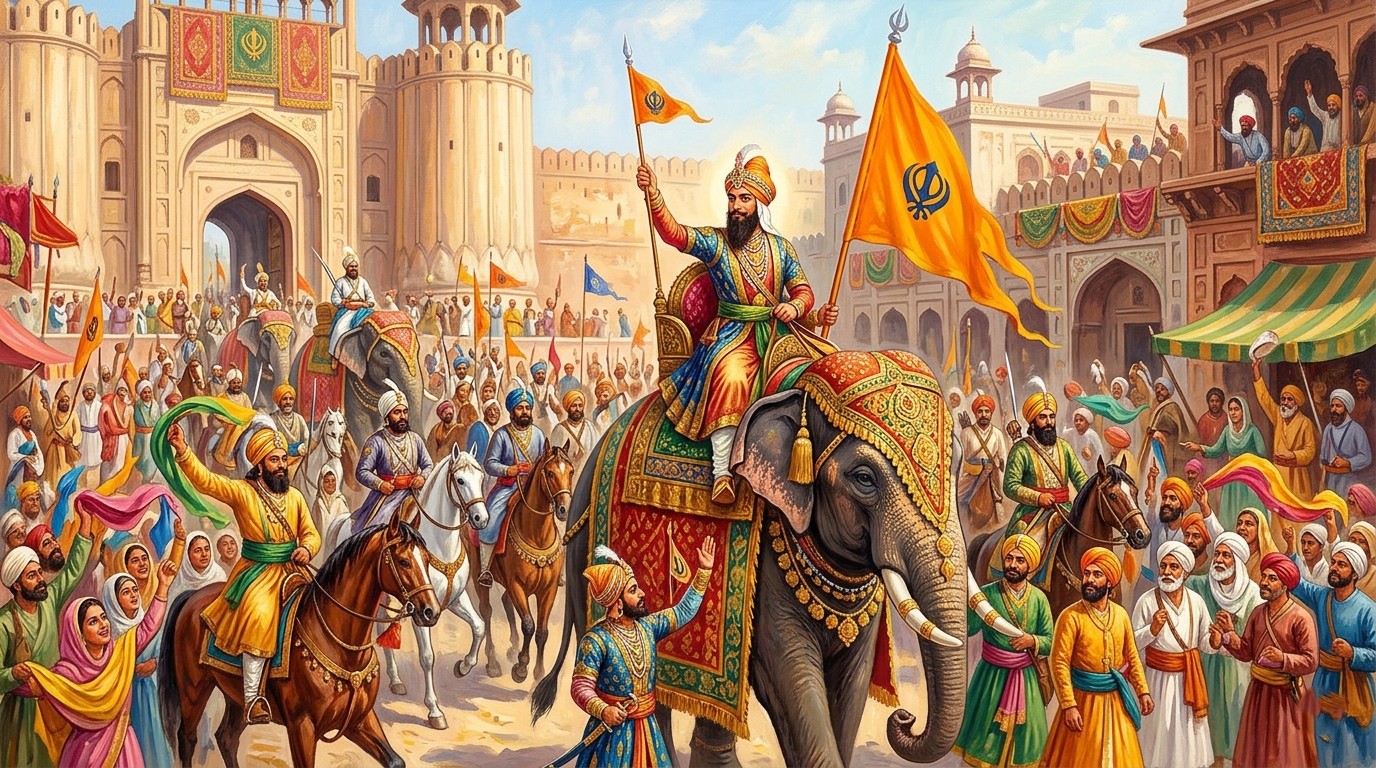
1799 CE: The Capture of Lahore – Maharaja Ranjit Singh and the Birth of the Sikh Empire
The capture of Lahore in 1799 CE stands as one of the most transformative moments in Sikh history. It marked the culmination of nearly three centuries of spiritual evolution, military struggle, political organization, and collective sacrifice that began with Guru Nanak Dev Ji and matured through the leadership of the Sikh Gurus, the Khalsa, Banda Singh Bahadur, the Misls, and countless martyrs who gave their lives for the survival of the Panth. When the young Sardar Ranjit Singh of the Sukerchakia Misl entered Lahore and assumed control of the city, he was not merely conquering another urban center. He was laying the foundation for a sovereign Sikh state that would soon become one of the most powerful kingdoms in Asia. The event transformed the political landscape of northern India and gave the Sikhs, for the first time since the era of Banda Singh Bahadur, a stable and expanding government capable of protecting their institutions, securing their territories, and projecting power beyond Punjab.
To understand the significance of Lahore's capture, one must appreciate the extraordinary journey that preceded it. The Sikh community had endured repeated attempts at destruction throughout the eighteenth century. The martyrdoms of the Gurus, the persecution under Mughal governors, the executions of Banda Singh Bahadur and his followers, the Chhota Ghallughara, the Vadda Ghallughara, and numerous invasions by Ahmad Shah Abdali had tested the very survival of the Panth. Yet from these trials emerged a resilient network of warrior confederacies known as the Misls. These Misls preserved Sikh political power during an era of instability but often operated independently. By the late eighteenth century, many Sikh leaders recognized that greater unity was essential if Punjab was to achieve lasting security and prosperity. The rise of Ranjit Singh and his capture of Lahore provided the catalyst for that transformation.
The Legacy of the Misls and the Political Landscape of Punjab
Before the rise of Maharaja Ranjit Singh, Punjab was divided among several powerful Sikh Misls. These confederacies had emerged during the turbulent decades following the formation of the Dal Khalsa. They functioned as military, political, and territorial organizations led by capable chiefs who defended Sikh interests and expanded their influence across the region. The Misls played a critical role in preserving Sikh autonomy during a period when both Mughal and Afghan authorities sought to suppress Sikh power.
Although the Misls shared a common religious identity and often cooperated against external threats, they remained largely independent political entities. Each controlled specific territories, maintained its own forces, and pursued its own interests. This decentralized structure provided flexibility and resilience during periods of persecution, but it also created challenges. Rivalries occasionally emerged, resources were dispersed, and coordinated governance remained difficult.
By the closing years of the eighteenth century, many Sikh leaders understood that Punjab required stronger political unity. The external threats posed by Afghan invasions, regional instability, and expanding foreign influence made consolidation increasingly desirable. The young leader who would ultimately achieve this task was Ranjit Singh.
The Early Life of Ranjit Singh
Ranjit Singh was born in 1780 into the Sukerchakia Misl, one of the most influential Sikh confederacies. His father, Mahan Singh, had established a strong regional position and left behind a legacy of military leadership. From an early age, Ranjit Singh experienced the realities of frontier politics and warfare. Smallpox left him blind in one eye and scarred his face, but these physical challenges did not diminish his determination or abilities.
Unlike many rulers who inherited stable kingdoms, Ranjit Singh grew up in a volatile environment where survival depended upon leadership, diplomacy, and military skill. He quickly demonstrated exceptional political instincts. Even as a teenager, he displayed courage in battle and an unusual ability to build alliances among competing factions.
His rise occurred during a critical moment in Punjabi history. The old political order was weakening, and opportunities existed for ambitious leaders capable of unifying diverse interests. Ranjit Singh recognized these opportunities and acted decisively.
Lahore: The Jewel of Punjab
Lahore occupied a unique position in the history of northern India. For centuries it had served as a major center of administration, commerce, culture, and military power. The city had functioned as a provincial capital under various dynasties and remained one of the most important urban centers in the region.
Control of Lahore carried immense symbolic and practical significance. Whoever governed the city possessed access to important trade routes, administrative institutions, and economic resources. Lahore also represented legitimacy. It was a city associated with kingship, governance, and regional authority.
By the late eighteenth century, Lahore was controlled by the Bhangi Misl, once one of the most powerful Sikh confederacies. However, internal weaknesses and declining effectiveness had reduced its ability to govern the city effectively. Political instability created conditions that favored intervention by stronger leadership.
The Decline of the Bhangi Misl
The Bhangi Misl had achieved remarkable success during earlier decades and controlled significant territories across Punjab. However, by 1799 its leadership faced mounting challenges. Internal divisions, administrative difficulties, and declining military effectiveness weakened the confederacy's position.
Residents of Lahore increasingly expressed dissatisfaction with local governance. Merchants, landowners, and influential citizens desired greater stability and security. The city's economic potential could not be fully realized under conditions of political uncertainty.
Ranjit Singh understood that Lahore's problems created an opportunity. Rather than viewing the city merely as a military target, he recognized it as the key to a larger vision of Punjabi unity and state-building.
The March on Lahore
In 1799, Ranjit Singh launched his campaign toward Lahore. The operation reflected both military planning and political calculation. He sought not simply to conquer but to establish himself as a legitimate and capable ruler who could restore order and stability.
As his forces approached the city, support grew among sections of Lahore's population. Many influential citizens viewed him as a leader capable of addressing the challenges that had hindered effective governance. This local support reduced resistance and strengthened his position.
The campaign demonstrated Ranjit Singh's understanding that successful leadership required more than battlefield victories. Political legitimacy and public confidence were equally important.
The Capture of Lahore in 1799
When Ranjit Singh entered Lahore in July 1799, the event marked a turning point in Sikh and Punjabi history. The city came under his control with relatively limited destruction compared to many conquests of the era. This outcome reflected both his strategic approach and the widespread recognition that change was necessary.
The capture of Lahore instantly elevated Ranjit Singh's status. He now controlled the most important city in Punjab and possessed a political base from which broader ambitions could be pursued. More importantly, the event symbolized the transition from a fragmented confederate system toward centralized statehood.
For many Sikhs, the moment represented the fulfillment of generations of struggle. The descendants of those who had endured persecution, martyrdom, and displacement now governed one of the most important cities in northern India.
The Beginning of Sikh Political Unification
The capture of Lahore initiated a process of political consolidation that would eventually unite much of Punjab under a single government. Ranjit Singh understood that long-term stability required cooperation among the various Sikh Misls. Rather than relying exclusively on force, he employed diplomacy, alliances, marriages, negotiations, and strategic partnerships.
This approach enabled him to gradually bring different territories under his influence while minimizing unnecessary conflict. His leadership style balanced firmness with pragmatism, allowing him to build consensus among diverse groups.
The result was the emergence of a more cohesive political structure capable of exercising authority across a vast region.
From Misl Leader to Maharaja
The capture of Lahore was only the beginning of Ranjit Singh's transformation from regional chief to sovereign ruler. In 1801, he would formally assume the title of Maharaja, symbolizing the creation of a unified Sikh kingdom.
His coronation reflected a broader shift in political culture. The Sikh community now possessed not merely military influence but a functioning state with administrative institutions, revenue systems, diplomatic relationships, and long-term strategic objectives.
The foundations for this achievement were laid in 1799 when Lahore came under his control.
The Administrative Vision of Ranjit Singh
One of the reasons for Ranjit Singh's enduring success was his commitment to effective governance. He recognized that military victories alone could not sustain a state. Stability required competent administration, economic development, and public trust.
After securing Lahore, he focused on strengthening institutions, improving revenue collection, promoting trade, and maintaining public order. His government welcomed talented individuals regardless of religious background. Sikhs, Hindus, and Muslims served in important administrative and military positions.
This inclusive approach contributed significantly to the durability of his rule and enhanced the legitimacy of the emerging Sikh Empire.
Lahore as the Capital of a Rising Empire
Under Ranjit Singh's leadership, Lahore became the capital of a rapidly expanding kingdom. The city experienced renewed political importance and economic vitality. Markets flourished, infrastructure improved, and diplomatic missions from various regions visited the capital.
The transformation of Lahore reflected the broader success of the Sikh state. Stability encouraged commerce, while effective governance attracted support from diverse communities.
The city became both a symbol and a practical center of Sikh sovereignty.
The Military Reforms that Followed
The consolidation of Lahore enabled Ranjit Singh to undertake military reforms that would later make the Sikh Empire one of the most formidable powers in Asia. He invested heavily in training, organization, artillery, and discipline.
European military advisors were recruited to modernize certain aspects of the army while preserving the strengths of traditional Sikh warfare. These reforms created a force capable of defending the kingdom against powerful adversaries.
The military strength of the Sikh Empire would become one of its defining characteristics during the early nineteenth century.
The Spiritual Dimension of Sikh Sovereignty
For many Sikhs, the rise of Ranjit Singh carried significance beyond politics and warfare. The establishment of a stable Sikh state represented the realization of aspirations rooted in centuries of sacrifice. The Gurus had emphasized justice, equality, and the defense of the oppressed. Sikh sovereignty provided an opportunity to embody these principles through governance.
Ranjit Singh maintained deep respect for Sikh institutions and patronized major religious centers. He also supported places of worship belonging to other faiths, reflecting the pluralistic traditions that had long characterized Sikh teachings.
This balance between political authority and religious respect became a hallmark of his reign.
The Impact on Punjab's Future
The capture of Lahore fundamentally altered the future of Punjab. What had previously been a region characterized by fragmented authority increasingly moved toward centralized governance. The resulting stability facilitated economic growth, military development, and cultural flourishing.
The Sikh Empire that emerged under Ranjit Singh would eventually extend from the Khyber Pass to the Sutlej River and from Kashmir to Multan. Its influence would be felt across much of northwestern South Asia.
None of these achievements would have been possible without the decisive events of 1799.
The Legacy of the Capture of Lahore
The significance of Lahore's capture extends far beyond military conquest. It represents the culmination of Sikh resilience and the beginning of Sikh statehood. The event demonstrated that a community forged through sacrifice could not only survive persecution but also build a powerful and stable political order.
For historians, 1799 serves as a bridge between the era of the Misls and the age of empire. It marks the moment when scattered centers of power began coalescing into a unified state capable of shaping regional history.
The legacy of this achievement continues to inspire Sikhs around the world as a testament to vision, leadership, perseverance, and unity.
Conclusion
The capture of Lahore in 1799 CE was one of the most consequential events in Sikh history. Under the leadership of the young Sardar Ranjit Singh, the Sukerchakia Misl secured control of Punjab's most important city and initiated the process of political unification that would lead to the creation of the Sikh Empire. The event marked the transition from confederate organization to centralized sovereignty and laid the foundation for one of the most successful states in South Asian history. More than a military victory, the capture of Lahore represented the fulfillment of generations of sacrifice and the realization of a vision rooted in the teachings of the Sikh Gurus. It remains a defining chapter in the story of Sikh resilience, leadership, and nation-building.
Frequently Asked Questions (FAQ)
1. Why was the capture of Lahore important in Sikh history?
The capture of Lahore marked the beginning of Sikh political unification and laid the foundation for the Sikh Empire.
2. Who captured Lahore in 1799?
Sardar Ranjit Singh of the Sukerchakia Misl captured Lahore in 1799 CE.
3. Which group controlled Lahore before Ranjit Singh?
Lahore was controlled by the Bhangi Misl before it came under Ranjit Singh's authority.
4. How old was Ranjit Singh when he captured Lahore?
Ranjit Singh was approximately nineteen years old when he captured the city.
5. What were the Sikh Misls?
The Misls were autonomous Sikh military and political confederacies that governed different regions of Punjab during the eighteenth century.
6. Did the capture of Lahore immediately create the Sikh Empire?
It marked the beginning of the process, while the formal establishment of the Sikh Empire occurred after Ranjit Singh's coronation in 1801.
7. Why was Lahore strategically important?
Lahore was a major political, economic, military, and cultural center in northern India.
8. How did Ranjit Singh unify the Sikh Misls?
He used a combination of diplomacy, alliances, negotiations, strategic marriages, and military strength to consolidate power.
9. What role did Lahore play after its capture?
Lahore became the capital of the Sikh Empire and the center of administration, diplomacy, and military planning.
10. What is the lasting legacy of the capture of Lahore?
The event symbolizes Sikh unity, sovereignty, effective leadership, and the emergence of one of the most influential states in South Asian history.