Historical Turning Points · Empire & Struggle
1809 Treaty of Amritsar
To avoid an immediate conflict with Western forces, Maharaja Ranjit Singh signed a defensive treaty with the British East India Company, establishing the Sutlej River as the permanent border between their empires.
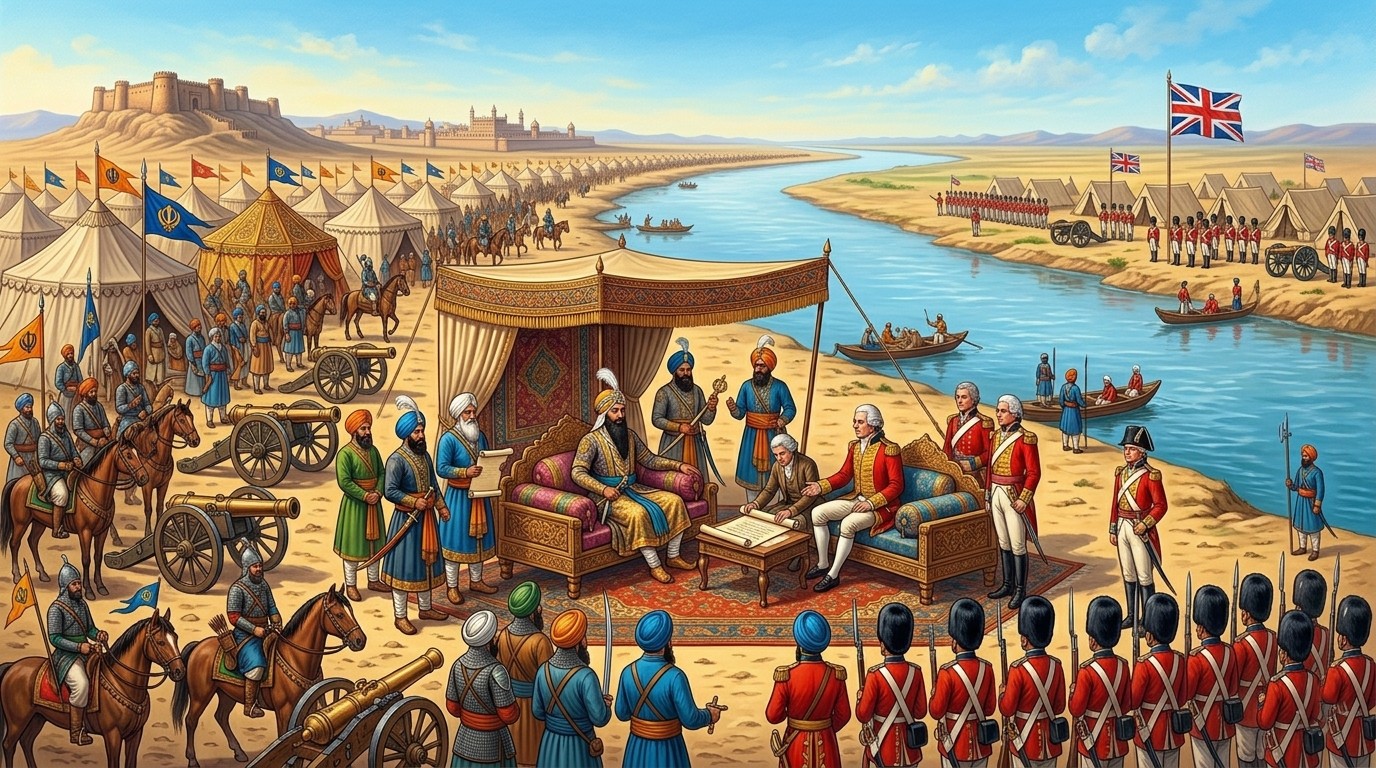
1809 CE: The Treaty of Amritsar – Maharaja Ranjit Singh, the British East India Company, and the Defining Border of the Sikh Empire
The Treaty of Amritsar, signed in 1809 between Maharaja Ranjit Singh and the British East India Company, stands as one of the most consequential diplomatic agreements in Sikh history. Unlike the dramatic battles, sieges, and military campaigns that often dominate narratives of the Sikh Empire, this treaty was forged not on a battlefield but at a negotiating table. Yet its impact was profound. It shaped the political geography of northern India, established the Sutlej River as the recognized boundary between the Sikh Empire and British-controlled territories, and defined the relationship between two of the most powerful states in the subcontinent. More importantly, it revealed Maharaja Ranjit Singh’s extraordinary ability to combine military strength with diplomatic realism. At a time when many rulers either underestimated British ambitions or rushed into unwinnable conflicts, Ranjit Singh chose a calculated strategy designed to preserve Sikh sovereignty while allowing his empire to consolidate and expand elsewhere.
As a Sikh historian, one cannot fully appreciate the Treaty of Amritsar without understanding the larger context of the era. The Sikh Empire was emerging as the dominant power in Punjab under the leadership of Maharaja Ranjit Singh, while the British East India Company was rapidly expanding across India. Both powers recognized each other's capabilities and ambitions. Neither side desired an immediate military confrontation, yet both understood that their spheres of influence were moving closer together. The Treaty of Amritsar became a carefully negotiated compromise that temporarily prevented war, established political boundaries, and created a period of relative stability that allowed the Sikh Empire to flourish. Although later generations would debate whether the treaty represented a strategic victory or a necessary concession, there is little doubt that it was one of the most important diplomatic achievements of Maharaja Ranjit Singh's reign.
The Rise of the Sikh Empire Before 1809
To understand the significance of the Treaty of Amritsar, one must first examine the remarkable rise of the Sikh Empire during the years preceding its signing. Following the capture of Lahore in 1799 and his coronation as Maharaja in 1801, Ranjit Singh embarked upon an ambitious project of political consolidation. The fragmented Sikh Misls that had dominated Punjab during the eighteenth century gradually came under his authority through diplomacy, alliances, military campaigns, and strategic statecraft.
Unlike many rulers who relied solely upon conquest, Ranjit Singh demonstrated an exceptional ability to unite diverse groups around a shared vision of stability and prosperity. His administration welcomed talented individuals regardless of religious affiliation, and his government quickly developed a reputation for efficiency and fairness. As his influence expanded, so did the territory of the Sikh Empire.
By the first decade of the nineteenth century, the Sikh state had become a major power. Lahore served as its capital, and its military strength was increasingly recognized throughout the region. Yet the empire's growth inevitably brought it into contact with another rising power: the British East India Company.
The Expansion of the British East India Company
During the late eighteenth and early nineteenth centuries, the British East India Company transformed from a commercial enterprise into a territorial empire. Through a combination of military victories, alliances, diplomacy, and economic influence, the Company steadily expanded its control across the Indian subcontinent.
By 1809, British influence extended over vast regions of India. Company officials closely monitored developments in Punjab and understood that Maharaja Ranjit Singh's growing power represented both an opportunity and a challenge. They admired his military abilities and administrative competence but also viewed the expanding Sikh Empire as a potential obstacle to their long-term ambitions.
At the same time, British leaders were concerned about broader geopolitical developments. The Napoleonic Wars in Europe created fears that France might attempt to establish influence in India through alliances with regional powers. Consequently, British policymakers sought stability along their northern frontiers and preferred diplomacy over immediate conflict with Punjab.
The Strategic Importance of the Sutlej Region
The area surrounding the Sutlej River occupied a critical position in the politics of northern India. Numerous Sikh chiefs controlled territories east of the river, while Maharaja Ranjit Singh increasingly asserted influence over these regions. The British East India Company also viewed the area as strategically significant because it formed a buffer between their expanding possessions and the Sikh Empire.
The Cis-Sutlej states, located east of the Sutlej River, became a particular source of tension. Some local rulers sought British protection against potential incorporation into the Sikh Empire, while Ranjit Singh considered many of these territories historically connected to Sikh political influence.
The competing interests of the Sikh Empire and the British East India Company made diplomatic negotiations increasingly necessary.
Maharaja Ranjit Singh's Political Vision
One of the defining characteristics of Maharaja Ranjit Singh was his ability to distinguish between battles worth fighting and conflicts best avoided. He was unquestionably a courageous military leader, yet he also possessed a sophisticated understanding of political realities.
Ranjit Singh recognized that a premature war with the British could threaten the stability of his still-developing empire. Although his forces were formidable, the British possessed vast resources and growing military capabilities. Rather than allowing emotions or pride to dictate policy, he pursued a strategy designed to preserve the independence of Punjab while avoiding unnecessary risks.
This pragmatic approach reflected a broader commitment to long-term state-building. His objective was not merely territorial expansion but the creation of a durable and prosperous kingdom capable of surviving for generations.
The Arrival of British Diplomacy
As tensions increased, the British East India Company dispatched diplomatic representatives to engage with the Sikh court. Among the most notable figures involved in these discussions was Charles Metcalfe, who played a significant role in negotiations.
The meetings between British officials and the Sikh leadership were characterized by careful calculation on both sides. Each party sought to protect its interests while avoiding direct confrontation. British negotiators hoped to secure the Cis-Sutlej region and prevent further Sikh expansion eastward. Ranjit Singh sought recognition of his authority west of the Sutlej and protection from British interference in his core territories.
The resulting discussions demonstrated the complexity of early nineteenth-century diplomacy in South Asia.
The Signing of the Treaty of Amritsar
In April 1809, the Treaty of Amritsar was formally concluded. The agreement established the Sutlej River as the recognized boundary between the Sikh Empire and British-protected territories. Maharaja Ranjit Singh agreed not to expand his authority east of the river, while the British acknowledged his sovereignty over territories west of the Sutlej.
The treaty effectively created a buffer zone between the two powers and reduced the likelihood of immediate conflict. Both sides gained important advantages. The British secured influence over the Cis-Sutlej states, while Ranjit Singh received formal recognition of his authority in Punjab.
The agreement represented a carefully balanced compromise that reflected the interests and concerns of both parties.
The Sutlej River as a Political Boundary
The designation of the Sutlej River as the border between the Sikh Empire and British territories had far-reaching consequences. Rivers have historically served as natural boundaries, and the Sutlej provided a clear geographical marker that could be easily identified and administered.
The new boundary reduced uncertainty and established a framework for managing relations between the two states. It also allowed each side to focus on internal development and external priorities without the constant threat of frontier disputes.
For the Sikh Empire, the border created stability at a critical moment in its development.
Why Ranjit Singh Accepted the Treaty
Some historians have questioned why Ranjit Singh accepted limitations on expansion east of the Sutlej. However, a deeper examination reveals that the decision was strategically sound. The Maharaja understood that the territories west of the Sutlej offered greater opportunities for growth and consolidation.
By securing peace with the British, he gained the freedom to expand toward Multan, Kashmir, Peshawar, and other strategically important regions. These campaigns would significantly strengthen the Sikh Empire during the following decades.
Rather than viewing the treaty as a defeat, many scholars interpret it as a calculated decision that preserved Sikh independence and facilitated future expansion.
The Benefits Gained by the Sikh Empire
The Treaty of Amritsar provided several important advantages to the Sikh Empire. First, it reduced the risk of a costly war against a powerful adversary. Second, it secured formal recognition of Ranjit Singh's authority by one of the most influential powers in the region. Third, it created conditions conducive to economic growth and administrative development.
The years following the treaty witnessed remarkable achievements. The Sikh Empire expanded significantly, modernized its military, strengthened its institutions, and enhanced its international reputation.
These accomplishments suggest that the stability created by the treaty contributed substantially to the success of Ranjit Singh's reign.
The British Perspective
From the British viewpoint, the treaty also represented a success. Company officials secured influence over the Cis-Sutlej states and established a defensive frontier without resorting to war. They recognized that direct conflict with Ranjit Singh at this stage would have been expensive and uncertain.
The agreement allowed the British to focus on other strategic priorities while maintaining cordial relations with the Sikh Empire. For several decades, this arrangement contributed to relative peace between the two powers.
The treaty therefore reflected mutual pragmatism rather than unilateral dominance.
The Expansion of the Sikh Empire After 1809
Freed from concerns about British interference along the Sutlej frontier, Ranjit Singh concentrated on expanding his empire elsewhere. During the following years, he successfully incorporated major regions including Multan, Kashmir, Attock, and Peshawar.
These conquests dramatically increased the size and strength of the Sikh state. The empire became one of the most powerful political entities in Asia and developed a military widely respected by both regional and European observers.
The ability to pursue these objectives was made possible, in part, by the stability established through the Treaty of Amritsar.
The Treaty's Long-Term Consequences
Although the treaty successfully prevented immediate conflict, it also marked the beginning of a complex relationship between the Sikh Empire and the British East India Company. Mutual respect coexisted with strategic competition. Both sides monitored each other's activities closely and prepared for potential future challenges.
After the death of Maharaja Ranjit Singh in 1839, political instability within Punjab altered the balance of power. Eventually, tensions culminated in the Anglo-Sikh Wars, which transformed the political landscape of the region.
Yet these later developments should not obscure the treaty's achievements during Ranjit Singh's lifetime.
The Diplomatic Genius of Maharaja Ranjit Singh
The Treaty of Amritsar highlights one of Maharaja Ranjit Singh's greatest strengths: his ability to combine military power with diplomatic intelligence. He understood that successful statecraft requires flexibility, patience, and strategic foresight.
Rather than pursuing short-term gains at the risk of long-term disaster, he prioritized the security and prosperity of his empire. His willingness to negotiate from a position of strength demonstrated confidence rather than weakness.
This diplomatic sophistication contributed significantly to the longevity and success of the Sikh Empire.
The Place of the Treaty in Sikh History
Within the broader narrative of Sikh history, the Treaty of Amritsar occupies a unique position. It represents the moment when the Sikh Empire achieved international recognition as a major political power. The agreement reflected the remarkable transformation of the Sikh community from a persecuted minority into the rulers of a powerful and respected kingdom.
The treaty also illustrates the importance of strategic decision-making in preserving sovereignty. Through diplomacy, Maharaja Ranjit Singh secured the conditions necessary for continued growth and development.
For this reason, the Treaty of Amritsar remains one of the defining events of the Sikh Empire's golden age.
Conclusion
The Treaty of Amritsar of 1809 was far more than a simple border agreement. It was a pivotal diplomatic achievement that shaped the future of the Sikh Empire and northern India. By establishing the Sutlej River as the boundary between Sikh and British spheres of influence, the treaty prevented an immediate conflict between two powerful states and created a period of stability that enabled Maharaja Ranjit Singh to strengthen and expand his empire. The agreement reflected the Maharaja's extraordinary political wisdom, strategic patience, and commitment to preserving Sikh sovereignty. While later events would alter the relationship between Punjab and the British, the Treaty of Amritsar remains a testament to the diplomatic skill and statecraft that characterized one of the greatest rulers in Sikh history.
Frequently Asked Questions (FAQ)
1. What was the Treaty of Amritsar?
The Treaty of Amritsar was an agreement signed in 1809 between Maharaja Ranjit Singh and the British East India Company establishing the Sutlej River as the boundary between their territories.
2. When was the treaty signed?
The treaty was signed in April 1809.
3. Who represented the Sikh Empire in the treaty?
Maharaja Ranjit Singh represented the Sikh Empire during the negotiations.
4. Why was the Sutlej River important?
The Sutlej River became the recognized border separating the Sikh Empire from British-protected territories.
5. What were the Cis-Sutlej states?
They were territories located east of the Sutlej River that came under British protection through the treaty arrangement.
6. Did the treaty weaken the Sikh Empire?
Many historians argue that it strengthened the empire by preventing war and allowing expansion in other directions.
7. What benefits did Maharaja Ranjit Singh gain?
He gained recognition of his sovereignty west of the Sutlej and secured peace with the British.
8. Who was Charles Metcalfe?
Charles Metcalfe was a British diplomat who played an important role in negotiations with the Sikh court.
9. How did the treaty affect future Sikh expansion?
It allowed Ranjit Singh to focus on expanding toward Multan, Kashmir, Attock, and Peshawar.
10. Why is the Treaty of Amritsar historically significant?
It established a lasting border, preserved Sikh sovereignty during a critical period, and demonstrated Maharaja Ranjit Singh's exceptional diplomatic skill.