Historical Turning Points · Empire & Struggle
1813 Battle of Attock
The Khalsa Army secured its first major victory over the Durrani Empire on the banks of the Indus River, capturing the strategic Attock Fort.
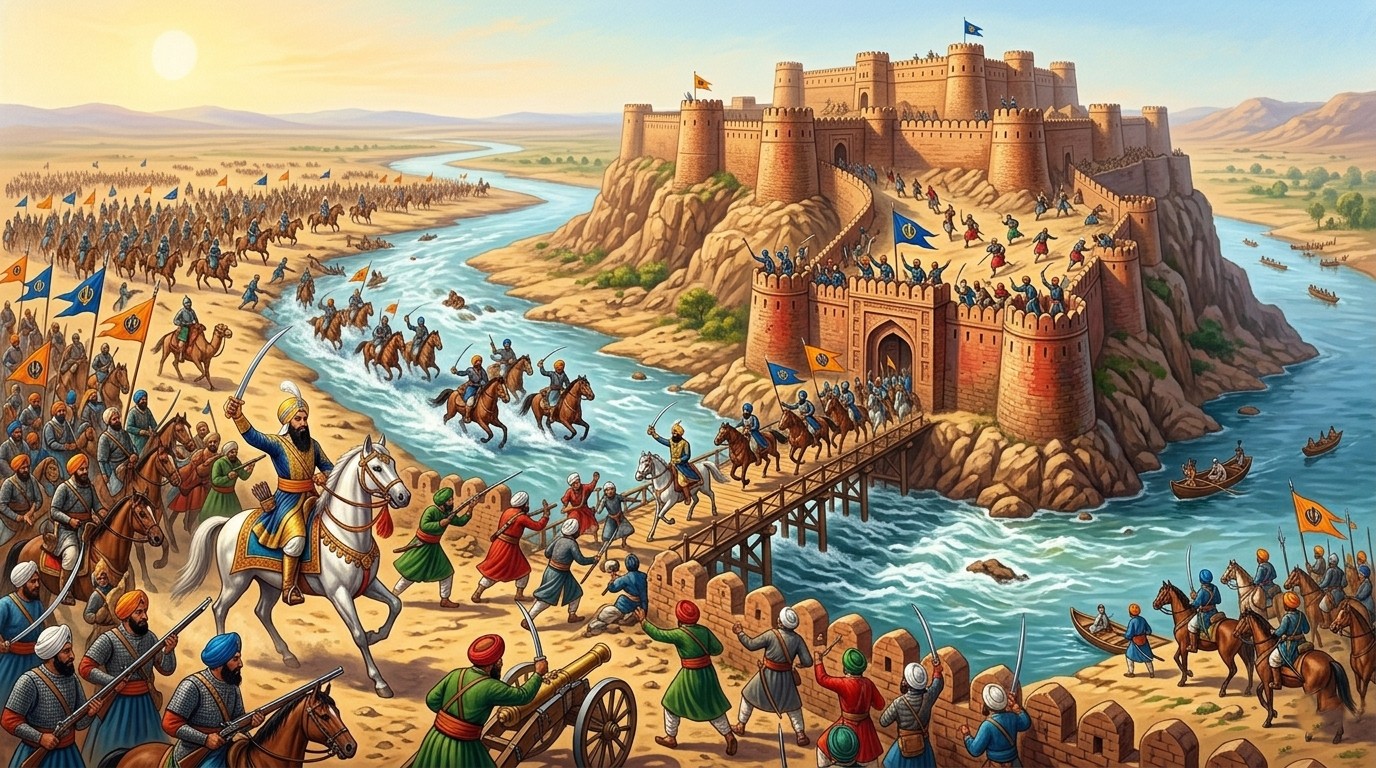
1813 CE: The Battle of Attock – The Khalsa Army's First Great Victory Beyond the Indus
The Battle of Attock in 1813 CE occupies a place of immense importance in Sikh military and political history. It was far more than a regional engagement between rival powers. It represented a decisive turning point in the rise of the Sikh Empire under Maharaja Ranjit Singh and demonstrated that the Khalsa Army had evolved into a disciplined and formidable force capable of defeating one of the most feared powers of the region. For centuries, the lands beyond the Indus River had served as a gateway through which numerous invaders entered the Indian subcontinent. Control of Attock, therefore, carried both strategic and symbolic significance. When Sikh forces secured victory and established their authority over the formidable Attock Fort, they not only expanded the boundaries of the Sikh Empire but also reversed a historical pattern that had long seen armies moving eastward into Punjab. For the first time in generations, a powerful Punjabi state projected its authority westward toward the traditional homelands of many former invaders.
As a Sikh historian, one cannot discuss the Battle of Attock without appreciating the broader historical journey that led to this remarkable achievement. The victory was built upon centuries of sacrifice, resilience, and institution-building. The teachings of Guru Nanak Dev Ji laid the spiritual foundations of the Sikh community. The martyrdoms of Guru Arjan Dev Ji and Guru Tegh Bahadur Ji strengthened the Panth's commitment to justice and religious freedom. Guru Hargobind's doctrine of Miri and Piri introduced the principle that spiritual authority must be accompanied by the capacity to defend righteousness. Guru Gobind Singh's creation of the Khalsa transformed the Sikh community into a disciplined brotherhood of saint-soldiers. The sacrifices of Banda Singh Bahadur, the horrors of the Chhota Ghallughara and Vadda Ghallughara, and the rise of the Misls all contributed to a tradition of resistance and self-governance. By 1813, the Sikh community had emerged from persecution and fragmentation to become a rising imperial power capable of challenging long-established regional dynasties.
The Geopolitical Landscape of Northwestern India
At the beginning of the nineteenth century, northwestern India was undergoing profound political transformation. The Mughal Empire, once the dominant force across much of the subcontinent, had declined dramatically. Numerous regional powers competed for influence and territory. Among these powers, the Sikh Empire under Maharaja Ranjit Singh was rapidly expanding, while the Durrani Empire, founded by Ahmad Shah Abdali in Afghanistan, struggled to maintain its authority over distant frontier territories.
The Durrani rulers continued to view Punjab and the frontier regions as areas of strategic importance. Their predecessors had repeatedly invaded northern India, extracting tribute and exerting influence over local rulers. However, the rise of the Sikh Empire fundamentally altered the balance of power. What had once been vulnerable territories now possessed a unified leadership, a modernizing military, and a ruler determined to secure Punjab against external threats.
As the influence of the Sikh Empire expanded westward, confrontation with Durrani interests became increasingly likely. The Battle of Attock emerged from this larger contest for control over the frontier.
The Strategic Importance of Attock
Attock occupied one of the most strategically significant locations in South Asia. Situated along the Indus River, the city and its fort controlled a major crossing point between Punjab and the regions to the northwest. Whoever held Attock possessed the ability to regulate trade, military movement, and communications across an important corridor linking Central Asia and the Indian subcontinent.
The Attock Fort itself was an imposing structure. Built during the Mughal period, it stood as a symbol of imperial authority and military strength. Its location provided natural defensive advantages, while its fortifications made it difficult to capture. For centuries, control of Attock had been considered essential for any power seeking dominance in the frontier regions.
For Maharaja Ranjit Singh, securing Attock was not merely a matter of territorial expansion. It was a strategic necessity. Control of the fort would protect Punjab's western frontier, limit the influence of rival powers, and provide a launching point for future operations beyond the Indus.
Maharaja Ranjit Singh's Frontier Strategy
Maharaja Ranjit Singh possessed a remarkable understanding of military geography and statecraft. He recognized that lasting security required more than defending existing borders. Potential threats had to be addressed proactively by securing strategic positions and establishing buffer zones against hostile forces.
Following the Treaty of Amritsar in 1809, which stabilized relations with the British East India Company along the eastern frontier, Ranjit Singh increasingly focused his attention westward. The territories beyond the Indus contained valuable trade routes, fertile lands, and important military positions. More importantly, they represented the source of many historical invasions into Punjab.
By extending Sikh authority into these regions, Ranjit Singh aimed to transform Punjab from a frontier vulnerable to invasion into the center of a secure and expanding empire.
The Rise of the Khalsa Army
The success of the Sikh Empire rested heavily upon the effectiveness of the Khalsa Army. Drawing upon traditions established by Guru Hargobind and Guru Gobind Singh, the army combined spiritual motivation with military professionalism. Under Maharaja Ranjit Singh's leadership, significant efforts were made to improve organization, training, discipline, and logistics.
Although later reforms would further modernize the military, the Khalsa Army of 1813 already possessed considerable strengths. Its soldiers were experienced, highly motivated, and accustomed to operating in challenging conditions. Many had grown up within a martial culture shaped by generations of conflict and resistance.
The army's leadership included capable commanders who understood both conventional and irregular warfare. Their ability to adapt to changing circumstances would prove crucial during the campaign for Attock.
The Durrani Challenge
The Durrani Empire remained a significant force despite internal difficulties. Afghan rulers and commanders possessed extensive military experience and maintained influence across large territories. They viewed Sikh expansion with increasing concern and sought to preserve their position in the frontier regions.
Control of Attock became a focal point of competition between the Sikh Empire and Durrani-aligned forces. Neither side could afford to ignore the strategic significance of the fort and surrounding territory.
The resulting confrontation would test the military capabilities and political ambitions of both powers.
The Campaign Toward Attock
The campaign leading to the Battle of Attock reflected careful planning by the Sikh leadership. Military operations in the frontier region required coordination, intelligence gathering, logistical preparation, and the ability to operate across difficult terrain.
As Sikh forces advanced toward Attock, they encountered resistance from opponents determined to prevent the expansion of Sikh authority. The campaign involved not only military engagements but also efforts to secure local support and establish administrative control over newly acquired territories.
The ability of the Sikh leadership to integrate military and political objectives contributed significantly to the success of the campaign.
The Battle of Attock
The decisive engagement occurred in 1813 and brought Sikh forces into direct confrontation with Durrani-aligned opponents. Although historical accounts vary in their descriptions of specific tactical details, the broader significance of the battle is clear. The Khalsa Army demonstrated superior coordination, determination, and leadership, ultimately securing victory.
The battle showcased the effectiveness of Sikh military organization during the early nineteenth century. Commanders successfully exploited opportunities, maintained discipline under pressure, and adapted to battlefield conditions. Their performance reflected years of experience gained through campaigns across Punjab and neighboring regions.
The victory was not merely tactical. It represented a strategic breakthrough that fundamentally altered the balance of power in the frontier region.
The Capture of Attock Fort
Following the successful campaign, Sikh forces secured control of Attock Fort. This achievement carried enormous symbolic weight. For generations, the fort had represented authority over one of the most important crossings of the Indus River. Its capture signaled the arrival of the Sikh Empire as a major frontier power.
The acquisition of the fort enhanced the defensive position of Punjab while providing new opportunities for expansion and trade. It also demonstrated that the Sikh Empire could successfully project power beyond traditional Punjabi heartlands.
The capture of Attock became a celebrated milestone in the growth of Sikh sovereignty.
The Indus River and the Reversal of History
Throughout South Asian history, the Indus River had often served as a gateway through which conquerors entered Punjab and northern India. Armies from Central Asia, Afghanistan, and beyond frequently crossed this region during campaigns of conquest.
The Battle of Attock symbolized a dramatic reversal of this historical pattern. Instead of passively defending against invasions, the Sikh Empire advanced beyond the traditional frontier and established authority over strategically important territory west of the river.
This achievement reflected a new level of confidence and capability within the Sikh state. Punjab was no longer merely resisting external threats; it was actively shaping the political future of the region.
The Role of Sikh Leadership
The success at Attock highlighted the quality of leadership within the Sikh Empire. Maharaja Ranjit Singh's strategic vision provided overall direction, while experienced military commanders translated that vision into battlefield success.
The leadership culture of the Sikh Empire emphasized merit, loyalty, adaptability, and courage. Commanders were expected not only to lead effectively but also to maintain the trust and respect of their soldiers.
These qualities contributed significantly to the army's performance during the campaign and strengthened the empire's long-term prospects.
The Impact on the Sikh Empire
The victory at Attock had profound consequences for the development of the Sikh Empire. It expanded territorial control, strengthened frontier security, and enhanced the empire's reputation among both allies and rivals.
The success also boosted morale throughout Punjab. Citizens, soldiers, and administrators alike recognized that the empire had achieved a major strategic objective. Confidence in the leadership of Maharaja Ranjit Singh grew, and support for further expansion increased.
The victory helped establish the momentum that would characterize the empire's growth during subsequent decades.
The Psychological Significance of Victory
Military victories often have effects that extend beyond immediate territorial gains. The Battle of Attock demonstrated that the Khalsa Army could defeat opponents associated with a long tradition of regional dominance. This realization strengthened confidence within the Sikh community and reinforced the legitimacy of the emerging empire.
For a people whose collective memory included persecution, martyrdom, and repeated struggles for survival, the victory carried deep emotional significance. It symbolized the transformation of the Sikh Panth from a persecuted community into a sovereign power capable of defending its interests and shaping its destiny.
The psychological impact of this achievement should not be underestimated.
The Road to Further Expansion
Control of Attock opened new possibilities for future campaigns. The Sikh Empire continued to expand its influence across strategically important regions, eventually incorporating territories such as Multan, Kashmir, and Peshawar.
Each of these achievements built upon foundations established through earlier victories. Attock served as both a defensive stronghold and a gateway to further opportunities.
The battle therefore occupies an important place within the broader narrative of Sikh imperial expansion.
The Legacy of the Battle of Attock
The legacy of the Battle of Attock extends far beyond military history. It represents the successful realization of principles that had guided Sikh development for generations: courage, resilience, discipline, justice, and collective determination. The victory demonstrated what could be achieved when spiritual inspiration was combined with effective leadership and organized statecraft.
Historians continue to view Attock as a defining moment in the rise of the Sikh Empire. It marked the first major Sikh victory over the Durrani Empire and established a new balance of power along the northwestern frontier.
For Sikhs around the world, the battle remains a source of pride and a reminder of the remarkable achievements of the Khalsa during the era of Maharaja Ranjit Singh.
Conclusion
The Battle of Attock in 1813 CE was one of the most significant military victories in Sikh history. By defeating Durrani-aligned forces and securing control of the strategic Attock Fort, the Khalsa Army demonstrated its growing strength and effectiveness. The victory strengthened the Sikh Empire, protected Punjab's western frontier, and signaled the emergence of a new regional power capable of shaping events far beyond its traditional homeland. Under the visionary leadership of Maharaja Ranjit Singh, the capture of Attock marked not only a military triumph but also a profound statement of Sikh sovereignty, resilience, and ambition. It remains one of the defining milestones in the remarkable rise of the Sikh Empire.
Frequently Asked Questions (FAQ)
1. What was the Battle of Attock?
The Battle of Attock was a major military engagement in 1813 CE in which Sikh forces secured victory over Durrani-aligned opponents and gained control of the strategic Attock region.
2. Why was Attock important?
Attock controlled a key crossing of the Indus River and served as an important military and commercial gateway between Punjab and the northwest.
3. Who led the Sikh Empire during the battle?
Maharaja Ranjit Singh ruled the Sikh Empire and directed its broader strategic objectives during the campaign.
4. What was Attock Fort?
Attock Fort was a heavily fortified stronghold built during the Mughal period that guarded a crucial crossing point on the Indus River.
5. Who were the Durranis?
The Durranis were the ruling dynasty of the Durrani Empire in Afghanistan, which exercised influence across parts of the frontier region.
6. Why is the battle considered historically significant?
It marked the first major Sikh victory over the Durrani Empire and strengthened the expansion of the Sikh Empire beyond Punjab.
7. How did the battle affect Punjab's security?
Control of Attock improved frontier defense and reduced the threat of incursions from the northwest.
8. Did the battle contribute to the growth of the Sikh Empire?
Yes, the victory enhanced territorial control, military prestige, and strategic opportunities for future expansion.
9. What role did the Khalsa Army play?
The Khalsa Army carried out the campaign, demonstrated effective military organization, and secured victory in the battle.
10. What is the lasting legacy of the Battle of Attock?
The battle symbolizes Sikh military achievement, frontier security, imperial expansion, and the growing power of the Sikh Empire under Maharaja Ranjit Singh.