Historical Turning Points · Empire & Struggle
1818–1819 Annexations of Multan & Kashmir
Under the tactical command of Diwan Mohkam Chand and Hari Singh Nalwa, the empire annexed the wealthy trade hubs of Multan (1818) and Kashmir (1819).
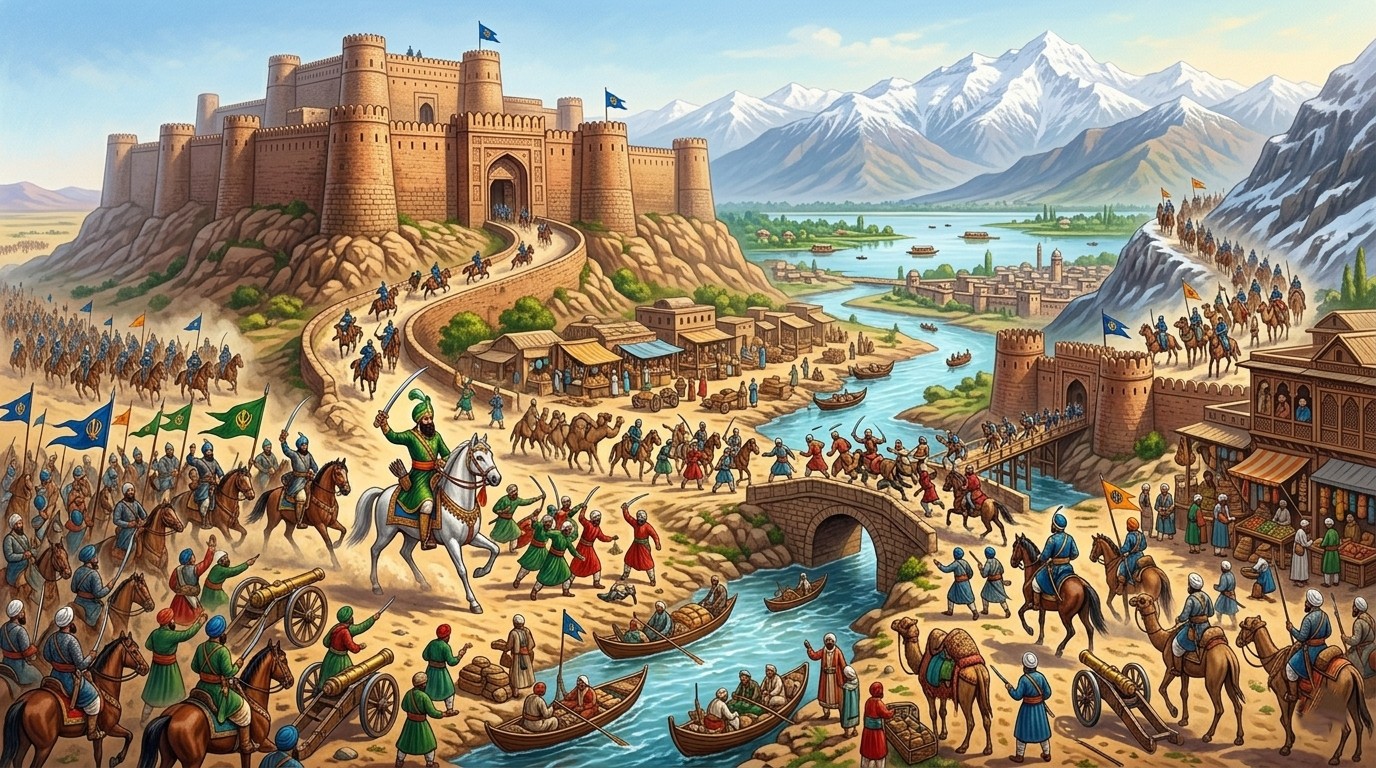
1818–1819 CE: The Annexations of Multan and Kashmir – The Expansion of the Sikh Empire to Its Greatest Heights
The years 1818 and 1819 stand among the most significant milestones in the history of the Sikh Empire. Within a remarkably short period, Maharaja Ranjit Singh's expanding kingdom achieved two of its greatest territorial victories: the annexation of Multan in 1818 and the conquest of Kashmir in 1819. These victories transformed the Sikh Empire from a powerful regional kingdom into one of the dominant states of Asia. The acquisitions not only expanded the empire's geographical boundaries but also brought under Sikh administration some of the most strategically important, economically prosperous, and historically significant territories in the northwestern subcontinent. The campaigns demonstrated the military effectiveness of the Khalsa Army, the administrative vision of Maharaja Ranjit Singh, and the exceptional leadership of commanders such as Diwan Mohkam Chand, Misr Diwan Chand, Hari Singh Nalwa, Akali Phula Singh, and numerous other distinguished generals who played vital roles in the empire's expansion.
As a Sikh historian, it is impossible to view the annexations of Multan and Kashmir merely as territorial acquisitions. They represented the culmination of a centuries-long journey that began with Guru Nanak Dev Ji's spiritual revolution and evolved through the institution-building efforts of the Sikh Gurus, the military transformation initiated by Guru Hargobind Ji and Guru Gobind Singh Ji, the sacrifices of Banda Singh Bahadur, and the resilience of the Misls during the eighteenth century. For generations, Sikhs had endured persecution, displacement, and repeated attempts at extermination. Yet by the second decade of the nineteenth century, they had become the rulers of an empire extending across vast territories. The victories in Multan and Kashmir symbolized not only military success but also the triumph of perseverance, leadership, and collective determination.
The Sikh Empire After the Victory at Attock
The annexations of Multan and Kashmir must be understood within the broader context of the rapid growth of the Sikh Empire following the capture of Lahore in 1799 and the Battle of Attock in 1813. Under Maharaja Ranjit Singh's leadership, Punjab had undergone a remarkable transformation. What had once been a landscape divided among competing Misls was now increasingly united under a centralized government capable of managing large territories and maintaining an effective military.
The victory at Attock had secured the empire's northwestern frontier and demonstrated the effectiveness of the Khalsa Army against powerful opponents. However, Maharaja Ranjit Singh recognized that true security required control of additional strategic regions. Multan and Kashmir were not merely neighboring territories; they were economic and political centers whose control would significantly strengthen the empire.
The Maharaja's vision extended beyond conquest for its own sake. He sought to create a stable and prosperous state capable of protecting its people, encouraging trade, and maintaining order across a diverse and expansive territory.
Why Multan Mattered
Multan was one of the oldest continuously inhabited cities in South Asia and possessed immense historical significance. Located along important trade routes connecting Central Asia, Punjab, Sindh, and the broader Indian subcontinent, the city had long served as a commercial hub. Merchants, travelers, scholars, and administrators passed through its markets and streets, contributing to its reputation as a center of wealth and influence.
Economically, Multan represented an attractive target for expansion. The region generated substantial revenue through agriculture, commerce, and taxation. Its fertile lands supported productive farming communities, while its strategic location facilitated trade across vast distances.
From a military perspective, control of Multan would eliminate a significant obstacle to Sikh expansion in southern Punjab and strengthen the empire's ability to project power toward Sindh and other neighboring regions.
The Challenge of Multan's Defenses
Despite its attractiveness as a target, Multan was not an easy city to conquer. The city was protected by formidable fortifications and defended by experienced forces under Nawab Muzaffar Khan. Previous attempts to exert influence over the region had encountered resistance, and any successful campaign would require careful planning and substantial resources.
The fortifications of Multan were among the strongest in the region. Thick walls, defensive positions, and determined defenders presented significant challenges to any attacking force. The city had a reputation for resilience and had successfully resisted numerous threats throughout its history.
Maharaja Ranjit Singh understood that conquering Multan would require a coordinated effort involving skilled commanders, disciplined troops, and effective siege tactics.
The Leadership of Diwan Mohkam Chand
Among the architects of Sikh military success during this period was Diwan Mohkam Chand, one of the most capable generals and administrators in the service of Maharaja Ranjit Singh. Although some campaigns involved multiple commanders, Mohkam Chand's contributions to the expansion and consolidation of the Sikh Empire were immense.
He possessed exceptional organizational abilities and demonstrated remarkable effectiveness in both military and administrative matters. His campaigns helped establish Sikh authority across numerous regions and strengthened the empire's foundations.
The military culture fostered by leaders such as Mohkam Chand emphasized discipline, strategic thinking, and adaptability. These qualities would prove essential as the empire pursued increasingly ambitious objectives.
The Campaign Against Multan
The final campaign against Multan in 1818 was one of the largest military operations undertaken by the Sikh Empire up to that point. The army assembled for the campaign included experienced infantry, cavalry, artillery units, and logistical support personnel. The operation reflected the growing sophistication of the Sikh military establishment.
The siege required patience, determination, and technical expertise. Artillery played an increasingly important role in breaching defensive structures, while coordinated assaults sought to exploit weaknesses in the city's defenses. The defenders fought with considerable courage, resulting in intense and prolonged combat.
Ultimately, Sikh forces succeeded in overcoming resistance and capturing the city. The fall of Multan represented a major strategic victory and significantly expanded the empire's influence.
The Death of Nawab Muzaffar Khan
The defense of Multan was marked by the determined resistance of Nawab Muzaffar Khan and his followers. Historical accounts describe fierce fighting and considerable sacrifice among the defenders. Muzaffar Khan ultimately lost his life during the struggle, bringing an end to his rule.
The conclusion of the campaign demonstrated both the effectiveness of Sikh military operations and the determination of local rulers to defend their territories. The victory enhanced the prestige of the Sikh Empire and confirmed its status as a major regional power.
Following the annexation, efforts were made to integrate Multan into the administrative structure of the empire and restore stability to the region.
The Economic Importance of Multan
The annexation of Multan brought substantial economic benefits to the Sikh Empire. The city's commercial networks generated valuable revenue, while agricultural production contributed to broader prosperity. Trade routes passing through the region connected Punjab with markets across Central Asia and the subcontinent.
The incorporation of Multan strengthened the empire's financial foundations and provided resources that could be invested in administration, infrastructure, and military modernization.
These economic gains played an important role in supporting the continued growth of the Sikh state.
The Strategic Value of Kashmir
If Multan represented commercial wealth, Kashmir represented both strategic and cultural significance. Known for its breathtaking natural beauty, fertile valleys, artisanal traditions, and strategic location, Kashmir had long attracted the attention of powerful rulers.
The region occupied a crucial position in the Himalayan frontier. Control of Kashmir offered access to important mountain routes and enhanced the empire's ability to manage relations with neighboring regions. It also provided valuable economic resources, including agriculture, handicrafts, and trade.
For Maharaja Ranjit Singh, the annexation of Kashmir would complete a major phase of imperial expansion and strengthen the empire's northern frontier.
Kashmir Under Afghan Rule
Before its annexation by the Sikh Empire, Kashmir had endured decades of Afghan rule. Many contemporary accounts describe periods of administrative difficulties, economic challenges, and public dissatisfaction. The region's population often faced heavy taxation and political instability.
The weakening position of Afghan authorities created an opportunity for intervention. Sikh leaders recognized that successful control of Kashmir would require not only military victory but also effective governance capable of addressing local concerns.
This dual focus on conquest and administration distinguished the broader strategy of the Sikh Empire.
Hari Singh Nalwa and the Frontier Tradition
Among the most celebrated figures associated with the expansion of the Sikh Empire was Hari Singh Nalwa. Renowned for his courage, leadership, and military achievements, Nalwa became one of the empire's most respected commanders.
His reputation extended far beyond Punjab. Both allies and adversaries recognized his abilities as a warrior and strategist. He played a vital role in securing frontier regions and defending the empire against external threats.
The campaigns of this period reflected the leadership qualities that made Hari Singh Nalwa one of the most iconic figures in Sikh military history.
The Conquest of Kashmir in 1819
The campaign against Kashmir culminated in 1819 with a decisive Sikh victory. The operation required navigating difficult terrain, coordinating military movements across mountainous regions, and overcoming determined opposition.
The success of the campaign demonstrated the growing capabilities of the Khalsa Army. No longer limited to the plains of Punjab, Sikh forces proved capable of conducting complex operations in challenging environments. Their victory established Sikh authority over one of the most strategically important regions in the north.
The annexation of Kashmir significantly expanded the geographical reach of the empire and enhanced its international stature.
The Administration of Newly Acquired Territories
Military victories alone could not guarantee lasting success. Maharaja Ranjit Singh understood the importance of effective administration and worked to integrate newly acquired territories into the empire's governing structure.
Officials were appointed to manage revenue collection, maintain law and order, oversee public works, and ensure stable governance. Efforts were made to encourage economic activity and strengthen local institutions.
This emphasis on administration helped transform conquered territories into productive and stable components of the Sikh Empire.
The Peak of Sikh Imperial Expansion
The annexations of Multan and Kashmir marked a major stage in the emergence of the Sikh Empire as a great power. Combined with earlier acquisitions and subsequent expansions, these victories created a vast and diverse state stretching across multiple geographic and cultural regions.
The empire now controlled fertile agricultural lands, major trade routes, strategic fortresses, and important population centers. Its influence extended across much of northwestern South Asia.
The achievements of this period reflected the extraordinary leadership of Maharaja Ranjit Singh and the dedication of countless soldiers, administrators, and citizens.
The Legacy of the Annexations
The legacy of the annexations of Multan and Kashmir extends far beyond military history. These victories demonstrated the ability of the Sikh Empire to govern diverse populations, manage complex territories, and compete successfully with other major powers of the era.
They also symbolized the remarkable transformation of the Sikh community over three centuries. What began as a spiritual movement under Guru Nanak had evolved into a powerful state capable of shaping regional history.
The annexations remain among the most significant achievements of the Sikh Empire and continue to occupy a central place in Sikh historical memory.
Conclusion
The annexations of Multan in 1818 and Kashmir in 1819 represent two of the greatest achievements of the Sikh Empire under Maharaja Ranjit Singh. These victories expanded the empire's territorial reach, strengthened its economic foundations, enhanced its strategic security, and elevated its status among the major powers of Asia. Guided by visionary leadership and supported by distinguished commanders such as Diwan Mohkam Chand, Hari Singh Nalwa, Misr Diwan Chand, and others, the Khalsa Army demonstrated extraordinary military capability and determination. The incorporation of Multan and Kashmir marked the arrival of the Sikh Empire at the height of its power and remains a lasting testament to the resilience, ambition, and statecraft of the Sikh people.
Frequently Asked Questions (FAQ)
1. Why were Multan and Kashmir important to the Sikh Empire?
Both regions were strategically valuable, economically prosperous, and critical for securing the empire's frontiers and trade networks.
2. When was Multan annexed by the Sikh Empire?
Multan was annexed in 1818 after a successful military campaign and siege.
3. When did the Sikh Empire conquer Kashmir?
Kashmir was annexed in 1819 following a successful military expedition.
4. Who ruled the Sikh Empire during these campaigns?
Maharaja Ranjit Singh led the Sikh Empire during both annexations.
5. Who was Hari Singh Nalwa?
Hari Singh Nalwa was one of the most celebrated generals of the Sikh Empire and played a major role in frontier expansion and defense.
6. Who was Diwan Mohkam Chand?
Diwan Mohkam Chand was a distinguished military commander and administrator who contributed significantly to the expansion of the Sikh Empire.
7. Why was Multan difficult to conquer?
Multan possessed strong fortifications, experienced defenders, and a strategic location that made military operations challenging.
8. What economic benefits came from annexing Multan?
The city provided access to important trade routes, agricultural revenue, and commercial wealth.
9. How did the conquest of Kashmir affect the empire?
It strengthened the northern frontier, expanded territorial control, and enhanced the empire's strategic position.
10. What is the historical significance of these annexations?
They marked the emergence of the Sikh Empire as a major regional power and represented the height of its territorial expansion under Maharaja Ranjit Singh.