Historical Turning Points · Empire & Struggle
1834 Conquest of Peshawar
General Hari Singh Nalwa annexed Peshawar, the gateway to the Khyber Pass. This victory pushed the borders of India to the Afghan frontier and permanently halted centuries of West-Asian invasions into the subcontinent.
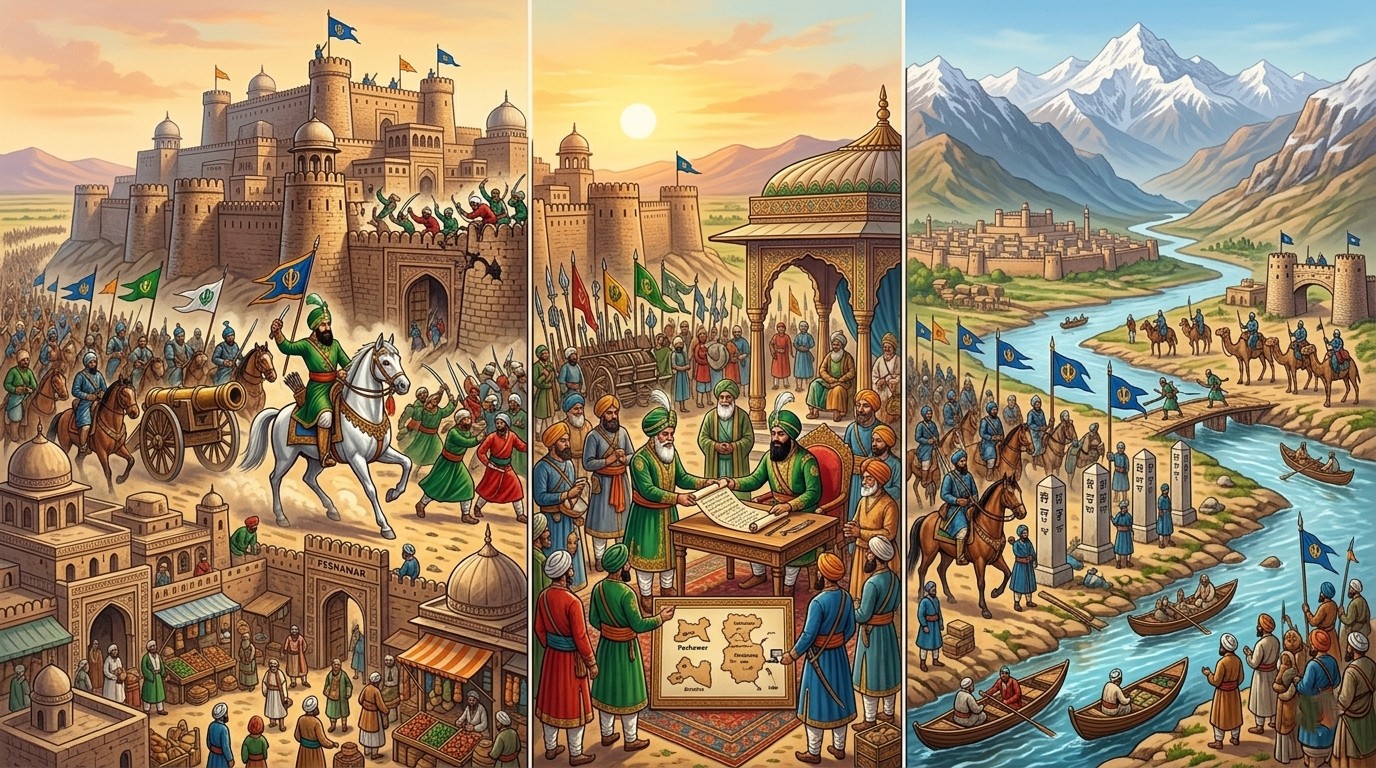
1834 CE: The Conquest of Peshawar and the Closing of the Gateway of Invasions
The year 1834 CE occupies a monumental place in the military, political, and civilizational history of the Indian subcontinent. It was in this year that General Hari Singh Nalwa, the legendary commander of the Sikh Empire under Maharaja Ranjit Singh, successfully annexed Peshawar, one of the most strategic cities in Asia and the historic gateway to the Khyber Pass. This achievement was not merely another territorial conquest. It represented the culmination of centuries of resistance against repeated invasions that had entered India through the northwestern frontier. The conquest transformed the geopolitical map of the region, extended the authority of the Sikh Empire to the very edge of Afghanistan, and established a defensive shield that permanently altered the balance of power in the northwest. For generations, the plains of India had witnessed the arrival of invading armies from Central Asia and West Asia. From Mahmud of Ghazni and Muhammad Ghori to Timur, Babur, Nadir Shah, and Ahmad Shah Durrani, countless conquerors had crossed through the Khyber Pass and Peshawar on their way into the heart of India. The capture of Peshawar by Hari Singh Nalwa marked a historic reversal of this pattern. For the first time in many centuries, an indigenous Indian power had not merely resisted invaders but had carried its authority to the very frontier from which invasions traditionally emerged.
The Historical Importance of Peshawar
Peshawar was far more than a provincial city. Situated near the entrance of the Khyber Pass, it occupied one of the most critical strategic positions in Eurasia. For thousands of years, armies, traders, travelers, pilgrims, and conquerors had passed through this corridor linking Central Asia with the Indian subcontinent. Whoever controlled Peshawar effectively controlled the principal gateway between Afghanistan and India. Ancient empires understood its significance. The Persians, Greeks, Kushans, Ghaznavids, Ghurids, Mughals, Durranis, and numerous tribal confederacies all sought dominion over the city because of its strategic location. Throughout medieval and early modern history, Peshawar served as the staging ground for invasions into northern India. Invading armies would gather supplies, recruit local allies, and prepare their campaigns from this frontier city before descending upon the rich agricultural and urban centers of the Punjab and the Gangetic plains. Consequently, the city became synonymous with both opportunity and danger. To secure India from future invasions, control of Peshawar was essential. The Sikh leadership understood this reality with remarkable clarity.
The Rise of the Sikh Empire
The conquest of Peshawar cannot be understood without appreciating the extraordinary rise of the Sikh Empire under Maharaja Ranjit Singh. Emerging from the turbulent period that followed the decline of Mughal authority and the repeated devastations caused by Afghan invasions, Ranjit Singh united the Sikh misls into a powerful and centralized state. His vision extended beyond simple survival. He sought to establish stability, prosperity, and security across Punjab while protecting the region from external threats. Through military modernization, administrative reforms, diplomatic skill, and strategic expansion, he transformed the Sikh Empire into one of the strongest states in Asia. By the early nineteenth century, the empire stretched across vast territories and commanded a disciplined army equipped with modern artillery and trained infantry. Among the Maharaja's most trusted commanders, none achieved greater fame than Hari Singh Nalwa, whose military genius and fearless leadership became legendary across the frontier.
Hari Singh Nalwa: The Lion of the Frontier
General Hari Singh Nalwa remains one of the most celebrated military figures in Sikh history. Born in 1791, he displayed exceptional courage and leadership from a young age. His title "Nalwa" is traditionally associated with a famous incident in which he reportedly slew a tiger with his bare hands, symbolizing his extraordinary bravery. Over the course of his career, he led numerous campaigns that expanded and secured the Sikh Empire's frontiers. His reputation became so formidable that stories of his exploits spread across Afghanistan and the tribal regions beyond the Khyber. Parents were said to invoke his name to discipline unruly children, while enemy warriors viewed him with a mixture of fear and respect. Yet his greatness lay not merely in personal courage. Hari Singh Nalwa was a strategist who understood the political complexities of the frontier. He recognized that lasting security required not temporary victories but the establishment of effective governance, fortified defenses, and stable administration in conquered territories.
The Struggle for Control of the Frontier
Before the annexation of Peshawar, the northwestern frontier was a contested zone characterized by shifting alliances, tribal rivalries, and competing claims from Afghan rulers. The decline of the Durrani Empire created opportunities for regional powers to assert themselves, but it also generated instability. Afghan chiefs continued to view Punjab as a target for raids and influence, while the Sikh Empire sought to establish secure borders. The struggle for Peshawar unfolded over several years and involved multiple military campaigns. Sikh forces gradually weakened Afghan influence in the region through a combination of battlefield victories, political negotiations, and strategic pressure. The decisive objective was clear: control of Peshawar would deny hostile forces a launching point for future invasions and would place the Sikh Empire in command of the historic gateway to India.
The Annexation of Peshawar in 1834
In 1834, Hari Singh Nalwa successfully annexed Peshawar, bringing the city firmly under Sikh authority. This achievement represented one of the crowning accomplishments of the Sikh Empire. The annexation was not simply a military occupation but the establishment of effective sovereignty. Sikh administration was introduced, defenses were strengthened, and the authority of Lahore extended to the frontier. The conquest demonstrated the organizational strength of the empire and the effectiveness of its military system. It also sent a powerful message throughout the region: the era in which invading forces could freely descend through the northwest into India was ending. By securing Peshawar, the Sikh Empire transformed the strategic landscape. Instead of defending the interior after invasions had already begun, the frontier itself became the primary line of defense.
The Khyber Pass and the End of an Era
The significance of controlling Peshawar was inseparable from control of the Khyber Pass. This mountain corridor had served as the principal invasion route into India for centuries. Geography dictated its importance. The rugged terrain of the surrounding region channeled movement through a limited number of passes, of which the Khyber was the most famous and practical for large armies. Countless invasions that reshaped Indian history had utilized this route. The conquest of Peshawar enabled the Sikh Empire to monitor, regulate, and defend access to the pass. Fortifications were strengthened, military outposts established, and frontier defenses coordinated under capable leadership. The result was a dramatic reduction in the vulnerability that had plagued northern India for generations. Historians often view the annexation as the symbolic closing of the traditional invasion corridor through which so many conquerors had entered the subcontinent.
Military Administration and Frontier Security
Hari Singh Nalwa understood that victory on the battlefield was only the first step. Lasting security required effective administration. Following the annexation, efforts were made to consolidate authority, maintain law and order, and strengthen defensive infrastructure. Forts were repaired and expanded, supply lines secured, and military garrisons positioned at strategic locations. Nalwa pursued policies designed to discourage raids and establish stable governance. His administration combined firmness with practicality, recognizing the complexities of frontier society. By creating a robust defensive system, he ensured that the Sikh Empire's authority extended beyond mere symbolic control. The frontier became an organized zone of security rather than a vulnerable borderland exposed to constant threats.
The Psychological Impact of the Victory
The conquest of Peshawar had profound psychological consequences. For centuries, many communities in northern India had lived with the memory and reality of invasions arriving from the northwest. The success of Hari Singh Nalwa represented a reversal of historical expectations. Instead of waiting for external powers to dictate events, an Indian empire had asserted control over the frontier itself. This achievement fostered confidence, pride, and a sense of security among the empire's subjects. It demonstrated that indigenous political and military institutions could not only resist foreign aggression but also establish dominance in regions long associated with external threats. The symbolic power of this accomplishment resonated far beyond Punjab and contributed to the enduring legacy of the Sikh Empire.
Relations with Afghanistan
The annexation inevitably affected relations with Afghan rulers and tribal groups. The Sikh Empire's expansion to the Afghan frontier altered traditional patterns of influence and challenged long-standing assumptions about regional power. While tensions and conflicts continued, the balance had shifted significantly. Afghan leaders could no longer assume uncontested access to the routes leading into India. The Sikh Empire had established itself as a formidable frontier power capable of defending its interests. This new reality compelled neighboring states and tribal confederacies to recognize the military and political strength of the empire. The frontier became a zone where authority was actively asserted and defended rather than merely contested.
The Legacy of Hari Singh Nalwa
The legacy of Hari Singh Nalwa extends far beyond the events of 1834. He is remembered not only as a brilliant military commander but also as a guardian of the frontier who fundamentally transformed the strategic position of the Indian subcontinent. His leadership exemplified courage, discipline, vision, and determination. By securing Peshawar and strengthening the northwestern defenses, he helped create conditions of stability that benefited the Sikh Empire and its people. His reputation survived long after his death, becoming part of the collective memory of Sikh history. To this day, he is celebrated as one of the greatest warriors and frontier commanders produced by the subcontinent.
A Turning Point in Indian History
The conquest of Peshawar stands as one of the defining moments in nineteenth-century Indian history. Its importance cannot be measured solely in territorial terms. The annexation represented the culmination of a long historical struggle over the northwestern gateway to India. By bringing Peshawar under Sikh authority, Hari Singh Nalwa and the Sikh Empire achieved what many earlier powers had sought but failed to sustain: effective control of the frontier through which centuries of invasions had entered the subcontinent. The victory altered strategic realities, strengthened regional security, and demonstrated the capabilities of an indigenous empire at the height of its power. Although later political developments would reshape the region, the achievement of 1834 remains a landmark event that symbolizes resilience, statecraft, and military excellence.
Conclusion
The annexation of Peshawar in 1834 was one of the greatest achievements of the Sikh Empire and one of the most consequential frontier victories in South Asian history. Under the leadership of General Hari Singh Nalwa and the vision of Maharaja Ranjit Singh, the Sikh state extended its authority to the very edge of Afghanistan and secured the gateway to the Khyber Pass. This accomplishment carried immense military, political, and symbolic significance. It marked a dramatic reversal of centuries during which invasions had repeatedly flowed into India from the northwest. By fortifying the frontier and establishing effective control over Peshawar, the Sikh Empire created a defensive barrier that changed the strategic landscape of the region. The conquest remains a powerful testament to the courage of Hari Singh Nalwa, the strength of the Sikh Empire, and the enduring importance of frontier security in shaping the history of the Indian subcontinent.
Frequently Asked Questions (FAQ)
1. Why was Peshawar strategically important in 1834?
Peshawar controlled access to the Khyber Pass, the principal route connecting Afghanistan and Central Asia with the Indian subcontinent. Whoever controlled Peshawar held a crucial military and commercial gateway.
2. Who annexed Peshawar in 1834?
General Hari Singh Nalwa, acting under the authority of Maharaja Ranjit Singh and the Sikh Empire, annexed Peshawar in 1834.
3. Who was Hari Singh Nalwa?
Hari Singh Nalwa was one of the most distinguished generals of the Sikh Empire, renowned for his military leadership, frontier administration, and victories against Afghan forces.
4. Why is the conquest of Peshawar considered historic?
The conquest secured the northwestern frontier, extended Sikh authority to the Afghan border, and represented a major shift in regional power dynamics.
5. What role did Maharaja Ranjit Singh play in the conquest?
Maharaja Ranjit Singh provided the political vision, military organization, and state support that enabled commanders such as Hari Singh Nalwa to expand and secure the empire's frontiers.
6. What is the Khyber Pass?
The Khyber Pass is a mountain corridor linking present-day Afghanistan and Pakistan. Historically, it served as one of the most important invasion and trade routes into the Indian subcontinent.
7. Did the conquest end all invasions into India?
The conquest significantly strengthened frontier defenses and curtailed the traditional pattern of large-scale invasions through the northwest, though historical interpretations may vary regarding the extent and permanence of this effect.
8. How did the Sikh Empire administer Peshawar after annexation?
The empire established military garrisons, strengthened fortifications, maintained law and order, and integrated the city into its broader administrative framework.
9. Why is Hari Singh Nalwa remembered as a frontier hero?
He successfully defended and expanded the empire's borders, secured strategic territories, and earned a reputation for exceptional courage and military skill.
10. What is the lasting legacy of the 1834 conquest of Peshawar?
The conquest symbolizes the strength of the Sikh Empire, the effectiveness of frontier defense, and the achievement of extending Indian political authority to the Afghan frontier during the nineteenth century.