Historical Turning Points · Empire & Struggle
1837 Battle of Jamrud
In a fierce defensive stand against Afghan forces, the legendary general Hari Singh Nalwa was martyred while successfully holding the fort.
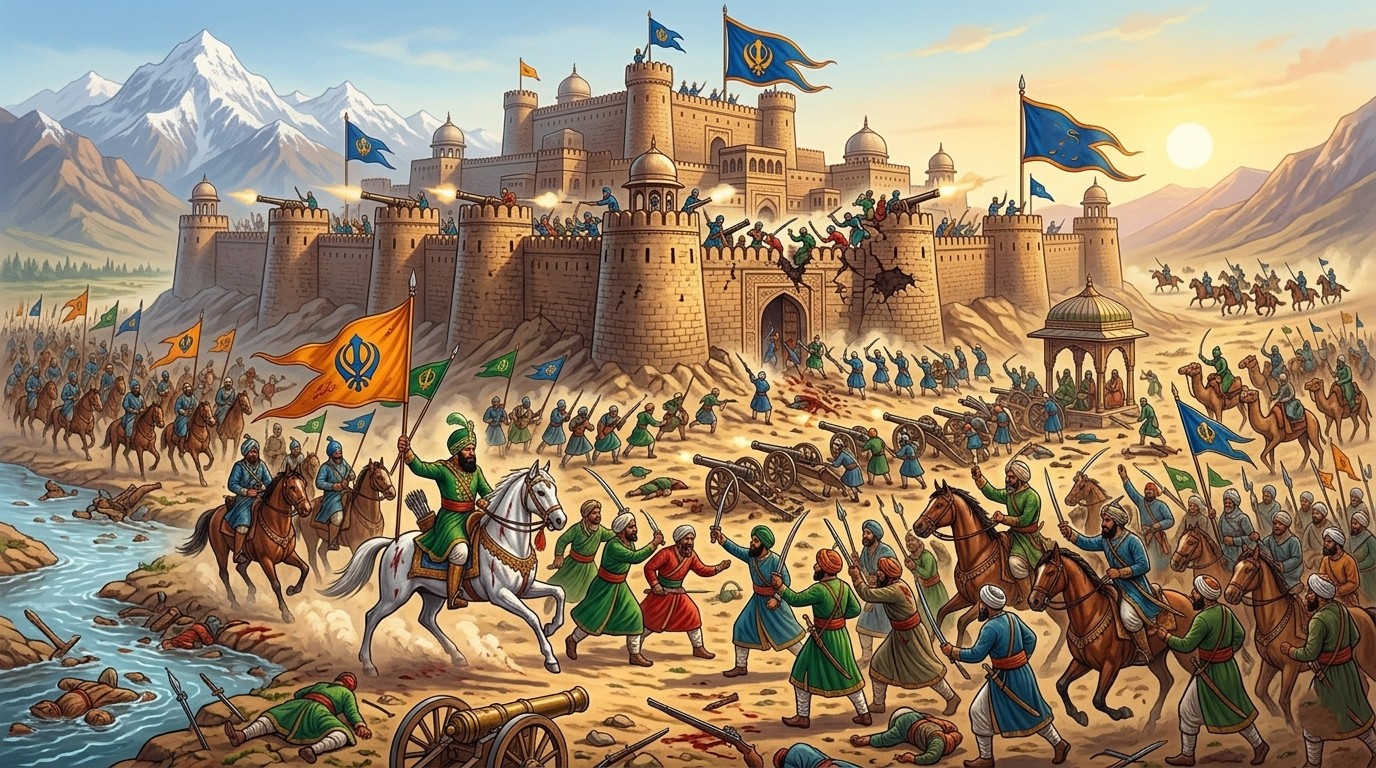
1837 CE: The Battle of Jamrud and the Martyrdom of Hari Singh Nalwa
The Battle of Jamrud in 1837 CE stands among the most dramatic and consequential military engagements in the history of the Sikh Empire. Fought on the rugged frontier between the Sikh Empire and Afghanistan, the battle represented far more than a clash between two armies. It was a struggle for control of the gateway to the Khyber Pass, a region that had shaped the destiny of the Indian subcontinent for centuries. At the center of this epic confrontation stood one of the greatest military commanders ever produced by the Sikh Empire: General Hari Singh Nalwa. Revered for his courage, feared by his enemies, and respected throughout the frontier, Nalwa had spent much of his life securing the northwestern borders of the Sikh state. At Jamrud, he would make his final stand. Though he was mortally wounded and attained martyrdom during the conflict, the fort remained in Sikh hands, and the Afghan offensive failed to achieve its objective. As a result, the battle became both a symbol of heroic sacrifice and a landmark victory in the defense of the Sikh Empire's western frontier.
The Strategic Importance of Jamrud
To understand the significance of the Battle of Jamrud, one must first appreciate the strategic value of the location itself. Jamrud was situated at the eastern entrance of the Khyber Pass, one of the most famous and historically important mountain passages in the world. For centuries, this corridor had connected Central Asia and Afghanistan with the plains of northern India. Through this route marched conquerors such as Mahmud of Ghazni, Muhammad Ghori, Timur, Babur, Nadir Shah, and Ahmad Shah Durrani. The Khyber Pass was not merely a road; it was the traditional gateway through which invading armies entered the subcontinent. By the 1830s, the Sikh Empire under Maharaja Ranjit Singh had expanded its authority westward and secured Peshawar. To protect this crucial conquest, the Sikhs constructed and fortified Jamrud, creating a defensive outpost that guarded the entrance to the pass. Whoever controlled Jamrud possessed the ability to monitor and influence movement through one of Asia's most critical strategic corridors.
The Frontier Policy of Maharaja Ranjit Singh
The Battle of Jamrud was the result of a broader strategic vision pursued by Maharaja Ranjit Singh. Having witnessed the devastation caused by repeated invasions from the northwest, the Maharaja sought to establish a strong and defensible frontier. Rather than waiting for enemies to enter Punjab, he aimed to secure the gateways through which invasions traditionally arrived. This policy led to the expansion of Sikh authority across the frontier regions and culminated in the annexation of Peshawar in 1834. To maintain this territorial gain, military forts were constructed and garrisoned throughout the region. Jamrud became one of the most important of these strongholds. It represented the forward edge of Sikh power and symbolized the determination of the empire to defend its territory against external threats. Maharaja Ranjit Singh entrusted this critical frontier to Hari Singh Nalwa, whose reputation for military excellence made him uniquely suited for the challenge.
Hari Singh Nalwa: Defender of the Frontier
By 1837, Hari Singh Nalwa had already earned legendary status throughout the Sikh Empire and beyond. His military career was marked by extraordinary victories, fearless leadership, and unwavering dedication to the state. He had participated in numerous campaigns that expanded Sikh authority and secured vulnerable regions. His success against Afghan forces was particularly notable. Through a combination of tactical brilliance, personal courage, and administrative competence, he established order in territories that had long been characterized by instability. The mere mention of his name inspired confidence among Sikh soldiers and caution among adversaries. Yet Nalwa's greatness was not based solely on battlefield achievements. He understood the importance of governance, fortification, and long-term security. His efforts transformed the frontier from a vulnerable borderland into a defensible region capable of resisting external aggression.
The Afghan Response
The expansion of Sikh influence into Peshawar and the construction of Jamrud alarmed Afghan leaders. Among them was Dost Mohammad Khan, the ruler of Afghanistan, who viewed Sikh control of these territories as a direct challenge to Afghan influence in the region. The loss of Peshawar was particularly painful because the city had long held political, economic, and symbolic significance for Afghan rulers. Determined to reverse Sikh gains, Afghan leaders sought opportunities to reclaim their lost influence. In 1837, a large Afghan force advanced toward Jamrud with the intention of challenging Sikh authority and reopening the path toward Peshawar. The confrontation that followed would become one of the most famous battles in frontier history.
The Siege and Battle of Jamrud
The Afghan offensive placed immense pressure on the defenders of Jamrud. The fort was manned by a relatively small Sikh garrison compared to the size of the attacking force. Despite this disadvantage, the defenders refused to surrender. Their determination reflected not only military discipline but also an understanding of the strategic importance of their position. If Jamrud fell, the security of Peshawar and the broader frontier could be endangered. The Afghan army launched repeated assaults, seeking to overwhelm the defenders and capture the fort. Fierce fighting erupted around the fortifications as Sikh soldiers resisted with remarkable tenacity. Every defensive position became a point of struggle, and the battle soon evolved into a test of endurance, courage, and leadership.
The Arrival of Hari Singh Nalwa
When news of the Afghan attack reached Hari Singh Nalwa, he immediately recognized the gravity of the situation. Despite suffering from illness and facing significant personal risk, he moved to support the defenders. His presence had an electrifying effect on Sikh morale. Soldiers who had already demonstrated extraordinary resilience found renewed determination under the leadership of their legendary commander. Nalwa understood that the defense of Jamrud was not merely a local engagement. It was a battle that would influence the future security of the frontier and the prestige of the Sikh Empire. He therefore committed himself fully to the struggle, despite the dangers involved.
The Martyrdom of a Legend
During the fierce fighting, Hari Singh Nalwa was gravely wounded. Historical accounts differ in certain details, but they consistently agree that he sustained fatal injuries while directing the defense and resisting the Afghan assault. Even after being wounded, efforts were made to conceal the severity of his condition from the enemy. Sikh commanders understood that news of Nalwa's death could embolden Afghan forces and weaken the morale of the defenders. Consequently, his condition was carefully managed while the defense continued. Eventually, Hari Singh Nalwa attained martyrdom, sacrificing his life in the service of the Sikh Empire. His death marked the end of one of the most remarkable military careers in South Asian history. Yet his sacrifice was not in vain. The fort remained unconquered, and the Afghan offensive failed to secure its primary objective.
The Successful Defense of Jamrud
Although the loss of Hari Singh Nalwa was a devastating blow, the Sikh defenders achieved their central mission. Jamrud remained under Sikh control despite repeated Afghan attacks. The fort's survival demonstrated the effectiveness of Sikh military organization and the resilience of its soldiers. Afghan forces were unable to achieve a decisive breakthrough, and their hopes of reversing Sikh gains on the frontier were frustrated. The defense of Jamrud therefore stands as a remarkable example of a smaller force successfully resisting a larger adversary through determination, discipline, and strategic leadership. The outcome reinforced Sikh authority in the region and preserved the defensive barrier that protected Peshawar and the Punjab.
The Psychological and Political Impact
The Battle of Jamrud carried profound psychological significance for both sides. For the Sikh Empire, the successful defense of the fort affirmed the strength of its frontier system and demonstrated that even the loss of a legendary commander would not immediately compromise its military effectiveness. The battle became a source of inspiration and pride, symbolizing the willingness of Sikh soldiers to sacrifice everything in defense of their homeland. For Afghan leaders, the inability to capture Jamrud highlighted the challenges of confronting a well-organized and determined frontier defense. Although the death of Hari Singh Nalwa was celebrated by some Afghan factions, the strategic objective of breaking Sikh control over the frontier remained unfulfilled.
The End of an Extraordinary Career
Hari Singh Nalwa's martyrdom at Jamrud marked the conclusion of an extraordinary chapter in Sikh military history. Throughout his life, he had been at the forefront of campaigns that expanded and defended the Sikh Empire. He played a crucial role in securing Kashmir, Hazara, Multan, Peshawar, and numerous frontier regions. His leadership combined battlefield courage with administrative vision, enabling the Sikh Empire to establish lasting authority in strategically vital territories. His death created a void that was difficult to fill. Few commanders possessed his combination of experience, charisma, and strategic insight. Yet his achievements ensured that his legacy would endure long after his passing.
The Legacy of the Battle
The Battle of Jamrud occupies a unique place in Sikh memory because it embodies both victory and sacrifice. On one hand, the defenders succeeded in holding the fort and preserving Sikh control over the frontier. On the other hand, the empire lost one of its greatest military leaders. This dual legacy gives the battle a powerful emotional resonance. It serves as a reminder that strategic success often carries a heavy human cost. The courage displayed by Hari Singh Nalwa and the defenders of Jamrud continues to inspire generations who study the history of the Sikh Empire. Their stand demonstrated that determination, unity, and sacrifice could overcome overwhelming odds.
Historical Significance in the Wider Context
The significance of Jamrud extends beyond Sikh history. The battle formed part of a broader struggle for control of the northwestern frontier, a region that had influenced the political development of South Asia for centuries. By holding Jamrud, the Sikh Empire maintained its defensive position at the entrance of the Khyber Pass and preserved a strategic reality established through years of military effort. The battle illustrated the importance of frontier security in shaping the fate of states and civilizations. It also highlighted the role of capable leadership in determining the outcome of critical moments in history. Hari Singh Nalwa's actions at Jamrud exemplify how individual courage and strategic vision can influence events of lasting consequence.
Conclusion
The Battle of Jamrud in 1837 CE remains one of the most celebrated episodes in the history of the Sikh Empire. Fought at the threshold of the Khyber Pass, it represented a decisive effort to defend the frontier against a determined Afghan offensive. At the center of the struggle stood Hari Singh Nalwa, whose leadership inspired the defenders and whose sacrifice became legendary. Though he attained martyrdom during the battle, the fort remained secure, the Afghan advance was checked, and Sikh authority on the frontier endured. The battle therefore stands as both a military success and a profound story of sacrifice. It symbolizes the determination of the Sikh Empire to defend its hard-won gains and honors the memory of one of the greatest generals in South Asian history. Nearly two centuries later, the courage displayed at Jamrud continues to resonate as a testament to duty, resilience, and unwavering commitment to the defense of one's homeland.
Frequently Asked Questions (FAQ)
1. What was the Battle of Jamrud?
The Battle of Jamrud was a major military engagement fought in 1837 between Sikh forces and Afghan forces near the entrance of the Khyber Pass.
2. Why was Jamrud strategically important?
Jamrud guarded the eastern entrance to the Khyber Pass, a historic route connecting Afghanistan and Central Asia with the Indian subcontinent.
3. Who commanded the Sikh forces at Jamrud?
General Hari Singh Nalwa was the principal Sikh commander associated with the defense of Jamrud and the broader frontier region.
4. Who was Hari Singh Nalwa?
Hari Singh Nalwa was one of the most renowned generals of the Sikh Empire and a key architect of its northwestern frontier defenses.
5. How did Hari Singh Nalwa die?
He sustained fatal wounds during the fierce fighting associated with the defense of Jamrud and attained martyrdom while serving the Sikh Empire.
6. Did the Sikhs win the Battle of Jamrud?
The Sikh defenders successfully held the fort and prevented the Afghan forces from achieving their primary objective, making the defense a strategic success.
7. Who led the Afghan side during this period?
Dost Mohammad Khan, the ruler of Afghanistan, was the leading Afghan figure seeking to challenge Sikh control of frontier territories.
8. Why is Hari Singh Nalwa considered a legendary figure?
He is remembered for his military victories, frontier administration, fearless leadership, and his role in securing the western borders of the Sikh Empire.
9. What impact did the battle have on the Sikh Empire?
The battle preserved Sikh control over Jamrud and the frontier, although the empire suffered the irreplaceable loss of one of its greatest commanders.
10. Why is the Battle of Jamrud still remembered today?
It symbolizes courage, sacrifice, frontier defense, and the enduring legacy of Hari Singh Nalwa, whose martyrdom became one of the most revered episodes in Sikh history.