Historical Turning Points · Empire & Struggle
1845–1846 First Anglo-Sikh War
Following the death of Maharaja Ranjit Singh in 1839, political instability fractured the Lahore Court. Due to the betrayal and treachery of commanders Lal Singh and Tej Singh, the Khalsa Army lost a series of bloody battles (Mudki, Ferozeshah, and Sobraon).
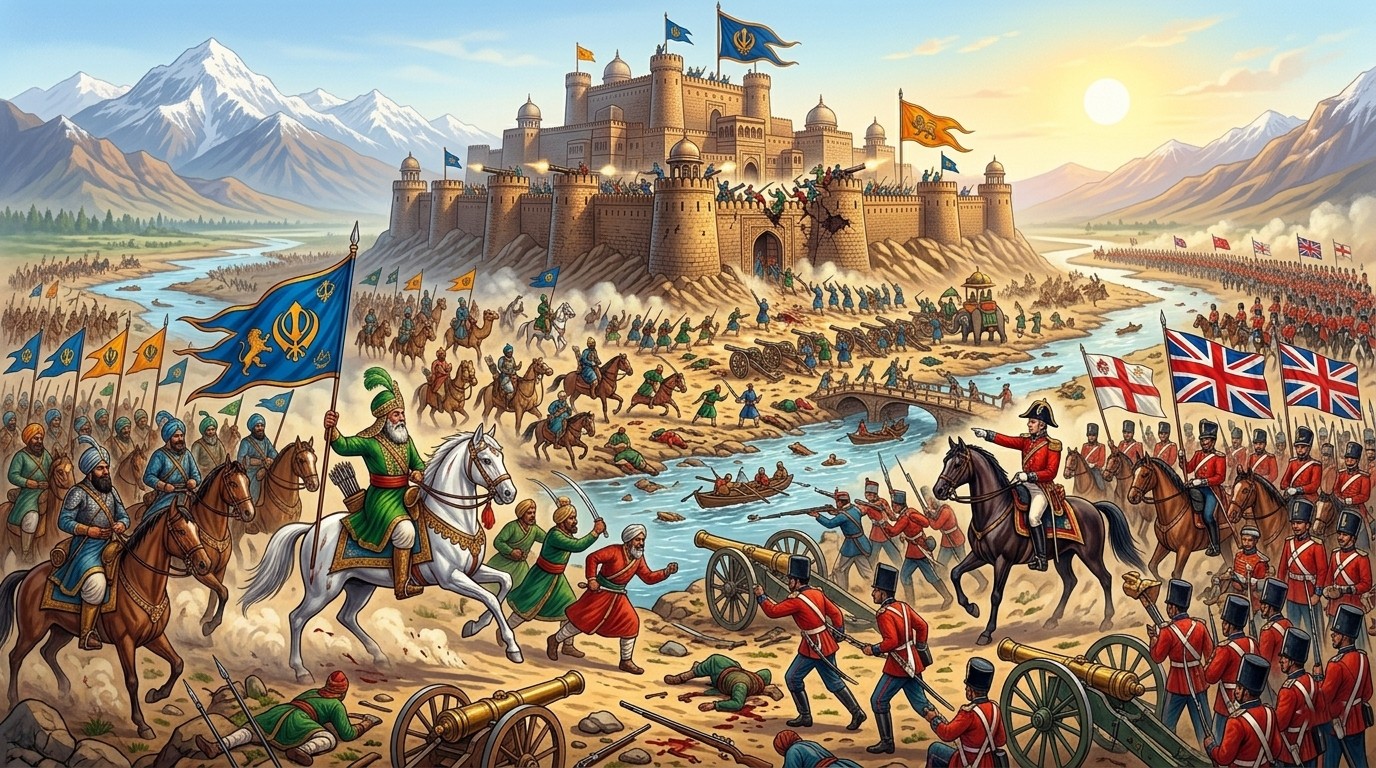
The First Anglo-Sikh War (1845–1846 CE): Betrayal, Sacrifice, and the Fall of Sikh Sovereignty
The First Anglo-Sikh War of 1845–1846 stands as one of the most tragic and consequential chapters in Sikh history. It was not merely a military conflict between the Sikh Empire and the British East India Company; it was a struggle shaped by political intrigue, internal betrayal, imperial ambition, and extraordinary courage on the battlefield. For the Sikh nation, the war represented the beginning of the end of the sovereign empire painstakingly built by Maharaja Ranjit Singh. While British historians often portrayed the conflict as a contest between two expanding powers, Sikh historical memory remembers it as a catastrophe brought about not by a lack of bravery among the Khalsa soldiers but by treachery within the highest levels of the Lahore Darbar. The sacrifices made by the Khalsa Army during the battles of Mudki, Ferozeshah, Aliwal, and Sobraon remain among the most remarkable examples of military courage in South Asian history.
The Legacy of Maharaja Ranjit Singh and the Crisis After His Death
To understand the First Anglo-Sikh War, one must first appreciate the immense achievement of Maharaja Ranjit Singh. By the early nineteenth century, he had unified the various Sikh misls into a powerful kingdom stretching from the Khyber Pass to the Sutlej River and from Kashmir to Multan. His empire was one of the strongest states in Asia and the only major Indian power capable of resisting British expansion. Through military modernization, diplomatic skill, and religious tolerance, Maharaja Ranjit Singh transformed Punjab into a prosperous and stable kingdom. The Khalsa Army became one of the finest military forces in the world, trained by European officers and equipped with modern artillery.
However, the death of Maharaja Ranjit Singh in 1839 created a vacuum that proved impossible to fill. Unlike the founder of the empire, his successors lacked both authority and political skill. A series of assassinations, palace conspiracies, and factional rivalries engulfed Lahore. Maharaja Kharak Singh died shortly after succeeding his father. His son Nau Nihal Singh also died under mysterious circumstances. Sher Singh eventually gained the throne but was assassinated in 1843. By the mid-1840s, the Lahore Court had become a battleground of competing interests involving royal claimants, aristocratic families, military leaders, and ambitious courtiers.
The Khalsa Army, conscious of its role as the defender of Sikh sovereignty, increasingly emerged as a political force. Soldiers feared that corrupt courtiers and nobles were undermining the state that Maharaja Ranjit Singh had built. At the same time, the British East India Company observed these developments with growing interest. British forces were steadily concentrated along the Sutlej frontier, creating widespread suspicion among Sikhs that an invasion of Punjab was being prepared.
The Rise of Lal Singh and Tej Singh
Among the most controversial figures of this period were Raja Lal Singh and Raja Tej Singh. Lal Singh served as the Wazir, or prime minister, while Tej Singh occupied a leading military position. Both men wielded enormous influence at the Lahore Court during the years immediately preceding the war. Sikh historical traditions and numerous contemporary accounts have long accused them of secretly collaborating with British authorities and deliberately sabotaging the Sikh war effort.
The allegations against these commanders are not simply the products of later nationalist sentiment. Historical evidence indicates that both men maintained secret communications with British officials during the conflict. Their actions on the battlefield repeatedly raised questions among Sikh soldiers and observers alike. Orders were delayed, opportunities for victory were squandered, and critical moments often saw inexplicable withdrawals or failures to reinforce engaged troops. While historians continue to debate the full extent of their betrayal, there is little doubt that their conduct profoundly damaged Sikh military effectiveness.
The tragedy of the First Anglo-Sikh War lies in the contrast between the courage displayed by ordinary Khalsa soldiers and the questionable leadership provided by some of their highest commanders. Time and again, Sikh troops demonstrated extraordinary discipline and fighting spirit, only to find their sacrifices undermined by decisions made at the highest levels.
British Preparations and the Road to War
Throughout the early 1840s, British military preparations along the Punjab frontier intensified. New cantonments were established, troops were reinforced, and logistical infrastructure was expanded. To many Sikhs, these actions appeared unmistakably threatening. The British East India Company had already defeated the Marathas, Mysore, and numerous regional powers. Punjab remained one of the few independent states capable of resisting British domination.
The atmosphere along the frontier became increasingly tense. The Sutlej River served as the boundary between the Sikh Empire and British-controlled territory. Mutual suspicion and military mobilization created conditions in which conflict became increasingly likely. In December 1845, Khalsa forces crossed the Sutlej, initiating open warfare. Although historians continue to debate responsibility for the outbreak of hostilities, there is broad agreement that both sides had been preparing for conflict long before the first shots were fired.
The Battle of Mudki (18 December 1845)
The first major engagement of the war occurred at Mudki on 18 December 1845. British forces under Sir Hugh Gough and Governor-General Sir Henry Hardinge encountered the advancing Khalsa Army. The battle was fierce and chaotic. Sikh artillery inflicted significant casualties upon the British, while Khalsa infantry fought with remarkable determination.
Many British officers later acknowledged the formidable quality of Sikh resistance at Mudki. The Khalsa Army demonstrated tactical competence, discipline, and courage equal to any force the British had faced in India. Yet despite these strengths, the battle ended without a decisive Sikh victory. Critics later argued that Lal Singh failed to exploit British vulnerabilities and withdrew forces when opportunities for greater success existed. Whether motivated by incompetence or deliberate treachery, his actions prevented the Khalsa Army from capitalizing fully on its battlefield performance.
The battle revealed an important reality that would characterize the entire war: British victories would come at tremendous cost. The Sikh soldier was not an inferior opponent. On the contrary, British troops repeatedly found themselves confronting one of the most effective military forces in Asia.
The Battle of Ferozeshah (21–22 December 1845)
Just days after Mudki, the opposing armies clashed again at Ferozeshah. This battle became one of the bloodiest encounters of the entire war and nearly resulted in a British disaster. Sikh defensive positions were exceptionally strong, protected by extensive fortifications and powerful artillery batteries. British assaults encountered devastating resistance.
Throughout the fighting, Khalsa gunners and infantrymen inflicted severe casualties upon British forces. Entire British units were shattered by concentrated artillery fire. At several points during the engagement, British commanders feared complete defeat. Governor-General Hardinge reportedly prepared for the possibility of capture or destruction.
Yet once again, leadership failures undermined Sikh prospects. Lal Singh's conduct during the battle remains one of the most controversial episodes of the war. Rather than coordinating a decisive effort to annihilate exhausted British forces, his actions contributed to confusion and missed opportunities. Many Sikh soldiers believed victory had been within reach. British survival at Ferozeshah owed much not only to determination but also to the inability of Sikh leadership to exploit favorable circumstances.
For the Khalsa Army, Ferozeshah demonstrated both its strength and its tragedy. Ordinary soldiers fought magnificently, but the strategic advantages gained through their sacrifices were squandered.
The Battle of Aliwal (28 January 1846)
The campaign continued into early 1846. At Aliwal, British forces under Sir Harry Smith confronted Sikh troops in another major engagement. The battle showcased the professionalism and bravery of the Khalsa Army, but it also exposed growing problems in coordination and command.
Despite determined resistance, Sikh forces suffered defeat. British commanders successfully exploited weaknesses in deployment and maneuver. Nevertheless, the battle further reinforced British respect for Sikh military capabilities. Contemporary accounts frequently noted the stubborn courage with which Khalsa soldiers defended their positions and fought against overwhelming odds.
Aliwal weakened Sikh strategic prospects but did not destroy the Khalsa Army. The decisive confrontation still lay ahead at Sobraon.
The Battle of Sobraon (10 February 1846)
The Battle of Sobraon stands among the most dramatic and heartbreaking episodes in Sikh history. The Khalsa Army had established a heavily fortified bridgehead near the village of Sobraon on the eastern side of the Sutlej River. Defensive works were extensive, and Sikh soldiers prepared for a determined stand against British assault.
When the battle began on 10 February 1846, British attacks encountered fierce resistance. Khalsa artillery and infantry inflicted severe casualties. Repeated British assaults were repulsed, and the defenders fought with extraordinary tenacity. British soldiers later described the battle as one of the hardest-fought engagements they had ever experienced.
Yet at the crucial moment, the role of Tej Singh became central to the disaster that followed. Historical accounts accuse him of abandoning the battlefield and withdrawing forces when leadership was most needed. Even more controversially, allegations emerged that the bridge across the Sutlej, vital for retreat and reinforcement, was left vulnerable or intentionally compromised. As British pressure increased, thousands of Sikh soldiers became trapped.
What followed was a scene of immense heroism and tragedy. Refusing surrender, many Khalsa warriors continued fighting until death. Others attempted to cross the river under enemy fire. Countless soldiers drowned in the Sutlej while trying to escape. The battlefield became a symbol of sacrifice comparable to the great martyrdoms that occupy such an important place in Sikh historical consciousness.
Sobraon effectively shattered organized Sikh resistance. The destruction of the Khalsa Army opened the road to Lahore and ensured British dominance in subsequent negotiations.
The Treaty of Lahore and the Loss of Independence
Following the defeat at Sobraon, British forces advanced toward Lahore. The resulting Treaty of Lahore, signed in March 1846, imposed severe conditions upon the Sikh state. Punjab was forced to surrender territory, pay a substantial indemnity, and accept the presence of British troops. The once-powerful empire founded by Maharaja Ranjit Singh was reduced to a dependent state operating under increasing British influence.
The treaty represented a profound blow to Sikh sovereignty. Although the Sikh Kingdom technically survived for a few more years, real independence had been fatally weakened. British political control expanded steadily, culminating in the annexation of Punjab after the Second Anglo-Sikh War in 1849.
For many Sikhs, the tragedy was intensified by the belief that defeat had not resulted primarily from military inferiority. The Khalsa Army had repeatedly demonstrated its ability to challenge British forces on equal terms. Rather, internal division, court intrigue, and the actions of leaders such as Lal Singh and Tej Singh were seen as decisive factors in the empire's downfall.
The Courage of the Khalsa Army
Any assessment of the First Anglo-Sikh War must emphasize the extraordinary courage displayed by the Khalsa Army. British officers consistently praised Sikh soldiers for their discipline, determination, and battlefield effectiveness. Unlike many opponents previously encountered by the East India Company, the Khalsa fought as a modern army possessing sophisticated artillery, professional training, and strong esprit de corps.
The war demonstrated that the military institutions created by Maharaja Ranjit Singh remained formidable even after years of political instability. At Mudki, Ferozeshah, Aliwal, and Sobraon, Sikh soldiers repeatedly stood against some of the most experienced forces in the British Empire. Their sacrifices became enduring symbols of loyalty to the ideals of the Khalsa and commitment to the defense of Punjab.
In Sikh historical memory, the rank-and-file soldiers of the Khalsa Army are remembered not as defeated men but as warriors whose courage was betrayed by those entrusted with leadership. Their story remains a powerful reminder that military strength alone cannot preserve a nation when political unity collapses.
Historical Legacy and Lessons
The First Anglo-Sikh War continues to occupy a central place in Sikh historical consciousness because it encapsulates themes that resonate deeply within the community's collective memory: bravery, sacrifice, betrayal, and resilience. The conflict marked the beginning of the decline of Sikh political sovereignty, yet it also showcased the extraordinary martial traditions that had developed under Maharaja Ranjit Singh and the Khalsa Panth.
Historians continue to debate the precise extent of the treachery committed by Lal Singh and Tej Singh, but few dispute that their conduct had devastating consequences. The war serves as a cautionary tale regarding the dangers of internal division and the vulnerability of even powerful states when leadership becomes compromised.
At the same time, the memory of the Khalsa soldiers who fought and died during the campaign remains a source of inspiration. Their actions demonstrated unwavering commitment to duty in the face of overwhelming adversity. Though the empire they defended eventually fell, their courage ensured that the First Anglo-Sikh War would be remembered not merely as a story of defeat but as a testament to the enduring spirit of the Sikh nation.
Frequently Asked Questions (FAQ)
1. What was the First Anglo-Sikh War?
The First Anglo-Sikh War was a conflict fought between the Sikh Empire and the British East India Company from December 1845 to February 1846. It resulted in a major British victory and significantly weakened Sikh independence.
2. Why did the war begin?
The war emerged from growing tensions along the Sutlej frontier, British military expansion near Punjab, and political instability within the Sikh Empire following the death of Maharaja Ranjit Singh.
3. Who was Maharaja Ranjit Singh?
Maharaja Ranjit Singh was the founder of the Sikh Empire and one of the most successful rulers in Indian history. He unified Punjab and created a powerful state capable of resisting foreign domination.
4. Who were Lal Singh and Tej Singh?
Lal Singh served as the Wazir of the Sikh Empire, while Tej Singh was a senior military commander. Both have been accused by many historians and Sikh traditions of betraying the Khalsa Army during the war.
5. What happened at the Battle of Mudki?
The Battle of Mudki was the first major engagement of the war. Sikh forces fought fiercely and inflicted heavy casualties, but failed to achieve a decisive victory.
6. Why is the Battle of Ferozeshah considered important?
Ferozeshah was one of the bloodiest battles of the war. British forces came close to defeat, but Sikh leadership failed to capitalize on the opportunity for a decisive victory.
7. What was the significance of the Battle of Sobraon?
Sobraon was the decisive battle of the war. The destruction of the Khalsa Army during this engagement paved the way for British occupation of Lahore and the Treaty of Lahore.
8. Did the Khalsa Army fight effectively during the war?
Yes. British officers frequently praised the discipline, courage, and effectiveness of the Khalsa Army. Many historians believe the soldiers performed exceptionally despite leadership failures.
9. What was the Treaty of Lahore?
Signed in March 1846, the Treaty of Lahore imposed territorial losses, financial penalties, and increased British influence over the Sikh state, significantly reducing its sovereignty.
10. Why is the First Anglo-Sikh War important in Sikh history?
The war marked the beginning of the end of Sikh political independence. It is remembered for the extraordinary sacrifices of the Khalsa Army and the tragic impact of internal betrayal on the fate of the Sikh Empire.