Historical Turning Points · Empire & Struggle
1848–1849 Second Anglo-Sikh War
Triggered by widespread anti-British rebellions in Multan and Hazara, the Khalsa army fought with great ferocity, inflicting catastrophic casualties on the British at the Battle of Chillianwala. However, the Sikhs suffered a final, crushing defeat at the Battle of Gujrat
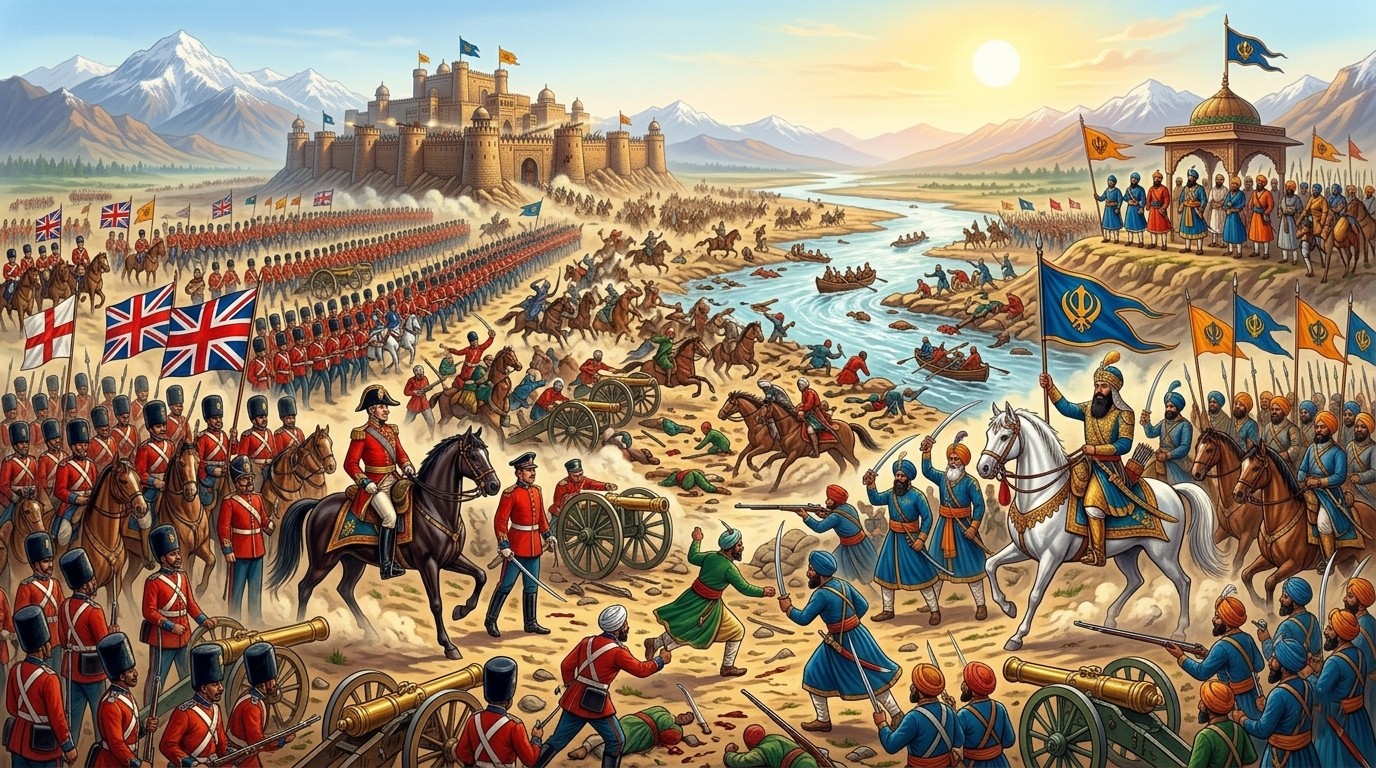
1848–1849 CE: The Second Anglo-Sikh War – Chillianwala, Gujrat, and the Fall of the Sikh Empire
The Second Anglo-Sikh War of 1848–1849 was the final act in the dramatic struggle between the Sikh Empire and the British East India Company. It was a conflict born from resentment, political interference, wounded national pride, and growing resistance against foreign domination. For Sikhs, the war represented a desperate effort to preserve the sovereignty established by Maharaja Ranjit Singh and defended by generations of Khalsa warriors. Although the Sikh Empire had survived the First Anglo-Sikh War, the Treaty of Lahore of 1846 had reduced it to a shadow of its former strength. British officials increasingly controlled the administration of Punjab, while the young Maharaja Duleep Singh ruled only in name under the supervision of British representatives. Across the province, dissatisfaction with British influence steadily grew. What began as localized rebellions in Multan and Hazara soon transformed into a wider struggle that would culminate in some of the bloodiest battles fought on Indian soil. The conflict would produce one of the most remarkable Sikh military victories at Chillianwala, inflict devastating casualties upon the British, and yet ultimately end with the crushing defeat of the Khalsa Army at Gujrat and the annexation of Punjab into the British Empire.
The Aftermath of the Treaty of Lahore
To understand the origins of the Second Anglo-Sikh War, it is necessary to examine the consequences of the Treaty of Lahore and the subsequent Treaty of Bhairowal. Following the First Anglo-Sikh War, the British East India Company gained unprecedented influence over Punjab. The Sikh Kingdom technically remained independent, but real authority increasingly rested in British hands. A British Resident was installed in Lahore, and the administration of the kingdom became subject to foreign supervision. Maharaja Duleep Singh, still a child, remained on the throne, while his mother, Maharani Jind Kaur, found her political influence steadily reduced. Many Sikhs viewed these developments as a direct assault upon their sovereignty.
The Khalsa Army, though reduced in size, retained its sense of identity and pride. Veterans of Mudki, Ferozeshah, Aliwal, and Sobraon remembered the sacrifices of their comrades and believed that Punjab's defeat had resulted more from betrayal and political intrigue than from military weakness. Across the province, many nobles, soldiers, and ordinary citizens resented the expanding authority of British officials. The atmosphere became increasingly tense as British interference extended into administrative, military, and financial affairs. The kingdom that Maharaja Ranjit Singh had built was being systematically transformed into a dependency.
The removal of Maharani Jind Kaur from political influence further intensified anger among many Sikhs. As the mother of Maharaja Duleep Singh, she was seen by many as a symbol of resistance to British encroachment. Her eventual separation from her son and marginalization by British authorities fueled widespread suspicion regarding British intentions. By 1848, Punjab had become a region simmering with frustration and uncertainty.
The Rebellion in Multan
The immediate spark for the Second Anglo-Sikh War emerged in Multan, one of the most important cities in the southern Punjab. In April 1848, British officials arrived to oversee the transfer of authority from the local governor, Diwan Mulraj. What should have been a routine administrative transition rapidly escalated into violence. During the proceedings, two British officers, Patrick Vans Agnew and William Anderson, were attacked and fatally wounded. Their deaths transformed a local dispute into a major political crisis.
Diwan Mulraj became the central figure in the ensuing rebellion. Although historians continue to debate the extent of his initial intentions, the uprising quickly evolved into a broader anti-British movement. British authority in Multan was openly challenged, and resistance spread throughout the region. What began as a local conflict soon attracted support from those who opposed increasing British control over Punjab.
The rebellion demonstrated that dissatisfaction with British rule extended beyond isolated individuals or factions. Many Punjabis viewed the events at Multan as an opportunity to challenge foreign interference. The uprising gained symbolic importance because it reflected broader concerns about the future of Sikh sovereignty and the dignity of the kingdom.
The Hazara Revolt and the Expansion of Resistance
At the same time that events unfolded in Multan, resistance also emerged in Hazara under the leadership of Chattar Singh Attariwalla. A respected Sikh noble and military leader, Chattar Singh became increasingly distrustful of British intentions. Tensions escalated as disputes arose between local authorities and British officials. What began as political disagreement eventually evolved into open rebellion.
The involvement of Chattar Singh and later his son Sher Singh Attariwalla transformed the conflict into a far more serious challenge. Sher Singh initially served alongside British forces but eventually joined the rebellion, bringing with him experienced troops and military resources. His decision significantly altered the balance of power and elevated the conflict from a regional uprising into a major war.
The participation of influential Sikh leaders demonstrated that opposition to British authority was widespread and deeply rooted. Many saw the rebellion not merely as a defense of local interests but as a struggle to preserve the independence and honor of the Sikh nation. The conflict increasingly assumed the character of a national resistance movement.
The Khalsa Army Returns to the Battlefield
As resistance spread across Punjab, former soldiers of the Khalsa Army rallied to the cause. Though weakened by the terms imposed after the First Anglo-Sikh War, the Khalsa remained a formidable military force. Its soldiers possessed extensive combat experience, strong discipline, and deep loyalty to the traditions established under Maharaja Ranjit Singh.
The return of the Khalsa Army to active warfare alarmed British authorities. They remembered well the fierce resistance encountered during the First Anglo-Sikh War. British commanders understood that they faced opponents who were capable, determined, and motivated by a powerful sense of national identity. The campaign that followed would confirm these fears.
Across Punjab, Sikh soldiers prepared once more to defend their homeland. The memory of previous battles and the perceived humiliation of British domination strengthened their resolve. Many believed that this conflict offered a final opportunity to reverse the losses suffered since 1846 and restore the independence of the Sikh Kingdom.
The Campaign of 1848–1849
The military campaign unfolded across a vast and challenging landscape. British forces advanced into Punjab while attempting to suppress multiple centers of resistance simultaneously. The Khalsa Army and allied forces sought to exploit their knowledge of the terrain, maintain local support, and challenge British movements whenever possible.
The campaign was marked by intense fighting, logistical difficulties, and shifting alliances. Unlike the First Anglo-Sikh War, which had been characterized by large set-piece battles along the Sutlej frontier, the Second Anglo-Sikh War involved a more complex series of operations across the Punjab heartland. Both sides recognized that the outcome would determine the future political destiny of the region.
As the conflict intensified, British commanders concentrated increasing numbers of troops and artillery. Reinforcements arrived from across British India, reflecting the importance attached to securing victory. Meanwhile, Sikh forces prepared for decisive confrontations that would test the strength and endurance of both armies.
The Battle of Ramnagar
The first major engagement occurred at Ramnagar in November 1848. Situated along the Chenab River, the battle demonstrated that the Khalsa Army remained a dangerous opponent. Sikh forces successfully resisted British attacks and inflicted notable casualties. The engagement boosted morale among Sikh troops and reinforced confidence in their ability to challenge British military power.
Although Ramnagar did not produce a decisive result, it served as an important reminder that the conflict would not be easily won by the British. The battle highlighted the effectiveness of Sikh cavalry and artillery while exposing weaknesses in British planning. The campaign remained far from settled.
The Battle of Chillianwala: A Day of British Disaster
The Battle of Chillianwala, fought on 13 January 1849, occupies a unique place in Sikh and British military history. It was one of the bloodiest and most fiercely contested battles ever fought by the British East India Company in India. The battlefield, covered with dense scrub and broken terrain, created confusion and limited visibility. Under these difficult conditions, the Khalsa Army demonstrated extraordinary courage and tactical skill.
As British forces advanced, they encountered determined Sikh resistance. The fighting quickly descended into brutal close-quarters combat. Entire British formations became disorganized, and several units suffered devastating losses. Sikh artillery inflicted heavy casualties, while infantry and cavalry repeatedly challenged British attacks. The battlefield became a scene of chaos and slaughter.
The casualties suffered by the British were catastrophic. Numerous officers were killed, regimental colors were lost, and several units experienced near collapse. Contemporary observers described the battle as one of the most severe reverses suffered by British arms in India. News of Chillianwala shocked Britain, where newspapers and politicians questioned military leadership and expressed concern regarding the conduct of the campaign.
For the Khalsa Army, Chillianwala represented a remarkable demonstration of resilience and martial excellence. Sikh soldiers had stood against one of the world's most powerful military forces and inflicted losses on a scale rarely seen in British colonial warfare. The battle became a symbol of Sikh courage and determination, proving that the spirit of the Khalsa remained unbroken despite years of political setbacks.
Yet Chillianwala also revealed a painful reality. Tactical success alone could not compensate for the broader strategic advantages enjoyed by the British Empire. While Sikh forces had inflicted devastating casualties, the British possessed greater resources, larger reserves, and the ability to replace losses. The conflict therefore continued toward its final and decisive stage.
The Siege and Fall of Multan
While major operations unfolded elsewhere, British forces continued their efforts against Multan. The city became the focus of a prolonged siege requiring substantial manpower and artillery. Diwan Mulraj and his defenders resisted with determination, forcing the British to commit significant resources.
The eventual fall of Multan in January 1849 marked a turning point in the war. The capture of the city freed British troops and artillery for deployment elsewhere. Resources that had been tied down in the siege could now be concentrated against the main Sikh field army. This development significantly strengthened the British position at a critical moment in the campaign.
The loss of Multan deprived the resistance movement of an important center of support and reduced its strategic flexibility. Although Sikh forces remained determined, the balance of power increasingly shifted in favor of the British.
The Battle of Gujrat: The Final Defeat
The decisive battle of the war took place at Gujrat on 21 February 1849. By this stage of the campaign, British forces had assembled overwhelming artillery and numerical superiority. Lessons learned from earlier battles, particularly Chillianwala, influenced British planning. Rather than relying upon costly frontal assaults, commanders sought to exploit their advantage in firepower.
The battle opened with an immense artillery bombardment. British guns unleashed sustained and concentrated fire against Sikh positions, gradually weakening defensive capabilities. The Khalsa Army fought with determination, but the scale of the bombardment proved difficult to withstand. British infantry and cavalry then advanced in coordination with artillery support, maintaining pressure across the battlefield.
Despite displaying courage and discipline, Sikh forces could not overcome the overwhelming weight of British firepower. The battle gradually turned into a general retreat. Unlike Chillianwala, where close combat and confusion had favored the defenders, Gujrat allowed the British to employ their numerical and technological advantages with devastating effect.
The defeat at Gujrat effectively ended organized Sikh resistance. The surviving forces withdrew, and many leaders recognized that further struggle would be futile. The battle represented the final military collapse of the Sikh Empire as an independent power.
The Annexation of Punjab
Following the victory at Gujrat, British authorities moved quickly to consolidate their control. On 29 March 1849, Punjab was formally annexed into the British Empire. Maharaja Duleep Singh was deposed, and the sovereignty of the Sikh Kingdom came to an end. The empire founded by Maharaja Ranjit Singh only half a century earlier ceased to exist as an independent state.
The annexation transformed the political landscape of northern India. British authority now extended across one of the most strategically important regions of the subcontinent. Punjab's military resources, economic wealth, and geographic position became assets of the British Empire.
For Sikhs, the annexation represented a profound national tragedy. The dream of a sovereign Sikh state had been extinguished. Yet even in defeat, the memory of resistance endured. The courage displayed by the Khalsa Army during the war ensured that the conflict would be remembered not solely as a story of conquest but also as a testament to sacrifice and determination.
The Legacy of Chillianwala and Gujrat
The Second Anglo-Sikh War occupies a unique place in Sikh history because it combined extraordinary military achievement with ultimate political defeat. Chillianwala demonstrated that Sikh soldiers remained among the finest warriors in Asia, capable of inflicting devastating losses upon a powerful imperial army. Gujrat, however, revealed the immense resources available to the British Empire and the challenges faced by regional powers confronting industrial-age military systems.
The war also reinforced enduring lessons regarding unity, leadership, and national sovereignty. The political instability that followed the death of Maharaja Ranjit Singh weakened the foundations of the empire and created opportunities for foreign intervention. While the courage of the Khalsa Army remained unquestioned, military valor alone could not compensate for political fragmentation and strategic disadvantage.
Today, the memory of Chillianwala occupies a place of honor within Sikh historical consciousness. It symbolizes resistance against overwhelming odds and serves as a reminder of the sacrifices made in defense of sovereignty. Gujrat, though associated with defeat, marks the conclusion of a struggle that demonstrated the resilience and fighting spirit of the Sikh nation.
Frequently Asked Questions (FAQ)
1. What was the Second Anglo-Sikh War?
The Second Anglo-Sikh War was fought between the Sikh Kingdom and the British East India Company from 1848 to 1849 and resulted in the annexation of Punjab by the British.
2. What caused the war?
The war was triggered by anti-British rebellions in Multan and Hazara, combined with widespread resentment against increasing British control over Punjab.
3. Who was Diwan Mulraj?
Diwan Mulraj was the governor of Multan whose resistance to British authority became a major catalyst for the conflict.
4. Who were Chattar Singh and Sher Singh Attariwalla?
They were influential Sikh leaders who joined the resistance against British rule and played important roles during the war.
5. Why is the Battle of Chillianwala famous?
Chillianwala is remembered for the severe casualties inflicted upon British forces and for the exceptional bravery displayed by the Khalsa Army.
6. Did the British suffer heavy losses at Chillianwala?
Yes. The battle resulted in some of the heaviest casualties suffered by British forces during their campaigns in India.
7. What happened at the Battle of Gujrat?
At Gujrat, British forces used overwhelming artillery and numerical superiority to defeat the Khalsa Army decisively.
8. What was the outcome of the war?
The war ended with a British victory, the annexation of Punjab, and the abolition of the Sikh Kingdom as an independent state.
9. What happened to Maharaja Duleep Singh after annexation?
He was removed from power, separated from Punjab's political authority, and eventually taken into British custody and influence.
10. Why is the Second Anglo-Sikh War important in Sikh history?
It marked the final fall of the Sikh Empire while also showcasing the extraordinary courage and resilience of the Khalsa Army during its last struggle for sovereignty.