Historical Turning Points · Living Heritage
1849 Annexation of Punjab
Following the Anglo-Sikh Wars in India, the Sikh Empire fell. Maharaja Duleep Singh was deposed and exiled, marking the heartbreaking Sikh diaspora
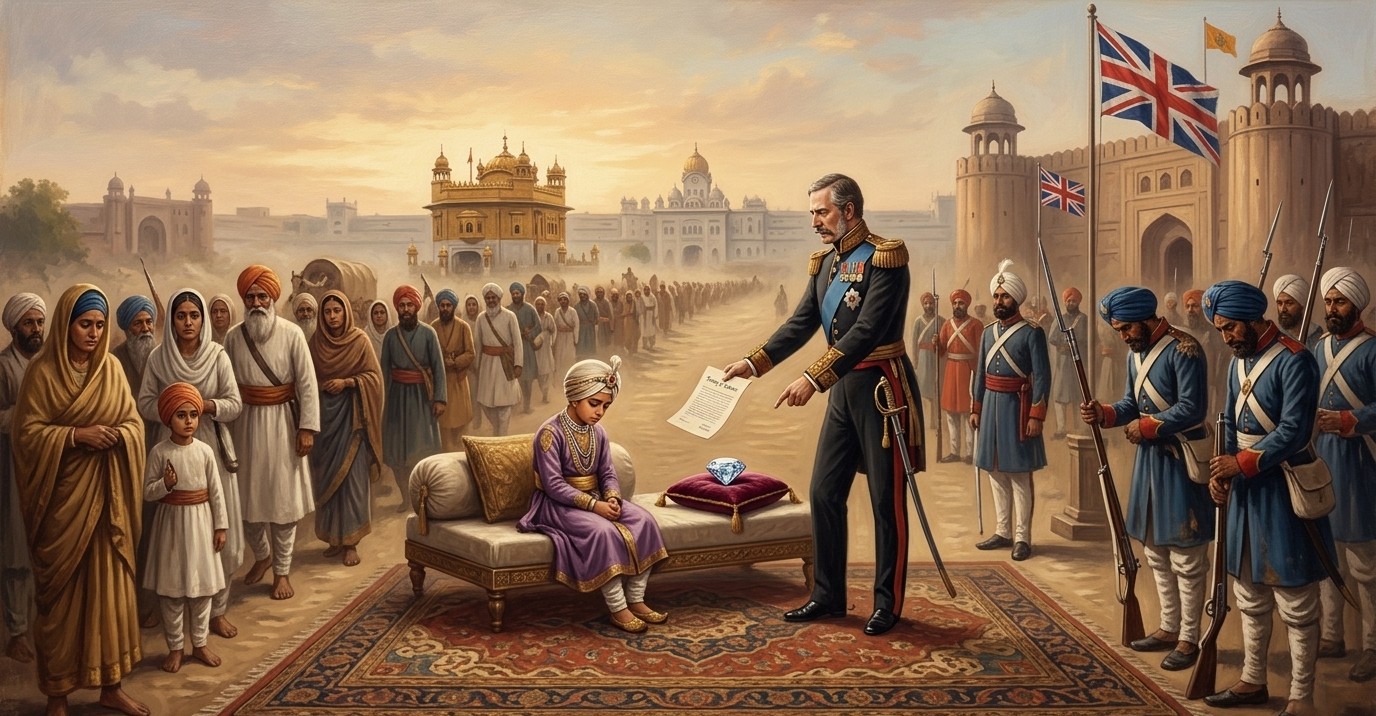
1849 Annexation of Punjab: The Fall of the Sikh Empire, the Exile of Maharaja Duleep Singh, and the Beginning of a Sikh Diaspora
The annexation of Punjab by the British East India Company in 1849 remains one of the most painful and transformative chapters in Sikh history. It marked the end of the Sikh Empire, the last major independent kingdom on the Indian subcontinent capable of resisting British expansion. For Sikhs, the event represented far more than a military defeat or political transition. It was the collapse of a sovereign state that had been built through extraordinary sacrifice, vision, and leadership under Maharaja Ranjit Singh. The annexation shattered the political independence that Sikhs had achieved after generations of struggle against Mughal persecution, Afghan invasions, and regional instability. It also initiated profound changes that would reshape Sikh society, identity, and its relationship with the wider world. At the center of this tragedy stood the young Maharaja Duleep Singh, the last ruler of the Sikh Empire, whose deposition and exile became enduring symbols of loss, displacement, and the heartbreak of a nation stripped of its sovereignty.
To understand the emotional and historical significance of 1849, one must appreciate what the Sikh Empire represented. It was not merely a territorial state but the culmination of a long historical journey that began with the teachings of Guru Nanak and evolved through the sacrifices of the Sikh Gurus, the formation of the Khalsa by Guru Gobind Singh, and the military struggles of the eighteenth century. The empire embodied Sikh aspirations for security, justice, religious freedom, and self-governance. Its collapse therefore carried consequences that extended far beyond politics. It altered the trajectory of Sikh history and planted the seeds of a global Sikh diaspora that continues to shape the community today.
The Rise of the Sikh Empire Under Maharaja Ranjit Singh
The story of the annexation cannot be understood without first examining the remarkable rise of the Sikh Empire. During the eighteenth century, Punjab endured repeated invasions, political fragmentation, and social upheaval. Despite persecution and immense hardship, Sikh forces gradually consolidated their strength through a confederation of autonomous groups known as misls. These Sikh confederacies defended local populations, resisted foreign invasions, and preserved the community's autonomy during a period of profound instability.
Out of this environment emerged Maharaja Ranjit Singh, one of the most extraordinary figures in South Asian history. Through diplomacy, military skill, and political vision, he united the Sikh misls and established a powerful kingdom centered in Lahore. Crowned Maharaja in 1801, Ranjit Singh created an empire that stretched from the Khyber Pass in the west to the Sutlej River in the east and from Kashmir in the north to Multan in the south. His administration was notable for its inclusivity, employing Sikhs, Hindus, Muslims, and Europeans in positions of responsibility. The empire became known for stability, prosperity, religious tolerance, and military strength.
Under Ranjit Singh's leadership, Punjab emerged as one of the most formidable states in Asia. The Khalsa Army was modernized and equipped with advanced weaponry, while economic development and administrative reforms strengthened the state. For many Sikhs, this era represented the realization of political sovereignty after centuries of struggle. It was a period in which Sikh power, culture, and confidence flourished on an unprecedented scale.
The Crisis After Ranjit Singh's Death
The death of Maharaja Ranjit Singh in 1839 marked the beginning of a period of instability that would ultimately lead to the empire's downfall. His exceptional leadership had held together a complex and diverse political structure. Without his unifying presence, succession disputes, court intrigues, assassinations, and factional rivalries began to undermine the stability of the state. Several rulers ascended the throne in rapid succession, and political authority became increasingly fragmented.
The Khalsa Army, once a disciplined instrument of state power, evolved into a significant political force in its own right. While its strength remained impressive, tensions emerged between military leaders, court officials, and competing factions within the government. At the same time, the British East India Company closely monitored developments in Punjab. Having already expanded across much of the Indian subcontinent, British officials viewed Punjab as both a strategic frontier and a potential target for annexation.
As internal divisions weakened the Sikh Empire, British influence along the borders increased. The stage was gradually set for a confrontation that would determine the future of Punjab.
The First Anglo-Sikh War
The First Anglo-Sikh War erupted in 1845 and represented one of the most significant military conflicts between the Sikh Empire and the British East India Company. Despite internal political instability, the Khalsa Army remained one of the most capable military forces in Asia. The war witnessed fierce battles at Mudki, Ferozeshah, Aliwal, and Sobraon. Sikh soldiers displayed extraordinary courage and determination, earning the respect of both allies and adversaries.
However, a combination of strategic challenges, political disunity, and alleged betrayals among certain leaders contributed to the Sikh defeat. The resulting Treaty of Lahore imposed severe conditions on the Sikh state. Significant territories were ceded, financial indemnities were demanded, and British influence over Punjab increased substantially. Although the Sikh Empire technically survived, its independence had been seriously compromised.
The treaty also transformed the political position of the young Maharaja Duleep Singh, who had ascended the throne as a child. Real power increasingly shifted toward British officials and their local allies, reducing the sovereignty of the kingdom and preparing the ground for further intervention.
The Second Anglo-Sikh War and the Final Defeat
The years following the First Anglo-Sikh War were characterized by growing tensions and resentment. Many Sikhs viewed British interference as a direct threat to their independence and dignity. Discontent spread among sections of the army and population, eventually contributing to the outbreak of the Second Anglo-Sikh War in 1848.
The conflict featured major engagements such as the battles of Chillianwala and Gujrat. Chillianwala, in particular, became one of the bloodiest battles fought by the British in India and demonstrated the continued effectiveness of Sikh resistance. Yet despite fierce opposition, the superior resources and organizational advantages of the British ultimately proved decisive.
Following the Sikh defeat at Gujrat in 1849, organized resistance collapsed. British authorities concluded that maintaining even a nominally independent Sikh state was no longer desirable. On 29 March 1849, Punjab was formally annexed by the British East India Company. The Sikh Empire ceased to exist, bringing an end to nearly half a century of sovereign Sikh rule.
The Deposition of Maharaja Duleep Singh
No figure embodies the tragedy of the annexation more than Maharaja Duleep Singh. Born in 1838, he became ruler of the Sikh Empire while still a child. His reign unfolded amid political turmoil, military conflict, and increasing British intervention. Following the annexation, he was compelled to surrender his authority and sign documents transferring sovereignty to the British.
The image of the young Maharaja stripped of his kingdom remains one of the most poignant moments in Sikh history. He had inherited a vast empire built by his father, yet circumstances beyond his control left him powerless to prevent its destruction. The annexation not only deprived him of political authority but also severed his connection to the land and people over whom he had been born to rule.
British officials carefully managed his future. Removed from Punjab and placed under British supervision, Duleep Singh gradually became isolated from his cultural, political, and religious roots. His personal story mirrored the broader experience of a community grappling with the loss of sovereignty and identity.
The Seizure of the Koh-i-Noor and the Symbols of Empire
Among the many consequences of annexation was the transfer of the Koh-i-Noor diamond to British possession. Under the terms imposed after the conquest, the famed diamond was surrendered and eventually presented to Queen Victoria. For many Sikhs, the loss of the Koh-i-Noor symbolized the broader dismantling of Sikh sovereignty.
The annexation involved more than territorial acquisition. It represented the transfer of political authority, military power, economic resources, and cultural symbols from the Sikh Empire to the British Empire. Objects, institutions, and traditions associated with Sikh rule became reminders of a lost era. The Koh-i-Noor, in particular, emerged as a powerful symbol of imperial conquest and the transfer of power from Lahore to London.
Exile in Britain and the Personal Tragedy of Duleep Singh
The later life of Maharaja Duleep Singh reveals the human dimension of imperial conquest. After being removed from Punjab, he was eventually taken to Britain, where he became a celebrated yet deeply isolated figure. He converted to Christianity under British influence and was integrated into elite social circles. Queen Victoria developed a personal interest in him, and he was often portrayed as a symbol of imperial benevolence.
Yet beneath this public image lay a profound personal struggle. As he matured, Duleep Singh increasingly reflected on his lost kingdom, cultural heritage, and Sikh identity. He came to resent the circumstances that had led to his exile and sought ways to reconnect with his roots. Efforts to challenge British authority and reclaim aspects of his heritage met with limited success. His later years were marked by disappointment, frustration, and a sense of displacement.
For many Sikhs, Duleep Singh's life came to symbolize the broader tragedy of annexation. He represented a generation separated from its homeland, struggling to preserve identity in the face of political and cultural dislocation.
The Beginning of the Sikh Diaspora
Although Sikh migration existed before 1849, the annexation accelerated processes that would eventually contribute to the formation of a global Sikh diaspora. British rule integrated Punjab into an expanding imperial network that connected South Asia with Africa, Southeast Asia, Europe, and North America. Economic changes, military recruitment, educational opportunities, and imperial mobility encouraged increasing numbers of Sikhs to travel abroad.
Many Sikhs joined the British Indian Army and served in distant parts of the empire. Others sought employment, trade opportunities, or agricultural land overseas. Over time, Sikh communities emerged in countries across the world. While these migrations often brought new opportunities, they also reflected the realities of a post-annexation world in which political sovereignty had been lost and mobility became a central feature of Sikh experience.
The story of the Sikh diaspora therefore cannot be separated from the events of 1849. The fall of the Sikh Empire reshaped the relationship between Sikhs and the wider world, creating conditions that encouraged global migration while simultaneously reinforcing attachment to a lost homeland.
The Impact of British Rule on Sikh Society
The annexation transformed Punjab politically, economically, and socially. British administrators introduced new legal systems, land revenue policies, educational institutions, and bureaucratic structures. Railways, canals, and infrastructure projects altered the landscape, while economic integration connected Punjab more closely to global markets.
At the same time, Sikh institutions adapted to changing circumstances. New reform movements emerged, seeking to preserve Sikh identity and religious traditions under colonial rule. Organizations such as the Singh Sabha Movement later played crucial roles in revitalizing Sikh education, literature, and religious practice. In this sense, the annexation generated both challenges and responses that profoundly influenced the evolution of modern Sikh identity.
The Memory of Annexation in Sikh Historical Consciousness
The annexation of Punjab continues to occupy a central place in Sikh historical memory. It is remembered not merely as a military defeat but as a turning point that altered the destiny of the Sikh nation. The fall of the empire, the exile of Duleep Singh, and the transfer of sovereignty to foreign rulers remain powerful symbols of loss and resilience.
At the same time, the memory of annexation has inspired ongoing reflection about leadership, unity, sovereignty, and cultural preservation. Historians, writers, and community leaders continue to study the events of 1849 in order to better understand both the strengths and vulnerabilities of the Sikh experience. The story serves as a reminder of how quickly political fortunes can change and how communities must continually adapt while preserving their core values.
Conclusion
The annexation of Punjab in 1849 marked the end of the Sikh Empire and the beginning of a new era in Sikh history. The defeat in the Anglo-Sikh Wars, the deposition of Maharaja Duleep Singh, and the incorporation of Punjab into the British Empire represented profound losses for a community that had fought for centuries to secure its freedom and sovereignty. Yet the story does not end with defeat. The resilience displayed by Sikhs in the decades that followed, their adaptation to changing circumstances, and the emergence of a global diaspora demonstrate the enduring strength of Sikh identity. The tragedy of 1849 remains deeply embedded in Sikh memory, but it also serves as a testament to the community's capacity to endure, rebuild, and preserve its heritage across generations and continents.
Frequently Asked Questions (FAQ)
1. What was the Annexation of Punjab?
The Annexation of Punjab occurred in 1849 when the British East India Company formally incorporated the Sikh Empire into British-controlled territory following the Anglo-Sikh Wars.
2. Who was Maharaja Duleep Singh?
Maharaja Duleep Singh was the last ruler of the Sikh Empire and the youngest son of Maharaja Ranjit Singh.
3. Why did the Sikh Empire fall?
The empire weakened after Maharaja Ranjit Singh's death due to political instability, internal divisions, succession disputes, and military conflicts with the British.
4. What were the Anglo-Sikh Wars?
The Anglo-Sikh Wars were two major conflicts fought between the Sikh Empire and the British East India Company in 1845–1846 and 1848–1849.
5. When was Punjab officially annexed?
Punjab was officially annexed by the British East India Company on 29 March 1849.
6. What happened to Maharaja Duleep Singh after annexation?
He was removed from power, separated from Punjab, taken under British supervision, and eventually exiled to Britain.
7. Why is the Koh-i-Noor associated with the annexation?
The famous diamond was surrendered to the British following the annexation and became a symbol of the transfer of power from the Sikh Empire to the British Empire.
8. Did the annexation contribute to the Sikh diaspora?
Yes. British rule and imperial networks created conditions that encouraged Sikh migration to many parts of the world, contributing to the growth of the global Sikh diaspora.
9. How did British rule affect Sikh society?
British rule introduced new administrative systems, economic policies, and educational institutions while also encouraging Sikh reform movements focused on preserving identity and tradition.
10. Why is the annexation of Punjab still important today?
It remains a defining event in Sikh history because it ended Sikh sovereignty, led to the exile of Maharaja Duleep Singh, influenced the formation of the Sikh diaspora, and continues to shape Sikh historical memory.