Historical Turning Points · Living Heritage
1873 Singh Sabha Movement
Sparked by the arrival of Christian missionaries and the influence of colonial bureaucracy, this internal renaissance emphasized education, standardized religious practices, and laid the foundation for modern Sikh identity.
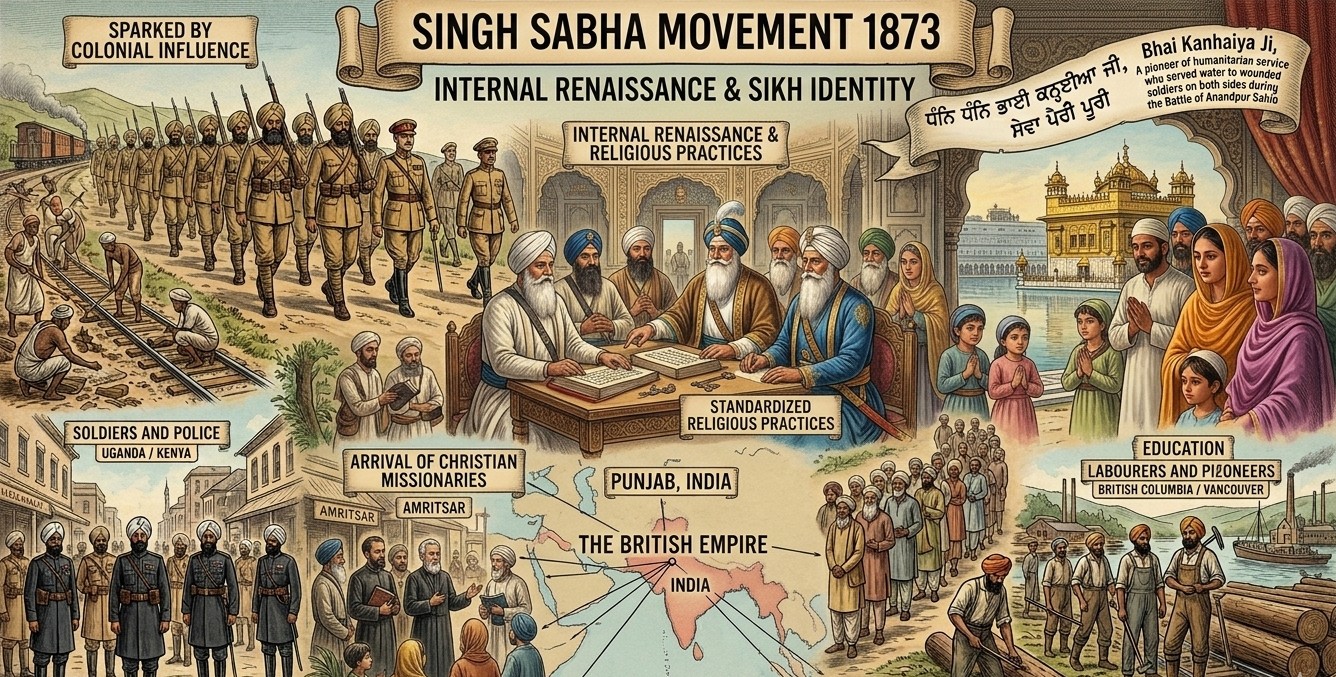
The Singh Sabha Movement of 1873: The Sikh Renaissance That Shaped Modern Sikh Identity
The Singh Sabha Movement, which emerged in 1873, stands among the most influential developments in the history of the Sikh community. Few movements have had such a profound impact on Sikh religious thought, education, institutional development, literary production, and collective identity. Arising during a period of enormous political and social transformation following the annexation of Punjab by the British in 1849, the movement sought to address challenges that many Sikh intellectuals, religious leaders, and community members believed threatened the distinctiveness and future of the Sikh faith. The arrival of Christian missionaries, the growth of Western education, the influence of colonial bureaucracy, the activities of reform movements within other religious communities, and increasing debates about religious identity created an environment in which Sikhs began to ask fundamental questions about who they were, what distinguished them from others, and how their traditions could be preserved in a rapidly changing world. The Singh Sabha Movement emerged as a powerful response to these concerns and ultimately became the foundation upon which modern Sikh identity was constructed.
As a Sikh historian, it is impossible to overstate the significance of the Singh Sabha Movement. While earlier generations of Sikhs had fought for survival, sovereignty, and political independence, the leaders of the Singh Sabha era confronted a different challenge. They sought to preserve the intellectual, spiritual, and institutional integrity of Sikhism under colonial rule. Their efforts transformed Sikh education, standardized religious practices, encouraged scholarship, promoted literacy, strengthened community institutions, and articulated a coherent vision of Sikh identity that continues to influence Sikh life around the world today. The movement represented not merely a religious reform effort but a broad cultural renaissance that reshaped the future of an entire community.
The Historical Context: Punjab After the Fall of the Sikh Empire
The roots of the Singh Sabha Movement can be traced to the dramatic changes that followed the annexation of Punjab by the British East India Company in 1849. The collapse of the Sikh Empire marked the end of independent Sikh political authority and ushered in a new era of colonial governance. Under British administration, Punjab underwent extensive economic, social, educational, and administrative transformation. Railways expanded, new schools were established, legal systems were reorganized, and bureaucratic institutions became increasingly influential in everyday life.
These changes created both opportunities and anxieties within Sikh society. The political structures that had once supported Sikh institutions no longer existed. Many traditional systems of authority were weakened, while new colonial institutions gained prominence. Educated Sikhs found themselves operating in a world increasingly shaped by Western ideas, modern administration, and competitive religious discourse. Questions of identity became more urgent as communities across India sought to define themselves within the categories and classifications introduced by colonial governance.
The British administration also conducted censuses and surveys that required individuals to identify themselves according to specific religious categories. Such processes encouraged communities to define boundaries, articulate doctrines, and establish clear markers of identity. For Sikhs, whose historical development had involved complex interactions with broader Punjabi society, this environment created pressure to clarify what distinguished Sikhism as a separate and unique religious tradition.
The Challenge of Christian Missionary Activity
One of the immediate catalysts for the Singh Sabha Movement was the growing presence of Christian missionaries in Punjab. Following British annexation, missionary organizations expanded their activities throughout the region. They established schools, colleges, hospitals, printing presses, and charitable institutions. These organizations often provided high-quality education and access to modern knowledge, attracting students from diverse backgrounds.
Missionaries actively sought converts and frequently engaged in public debates concerning religion and theology. Through books, pamphlets, lectures, and educational programs, they challenged traditional beliefs and promoted Christianity as a superior alternative. Some Sikh families, particularly among the educated elite, converted to Christianity, generating concern among community leaders.
The conversion of several prominent Sikh youths became especially alarming. Many Sikh intellectuals feared that a lack of organized educational institutions and scholarly engagement left the community vulnerable to external influences. Rather than responding solely through opposition, reformers concluded that Sikhs needed stronger educational systems, better religious instruction, and greater access to scholarly resources. The Singh Sabha Movement emerged partly from this realization that intellectual engagement and institutional development were essential for preserving Sikh traditions in the modern age.
The Founding of the First Singh Sabha
The first Singh Sabha was established in Amritsar in 1873. Its founders included prominent Sikh aristocrats, scholars, religious leaders, and educated professionals who shared concerns about the future of the Sikh community. Their objective was not simply to resist missionary influence but to revitalize Sikhism through education, scholarship, and religious renewal.
The establishment of the organization reflected a growing conviction that Sikhs needed institutions capable of addressing contemporary challenges while remaining faithful to the teachings of the Gurus. Members sought to promote knowledge of Sikh history, encourage the study of Sikh scriptures, support educational initiatives, and strengthen community awareness. They viewed reform as a means of ensuring continuity rather than abandoning tradition.
From its earliest days, the Singh Sabha Movement emphasized intellectual engagement. It recognized that preserving religious identity required more than emotional attachment or inherited customs. Future generations needed access to systematic education, reliable scholarship, and a clear understanding of Sikh teachings. This commitment to learning would become one of the movement's defining characteristics.
The Rise of the Lahore Singh Sabha and Reformist Thought
In 1879, a second major organization known as the Lahore Singh Sabha was established. While sharing many objectives with the Amritsar Sabha, the Lahore group adopted a more vigorous reformist approach. Its members included highly educated individuals who emphasized modern education, historical research, literary production, and doctrinal clarification.
The Lahore Singh Sabha played a critical role in shaping the intellectual foundations of modern Sikhism. Its leaders argued that Sikh teachings should be understood directly through the Guru Granth Sahib and the historical traditions associated with the Sikh Gurus. They sought to distinguish Sikh practices from customs they believed had been incorporated over time from other religious traditions.
This emphasis on doctrinal clarity encouraged extensive study of Sikh scriptures, history, and theology. Scholars produced books, articles, translations, and commentaries designed to educate both Sikhs and non-Sikhs about the distinctiveness of the Sikh faith. The movement's intellectual energy generated a remarkable body of literature that continues to influence Sikh scholarship today.
Education as the Cornerstone of Renewal
Perhaps no aspect of the Singh Sabha Movement proved more transformative than its commitment to education. Reformers understood that long-term community development depended upon creating institutions capable of educating future generations. Schools and colleges became central instruments of religious, cultural, and social renewal.
The movement promoted both modern and religious education, seeking to combine contemporary knowledge with Sikh values. Educational institutions encouraged literacy, critical thinking, and scholarly engagement while simultaneously strengthening awareness of Sikh history and teachings. This balanced approach enabled Sikhs to participate effectively in the modern world without abandoning their religious heritage.
One of the most important outcomes of this educational emphasis was the establishment of institutions that would shape Sikh intellectual life for generations. Colleges, schools, libraries, and publishing initiatives expanded opportunities for learning and fostered a culture of scholarship within the community. The educational legacy of the Singh Sabha Movement remains visible in Sikh institutions across the globe.
The Standardization of Sikh Religious Practices
Another major objective of the Singh Sabha Movement was the standardization of Sikh religious practices. By the late nineteenth century, considerable diversity existed in how Sikh traditions were observed across different regions and communities. Reformers believed that greater consistency was necessary to strengthen collective identity and preserve the integrity of Sikh teachings.
This effort involved encouraging greater familiarity with the Guru Granth Sahib, promoting the use of Sikh religious ceremonies, and emphasizing practices rooted in the teachings of the Gurus. Leaders sought to distinguish Sikh rituals from customs they regarded as inconsistent with Sikh principles. Through publications, educational programs, and public discussions, they worked to create a more unified understanding of Sikh practice.
The process was neither simple nor uncontested. Different groups held varying interpretations of tradition and reform. Nevertheless, the movement succeeded in fostering greater awareness of Sikh distinctiveness and encouraging broader participation in shared religious practices. Many features of contemporary Sikh religious life can be traced to these efforts at standardization.
The Growth of Sikh Literature and Print Culture
The Singh Sabha era witnessed an extraordinary expansion of Sikh literary activity. Reformers recognized the power of print culture in shaping public opinion and educating communities. Printing presses became essential tools for disseminating knowledge, defending Sikh beliefs, and promoting reform.
Newspapers, journals, pamphlets, books, and educational materials were produced in large numbers. These publications addressed theology, history, ethics, language, and contemporary social issues. Writers sought not only to preserve traditional knowledge but also to present Sikh teachings in forms accessible to modern audiences.
The development of Sikh literature during this period had lasting consequences. It enabled broader access to religious knowledge, encouraged historical research, and strengthened community awareness. Print culture connected Sikhs across geographical distances and fostered a sense of collective identity that transcended local boundaries.
Language, Identity, and the Promotion of Punjabi
The Singh Sabha Movement also contributed significantly to the promotion of Punjabi language and Gurmukhi script. Reformers viewed language as an essential component of religious and cultural identity. They encouraged literacy in Gurmukhi and supported the publication of educational materials in Punjabi.
At a time when linguistic and cultural identities were becoming increasingly politicized, the promotion of Punjabi served both practical and symbolic purposes. It facilitated access to Sikh scriptures and historical texts while reinforcing connections to community heritage. Language became a vehicle through which collective memory, values, and traditions could be transmitted across generations.
The movement's efforts helped establish Punjabi as a central element of Sikh identity. This legacy remains evident today in educational initiatives, literary traditions, and cultural institutions throughout the Sikh world.
Defining Modern Sikh Identity
The most enduring achievement of the Singh Sabha Movement was its role in shaping modern Sikh identity. Through scholarship, education, institutional development, and religious reform, the movement articulated a coherent vision of what it meant to be Sikh in the modern era. This vision emphasized the authority of the Guru Granth Sahib, the distinctiveness of Sikh teachings, the importance of the Khalsa tradition, and the value of education and community service.
Prior to the Singh Sabha era, Sikh identity often existed within fluid social and cultural environments. The movement sought to define clearer boundaries while preserving continuity with historical traditions. Its leaders emphasized that Sikhism possessed its own theology, scriptures, history, and institutions. This understanding influenced subsequent generations and became central to community self-perception.
The modern conception of Sikh identity found in educational curricula, religious institutions, historical narratives, and community organizations owes much to the work of Singh Sabha reformers. Their efforts provided the intellectual framework through which Sikhs would navigate the challenges of the twentieth and twenty-first centuries.
The Legacy of the Singh Sabha Movement
The influence of the Singh Sabha Movement extends far beyond the nineteenth century. Its educational institutions, literary contributions, and religious reforms created foundations upon which later developments were built. Organizations such as the Chief Khalsa Diwan, the Gurdwara Reform Movement, and the Shiromani Gurdwara Parbandhak Committee emerged within an environment shaped by Singh Sabha ideas.
The movement also prepared Sikhs to engage with modernity on their own terms. By embracing education and scholarship while preserving religious identity, reformers demonstrated that tradition and progress need not be mutually exclusive. This balance became a defining feature of Sikh responses to changing social and political conditions.
Today, Sikh communities around the world continue to benefit from the institutions, ideas, and educational traditions established during the Singh Sabha era. Whether in Punjab, North America, Europe, Southeast Asia, Africa, or Australia, the movement's legacy remains deeply embedded in contemporary Sikh life.
Conclusion
The Singh Sabha Movement of 1873 was far more than a religious reform campaign. It was a comprehensive cultural, intellectual, and educational renaissance that transformed Sikh society during a period of profound change. Sparked by the challenges of missionary activity, colonial administration, and evolving social realities, the movement responded with remarkable creativity and determination. Through its commitment to education, scholarship, standardized religious practices, language preservation, and institutional development, it laid the foundations of modern Sikh identity. The movement ensured that Sikhism would not merely survive the colonial era but emerge from it with renewed confidence, intellectual vitality, and organizational strength. More than a century later, its influence continues to shape how Sikhs understand their history, practice their faith, and engage with the wider world.
Frequently Asked Questions (FAQ)
1. What was the Singh Sabha Movement?
The Singh Sabha Movement was a Sikh religious and educational reform movement founded in 1873 to strengthen Sikh identity, promote education, and preserve Sikh teachings.
2. Why was the Singh Sabha Movement established?
It was established in response to challenges posed by Christian missionary activity, colonial influences, religious debates, and concerns about preserving Sikh distinctiveness.
3. Where was the first Singh Sabha founded?
The first Singh Sabha was founded in Amritsar in 1873.
4. What role did education play in the movement?
Education was central to the movement's goals, leading to the establishment of schools, colleges, libraries, and publishing initiatives that promoted both modern and religious learning.
5. What was the Lahore Singh Sabha?
The Lahore Singh Sabha, founded in 1879, was a major branch of the movement known for its strong emphasis on scholarship, reform, and doctrinal clarity.
6. How did the movement influence Sikh religious practices?
It encouraged greater consistency in religious observance, emphasized the authority of Sikh scriptures, and promoted practices rooted in the teachings of the Gurus.
7. Why was Punjabi language important to the movement?
The movement promoted Punjabi and Gurmukhi because they were essential for preserving Sikh literature, scriptures, culture, and identity.
8. Did the Singh Sabha Movement produce new Sikh literature?
Yes. It generated a vast body of books, newspapers, journals, pamphlets, and scholarly works that expanded knowledge of Sikh history and theology.
9. How did the movement shape modern Sikh identity?
It helped define Sikhism as a distinct religious tradition with its own scriptures, history, institutions, and practices, creating the framework for modern Sikh self-understanding.
10. What is the lasting legacy of the Singh Sabha Movement?
Its legacy includes educational institutions, scholarly traditions, religious reforms, language preservation efforts, and the intellectual foundations of contemporary Sikh identity worldwide.