Historical Turning Points · Living Heritage
1913 Ghadar Movement
Sikh emigrants on the West Coast of North America, facing intense racism, established the Pacific Coast Hindustani Association to overthrow British colonial rule in India, shaping early global political activism.
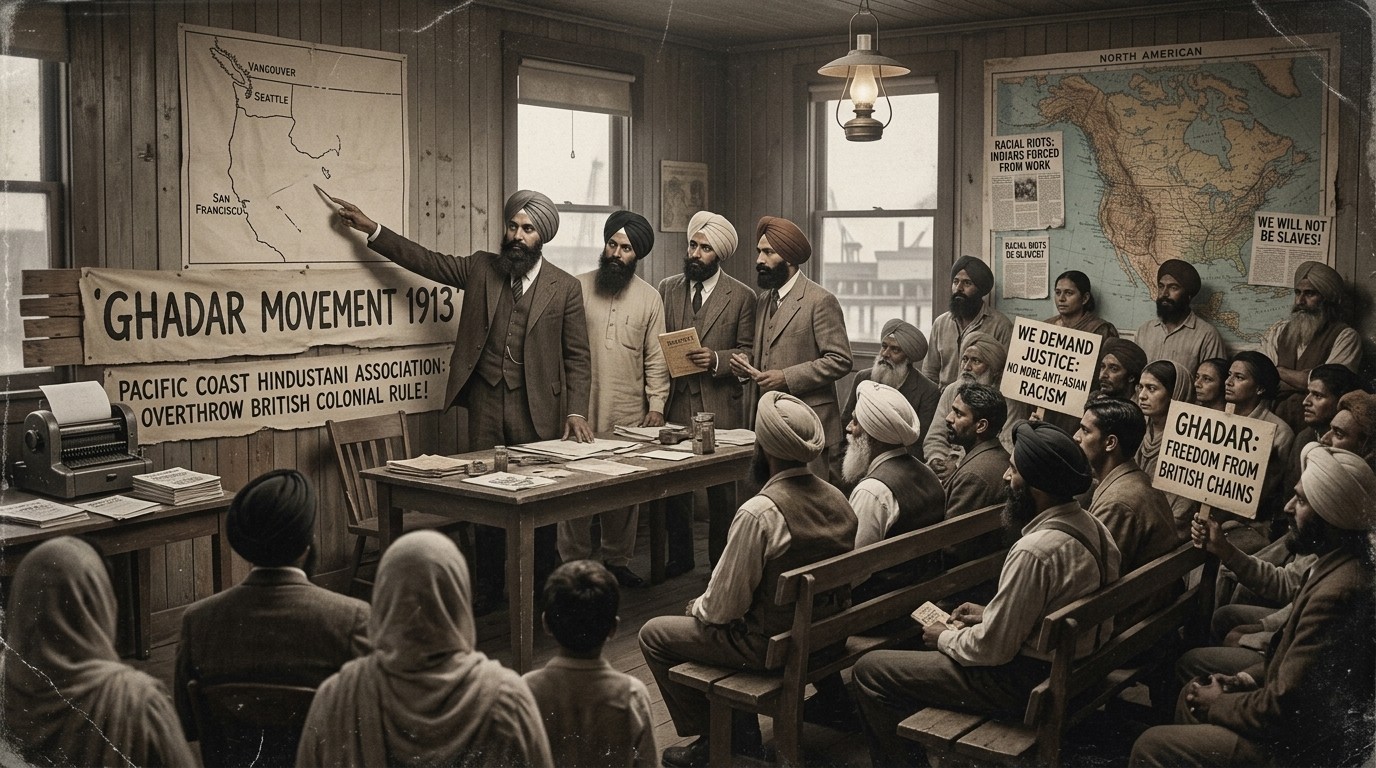
The Ghadar Movement of 1913: Sikh Emigrants, Global Resistance, and the Birth of Revolutionary Anti-Colonial Activism
The Ghadar Movement occupies a unique and transformative place in Sikh history, Indian nationalism, and the broader history of global anti-colonial resistance. Emerging in 1913 among Indian emigrants on the Pacific Coast of North America, the movement represented one of the earliest organized attempts by overseas Indians to challenge British imperial rule through international political activism. While the movement drew support from Hindus, Muslims, and Sikhs alike, Sikhs formed its overwhelming backbone, providing much of its leadership, membership, financial support, and revolutionary energy. The story of the Ghadar Movement is not merely one of political conspiracy or revolutionary ambition; it is a story of migration, racial discrimination, identity, sacrifice, and the determination of a displaced community to transform humiliation into resistance. It was born thousands of miles away from India, in the lumber mills, railway camps, farms, and industrial towns of North America, where Sikh immigrants encountered harsh racism and exclusion. Their experiences abroad convinced many that true dignity could never be achieved while India remained under colonial domination. The movement they created would become one of the most important early expressions of transnational political activism, inspiring generations of freedom fighters and leaving a lasting legacy in Sikh and Indian history.
The Sikh Migration to North America
The origins of the Ghadar Movement can be traced to the migration of Punjabis, particularly Sikhs, to North America during the late nineteenth and early twentieth centuries. Following the annexation of Punjab by the British Empire in 1849, significant economic and social changes reshaped the region. Many Sikh families sought opportunities beyond India, motivated by agricultural pressures, military service traditions, and the promise of employment abroad. The expansion of the British Empire facilitated mobility, allowing Punjabis to travel to various parts of the world, including East Africa, Southeast Asia, Australia, and North America.
By the early 1900s, a growing number of Sikh immigrants had settled on the Pacific Coast of Canada and the United States. Most originated from rural Punjab and found employment in physically demanding industries such as lumber milling, railway construction, agriculture, and manufacturing. These immigrants possessed a strong work ethic and often earned reputations as reliable laborers. Despite their contributions, however, they encountered widespread hostility from sections of the local population. White supremacist attitudes, economic competition, and xenophobic fears fueled discrimination against Asian immigrants, including Indians. Sikhs, identifiable through their turbans and beards, frequently became targets of prejudice and exclusion.
The experience of migration proved deeply transformative. Many Sikh immigrants had served in the British Indian Army or had grown up believing in the promises of imperial citizenship. They expected that as subjects of the British Empire, they would enjoy certain rights and protections. Instead, they found themselves treated as racial outsiders. This contradiction between imperial rhetoric and lived reality became a powerful catalyst for political awakening.
Racism, Exclusion, and Political Radicalization
The early Sikh immigrants to North America faced a harsh and often hostile environment. Anti-Asian riots erupted in several cities, immigration restrictions became increasingly severe, and discriminatory laws limited opportunities for settlement and citizenship. Public campaigns frequently portrayed Asian immigrants as undesirable outsiders who threatened social and economic stability. Newspapers, politicians, and labor organizations often contributed to an atmosphere of exclusion and suspicion.
For Sikh immigrants, these experiences raised profound questions about identity and justice. Many began to ask why they were denied equal treatment despite being subjects of the same empire that governed Canada, the United States, and India. The answer, they increasingly concluded, lay in India's colonial status. They reasoned that discrimination abroad reflected the broader reality of British domination at home. If India were independent, they believed, Indians would command greater respect internationally and possess the political power necessary to defend their rights.
This realization transformed personal grievances into political consciousness. The struggle against racism became linked to the struggle against colonialism. What began as frustration with discriminatory treatment evolved into a broader critique of imperial power. The idea emerged that liberation from colonial rule was essential not only for India's future but also for the dignity of Indians worldwide.
The Formation of the Pacific Coast Hindustani Association
Against this backdrop, a group of politically conscious immigrants established the Pacific Coast Hindustani Association in 1913. The organization would soon become popularly known as the Ghadar Party, deriving its name from the Urdu and Punjabi word "Ghadar," meaning revolt, rebellion, or uprising. The choice of name was deliberate and reflected the organization's revolutionary objectives. Its founders sought nothing less than the overthrow of British rule in India.
The movement's headquarters was established at Yugantar Ashram in San Francisco, California. This location became a hub of political activity, intellectual debate, and revolutionary planning. Members came from diverse religious backgrounds, including Sikhs, Hindus, and Muslims, united by a common commitment to Indian independence. Yet Sikhs constituted the largest and most active component of the organization, reflecting the demographic composition of the immigrant community on the Pacific Coast.
The Ghadar Movement represented a remarkable departure from conventional politics of the era. Rather than petitioning authorities for reforms or seeking incremental concessions, its leaders advocated complete independence. At a time when many political organizations in India still focused on constitutional reforms within the imperial framework, the Ghadarites openly demanded the end of British rule. Their rhetoric was bold, uncompromising, and revolutionary.
The Intellectual Architects of Ghadar
The movement benefited from the contributions of several visionary leaders whose ideas shaped its direction. Among the most influential was Lala Har Dayal, a brilliant intellectual and political activist who became one of the movement's principal ideologues. Har Dayal emphasized the need for revolutionary action and encouraged Indian immigrants to dedicate themselves to the cause of national liberation. His speeches and writings inspired many young immigrants to view political activism as a moral obligation.
Equally important were Sikh leaders such as Sohan Singh Bhakna, who became the first president of the organization. Bhakna embodied the values of sacrifice, discipline, and commitment that characterized the movement. Numerous other Sikh activists contributed their energy, resources, and leadership. These individuals transformed the organization from a small political association into a dynamic international network.
What distinguished the Ghadar leadership was its ability to connect local experiences of discrimination with global political realities. They framed the struggle against colonialism as part of a broader quest for human dignity and self-determination. Their vision transcended regional, religious, and linguistic divisions, emphasizing unity among Indians in pursuit of freedom.
The Ghadar Newspaper and Revolutionary Propaganda
One of the movement's most powerful tools was its newspaper, also titled Ghadar. Published in multiple languages, including Punjabi, Urdu, Hindi, and English, the newspaper became a vehicle for spreading revolutionary ideas across the globe. Copies circulated among Indian communities in North America, Asia, Africa, and beyond. Through poems, essays, editorials, and reports, the publication encouraged readers to reject colonial rule and participate in the struggle for independence.
The newspaper's tone was direct and uncompromising. It celebrated resistance, condemned imperial exploitation, and called upon Indians to rise against British authority. Unlike many contemporary publications that adopted cautious language, Ghadar openly advocated rebellion. Its pages featured accounts of colonial injustices, historical examples of resistance, and appeals to patriotism. For many readers, the newspaper served as both an educational resource and a revolutionary manifesto.
The publication also played a crucial role in fostering a sense of global Indian identity. Readers who had never met one another became connected through shared political aspirations. The newspaper helped transform scattered immigrant communities into participants in a common movement dedicated to national liberation.
The Komagata Maru Incident and Rising Anger
The Komagata Maru incident of 1914 further intensified support for the Ghadar Movement. The Komagata Maru, a Japanese steamship carrying mostly Sikh passengers from Punjab, arrived in Vancouver seeking entry into Canada. Despite being British subjects, the passengers were denied permission to disembark due to discriminatory immigration policies. After months of legal battles and hardship, the ship was forced to return to India.
The incident generated outrage among Indian communities worldwide. For many Sikhs, it symbolized the hypocrisy of imperial claims regarding equality and justice. The treatment of the passengers confirmed the belief that Indians would never receive fair treatment as long as they remained subjects of a colonial empire. The episode became a powerful recruiting tool for the Ghadar Movement, convincing many previously apolitical individuals to embrace revolutionary activism.
When the ship returned to India, further violence occurred as colonial authorities attempted to control returning passengers. The resulting confrontation deepened resentment and strengthened the conviction that resistance was necessary. The Komagata Maru incident remains one of the most significant events in the history of Sikh migration and political mobilization.
World War I and the Revolutionary Opportunity
The outbreak of World War I in 1914 appeared to provide the Ghadar Movement with an unprecedented opportunity. British resources were stretched by the demands of global conflict, and Ghadar leaders believed the moment had arrived to launch an uprising in India. Thousands of activists and supporters returned from North America and other regions with the intention of inciting rebellion among soldiers and civilians.
The movement's strategy focused heavily on encouraging mutiny within the British Indian Army. Many Ghadarites believed that Indian soldiers, once inspired by revolutionary ideals, would turn against colonial authorities. Efforts were made to distribute propaganda, establish underground networks, and coordinate planned uprisings across multiple regions.
However, British intelligence agencies successfully infiltrated many aspects of the movement. Informants provided authorities with crucial information, allowing colonial officials to disrupt planned revolts before they could gain momentum. Mass arrests followed, and numerous leaders were imprisoned, exiled, or executed. Although the uprising failed to achieve its immediate objectives, the courage and determination displayed by its participants earned lasting admiration.
Sacrifice, Trials, and Martyrdom
The suppression of the Ghadar Movement was severe. Colonial authorities launched extensive investigations and prosecutions aimed at dismantling revolutionary networks. The Lahore Conspiracy Cases and related trials resulted in numerous convictions. Many activists received lengthy prison sentences, transportation to penal colonies, or execution.
Among Sikhs, the sacrifices of Ghadar revolutionaries became part of a broader tradition of resistance and martyrdom. Their willingness to risk everything for the cause of freedom resonated deeply with historical memories of Sikh struggles against oppression. Although their immediate goals were not realized, their sacrifices inspired future generations of nationalists and revolutionaries.
The movement's participants demonstrated extraordinary commitment. Many abandoned stable livelihoods abroad, knowing they faced imprisonment or death upon returning to India. Their actions reflected a profound sense of responsibility toward their homeland and an unwavering belief in the possibility of independence.
The Legacy of the Ghadar Movement
The long-term significance of the Ghadar Movement extends far beyond its immediate revolutionary activities. It pioneered forms of transnational political organization that would become increasingly important throughout the twentieth century. Long before globalization became a common concept, Ghadar activists created international networks linking communities across continents. They utilized newspapers, public meetings, fundraising campaigns, and personal connections to sustain a global movement for political change.
For Sikhs, the movement represented a powerful example of how diaspora communities could influence events in their homeland. It demonstrated that migration did not diminish political engagement but could instead expand opportunities for activism. The movement also reinforced values deeply embedded in Sikh tradition: courage, resistance to injustice, commitment to collective welfare, and willingness to sacrifice for a greater cause.
In the broader history of Indian independence, the Ghadar Movement occupies a foundational position. Although overshadowed at times by later developments, its members articulated demands for complete independence years before such goals became mainstream within Indian politics. Their vision, activism, and sacrifices contributed to the evolving struggle that eventually culminated in India's freedom.
Conclusion
The Ghadar Movement of 1913 stands as one of the most remarkable chapters in Sikh and Indian history. Born among immigrant workers confronting racism and exclusion on the Pacific Coast of North America, it transformed experiences of discrimination into a global campaign against colonial rule. Through the establishment of the Pacific Coast Hindustani Association, the publication of revolutionary literature, and the mobilization of transnational networks, Sikh emigrants and their allies pioneered a new form of international political activism. Although their immediate revolutionary ambitions were thwarted, their courage, vision, and sacrifices left an enduring legacy. The Ghadar Movement remains a testament to the power of diaspora communities to influence historical change and a powerful reminder that the quest for justice often transcends national borders.
Frequently Asked Questions (FAQ)
1. What was the Ghadar Movement?
The Ghadar Movement was a revolutionary anti-colonial organization founded in 1913 by Indian immigrants, primarily Sikhs, in North America to overthrow British rule in India.
2. What does the word "Ghadar" mean?
The word "Ghadar" means revolt, rebellion, or uprising and reflected the movement's revolutionary objectives.
3. Why did many Sikhs support the Ghadar Movement?
Many Sikhs experienced racism and discrimination in North America and concluded that colonial rule in India contributed to their lack of rights and respect abroad.
4. What was the Pacific Coast Hindustani Association?
It was the formal organization established in 1913 that later became widely known as the Ghadar Party.
5. Where was the Ghadar Movement headquartered?
The movement's headquarters was located at Yugantar Ashram in San Francisco, California.
6. What role did the Ghadar newspaper play?
The newspaper spread revolutionary ideas, encouraged resistance to British rule, and connected Indian communities across the world.
7. How did the Komagata Maru incident affect the movement?
The incident increased anger toward British imperial policies and inspired greater support for revolutionary activism among overseas Indians.
8. Did the Ghadar Movement succeed in overthrowing British rule?
No, its planned uprising during World War I was largely suppressed, but it significantly influenced later independence movements.
9. Who was Sohan Singh Bhakna?
Sohan Singh Bhakna was a prominent Sikh leader and the first president of the Ghadar organization.
10. Why is the Ghadar Movement important today?
It is remembered as an early example of global political activism, diaspora engagement, anti-colonial resistance, and Sikh contributions to the struggle for Indian independence.