Historical Turning Points · Living Heritage
1920s Gurudwara Reform Movement
Sikhs launched peaceful mass agitations to reclaim control of their historic places of worship from corrupt mahants (caretakers), resulting in the Shiromani Gurdwara Prabandhak Committee (SGPC) Act of 1925, which secured democratic control of Gurdwaras.
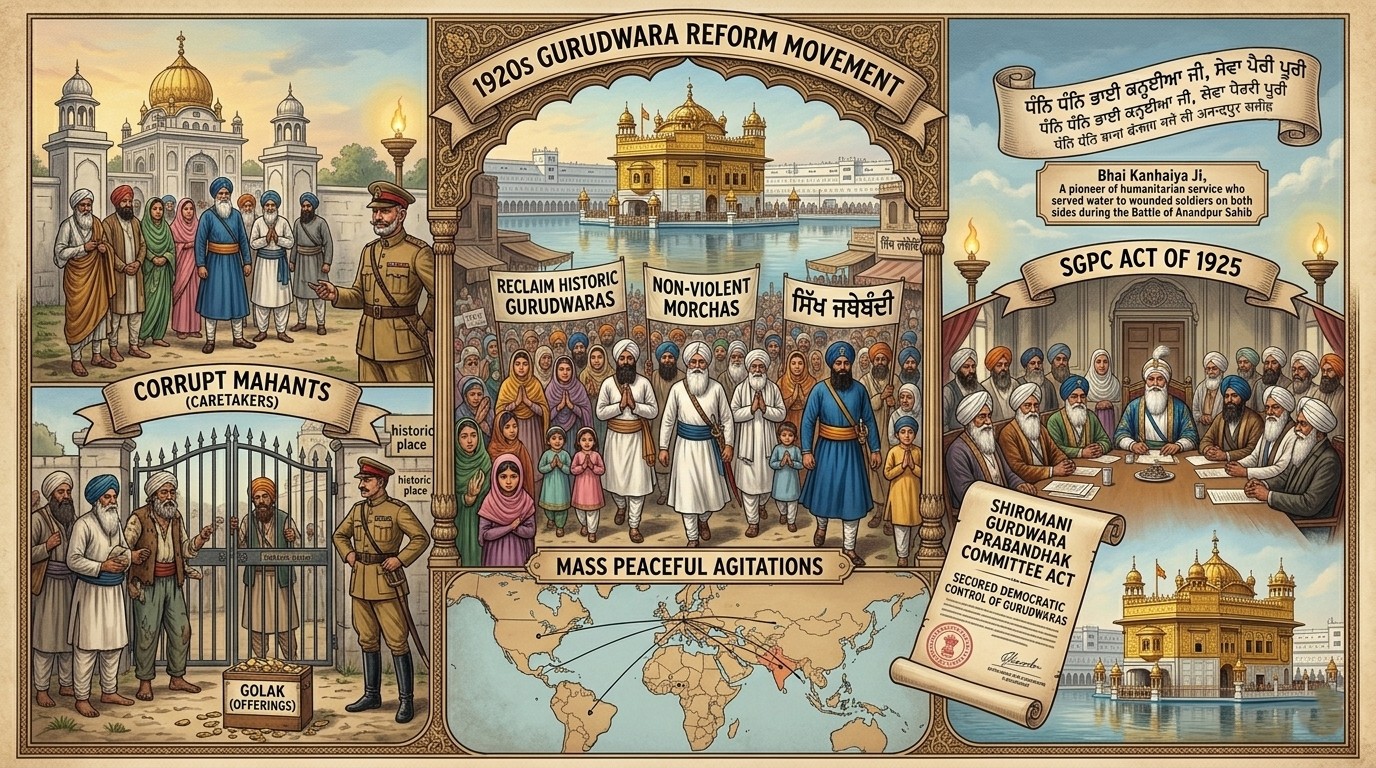
The Gurudwara Reform Movement of the 1920s: The Sikh Struggle for Religious Freedom, Democratic Governance, and the Birth of the SGPC
The Gurudwara Reform Movement of the 1920s stands as one of the most remarkable chapters in Sikh history and one of the most successful non-violent religious reform movements of the modern era. Known among Sikhs as the Akali Movement, this historic struggle sought to reclaim control of Sikh gurdwaras from corrupt mahants, hereditary caretakers who had gradually come to dominate many of the community's most sacred institutions during the nineteenth century. Through extraordinary discipline, sacrifice, moral courage, and commitment to non-violent resistance, ordinary Sikhs transformed a religious reform campaign into a mass movement that reshaped the future of Sikh institutions. The movement culminated in the passage of the Sikh Gurdwaras Act of 1925, which legally transferred the management of major Sikh shrines to elected representatives of the Sikh community through the Shiromani Gurdwara Prabandhak Committee (SGPC). The achievement represented far more than an administrative reform. It restored community ownership over sacred institutions, strengthened Sikh identity, encouraged democratic participation, and established governance structures that continue to influence Sikh religious life to the present day.
As a Sikh historian, one must view the Gurudwara Reform Movement not merely as a dispute over property or management. It was fundamentally a struggle over the soul of the Sikh Panth. At stake was the question of who would define Sikh religious life, interpret Sikh traditions, and control institutions created through centuries of sacrifice. The movement represented a powerful assertion that Sikh gurdwaras belonged not to hereditary custodians or external authorities but to the collective Sikh community itself. It demonstrated how deeply rooted principles of equality, service, accountability, and collective responsibility could be mobilized to achieve profound institutional change through peaceful means.
The Historical Background: From Sikh Sovereignty to Colonial Rule
To understand the origins of the Gurudwara Reform Movement, one must first examine the transformations that occurred after the annexation of Punjab by the British in 1849. During the era of Maharaja Ranjit Singh and the Sikh Empire, many major gurdwaras received state patronage and enjoyed considerable prestige. The institutions served not only as places of worship but also as centers of education, community organization, charity, and cultural preservation. Following the collapse of Sikh political sovereignty, however, the relationship between Sikh institutions and political authority changed dramatically.
Under British rule, many gurdwaras came under the control of mahants, individuals who often inherited authority over religious sites through hereditary succession. While some mahants managed these institutions responsibly, others became increasingly detached from Sikh teachings and community expectations. Over time, allegations emerged concerning financial mismanagement, misuse of religious property, personal enrichment, and the introduction of practices that many Sikhs considered inconsistent with Sikh principles. The absence of democratic oversight enabled abuses to continue in numerous locations.
The growing dissatisfaction among Sikhs reflected broader trends within the community. The Singh Sabha Movement of the late nineteenth century had already stimulated renewed interest in Sikh identity, education, history, and religious reform. As Sikhs became increasingly conscious of their distinct religious traditions, concerns about the management of sacred institutions intensified. By the beginning of the twentieth century, demands for reform had become a major issue within Sikh public life.
The Problem of the Mahants
The controversy surrounding the mahants was not simply a matter of administrative inefficiency. For many Sikhs, it involved fundamental questions regarding religious integrity and accountability. Numerous reports described situations in which gurdwara revenues were used for personal purposes rather than community welfare. In some cases, mahants were accused of neglecting religious responsibilities, engaging in immoral conduct, or permitting practices that reformers believed contradicted Sikh teachings.
Particularly troubling was the perception that some mahants enjoyed protection from colonial authorities. British officials often viewed hereditary custodians as convenient intermediaries through whom religious institutions could be monitored and managed. As a result, many Sikhs came to believe that meaningful reform would require not only challenging individual mahants but also confronting broader structures of authority that sustained their positions.
The issue resonated deeply because gurdwaras occupied a central place in Sikh life. These institutions were linked to the memories of the Gurus, the sacrifices of martyrs, and the collective heritage of the Panth. Control over such sites carried immense symbolic significance. Consequently, the demand for reform became inseparable from broader aspirations concerning Sikh dignity, self-governance, and community empowerment.
The Rise of the Akali Movement
The movement for gurdwara reform gained momentum after the First World War, a period characterized by political awakening across India. Sikh veterans returning from military service, educated reformers influenced by the Singh Sabha tradition, religious leaders, and ordinary villagers increasingly united around the cause of institutional reform. Out of this environment emerged the Akali Movement, a disciplined campaign dedicated to reclaiming Sikh shrines through peaceful action.
The term "Akali" carried powerful historical associations. Derived from the Punjabi word for "immortal," it evoked memories of Sikh warriors and defenders of the faith. Yet the Akalis of the 1920s embraced a strategy that emphasized non-violent resistance rather than armed struggle. Volunteers organized jathas, or disciplined groups, that traveled to contested gurdwaras, asserted community claims, and peacefully challenged existing management structures.
The movement rapidly attracted widespread support. Rural and urban Sikhs alike contributed resources, volunteers, and moral encouragement. The campaign transcended social divisions and fostered a remarkable sense of collective purpose. Men and women from diverse backgrounds participated in what they viewed as a sacred duty to restore the integrity of Sikh institutions.
The Formation of the SGPC and Centralized Leadership
A major turning point occurred in 1920 with the establishment of the Shiromani Gurdwara Prabandhak Committee, commonly known as the SGPC. Created as a representative body for managing Sikh gurdwaras, the SGPC provided organizational structure and strategic leadership to the reform movement. Its formation reflected the growing conviction that democratic governance offered the best means of ensuring accountability and community participation.
The SGPC embodied principles deeply rooted in Sikh tradition. Decisions were to be made collectively, leaders would be accountable to the community, and religious institutions would serve the interests of the Panth rather than individual custodians. By creating a representative organization, reformers sought to replace hereditary control with democratic administration.
The emergence of the SGPC also strengthened the movement's legitimacy. It demonstrated that reformers were not merely protesting existing conditions but proposing an alternative system of governance grounded in transparency and collective responsibility. This institutional vision would prove crucial in securing widespread support and eventual legal recognition.
The Nankana Sahib Massacre: A Defining Moment
One of the most tragic and consequential events of the movement occurred at Nankana Sahib in February 1921. This sacred site, associated with the birth of Guru Nanak, had become a focal point of reform efforts. Concerned about allegations regarding its management, Sikh reformers organized a peaceful mission to assert community control over the shrine.
The response was devastating. Armed supporters of the local mahant attacked unarmed volunteers who had entered the gurdwara. The resulting massacre shocked Sikhs throughout Punjab and beyond. Numerous reformers lost their lives while adhering to principles of non-violence and religious devotion.
The tragedy transformed public opinion. News of the killings spread rapidly, generating widespread outrage and sympathy for the reform movement. Rather than intimidating the community, the massacre strengthened determination and increased participation. The martyrs of Nankana Sahib became symbols of sacrifice, inspiring thousands of others to join the struggle for reform.
Non-Violence, Discipline, and Moral Authority
One of the most extraordinary aspects of the Gurudwara Reform Movement was its unwavering commitment to non-violent resistance. Volunteers frequently faced arrests, beatings, intimidation, and even death, yet they remained disciplined and peaceful. This approach reflected both practical strategy and spiritual conviction. Reformers believed that moral authority derived not from force but from adherence to truth, justice, and self-sacrifice.
Jathas often underwent careful preparation before participating in campaigns. Volunteers were instructed to maintain discipline under provocation, avoid retaliation, and conduct themselves in ways consistent with Sikh ethical principles. Their willingness to endure suffering without abandoning non-violence earned widespread admiration and strengthened the movement's moral legitimacy.
The commitment to peaceful resistance also distinguished the Akali Movement within the broader political landscape of colonial India. While sharing certain objectives with other reform and nationalist campaigns, the movement maintained a distinct focus on religious institutions and community governance. Its success demonstrated the power of organized, principled, non-violent action.
The Keys Affair and Expanding Public Support
Another significant episode occurred in 1921 during what became known as the Keys Affair. British authorities seized the keys of the treasury belonging to the Harmandir Sahib complex in Amritsar. The action was widely perceived as an attempt to undermine the authority of the reform movement and the emerging SGPC.
The Sikh response was immediate and united. Peaceful protests, public meetings, and widespread mobilization placed considerable pressure on the colonial administration. Ultimately, the government returned the keys to Sikh representatives, a decision widely interpreted as a major victory for the movement.
The Keys Affair demonstrated that organized public pressure could achieve tangible results. It also reinforced confidence in the SGPC as the legitimate representative of Sikh interests. The episode became an important symbol of community solidarity and institutional self-determination.
The Guru Ka Bagh Morcha and the Spirit of Sacrifice
The Guru Ka Bagh Morcha of 1922 further highlighted the movement's commitment to non-violence. The dispute centered on access to land associated with a gurdwara, but it quickly evolved into a broader confrontation over rights and authority. Volunteers repeatedly entered the disputed area knowing they would likely be arrested or assaulted.
Observers, including journalists and international visitors, documented scenes in which unarmed Sikhs calmly endured severe beatings without retaliation. These accounts generated sympathy not only within India but also abroad. The courage displayed by participants enhanced the movement's reputation and exposed the harshness of colonial responses.
The Guru Ka Bagh campaign illustrated how disciplined suffering could become a powerful form of political communication. Through their actions, volunteers demonstrated unwavering commitment to principles they considered sacred. Their sacrifices helped sustain momentum and draw attention to the broader goals of the reform movement.
The Road to the Sikh Gurdwaras Act of 1925
By the mid-1920s, it had become increasingly difficult for colonial authorities to ignore the scale and determination of the reform movement. Years of agitation, public mobilization, negotiations, and sacrifice had transformed the political landscape. The demand for a legal framework governing Sikh religious institutions could no longer be dismissed.
After extensive discussions and political pressure, the Sikh Gurdwaras Act was passed in 1925. This landmark legislation formally recognized the rights of the Sikh community to manage its historic gurdwaras through representative institutions. The act established legal mechanisms for determining which shrines fell under Sikh control and confirmed the role of the SGPC in administering these institutions.
The legislation represented a historic victory. It transferred authority from hereditary custodians to democratically elected representatives and institutionalized principles of accountability and collective governance. For many Sikhs, the act symbolized the successful completion of a struggle rooted in faith, sacrifice, and community solidarity.
The Long-Term Impact on Sikh Identity and Institutions
The consequences of the Gurudwara Reform Movement extended far beyond the 1920s. By establishing democratic governance structures, the movement fundamentally reshaped the relationship between Sikhs and their religious institutions. The SGPC became one of the most important organizations in Sikh life, overseeing major shrines, educational initiatives, religious programs, and community services.
The movement also reinforced key elements of modern Sikh identity. It emphasized collective responsibility, participation in public affairs, accountability of leadership, and commitment to preserving religious traditions. These principles influenced subsequent generations and contributed to the development of Sikh institutions worldwide.
Perhaps most importantly, the movement demonstrated the power of ordinary individuals acting together in pursuit of shared values. Farmers, laborers, students, religious leaders, and professionals all contributed to a campaign that transformed the governance of Sikh sacred spaces. Their achievements continue to inspire Sikhs around the globe.
Conclusion
The Gurudwara Reform Movement of the 1920s remains one of the greatest examples of peaceful mass mobilization in Sikh history. Confronting corruption, institutional stagnation, and political obstacles, Sikhs launched a disciplined and morally grounded campaign to reclaim their sacred institutions. Through extraordinary sacrifice, unwavering commitment to non-violence, and effective organization under the leadership of the SGPC, they succeeded in securing democratic control over historic gurdwaras. The passage of the Sikh Gurdwaras Act of 1925 marked the culmination of this remarkable struggle and established governance structures that continue to shape Sikh religious life today. More than a century later, the movement stands as a testament to the enduring power of faith, collective action, and principled leadership in achieving lasting institutional change.
Frequently Asked Questions (FAQ)
1. What was the Gurudwara Reform Movement?
The Gurudwara Reform Movement was a Sikh campaign during the 1920s aimed at reclaiming control of historic gurdwaras from corrupt mahants and placing them under community management.
2. Why did Sikhs oppose the mahants?
Many mahants were accused of financial mismanagement, corruption, misuse of religious property, and practices considered inconsistent with Sikh teachings.
3. What was the Akali Movement?
The Akali Movement was the organized Sikh campaign that led the struggle for gurdwara reform through peaceful mass mobilization and non-violent resistance.
4. What is the SGPC?
The Shiromani Gurdwara Prabandhak Committee (SGPC) is the representative body established to manage major Sikh gurdwaras and oversee religious affairs.
5. When was the SGPC formed?
The SGPC was established in 1920 as part of the broader effort to reform and democratize Sikh religious institutions.
6. What happened at Nankana Sahib in 1921?
Peaceful Sikh reformers were attacked and killed by armed supporters of a mahant, resulting in the Nankana Sahib Massacre, a defining event in the movement.
7. What was the Keys Affair?
The Keys Affair involved the seizure of treasury keys connected to the Harmandir Sahib complex by British authorities and their eventual return after Sikh protests.
8. What was the Guru Ka Bagh Morcha?
It was a major non-violent protest campaign in which Sikh volunteers peacefully endured arrests and beatings while asserting community rights.
9. What was the Sikh Gurdwaras Act of 1925?
The act legally recognized Sikh control over major gurdwaras and established the SGPC as the governing body responsible for their management.
10. Why is the Gurudwara Reform Movement important today?
It secured democratic management of Sikh religious institutions, strengthened modern Sikh identity, and remains a powerful example of successful non-violent collective action.