Historical Turning Points · Living Heritage
1947 Partition of Punjab
The division of India and Pakistan led to the displacement of millions and the loss of major historical sites.
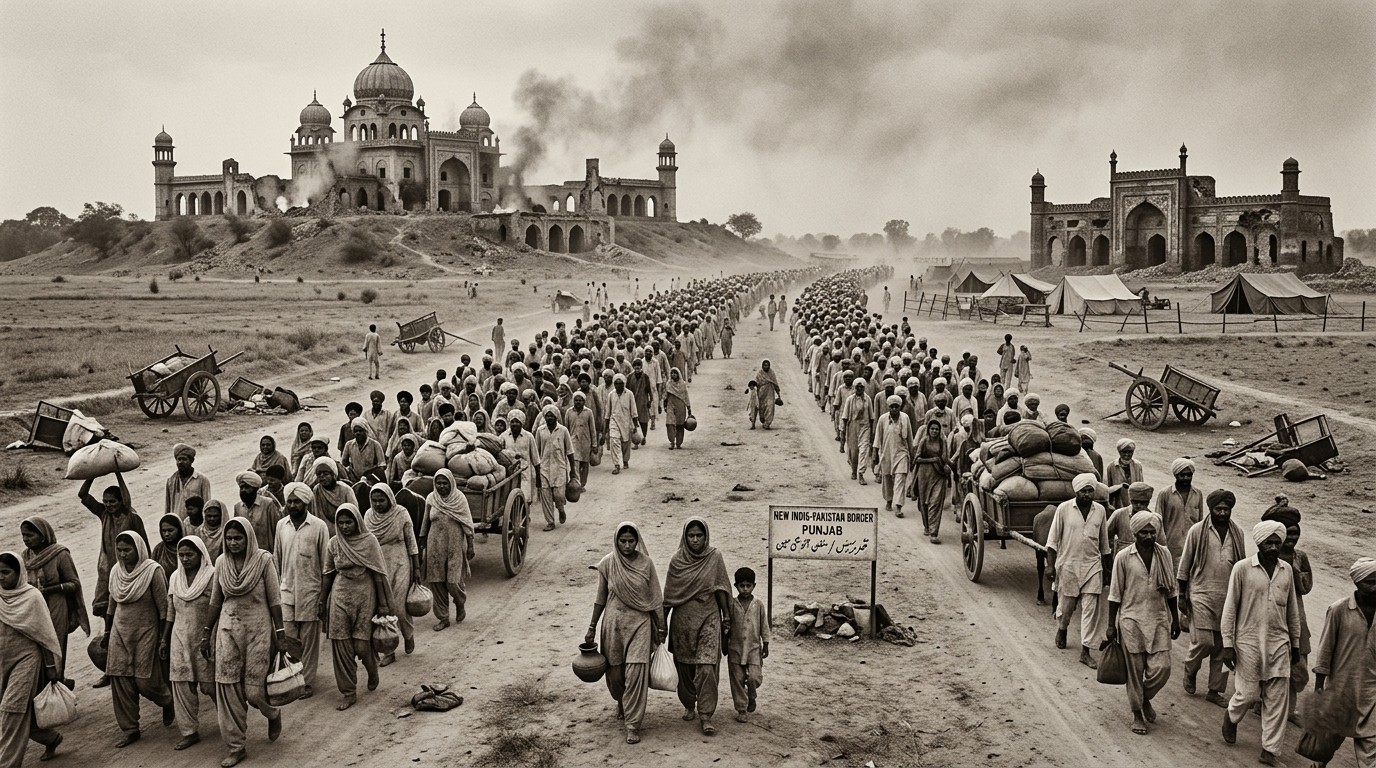
Partition of Punjab: The Great Division, Mass Displacement, and the Loss of Sikh Historical Heritage
The Partition of Punjab in 1947 stands as one of the most traumatic and transformative events in Sikh history. More than a political rearrangement of territory, it was a human catastrophe that shattered centuries-old communities, uprooted millions from their ancestral homes, and severed the Sikh community from many of its most sacred historical sites. For Sikhs, Punjab was not merely a geographical region; it was the homeland where the Sikh faith had been born, nurtured, and defended through generations of sacrifice. It was the land where Guru Nanak walked and preached, where the Sikh Gurus established centers of spiritual learning, where countless martyrs gave their lives for religious freedom, and where the Khalsa rose as a distinct and sovereign community. The division of Punjab between India and Pakistan in August 1947 not only redrew borders but also fractured a historical landscape that had been central to Sikh identity for nearly five centuries. The consequences of Partition continue to shape Sikh memory, politics, culture, and religious consciousness to this day.
Punjab Before Partition: A Shared Homeland
Prior to 1947, Punjab was one of the most diverse and vibrant regions of the Indian subcontinent. Muslims constituted the majority population, while Hindus and Sikhs formed significant minorities. For centuries, these communities had lived alongside one another in villages, towns, and cities. Although differences and occasional tensions existed, Punjab had developed a distinctive culture characterized by shared languages, agricultural traditions, festivals, folklore, and commercial networks. Lahore, Amritsar, Rawalpindi, Multan, Sialkot, Gujranwala, Sheikhupura, and Lyallpur were interconnected centers of trade, education, religion, and administration.
For Sikhs, the undivided Punjab possessed immense historical and spiritual significance. The birthplace of Guru Nanak at Nankana Sahib, the site of Guru Arjan's martyrdom in Lahore, the locations associated with Guru Ram Das and Guru Hargobind, and numerous battlefields, shrines, and historic Gurdwaras were spread across the province. The Sikh Empire of Maharaja Ranjit Singh had emerged from this landscape in the nineteenth century, further strengthening Sikh attachment to the region. Many Sikh families had cultivated the same lands for generations, creating deep emotional connections to villages and towns that had become integral parts of their identity. Few could have imagined that within a matter of months, these communities would be forced to abandon homes, farms, businesses, and sacred sites forever.
The Political Road to Partition
The origins of Partition lay in the complex political developments of the late colonial period. As British rule in India approached its end, competing visions emerged regarding the future political structure of the subcontinent. The Indian National Congress advocated a united India, while the Muslim League increasingly pushed for the creation of a separate Muslim-majority state known as Pakistan. Punjab became a focal point of these debates because of its mixed population and strategic importance.
Sikh leaders found themselves in a particularly difficult position. Unlike Muslims and Hindus, Sikhs did not constitute a majority in any large contiguous region. Yet Punjab contained the overwhelming majority of Sikh population centers and nearly all major Sikh historical sites. Sikh political representatives repeatedly expressed concerns about proposals that would divide Punjab. They feared that partitioning the province would leave many sacred shrines and Sikh populations on the Pakistani side of the border. Despite these concerns, negotiations among British officials, Congress leaders, and the Muslim League increasingly moved toward partition as communal tensions intensified throughout India.
The final decision came with alarming speed. The British government announced its intention to transfer power in 1947, and a boundary commission under Sir Cyril Radcliffe was tasked with drawing the border between India and Pakistan. Radcliffe had never previously visited India and was given only a few weeks to determine the fate of millions of people. The resulting boundary line divided Punjab into East Punjab, which became part of India, and West Punjab, which became part of Pakistan. The consequences would be immediate and devastating.
The Violence of 1947
When Partition became a reality in August 1947, Punjab descended into unprecedented violence. Communal tensions that had been escalating for months exploded into widespread massacres, arson, kidnappings, forced conversions, and revenge attacks. Villages that had coexisted for generations suddenly found themselves engulfed in fear and suspicion. Armed groups emerged on all sides, and law enforcement mechanisms collapsed under the scale of the crisis.
The violence was particularly severe in Punjab because the province was being physically divided between two newly created states. Entire populations became targets simply because of their religious identity. Muslims fled eastward toward Pakistan, while Hindus and Sikhs fled westward toward India. Trains carrying refugees often arrived filled with corpses rather than passengers. Long caravans of displaced people stretched for miles across the countryside, vulnerable to attack and deprivation. Families became separated, children disappeared, and countless individuals never learned the fate of their loved ones.
For Sikhs, the violence carried an especially profound emotional burden. Many communities in West Punjab had believed they would remain in their ancestral homes. Instead, they found themselves caught in a rapidly deteriorating situation where survival often required immediate flight. Villages that had stood for centuries were abandoned within days. Homes, farms, businesses, and personal possessions accumulated over generations were left behind. The trauma of these experiences became deeply embedded in Sikh collective memory and continues to be remembered through family stories passed down across generations.
The Largest Migration in Human History
The Partition of Punjab triggered one of the largest forced migrations in human history. Millions of people crossed the newly established border in both directions within a matter of months. Sikhs and Hindus from West Punjab moved into India, while Muslims from East Punjab moved into Pakistan. The scale of displacement was staggering. Entire districts underwent demographic transformation almost overnight as centuries-old patterns of settlement disappeared.
Sikh refugees arriving in Indian Punjab often possessed little more than the clothes they wore. Many had lost family members, livelihoods, and property. Refugee camps sprang up across northern India to accommodate the enormous influx of displaced persons. Conditions in these camps were frequently overcrowded and difficult, yet they also became spaces of resilience and community rebuilding. Sikh religious institutions, voluntary organizations, and ordinary families played critical roles in providing food, shelter, and support to those affected by the crisis.
The resettlement process was both painful and transformative. Refugees had to rebuild their lives from scratch, often in unfamiliar environments. Agricultural families were relocated to new lands, merchants established new businesses, and communities reconstructed social networks that had been shattered by displacement. Despite enormous hardship, many Sikhs demonstrated remarkable resilience and contributed significantly to the economic and social development of post-independence India.
The Loss of Sacred Sikh Historical Sites
Among the most enduring consequences of Partition for Sikhs was the loss of direct access to numerous historical and religious sites located in what became Pakistan. Many of the most important places associated with the Sikh Gurus remained on the western side of the border. This created a unique situation in which a significant portion of Sikh sacred geography suddenly lay outside India and beyond the reach of most Sikh pilgrims.
The most prominent example is Nankana Sahib, the birthplace of Guru Nanak. Revered as the founder of Sikhism, Guru Nanak's birthplace occupies a central position in Sikh religious consciousness. Before Partition, Sikhs from across Punjab could easily visit this sacred site. After 1947, access became dependent upon political relations between India and Pakistan. Similarly, Lahore, one of the most important cities in Sikh history, became part of Pakistan. The city contains locations associated with Guru Arjan's martyrdom, the legacy of Maharaja Ranjit Singh, and numerous historic Gurdwaras. Other significant sites, including Panja Sahib, Dera Sahib, Kartarpur Sahib, and many lesser-known shrines, also remained in Pakistan.
The separation from these sacred places created a profound sense of loss. For many Sikhs, the issue was not merely one of physical access but of emotional and spiritual disconnection from a historical landscape that had shaped Sikh identity. Pilgrimage, remembrance, and direct engagement with sacred geography had long been integral aspects of Sikh religious life. Partition transformed these experiences into aspirations dependent upon diplomatic arrangements and cross-border cooperation.
The Human Cost for Sikh Families
While discussions of Partition often focus on political decisions and demographic statistics, the human dimension remains central to understanding its impact. Nearly every Sikh family whose roots lay in West Punjab carries stories of displacement. Grandparents and great-grandparents recounted memories of villages left behind, neighbors who disappeared, journeys undertaken under terrifying circumstances, and lives rebuilt through perseverance and determination.
Many refugees preserved keys to homes they would never see again. Others carried documents, photographs, or religious manuscripts as reminders of a lost world. Oral histories reveal both immense suffering and extraordinary courage. Stories of individuals risking their lives to save neighbors of different faiths coexist alongside accounts of violence and tragedy. These memories form an essential part of Sikh historical consciousness and serve as reminders of the devastating consequences of communal conflict.
Rebuilding Sikh Society After Partition
The years following Partition witnessed one of the most remarkable examples of community reconstruction in modern history. Despite losing vast amounts of property and enduring immense personal trauma, Sikh refugees played a major role in rebuilding northern India. New agricultural settlements transformed regions of Indian Punjab, Haryana, Rajasthan, and beyond. Refugee entrepreneurs established businesses that contributed significantly to economic growth. Educational institutions, religious organizations, and community networks emerged to support future generations.
The reconstruction of Sikh society after Partition was not simply an economic achievement. It reflected deeply rooted cultural values emphasizing hard work, collective responsibility, faith, and resilience. Gurdwaras became centers of support and community organization. The tradition of seva, or selfless service, played a crucial role in assisting displaced families. Through these efforts, the Sikh community transformed tragedy into renewal while preserving memories of its lost homeland.
The Continuing Legacy of Partition
The legacy of Partition remains deeply relevant in contemporary Sikh life. The memory of displacement continues to influence cultural identity, historical scholarship, political discourse, and religious practice. Efforts to preserve historical connections with sites in Pakistan have become increasingly important. Pilgrimage initiatives, restoration projects, and diplomatic agreements have sought to facilitate access to sacred locations. Developments such as the Kartarpur Corridor have demonstrated the possibility of reconnecting Sikhs with portions of their historical heritage despite international borders.
At the same time, Partition serves as a powerful reminder of the dangers of communal polarization and political conflict. The experiences of 1947 illustrate how rapidly coexistence can unravel when fear, mistrust, and violence overwhelm social bonds. For Sikh historians, the study of Partition is not merely an examination of past events but an effort to preserve lessons that remain relevant for future generations.
Conclusion
The Partition of Punjab was one of the defining events in Sikh history. It transformed the geographical, demographic, and emotional landscape of the Sikh community in ways that continue to resonate nearly eight decades later. The division of Punjab resulted in the displacement of millions, the destruction of countless communities, and the separation of Sikhs from many of their most cherished historical and religious sites. Yet it also revealed extraordinary resilience, determination, and faith. Through rebuilding, remembrance, and continued engagement with their historical heritage, Sikhs have preserved the legacy of a homeland divided but never forgotten. The story of Partition remains a testament to both the immense human cost of political division and the enduring strength of a community shaped by sacrifice and perseverance.
Frequently Asked Questions (FAQ)
1. What was the Partition of Punjab?
The Partition of Punjab was the division of the province between India and Pakistan in 1947 as part of the broader Partition of British India.
2. Why was Punjab divided?
Punjab was divided because the creation of Pakistan required the separation of Muslim-majority and non-Muslim-majority regions according to the political decisions made during the transfer of power.
3. How did Partition affect Sikhs?
Sikhs experienced mass displacement, loss of property, separation from historical sites, and significant casualties during the violence accompanying Partition.
4. What happened to Sikh historical sites after Partition?
Many important Sikh shrines, including Nankana Sahib and Panja Sahib, became part of Pakistan and were no longer easily accessible to most Sikh pilgrims.
5. What was the role of Lahore in Sikh history?
Lahore was a major center of Sikh religious, political, and cultural life and contains several important sites associated with Sikh Gurus and Maharaja Ranjit Singh.
6. How many people were displaced during Partition?
Millions of people crossed the new India-Pakistan border, making it one of the largest forced migrations in human history.
7. Why is Nankana Sahib important to Sikhs?
Nankana Sahib is the birthplace of Guru Nanak, the founder of Sikhism, making it one of the holiest sites in the Sikh faith.
8. How did Sikh refugees rebuild their lives?
Through hard work, community support, agricultural development, entrepreneurship, and religious institutions, Sikh refugees successfully rebuilt their communities after displacement.
9. What is the Kartarpur Corridor?
The Kartarpur Corridor is a visa-free border crossing that allows Sikh pilgrims from India to visit Gurdwara Darbar Sahib Kartarpur in Pakistan.
10. Why is the study of Partition important today?
The study of Partition helps preserve historical memory, honor the experiences of survivors, understand the consequences of communal violence, and promote peace and reconciliation.