Historical Turning Points · Living Heritage
1966 Punjabi Suba Movement
Following a long struggle spearheaded by the Shiromani Akali Dal, the Indian government reorganized Punjab on a linguistic basis, creating the modern Punjabi-speaking state, though significant territorial and water disputes remained unresolved.
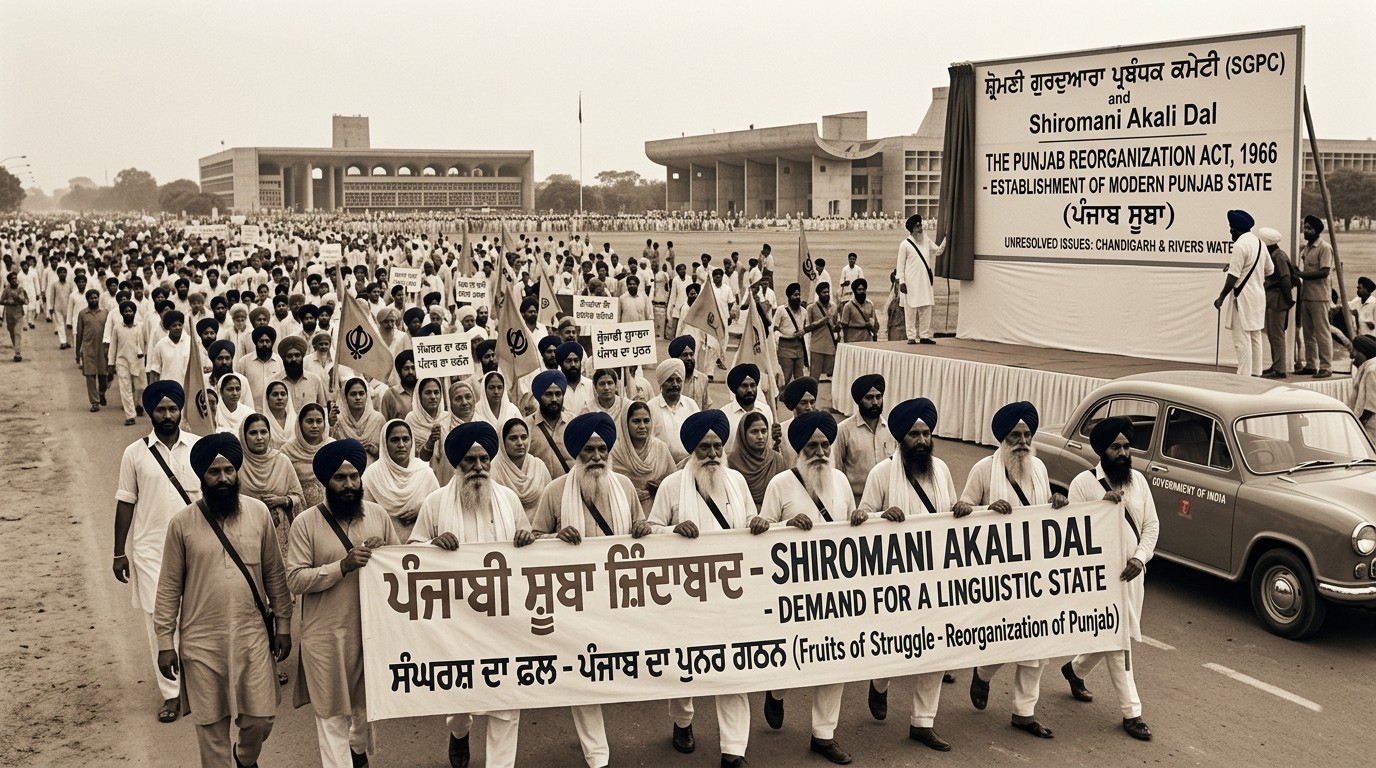
1966 Punjabi Suba Movement: The Long Struggle for a Punjabi-Speaking State and the Unfinished Questions of Punjab
The Punjabi Suba Movement occupies a pivotal place in modern Sikh and Punjabi history. It was a prolonged political, cultural, and linguistic struggle that unfolded over nearly two decades following the independence and partition of India in 1947. Led primarily by the Shiromani Akali Dal, the movement sought the creation of a Punjabi-speaking state within the Indian Union based on linguistic principles that were being applied elsewhere in the country. For many Sikhs, the movement represented an effort to preserve the Punjabi language, protect regional identity, and secure a measure of political autonomy within a democratic framework. For others, including many political opponents, the movement was viewed with suspicion and often misunderstood as a religious demand rather than a linguistic and cultural one. The eventual reorganization of Punjab in 1966 marked a significant victory for the movement, resulting in the creation of the modern Punjabi-speaking state of Punjab. However, the settlement left several contentious issues unresolved, including disputes over territorial boundaries, the status of Chandigarh, and the distribution of river waters. These unresolved questions would continue to influence Punjab's political landscape for decades to come.
As a Sikh historian, it is important to understand the Punjabi Suba Movement not simply as a political campaign but as a continuation of broader historical processes that shaped Sikh identity after the end of British colonial rule. The movement emerged in the aftermath of partition, a period marked by displacement, trauma, demographic transformation, and political uncertainty. It reflected the aspirations of a community seeking to rebuild itself after one of the greatest upheavals in South Asian history. The story of Punjabi Suba is therefore a story of language, identity, democracy, federalism, and the ongoing search for recognition within an evolving Indian nation-state.
The Historical Legacy of Partition and Its Impact on Punjab
The roots of the Punjabi Suba Movement can be traced directly to the partition of British India in 1947. The division of Punjab between India and Pakistan produced one of the largest forced migrations in human history. Millions of people crossed newly established borders amid widespread violence and uncertainty. Sikhs suffered immense losses during this period. Many of their most historic religious sites, including Nankana Sahib, the birthplace of Guru Nanak, became part of Pakistan. Large Sikh populations were uprooted from ancestral lands in West Punjab and forced to rebuild their lives in Indian territory.
The post-partition Indian Punjab that emerged in 1947 differed significantly from the historic Punjab that had existed under British rule. The province was smaller, demographically transformed, and politically reconfigured. Refugees had to be resettled, agricultural systems reconstructed, and social institutions rebuilt. Amid these challenges, questions concerning language, culture, and political representation became increasingly important. Many Punjabis believed that preserving their linguistic heritage was essential for maintaining cultural continuity after the profound disruptions caused by partition.
The trauma of partition also influenced Sikh political consciousness. Having experienced the loss of historic territories and sacred sites, many Sikhs became deeply concerned about protecting their cultural and linguistic identity within the new political realities of independent India. These concerns would eventually contribute to support for the Punjabi Suba Movement.
The Linguistic Reorganization of India
During the years immediately following independence, India faced the challenge of organizing its vast and diverse territory into administrative units that reflected linguistic and cultural realities. Across the country, movements emerged demanding states based on language rather than colonial administrative boundaries. These demands were rooted in the belief that linguistic communities should have the opportunity to govern themselves within India's federal framework.
The States Reorganisation Commission, established in the 1950s, examined these questions and influenced the creation of several linguistic states. Telugu speakers gained Andhra Pradesh, Kannada speakers obtained Karnataka, and Malayalam speakers saw the formation of Kerala. Similar reorganizations occurred elsewhere, reflecting a broader national acceptance of linguistic federalism.
Against this backdrop, supporters of Punjabi Suba argued that Punjabi speakers deserved similar recognition. They contended that if other linguistic communities could receive states organized around language, then Punjabi speakers should be granted the same opportunity. The demand was therefore presented as part of a broader national process rather than an exceptional or separatist claim.
The Role of the Shiromani Akali Dal
The Shiromani Akali Dal became the principal political force advocating for Punjabi Suba. Having played a significant role in Sikh religious and political affairs throughout the twentieth century, the party viewed linguistic reorganization as essential for safeguarding Punjabi language and culture. Akali leaders argued that Punjabi was a distinct language with a rich literary tradition and deserved official recognition within an administrative unit where it could flourish.
Prominent leaders such as Master Tara Singh and later Sant Fateh Singh emerged as key figures in the movement. Through speeches, public campaigns, negotiations, and political mobilization, they sought to build support among Punjabis while engaging with national political leaders. Their efforts reflected a belief that linguistic recognition could coexist with loyalty to the Indian Union.
The Akali Dal's involvement ensured that the movement remained highly organized and visible. Public meetings, demonstrations, petitions, and electoral campaigns kept the issue at the forefront of political debate. Over time, the demand for Punjabi Suba became one of the defining issues in Punjab's post-independence political history.
Language, Script, and Identity
One of the most complex aspects of the Punjabi Suba Movement involved questions of language and script. Punjabi was spoken by people belonging to multiple religious communities, including Sikhs, Hindus, and others. However, political tensions emerged over how language was identified and recorded. During census operations, some Punjabi-speaking Hindus declared Hindi rather than Punjabi as their mother tongue, often for political or ideological reasons.
This phenomenon complicated efforts to determine the actual linguistic composition of Punjab. Supporters of Punjabi Suba argued that such declarations underestimated the number of Punjabi speakers and distorted demographic realities. They maintained that Punjabi was a shared regional language that transcended religious boundaries and deserved recognition regardless of political considerations.
The debate highlighted how language could become intertwined with questions of identity and power. For many Sikhs, defending Punjabi became synonymous with defending cultural heritage. The Gurmukhi script, in particular, held special significance because of its historical association with Sikh scripture and literature. Consequently, linguistic issues acquired emotional and symbolic importance far beyond administrative concerns.
Political Opposition and National Concerns
The Punjabi Suba demand faced significant opposition from various quarters. Critics argued that the movement risked encouraging communal divisions or undermining national unity. Some political leaders feared that creating a Punjabi-speaking state might strengthen religious identities in ways that could complicate India's secular framework.
These concerns were intensified by memories of partition and ongoing efforts to consolidate national integration. Opponents often interpreted the movement through the lens of communal politics rather than linguistic federalism. As a result, negotiations between Punjabi Suba advocates and the central government were frequently marked by mistrust and misunderstanding.
Supporters of the movement consistently emphasized that their demands were constitutional and democratic. They pointed out that similar linguistic reorganizations had already been implemented elsewhere in India without threatening national unity. Nevertheless, political resistance delayed resolution for many years and contributed to growing frustration among supporters.
Mass Mobilization and Peaceful Agitation
The Punjabi Suba Movement was characterized by extensive public mobilization and non-violent political activism. Thousands of volunteers participated in demonstrations, marches, and acts of civil disobedience. Many activists willingly faced arrest as part of campaigns designed to draw attention to their demands.
The movement's methods reflected a long tradition of peaceful protest within Sikh political culture. Leaders sought to maintain discipline and emphasize constitutional means of pursuing political objectives. Public gatherings frequently combined political advocacy with expressions of cultural pride and community solidarity.
The willingness of ordinary Punjabis to participate in these campaigns demonstrated the depth of support for linguistic recognition. Farmers, students, religious leaders, professionals, and workers all contributed to the movement in various ways. Their participation transformed Punjabi Suba from a party platform into a broad-based social movement.
Sant Fateh Singh and the Final Phase of the Movement
Among the movement's most influential leaders was Sant Fateh Singh, whose leadership helped sustain momentum during critical years. A respected religious and political figure, he became closely associated with efforts to secure Punjabi Suba through peaceful means. His campaigns attracted widespread attention and increased pressure on the central government to address the issue.
Sant Fateh Singh's leadership combined religious authority with political advocacy. He emphasized the cultural and linguistic dimensions of the demand while maintaining commitment to democratic methods. His ability to mobilize public opinion contributed significantly to the movement's eventual success.
By the mid-1960s, it had become increasingly apparent that the existing administrative arrangement could not indefinitely contain demands for linguistic reorganization. Political realities, public pressure, and changing national circumstances created conditions favorable to a negotiated solution.
The Reorganization of Punjab in 1966
In 1966, the Government of India enacted the Punjab Reorganisation Act, fundamentally altering the political geography of the region. The existing state of Punjab was divided into multiple administrative units. The modern Punjabi-speaking state of Punjab was created, while the Hindi-speaking regions were organized into the new state of Haryana. Certain hilly areas were transferred to Himachal Pradesh.
The reorganization represented a major milestone in the history of the Punjabi Suba Movement. For supporters, it confirmed the legitimacy of their long-standing demand and recognized Punjabi as the defining language of the new state. The creation of Punjab provided a framework within which Punjabi language, literature, education, and culture could be promoted more effectively.
The achievement also demonstrated the capacity of democratic institutions to address complex regional demands. Through decades of negotiation, political activism, and public engagement, the movement had secured a significant constitutional victory without resorting to violence.
The Chandigarh Dispute
Despite the success of reorganization, important questions remained unresolved. Perhaps the most prominent concerned the city of Chandigarh. Constructed after partition to serve as the capital of Indian Punjab, Chandigarh occupied a unique position following the division of the state.
Rather than being assigned exclusively to either Punjab or Haryana, Chandigarh became a Union Territory administered by the central government while serving as the capital of both states. Many Punjabis believed that Chandigarh should have been transferred fully to Punjab, while competing claims emerged from Haryana.
The dispute became one of the most enduring legacies of the reorganization process. Decades after 1966, discussions concerning Chandigarh's status continued to generate political debate and influence intergovernmental relations.
The Question of River Waters
Another major unresolved issue involved the allocation of river waters. Punjab's agricultural prosperity depends heavily upon access to water resources, making river management a matter of immense economic and political significance. Following reorganization, disputes emerged regarding the distribution of waters from rivers flowing through the region.
Many Punjabis argued that existing arrangements unfairly allocated water resources to neighboring states. These concerns became increasingly prominent as agriculture expanded and water demands grew. Debates over river waters would later become central elements of Punjab's political discourse.
The issue illustrates how administrative reorganization often produces complex secondary challenges. While linguistic boundaries could be redrawn through legislation, questions concerning shared resources proved more difficult to resolve.
The Impact on Sikh and Punjabi Identity
The creation of Punjabi-speaking Punjab had profound cultural consequences. It strengthened the institutional position of the Punjabi language, encouraged educational development, and reinforced regional cultural expression. For many Sikhs, the achievement represented the successful preservation of a linguistic and cultural heritage that had faced uncertainty in the years following partition.
At the same time, the movement contributed to broader discussions concerning federalism, minority rights, and regional autonomy within India. It demonstrated that linguistic identity could serve as a legitimate basis for political organization while remaining compatible with national citizenship.
The Punjabi Suba Movement also shaped future Sikh political thought. The unresolved issues left behind by reorganization continued to influence debates concerning autonomy, representation, and resource distribution. Consequently, the movement occupies an important place not only in the history of Punjab but also in the evolution of modern Indian federalism.
Historical Legacy and Continuing Relevance
More than half a century after the creation of Punjabi-speaking Punjab, the legacy of the Punjabi Suba Movement remains highly relevant. The movement achieved its primary objective of establishing a state where Punjabi language and culture could flourish. Yet the unresolved questions surrounding territory, water, and administrative arrangements ensured that political debates would continue long after 1966.
Historians increasingly recognize the movement as an important example of democratic mobilization centered on linguistic and cultural identity. It reflected broader global trends in which communities sought recognition within larger political systems while maintaining distinct cultural traditions. The movement's successes and limitations continue to offer valuable insights into the challenges of managing diversity within federal democracies.
Conclusion
The Punjabi Suba Movement was one of the most significant political and cultural struggles in modern Sikh history. Emerging from the trauma of partition and shaped by broader debates about language and federalism, the movement sought recognition for Punjabi speakers within the framework of the Indian Union. Led primarily by the Shiromani Akali Dal and supported by countless ordinary Punjabis, it employed democratic and non-violent methods to pursue its goals. The creation of the modern state of Punjab in 1966 represented a historic achievement that safeguarded Punjabi language and strengthened regional identity. Yet the movement also left behind unresolved issues concerning territory, Chandigarh, and river waters that continue to influence politics today. Its history remains a powerful reminder of the enduring relationship between language, identity, democracy, and the quest for cultural recognition.
Frequently Asked Questions (FAQ)
1. What was the Punjabi Suba Movement?
The Punjabi Suba Movement was a political and linguistic campaign seeking the creation of a Punjabi-speaking state within India.
2. Who led the Punjabi Suba Movement?
The movement was primarily led by the Shiromani Akali Dal, with leaders such as Master Tara Singh and Sant Fateh Singh playing important roles.
3. Why was the movement launched?
Supporters sought recognition for Punjabi language and culture and argued that Punjabi speakers deserved a linguistic state similar to those created elsewhere in India.
4. Was Punjabi Suba a religious demand?
Its supporters generally presented it as a linguistic and cultural demand, although critics sometimes interpreted it through a religious lens.
5. What happened in 1966?
The Punjab Reorganisation Act created the modern Punjabi-speaking state of Punjab and established Haryana as a separate state.
6. What happened to Chandigarh after reorganization?
Chandigarh became a Union Territory and serves as the capital of both Punjab and Haryana.
7. Why is Chandigarh still controversial?
Competing claims regarding its permanent status have remained unresolved since the reorganization of Punjab.
8. What are the river water disputes?
They involve disagreements concerning the allocation and management of river waters shared between Punjab and neighboring states.
9. How did the movement affect Punjabi identity?
It strengthened the position of Punjabi language, encouraged cultural preservation, and reinforced regional consciousness.
10. Why is the Punjabi Suba Movement historically important?
It reshaped the political geography of northern India, secured recognition for Punjabi speakers, and remains a key chapter in the history of Sikh politics and Indian federalism.