Historical Turning Points · Living Heritage
1973 Anandpur Sahib Resolution
A defining political document was passed by the Akali Dal demanding greater state autonomy for Punjab, which fueled subsequent debates over federalism, religion, and politics in India.
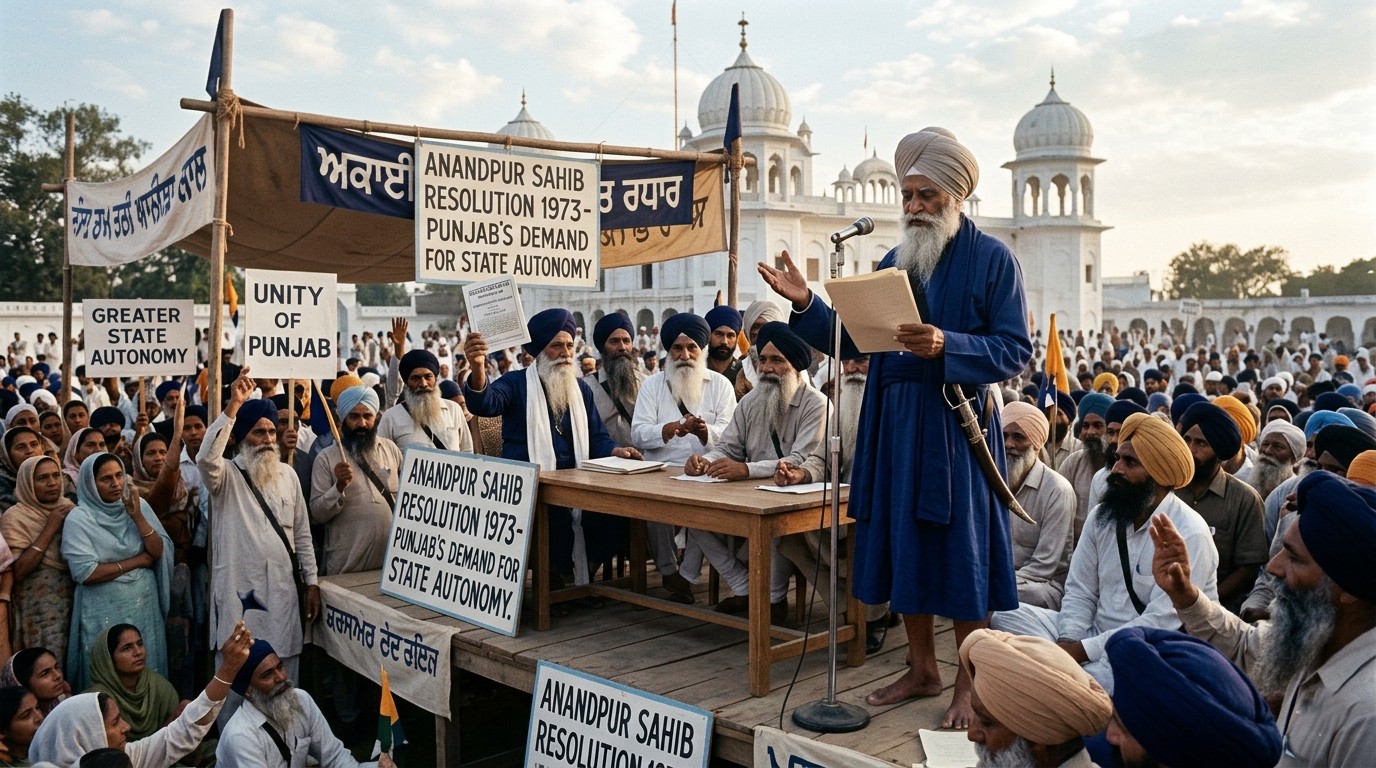
The 1973 Anandpur Sahib Resolution: Federalism, Sikh Political Aspirations, and the Debate That Reshaped Modern Punjab
The Anandpur Sahib Resolution of 1973 remains one of the most significant, debated, and frequently misunderstood political documents in modern Sikh history. Passed by the Shiromani Akali Dal at Anandpur Sahib, one of Sikhism's most sacred historical centers, the resolution sought to articulate a vision for Punjab's political, economic, cultural, and religious future within the framework of the Indian Union. For its supporters, the document represented a constitutional and democratic demand for greater state autonomy, federal balance, protection of regional rights, and recognition of Punjab's distinct linguistic and cultural identity. For many critics, however, the resolution generated concerns regarding national unity, the relationship between religion and politics, and the future direction of Sikh political mobilization. Over the decades, the Anandpur Sahib Resolution has become both a symbol of Sikh political aspirations and a focal point of intense debate about federalism, minority rights, state power, and the nature of Indian democracy.
As a Sikh historian, one must approach the Anandpur Sahib Resolution with careful attention to historical context rather than retrospective assumptions. The document emerged during a period of political transformation in India and reflected concerns that had developed over many years. It was not produced in isolation, nor was it solely concerned with religious issues. Rather, it represented the culmination of debates surrounding the Punjabi Suba Movement, the reorganization of Punjab, unresolved territorial and resource disputes, economic grievances, and broader questions regarding the distribution of authority between the central government and the states. Understanding the resolution requires examining not only its text but also the political environment that produced it and the controversies that followed.
The Historical Background: Punjab After Reorganization
The roots of the Anandpur Sahib Resolution can be traced to the political developments that followed the creation of the Punjabi-speaking state of Punjab in 1966. The Punjabi Suba Movement had achieved its principal objective when the Government of India reorganized Punjab along linguistic lines. The new state represented a significant victory for those who had campaigned for recognition of Punjabi language and culture. However, many issues remained unresolved even after reorganization.
One of the most contentious questions concerned the city of Chandigarh. Although built as the capital of post-partition Punjab, Chandigarh was designated a Union Territory and served as the capital of both Punjab and the newly created state of Haryana. Many Punjabis believed that Chandigarh rightfully belonged to Punjab, while competing claims emerged from Haryana. The dispute became a persistent source of political tension.
Equally important were disagreements concerning the distribution of river waters. Punjab's agricultural economy depended heavily upon access to water resources, and many political leaders argued that water allocation policies disadvantaged the state. Questions regarding control over economic resources, agricultural pricing, industrial development, and federal authority also generated growing dissatisfaction. By the early 1970s, many within the Akali Dal believed that Punjab's concerns required a comprehensive political response.
The Political Climate of the Early 1970s
The early 1970s were characterized by increasing centralization within Indian politics. The national government exercised considerable authority over state affairs, and debates concerning the balance of power within India's federal structure became more prominent. Regional political parties across various states expressed concerns about the concentration of decision-making authority in New Delhi. These concerns were not unique to Punjab; similar discussions occurred in other regions with strong linguistic and cultural identities.
Within Punjab, the Akali Dal sought to articulate a vision that addressed both regional grievances and broader constitutional questions. Party leaders argued that India's federal system had evolved in ways that limited the autonomy originally envisioned for the states. They believed that strengthening federalism would benefit not only Punjab but the entire country by promoting greater regional participation and reducing excessive centralization.
Against this backdrop, the Akali Dal convened discussions that eventually resulted in the formulation of the Anandpur Sahib Resolution. The document reflected both immediate political concerns and larger philosophical questions about governance, democracy, and regional identity.
The Adoption of the Anandpur Sahib Resolution
In October 1973, the Shiromani Akali Dal formally adopted the Anandpur Sahib Resolution. Named after the historic town where Guru Gobind Singh established the Khalsa in 1699, the resolution carried symbolic significance as well as political importance. Its adoption represented an effort to define the party's long-term objectives and provide a framework for future political action.
The document addressed a wide range of issues, including federal relations, economic development, cultural preservation, agricultural policy, minority rights, and administrative reform. Contrary to many simplified portrayals, the resolution was not a single-issue manifesto. Rather, it was a comprehensive statement of political priorities reflecting multiple dimensions of Punjab's concerns.
Supporters emphasized that the resolution sought solutions through constitutional and democratic means. They argued that its proposals were intended to strengthen India's federal structure rather than weaken national unity. Nevertheless, the document quickly became the subject of intense political debate, with different groups interpreting its provisions in markedly different ways.
The Federalism Question
At the heart of the Anandpur Sahib Resolution lay the issue of federalism. The document argued that greater authority should be vested in state governments while the central government should retain responsibility for essential national functions such as defense, foreign affairs, currency, and communications. Supporters believed that this arrangement would create a more balanced and effective federal system.
The demand reflected longstanding concerns regarding centralization. Many Akali leaders argued that states possessed unique cultural, linguistic, and economic characteristics that required local decision-making authority. They maintained that excessive concentration of power at the national level limited the ability of states to address regional needs effectively.
These arguments resonated with broader discussions occurring throughout India. Various regional parties advocated greater decentralization and sought stronger protections for state rights. The Anandpur Sahib Resolution therefore formed part of a wider national conversation about the nature of Indian federalism and the appropriate balance between unity and regional autonomy.
Economic Concerns and Agricultural Interests
Economic issues occupied a central place within the resolution. Punjab had emerged as a crucial contributor to India's agricultural production through the Green Revolution. Farmers played a vital role in ensuring national food security, yet many believed that agricultural policies did not adequately reflect their interests. Concerns regarding procurement prices, resource allocation, industrial investment, and economic planning became increasingly prominent.
The resolution called for policies that would provide greater economic justice and support for agricultural communities. It emphasized the importance of allowing states more influence over economic decision-making and resource management. Supporters argued that local governments were often better positioned to understand regional economic conditions and implement effective solutions.
These economic demands reflected practical concerns rather than purely ideological positions. Farmers, traders, and community leaders viewed economic autonomy as essential for sustaining prosperity and ensuring equitable development. Consequently, economic issues became inseparable from broader debates concerning federalism and governance.
Cultural and Linguistic Dimensions
The Anandpur Sahib Resolution also emphasized the importance of protecting Punjab's linguistic and cultural heritage. The Punjabi language had been at the center of political mobilization for decades, particularly during the Punjabi Suba Movement. Many supporters viewed language preservation as fundamental to maintaining cultural continuity and regional identity.
The resolution advocated policies that would promote Punjabi language, literature, education, and cultural institutions. It reflected concerns that rapid modernization and centralized policymaking could erode regional traditions. For many Punjabis, safeguarding cultural heritage was not incompatible with national citizenship but rather an essential component of India's diverse social fabric.
The emphasis on culture also reflected Sikh historical experiences. Having witnessed significant transformations during colonial rule, partition, and post-independence nation-building, many Sikhs regarded cultural preservation as a critical responsibility. The resolution sought to address these concerns within a constitutional framework.
Religion and Politics: A Continuing Debate
One of the most controversial aspects of the Anandpur Sahib Resolution involved the relationship between religion and politics. Because the Akali Dal was closely associated with Sikh political representation, critics often interpreted the resolution through a religious lens. Some argued that its proposals blurred the distinction between religious and political objectives.
Supporters rejected this characterization. They maintained that the resolution primarily addressed constitutional, economic, and administrative issues affecting Punjab as a state. While acknowledging the party's Sikh roots, they emphasized that many of the document's demands related to governance and federalism rather than religious doctrine.
The debate highlighted broader questions concerning identity politics in democratic societies. In a country as diverse as India, religious, linguistic, and regional identities frequently intersect with political activity. The Anandpur Sahib Resolution became an important case study in how these identities can influence political discourse and public perception.
National Reactions and Political Controversy
The resolution generated strong reactions from political leaders, journalists, scholars, and government officials. Some viewed it as a legitimate contribution to discussions about federal reform and regional rights. Others expressed concern that its implementation could encourage separatist tendencies or weaken national cohesion.
These differing interpretations often reflected broader political disagreements. Supporters focused on the document's constitutional proposals and federalist arguments, while critics emphasized perceived implications for national integration. Media coverage frequently amplified these differences, contributing to public confusion regarding the resolution's objectives.
As political tensions increased during the late 1970s and early 1980s, the Anandpur Sahib Resolution became increasingly controversial. Its provisions were cited, debated, and sometimes selectively interpreted by various actors seeking to advance different political agendas.
The Resolution and the Rise of Political Tensions
The years following the adoption of the Anandpur Sahib Resolution witnessed growing tensions in Punjab. Economic grievances, political competition, religious mobilization, and disputes between regional and national authorities created a volatile environment. While the resolution itself remained a constitutional document, its existence became intertwined with broader political conflicts.
Some leaders invoked the resolution as a basis for negotiations with the central government, while others used it to mobilize public support. Opponents frequently portrayed it as evidence of separatist ambitions, despite ongoing disagreements regarding its interpretation. As tensions escalated, opportunities for constructive dialogue often diminished.
The increasing polarization surrounding the resolution illustrates how political documents can acquire meanings beyond their original context. Over time, public perceptions may be shaped as much by political narratives and historical events as by the actual content of the document itself.
Misconceptions and Historical Reassessment
Historians have devoted considerable attention to examining the Anandpur Sahib Resolution in its original context. Many scholars argue that public discussions have often oversimplified the document by reducing it to a single issue or interpreting it exclusively through later political developments. Such approaches can obscure the complexity of the resolution and the diverse concerns it sought to address.
Historical reassessment has highlighted the importance of distinguishing between the document's actual provisions and the political meanings subsequently attached to it. While legitimate debates continue regarding its implications, careful scholarship emphasizes the need to evaluate the resolution within the broader framework of Indian federalism, regional politics, and constitutional discourse.
This reassessment has contributed to a more nuanced understanding of the resolution's significance. Rather than viewing it solely as a source of controversy, many historians regard it as an important expression of regional political thought during a transformative period in India's history.
The Legacy of the Anandpur Sahib Resolution
The influence of the Anandpur Sahib Resolution extends far beyond the circumstances of its adoption in 1973. It remains a reference point in discussions concerning federalism, state autonomy, resource distribution, minority rights, and constitutional reform. Political leaders, scholars, and activists continue to debate its relevance and meaning in contemporary India.
For many Sikhs, the resolution symbolizes efforts to secure greater recognition of Punjab's interests within the Indian Union. For others, it represents an important contribution to broader conversations about democratic governance and decentralization. Its enduring significance reflects the persistence of questions that remain relevant today: How should power be distributed within a federal system? How can regional identities coexist with national unity? What mechanisms best protect cultural diversity while maintaining political cohesion?
These questions continue to shape public debate not only in Punjab but throughout India. The Anandpur Sahib Resolution remains valuable because it compels citizens and policymakers alike to engage with these fundamental issues.
Conclusion
The Anandpur Sahib Resolution of 1973 stands as one of the most consequential political documents in modern Sikh history. Emerging from the unresolved challenges of post-reorganization Punjab, it articulated a vision centered on greater state autonomy, stronger federalism, economic justice, cultural preservation, and democratic participation. While supporters viewed it as a constitutional framework for addressing regional concerns, critics raised questions regarding its broader implications. Over time, the resolution became deeply intertwined with debates about religion, politics, identity, and national integration. Yet beyond the controversies, it remains a landmark statement of political thought that continues to influence discussions about governance and federal relations in India. Understanding the Anandpur Sahib Resolution requires moving beyond simplistic interpretations and appreciating its place within the larger history of Punjab, Sikh political aspirations, and the ongoing evolution of Indian democracy.
Frequently Asked Questions (FAQ)
1. What was the Anandpur Sahib Resolution?
The Anandpur Sahib Resolution was a political document adopted by the Shiromani Akali Dal in 1973 outlining demands related to federalism, state autonomy, economic policy, and cultural preservation.
2. Why was the resolution adopted?
It was adopted to address concerns regarding Punjab's political, economic, and cultural interests and to advocate greater autonomy within India's federal framework.
3. Where was the resolution passed?
The resolution was adopted at Anandpur Sahib, a historically important Sikh city associated with Guru Gobind Singh and the founding of the Khalsa.
4. What was the main demand of the resolution?
Its central theme was greater state autonomy and a more decentralized federal system in which states would exercise broader powers.
5. Did the resolution advocate secession from India?
Supporters generally argued that it sought constitutional reforms within India, although critics interpreted some aspects differently and debated its implications.
6. Why is the resolution controversial?
It became controversial because different political groups interpreted its demands in contrasting ways, particularly regarding federalism and regional identity.
7. How did economic issues influence the resolution?
The document addressed concerns about agricultural policy, resource allocation, economic development, and Punjab's contribution to the national economy.
8. What role did language and culture play in the resolution?
The resolution emphasized preserving Punjabi language, literature, education, and cultural traditions as important aspects of regional identity.
9. How does the resolution relate to Indian federalism?
It remains one of the most prominent examples of a regional political movement advocating greater decentralization and stronger state powers within India.
10. Why is the Anandpur Sahib Resolution still important today?
It continues to influence discussions about federalism, state autonomy, cultural rights, democratic governance, and the relationship between regional aspirations and national unity.