Historical Turning Points · Living Heritage
1984 Turmoil & State Conflict
A deeply traumatic decade for Sikhs worldwide, characterized by the Indian military’s attack on the Golden Temple complex (Operation Blue Star), the anti-Sikh violence across India, and the rise of the Khalistan movement
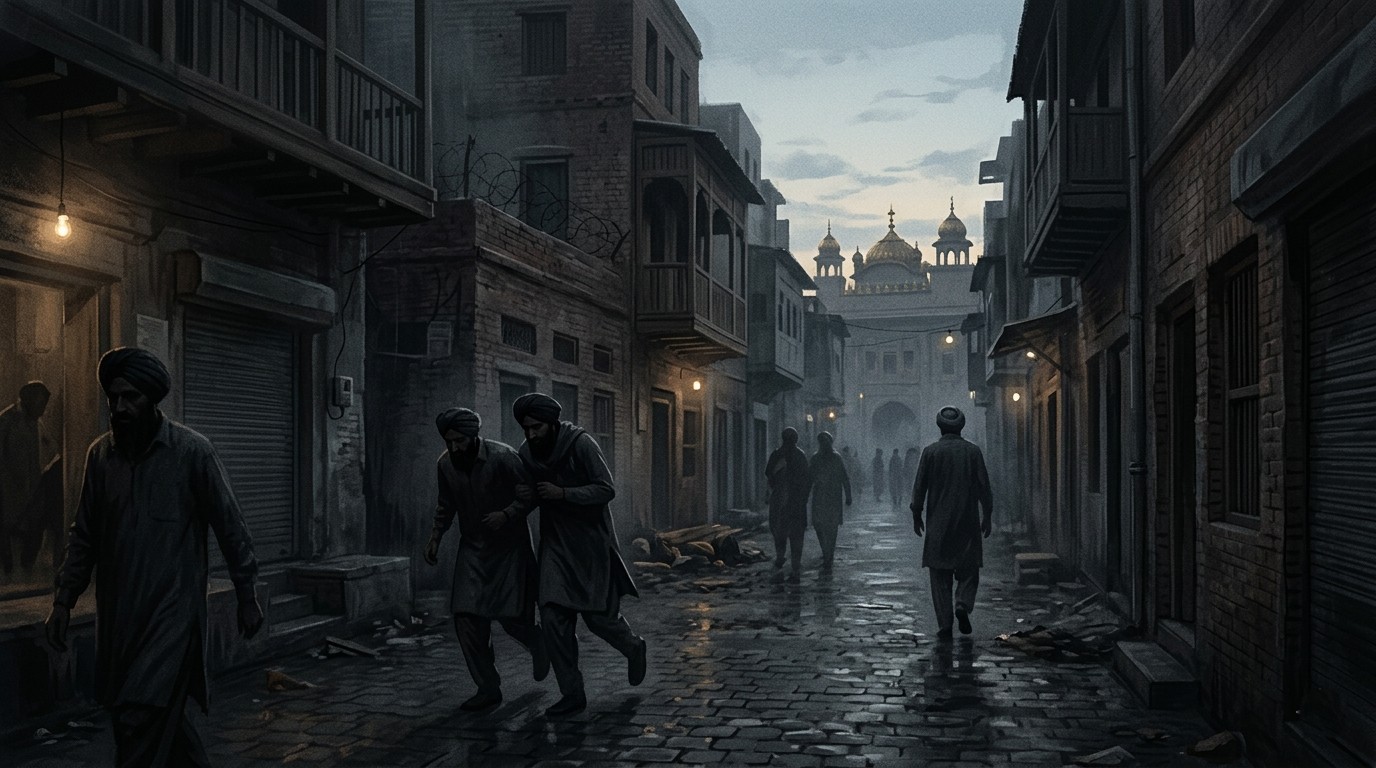
1984 Turmoil and State Conflict: Operation Blue Star, Anti-Sikh Violence, and the Rise of the Khalistan Movement
The year 1984 occupies a uniquely painful and emotionally charged place in Sikh history. For Sikhs across India and throughout the global diaspora, it represents not a single event but a series of interconnected tragedies that transformed the political, social, and psychological landscape of the community. The decade surrounding 1984 witnessed escalating tensions between sections of Sikh political leadership and the Indian state, the rise of militant movements in Punjab, the Indian Army's military operation inside the Harmandir Sahib complex during Operation Blue Star, the assassination of Prime Minister Indira Gandhi, and the horrific anti-Sikh violence that followed across numerous Indian cities. These events collectively produced a profound crisis of trust, identity, and belonging that continues to shape Sikh memory and political discourse decades later. The period also witnessed the growth of the Khalistan movement, which sought an independent Sikh homeland and gained support among some segments of the Sikh population in response to perceived political grievances, state actions, and the trauma of 1984.
As a Sikh historian, it is essential to approach this period with sensitivity, historical rigor, and an awareness of its enduring emotional significance. The events of 1984 remain deeply contested and interpreted differently by various political actors, governments, scholars, and community groups. Yet certain realities are undeniable. Thousands of lives were lost, sacred spaces were damaged, communities experienced immense suffering, and the consequences reverberated far beyond Punjab. The decade became a defining turning point in modern Sikh history, influencing relationships between Sikhs and the Indian state, shaping diaspora politics, and leaving a legacy that remains unresolved in many respects.
The Historical Background: Punjab After Independence
To understand the crisis of 1984, one must first examine the political developments that unfolded in Punjab after Indian independence. The decades following 1947 were characterized by efforts to define the relationship between Punjab, Sikh political aspirations, and the Indian federal system. The Punjabi Suba Movement, which culminated in the reorganization of Punjab in 1966, secured the creation of a Punjabi-speaking state. While this achievement satisfied some demands, several contentious issues remained unresolved. Questions concerning Chandigarh, the distribution of river waters, state autonomy, agricultural policy, and the balance of power between the central government and regional authorities continued to generate political debate.
Throughout the 1970s, many Sikh political leaders argued that Punjab required greater autonomy within India's federal framework. These concerns were articulated through political resolutions and public campaigns. The Anandpur Sahib Resolution, adopted by the Shiromani Akali Dal in 1973, became a focal point of discussion. While supporters viewed it as a constitutional proposal seeking greater federal decentralization and protection of regional rights, critics often portrayed it as separatist. The differing interpretations of these demands contributed to growing mistrust between regional political leaders and the central government.
At the same time, Punjab was experiencing significant social and economic changes. The Green Revolution had transformed agricultural production and brought prosperity to many farmers. However, economic development also created new inequalities and expectations. Rising unemployment among youth, social tensions, and political competition contributed to an increasingly complex environment. These conditions formed part of the backdrop against which later conflicts emerged.
The Rise of Sant Jarnail Singh Bhindranwale
One of the most significant figures of the period was Sant Jarnail Singh Bhindranwale, a religious preacher who emerged as a prominent voice within Sikh society during the late 1970s and early 1980s. Initially known for promoting religious observance and encouraging Sikhs to adhere more closely to traditional practices, Bhindranwale gradually became a central figure in Punjab's political and social conflicts.
Supporters viewed him as a defender of Sikh rights and religious identity during a period of perceived political marginalization. They admired his emphasis on faith, discipline, and resistance to social problems such as substance abuse. Critics, however, accused him of encouraging extremism and contributing to an atmosphere of confrontation. As violence increased in Punjab, Bhindranwale became one of the most controversial figures in modern Indian history.
The growth of his influence reflected broader frustrations within sections of Sikh society. Many individuals who felt dissatisfied with existing political leadership or concerned about unresolved grievances found his message compelling. By the early 1980s, his presence had become deeply intertwined with the escalating conflict between militant groups and state authorities.
Escalating Violence in Punjab
The years leading up to 1984 witnessed a sharp deterioration in law and order throughout Punjab. Various militant organizations emerged, advocating different political objectives, including the creation of Khalistan, an independent Sikh state. Acts of violence targeted political opponents, government officials, police personnel, and civilians. Assassinations, bombings, and armed confrontations became increasingly common.
The state's response involved intensified policing, arrests, and security operations. Allegations of human rights abuses, arbitrary detentions, and excessive use of force further deepened resentment in some communities. The cycle of violence and counter-violence created an atmosphere of fear and uncertainty. Ordinary citizens often found themselves trapped between militant activity and aggressive state responses.
As tensions escalated, political negotiations repeatedly failed to produce durable solutions. Positions hardened on all sides, reducing opportunities for compromise. By 1984, the situation had reached a point where the Indian government concluded that a major intervention was necessary to restore control.
Operation Blue Star
In June 1984, the Indian government launched Operation Blue Star, a military operation aimed at removing armed militants who had established positions within the Harmandir Sahib complex in Amritsar. The operation remains one of the most controversial events in modern Indian history and one of the most traumatic moments in Sikh collective memory.
The Harmandir Sahib, often known internationally as the Golden Temple, is the most sacred shrine in Sikhism. For Sikhs around the world, it is not merely an architectural landmark but the spiritual center of the faith. The decision to deploy military forces into such a sacred space therefore carried profound symbolic and emotional consequences.
During the operation, intense fighting occurred between Indian Army units and armed militants. The use of tanks, armored vehicles, and heavy weaponry inside the complex resulted in extensive damage to buildings, including the Akal Takht, one of the most important institutions of Sikh temporal authority. Significant numbers of soldiers, militants, pilgrims, and civilians lost their lives, although exact casualty figures remain debated.
The timing of the operation further intensified its impact. It occurred during a period when many pilgrims had gathered to commemorate the martyrdom anniversary of Guru Arjan. For countless Sikhs, the military assault on their holiest shrine created a deep sense of shock, grief, and outrage. Images of the damaged Akal Takht became enduring symbols of the tragedy.
The Global Sikh Reaction
The reaction among Sikhs worldwide was immediate and profound. Communities across India, North America, Europe, Southeast Asia, Australia, and East Africa closely followed developments in Amritsar. Many experienced the operation as a collective wound that transcended geographical boundaries.
Gurdwaras became centers of mourning, discussion, and political mobilization. Demonstrations were organized in numerous countries, and community leaders issued statements expressing grief and concern. For many members of the diaspora, Operation Blue Star became the defining event that shaped their political consciousness regarding Punjab and Sikh identity.
The global response also contributed to increased support for various political causes. Some individuals intensified efforts to seek justice and accountability through democratic advocacy, while others became more sympathetic to separatist narratives. The operation therefore had consequences far beyond Punjab itself, influencing Sikh communities throughout the world.
The Assassination of Indira Gandhi
On 31 October 1984, Prime Minister Indira Gandhi was assassinated by two of her Sikh bodyguards. The assassination occurred several months after Operation Blue Star and was widely interpreted as an act of retaliation for the military operation.
The killing shocked India and generated intense emotions throughout the country. While many Sikhs condemned the assassination, the event immediately heightened communal tensions and created conditions in which widespread violence could occur. Rather than remaining an isolated political assassination, it became the catalyst for one of the darkest episodes in independent India's history.
The days that followed would prove devastating for Sikh communities in numerous cities, particularly in the national capital of Delhi.
The Anti-Sikh Violence of 1984
Following the assassination, organized anti-Sikh violence erupted across several parts of India. Thousands of Sikhs were attacked, killed, injured, or displaced. Homes, businesses, vehicles, and gurdwaras were destroyed. Survivors and witnesses described horrifying scenes of targeted violence, arson, looting, and murder.
Particularly disturbing were allegations that political actors, local leaders, and organized groups played active roles in directing or facilitating attacks. Numerous reports also documented failures by authorities to intervene effectively during critical moments. These allegations became central issues in subsequent investigations and continue to shape discussions concerning accountability.
For Sikh families, the violence represented a profound betrayal. Citizens who believed they were protected by the institutions of a democratic state suddenly found themselves vulnerable to targeted attacks. The trauma experienced during these days left deep scars that remain visible in survivor testimonies and community memory.
The Search for Justice and Accountability
In the decades following 1984, numerous commissions, inquiries, and investigations examined the anti-Sikh violence. Survivors, activists, journalists, lawyers, and human rights organizations campaigned tirelessly to document events and seek accountability for those responsible.
While some legal proceedings resulted in convictions years later, many survivors expressed frustration regarding the pace and scope of justice. Questions concerning political responsibility, institutional failures, and compensation remained subjects of ongoing debate. The pursuit of accountability became an important element of Sikh political activism both within India and throughout the diaspora.
The continued demand for justice reflects the enduring significance of the violence in community memory. For many families, the events of 1984 are not distant historical episodes but lived experiences whose consequences continue across generations.
The Rise of the Khalistan Movement
The events of 1984 significantly influenced the growth of the Khalistan movement. Although demands for an independent Sikh state had existed previously among certain groups, Operation Blue Star and the anti-Sikh violence led some Sikhs to conclude that meaningful security and political rights could not be achieved within existing structures.
Support for Khalistan varied considerably across different regions, generations, and political perspectives. Some viewed independence as the only solution to perceived injustices, while others continued to advocate for constitutional reforms, federalism, and democratic engagement within India. The diversity of opinion within the Sikh community often became overshadowed by polarized political narratives.
Throughout the late 1980s and early 1990s, Punjab experienced a violent insurgency involving militant organizations, security forces, and civilian populations. The conflict resulted in thousands of deaths and widespread suffering. Ultimately, militant activity declined significantly during the 1990s, but debates surrounding Khalistan continued to influence political discussions among segments of the Sikh diaspora and within Punjab itself.
The Human Cost of the Conflict
Beyond political debates and historical controversies lies the immense human cost of the decade. Families lost loved ones during Operation Blue Star, the anti-Sikh violence, militant attacks, police actions, and the broader insurgency. Entire communities experienced displacement, fear, and uncertainty. Children grew up amid conflict, while survivors carried psychological and emotional burdens that often remained unrecognized.
The experiences of ordinary individuals remind historians that the story of 1984 is not solely about governments, political leaders, or militant organizations. It is also about mothers who lost sons, children who lost parents, families who lost homes, and communities struggling to rebuild trust after unimaginable trauma. Their stories remain central to understanding the true impact of the period.
Memory, Commemoration, and Historical Debate
The legacy of 1984 continues to shape Sikh identity and historical consciousness. Annual commemorations, memorial projects, academic research, documentaries, and community discussions ensure that the events remain deeply embedded in collective memory. Different interpretations coexist, reflecting the complexity of the period and the diverse experiences of those affected.
For many Sikhs, remembering 1984 is both an act of mourning and a commitment to preserving historical truth. The events have become reference points in discussions concerning human rights, religious freedom, state power, minority protections, and democratic accountability. They continue to influence political attitudes and community engagement across generations.
Historians face the challenge of documenting these events with accuracy, empathy, and balance. The emotional weight of the subject requires careful examination of evidence while recognizing the profound suffering experienced by countless individuals.
Conclusion
The turmoil of 1984 and the broader state conflict that surrounded it represent one of the most consequential and traumatic periods in modern Sikh history. Operation Blue Star, the anti-Sikh violence that followed the assassination of Indira Gandhi, and the rise of the Khalistan movement fundamentally altered the relationship between the Sikh community and the Indian state. These events generated deep wounds that continue to shape memory, identity, and political discourse among Sikhs worldwide. Understanding this period requires acknowledging the complexity of its causes, the tragedy of its consequences, and the humanity of those who suffered. More than four decades later, the legacy of 1984 remains a powerful reminder of the importance of justice, dialogue, accountability, and the protection of religious and minority rights in any democratic society.
Frequently Asked Questions (FAQ)
1. What was Operation Blue Star?
Operation Blue Star was a military operation conducted by the Indian Army in June 1984 to remove armed militants from the Harmandir Sahib complex in Amritsar.
2. Why is Operation Blue Star significant for Sikhs?
It involved military action inside the holiest shrine of Sikhism and resulted in loss of life and damage to important religious structures, making it deeply traumatic for many Sikhs.
3. Who was Sant Jarnail Singh Bhindranwale?
He was a Sikh religious preacher and influential figure in Punjab during the late 1970s and early 1980s whose role remains the subject of considerable historical debate.
4. What happened after the assassination of Indira Gandhi?
Widespread anti-Sikh violence erupted in several parts of India, resulting in the deaths, injuries, and displacement of thousands of Sikhs.
5. What are the anti-Sikh violence events of 1984?
They were large-scale attacks against Sikh individuals and communities that occurred after the assassination of Prime Minister Indira Gandhi.
6. What is the Khalistan movement?
The Khalistan movement is a political movement advocating the creation of an independent Sikh state called Khalistan.
7. Did the events of 1984 influence support for Khalistan?
Yes. For some individuals and groups, the events of 1984 increased support for separatist ideas, although opinions within the Sikh community remained diverse.
8. Were investigations conducted into the anti-Sikh violence?
Yes. Multiple commissions, inquiries, and legal proceedings examined the violence and issues of accountability over subsequent decades.
9. How did Sikhs outside India react to 1984?
Sikh diaspora communities organized demonstrations, commemorations, advocacy campaigns, and discussions that helped shape global awareness of the events.
10. Why does 1984 remain important today?
It remains important because of its lasting impact on Sikh identity, community memory, human rights discussions, political activism, and relations between the Sikh community and the Indian state.