Gurus and Bhagats, Bani Contributors · Origins & Gurus
A Historical Evolution of the Gurudwara
Gurudwara or Gurdwara is a holy place where Sri Guru Granth Sahib ji is installed on the throne and where common people, without any distinction of community or caste congregate in order to pay obeisance to and recite the glory of God.
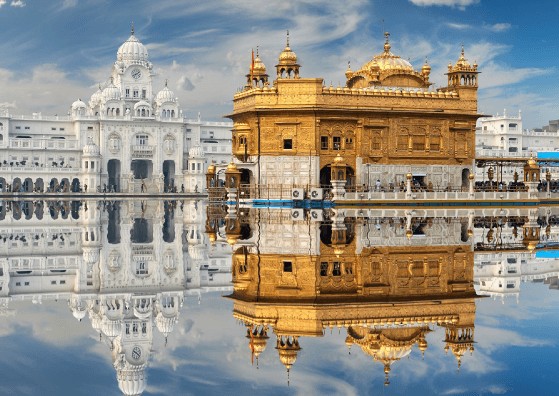
Derived from the Punjabi words Guru (enlightener) and Dwara (door or gateway), a Gurudwara is conceptually and physically the "Gateway to the Guru." It is a sovereign sacred space where the Sri Guru Granth Sahib Ji (the holy Sikh scripture) is formally installed upon a Prakash (throne), presiding over a congregation that explicitly rejects any distinction of community, caste, gender, or creed.
From its earliest iterations, this institution was designed not merely as a house of prayer, but as a living laboratory for radical egalitarianism and communal solidarity.
The spatial history of the Gurdwara begins with the travel and settlement patterns of the Sikh Gurus themselves, spanning from Guru Nanak Dev Ji in the late 15th century to Guru Gobind Singh Ji at the dawn of the 18th century. Wherever the Gurus traveled, stayed, or established communities, they sanctified the geography through Kirtan (the singing of divine praises) and philosophical discourse.
As the decades progressed, devout followers identified these specific historic sites as sacred topographies, building permanent structures to preserve the memory of the Gurus' physical presence and teachings.
Saa dharat bhaee harlaavalee, Jithe mera satgur baithaa aai. (Sri Guru Granth Sahib, Ang 310)
“That land becomes green and prosperous, where my True Guru comes and sits.”
Jithe Jaai bahe mera satguru So thaan suhaavaa raam raaje. (Sri Guru Granth Sahib, Ang 450)
“Wherever my True Guru goes and sits, that place becomes beautiful and magnificent.”
The early institutionalization of these spaces is meticulously documented by the contemporary 17th-century scholar and scribe Bhai Gurdas Ji. In the twenty-seventh Paudi (stanza) of his first Var (epic poem), Bhai Gurdas outlines how ordinary spaces were transformed into centers of worship simply through the touch of the Guru's feet:
Jithe baabaa pair dhare, Pooja aasan thaapan soaa. (Vars of Bhai Gurdas, 1.27)
“Wherever Baba Nanak set his foot, that place became an established seat of worship.”
From Dharamsal to Gurdwara: A Semantic and Structural Transition
To trace the institutional lineage of the Gurdwara requires an understanding of its early nomenclature. From the era of Guru Nanak Dev Ji until the pontificate of the fifth Guru, Guru Arjan Dev Ji, these sacred gathering places were uniformly known as Dharamsals—sanctuaries of righteousness or duty.
The earliest Dharamsal was established by Guru Nanak himself at Kartarpur (now in Pakistan) around 1521. Here, a fledgling community of disciples gathered daily to farm, share meals, and listen to devotional hymns. The Dharamsal was structurally simple but socially revolutionary; it served as the original crucible for Sangat (the egalitarian holy congregation).
A major historical pivot occurred under Guru Arjan Dev Ji, who conceptualized and constructed the Amrit Sarovar (the pool of nectar) and the central shrine at Amritsar, naming it the Har Mandir (the House of God). By compiling the Adi Granth (the primary scripture) in 1604 and installing it within the Har Mandir, Guru Arjan provided the global Sikh community with a physical and spiritual anchor.
The explicit transition from the term Dharamsal to Gurdwara crystallized during the time of the sixth spiritual master, Guru Hargobind Ji. Following the martyrdom of his father, Guru Arjan, Guru Hargobind donned two swords representing Miri (temporal authority) and Piri (spiritual authority).
He constructed the Akal Takht (the Throne of the Timeless One) directly facing the Har Mandir, formally interlocking the spiritual and political destinies of the Sikh community. It was during this period of structural maturation and defensive consolidation that these holy sites began to be universally recognized as Gurdwaras.
Gurudware har kirtan suneeal, Satgur bhet har mukh bhaneeal. Kal kalesh mitaae satgur, Har dargah deval maana he. (Sri Guru Granth Sahib, Ang 1075)
“At the Gurdwara, the Lord's praise is heard; by meeting the True Guru, one recites the Divine Name. The True Guru erases all sorrows and strife, bestowing honor in the court of the Lord.”
The Architecture of Inclusivity and Global Expansion
Architecturally, historic Gurdwaras developed a highly unique aesthetic that fused elements of contemporary Indo-Islamic design with distinct indigenous innovations, such as fluted domes, jharokhas (oriel windows), and intricate marble inlay work.
However, the most profound architectural element of a Gurdwara is not its ornamentation, but its layout, which reflects its core philosophy.
Unlike traditional medieval religious structures that featured singular, restricted entryways, prominent Gurdwaras—most famously the Sri Harmandir Sahib—were designed with four entrances, facing the North, South, East, and West.
From a historical and sociological standpoint, this was an explicit visual declaration that humanity from all four corners of the earth, and from all four traditional varnas (castes), were equally welcome without reservation.
As the Sikh diaspora expanded across the centuries, Gurdwaras migrated far beyond the borders of the Punjab region and the Indian subcontinent.
Today, majestic Gurdwaras stand as vital civic landmarks across the United Kingdom, Canada, the United States, East Africa, Australia, and Southeast Asia.
Whether it is a centuries-old historic shrine in India marking a battlefield or a modern eco-friendly structure in Vancouver, every Gurdwara is unified by the presence of the Nishan Sahib—a saffron or blue triangular flag flying from a tall flagpole wrapped in cloth, topped with a double-edged sword called a Khanda.
Historically, this flag served as a beacon visible from miles away, signaling to any traveler, refugee, or hungry soul that a safe haven was near.
The Multifunctional Nexus of the Community
From a holistic historical perspective, reducing the Gurdwara to a mere "temple" or house of worship is an analytical error.
The Gurdwara was deliberately designed by the Gurus to function as a self-sustaining, multi-dimensional civic apparatus. It served as a community center, a school (schooling through Gurmukhi script), a court of arbitration, and a defensive fort during times of persecution.
For centuries, when women and marginalized communities were systematically denied access to literacy and bodily autonomy, the Gurdwara stood as a protective citadel and an academy where spiritual knowledge was democratized.
The most enduring manifestation of this multifaceted service is the institution of Langar (the community kitchen).
Established by Guru Nanak and structurally formalized by Guru Angad Dev Ji, Langar requires every individual—whether an emperor or a peasant—to sit together in straight lines (Pangat) on the floor to consume a simple, free vegetarian meal prepared by volunteers (Seva).
When the Mughal Emperor Akbar visited Guru Amar Das Ji at Goindwal, historical accounts note that the Emperor was required to sit on the muddy ground and eat Langar alongside commoners before he was granted an audience with the Guru.
Ultimately, the Gurdwara operates as a living sanctuary for the physical, psychological, and spiritual needs of humanity.
It functions as an educational academy for the seeker, a dispensary or healing space for the sick, a shelter for the homeless traveler, and an unyielding sanctuary for the oppressed.
By intertwining deep mystical devotion with an unwavering commitment to social justice, the Gurdwara transcends its identity as a Sikh place of worship, enduring through history as a radiant lighthouse of liberty, equality, and compassion for all of mankind.