Panthic Personalities · Origins & Gurus · Guru Angad Dev Ji
Baba Buddha Ji
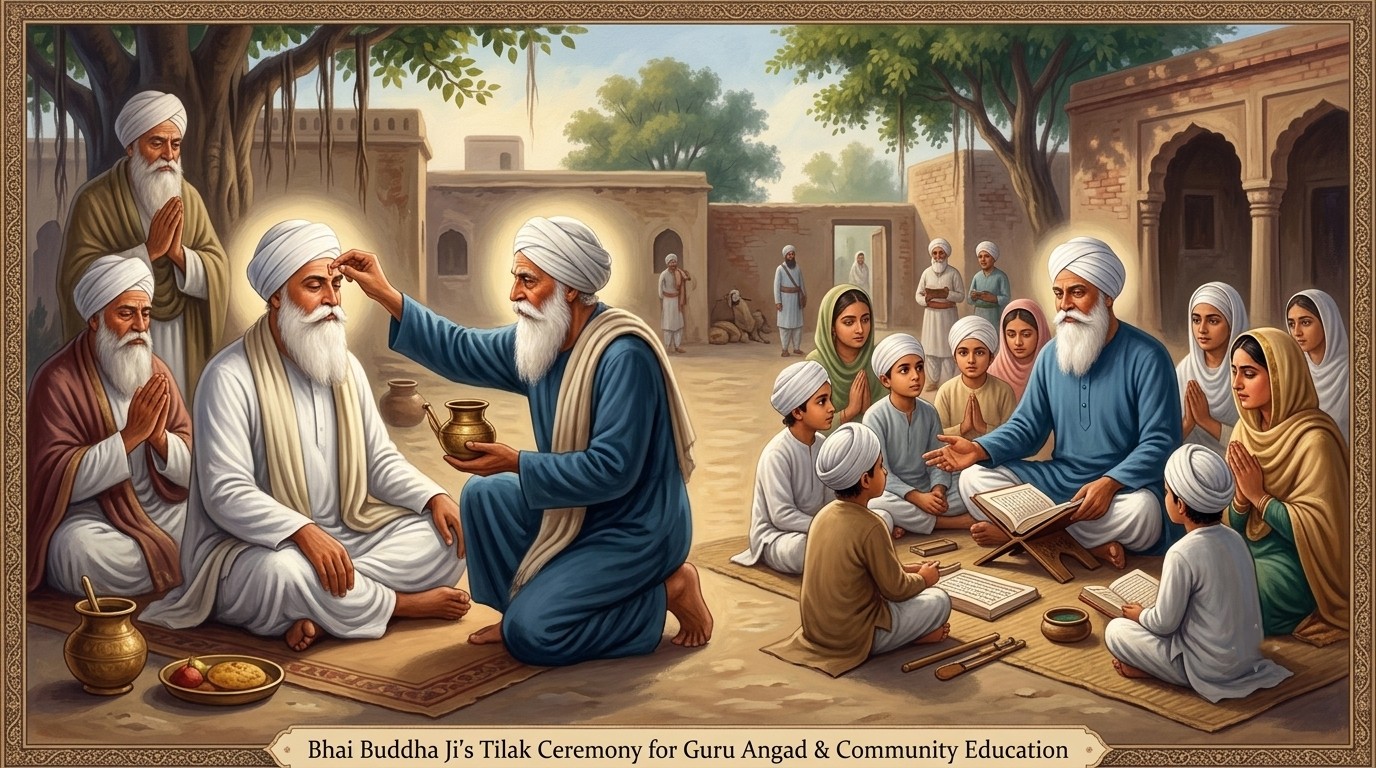
The visionary who performed the tilak (anointment) ceremony for Guru Angad and assisted in the education of the community.
The Sage of Kathu Nangal: The Mystic Encounter and the Birth of a Legend
To understand the foundational architecture of the Sikh Panth, one must examine the extraordinary life of Baba Buddha Ji, a figure who stands as the longest-lived and most influential patriarch of early Sikh history. Born in 1506 in the small, dusty village of Kathu Nangal, Punjab, to a simple agricultural family of the Randhawa clan, he was originally named Bura. His early childhood was typical of the agrarian landscape of medieval Punjab, centered around the fields and the herding of cattle. However, beneath this ordinary exterior lay a mind of intense spiritual inquiry and acute existential awareness. The trajectory of his life was permanently altered around 1518 when Guru Nanak Dev Ji, the founder of Sikhism, visited the outskirts of Kathu Nangal while traveling through the region. The young Bura, herding his cattle nearby, approached the Guru and offered him a bowl of fresh, warm milk with deep humility. During this quiet, pastoral meeting, the young boy posed a series of profound questions about life, death, and the salvation of the soul that completely astonished the Great Guru.
For a Sikh historian, this dialogue is not merely a charming legend but a critical theological milestone. The young Bura explained to Guru Nanak his profound fear of mortality, stating that while watching soldiers raid villages and firewood burn in a hearth, he noticed that the dry, young twigs caught fire and burned faster than the older, thicker logs. He reasoned that death does not wait for old age; it can snatch away a child just as easily as an elder, and therefore, one must begin the search for spiritual liberation immediately. Guru Nanak, deeply moved by the child’s profound realization of impermanence and his mature spiritual insights, declared that the boy spoke not like a child, but with the wisdom of an old sage. The Guru remarked, "You are not a child (Bura); you possess the intellect of an old man (a Buddha)." From that historic moment, he was known as Baba Buddha (the Wise Brother), and he surrendered his life entirely to the service of Guru Nanak's newly emerging community of householder-saints, embarking on a centennial journey of unparalleled spiritual and temporal service.
The Custodian of the Jot: The Tilak Ceremony and the Continuity of Divine Sovereignty
Perhaps the most politically and spiritually significant role Baba Buddha Ji occupied was his designated responsibility of performing the anointment (Tilak) ceremony for five successive Gurus, from Guru Angad Dev Ji to Guru Hargobind Sahib. In the highly charged socio-political climate of sixteenth and seventeenth-century Punjab, the transition of spiritual leadership from one Guru to the next was a critical process that required absolute institutional validation to prevent schisms. When Guru Nanak chose Bhai Lehna as his successor, bypasssing his own biological sons, he instructed Baba Buddha Ji to apply the saffron mark to Bhai Lehna's forehead, formally declaring him Guru Angad Dev Ji. This established an institutional precedent where Baba Buddha Ji served as the ultimate independent witness and validator of the transmission of the Divine Light (Jot).
This coronation ritual was not a hollow, monarchical ceremony; rather, it was a profound theological declaration. By having Bhai Buddha Ji—the direct disciple of Guru Nanak—anoint each successive Guru, the community was visually and spiritually reassured that the exact same divine authority, message, and spiritual essence were flowing through each new leader. Bhai Buddha Ji performed this sacred duty for Guru Amar Das Ji, Guru Ram Das Ji, Guru Arjan Dev Ji, and finally Guru Hargobind Sahib. His presence at these successions was a powerful, living bridge that linked the early, radical days of Kartarpur directly to the sprawling, institutionalized Sikh nation of the seventeenth century. He stood as the ultimate guardian of the lineage, and his stamp of approval silenced rival factions and pretenders who attempted to fracture the community, ensuring the theological purity and political unity of the Guruship.
Building the Physical Panth: The Architect of Goindwal, Amritsar, and the Akal Takht
Bhai Buddha Ji’s contributions to the Sikh path were not confined to the metaphysical; he was also a master builder and administrative strategist who oversaw the physical infrastructure of the emerging Sikh empire. As the Sikh community grew from a localized group of devotees into a transnational movement, there was an urgent need to establish centers of administration, spiritual assembly, and economic activity. When Guru Amar Das Ji decided to construct the historic Baoli Sahib (a stepped well with eighty-four steps) at Goindwal, he appointed Bhai Buddha Ji to manage the massive engineering and excavation project. Bhai Buddha Ji lived on the construction site, organizing labor, sourcing materials, and transforming the physical labor of the devotees into a sacred form of active meditation (Seva).
This administrative excellence was utilized even more extensively during the excavation of the holy pools of Santokhsar and Amritsar under the guidance of Guru Ram Das Ji and Guru Arjan Dev Ji. Bhai Buddha Ji was appointed the chief supervisor of the entire construction project. He sat under the branches of an ancient ber tree—known to this day as the *Bhai Buddha Ji Beri* on the northern edge of the Harmandir Sahib complex—overseeing the hundreds of volunteers digging the pool, designing the structural foundations of the temple, and managing the treasury. Furthermore, when the tyrannical Mughal Emperor Jahangir executed Guru Arjan Dev Ji in 1606, and Guru Hargobind Sahib decided to construct the Akal Takht (the Throne of the Timeless One) as a symbol of parallel temporal sovereignty, Bhai Buddha Ji was one of only two individuals—along with Bhai Gurdas Ji—who personally built the platform. By refusing to allow any external labor to touch the Akal Takht, Bhai Buddha Ji solidified its status as an unassailable, sovereign space that stood independent of Mughal imperial authority.
The Pedagogue of Sovereignty: Educating the Young Guru Hargobind Ji
The martyrdom of Guru Arjan Dev Ji marked a critical evolutionary turning point for the Sikh community, necessitating a transition from a purely spiritual congregation to a martial, defensive order. Anticipating this structural shift, Guru Arjan Dev Ji had entrusted the education of his young son, Hargobind, to none other than the venerable Bhai Buddha Ji. The Guru knew that only a figure who possessed the deep, internal spiritual discipline of Guru Nanak’s direct court, combined with an understanding of the practical realities of the world, could raise the future Sixth Sovereign to lead the Panth through its impending military trials.
Under Bhai Buddha Ji's tutelage, the young Hargobind was subjected to a highly comprehensive and rigorous curriculum. Bhai Buddha Ji did not merely teach him the scriptures and the recitation of Gurbani; he also trained him in the arts of statecraft, horsemanship, archery, swordsmanship, and martial tactics. This dual education was the practical precursor to the doctrine of Miri and Piri (temporal and spiritual sovereignty). Bhai Buddha Ji taught the young Guru that the sword was not a tool for oppression, but a sacred instrument of justice, to be drawn only when all peaceful options had failed to protect the weak and uphold righteousness. Through his pedagogical brilliance, Bhai Buddha Ji successfully forged a warrior-saint who could fearlessly ascend the temporal throne at the Akal Takht, proving that in Sikhism, physical prowess and spiritual illumination are deeply interconnected and mutually reinforcing paths.
The First Granthi: Guarding the Living Word at the Harmandir Sahib
In 1604, a monumental milestone in world religious history was achieved when Guru Arjan Dev Ji compiled the Adi Granth, the first authoritative scripture of the Sikhs, and installed it within the newly constructed Harmandir Sahib (the Golden Temple) in Amritsar. To hold the position of the chief custodian of this sacred text was a matter of ultimate spiritual trust. Guru Arjan Dev Ji chose Bhai Buddha Ji to be the very first Head Granthi (high priest and custodian) of the Harmandir Sahib. When the holy volume was carried in a grand, reverent procession from the Ramsar Sarovar to the temple, Guru Arjan Dev Ji carried the Granth on his head, while Bhai Buddha Ji walked ahead, waving the ceremonial fly-whisk (Chaur Sahib) to signify its supreme spiritual sovereignty.
As the first Granthi, Bhai Buddha Ji established the protocols for how the scriptures were to be opened, read, respected, and closed—rituals that are followed with absolute precision in every Gurdwara across the world to this day. He was responsible for reciting the daily command (Hukamnama) to the congregation, translating the complex, poetic, and multi-linguistic verses of the Granth into clear, practical wisdom for the seekers. His deep intimacy with the Gurus' philosophy, combined with his own advanced spiritual state, made his interpretations authoritative. By appointing Bhai Buddha Ji to this position, Guru Arjan Dev Ji signaled that the ultimate guardian of the written word must be someone whose own life was a living embodiment of the Gurus' teachings, establishing a standard of spiritual stewardship that remains the gold standard for the Sikh clergy.
The Girding of Miri and Piri: The Transformation of the Panth
The culmination of Bhai Buddha Ji’s long, illustrious life occurred during the historic coronation of Guru Hargobind Sahib in 1606. Following the tragic and brutal execution of Guru Arjan Dev Ji by Mughal authorities, the young Guru Hargobind Sahib, then only eleven years old, stood ready to ascend the throne. During the ceremony, Bhai Buddha Ji was tasked with applying the Tilak and presenting the young Guru with the traditional woollen cord and turban that symbolized spiritual authority. However, in a dramatic departure from tradition, Guru Hargobind Sahib requested that instead of a woollen cord, he be girded with two swords. Bhai Buddha Ji, understanding the historic necessity of this moment, willingly and enthusiastically participated in this paradigm shift.
Bhai Buddha Ji personally girded the two swords of Miri (temporal authority) and Piri (spiritual authority) onto the body of the young Guru. This act was deeply symbolic: it demonstrated that the transformation of the Sikh Panth from a peaceful devotional community to an armed sovereign state was not a betrayal or a deviation from Guru Nanak’s original mission, but its natural fulfillment under tyrannical circumstances. By having the most respected, ancient disciple of Guru Nanak perform this act, the transition was granted absolute theological and historical legitimacy. It showed that the sword of the Sikh was fully rooted in the spiritual soil of Kartarpur, and that Bhai Buddha Ji, who had seen the gentle, pastoral beginnings of the faith, was fully supportive of its new, militarized path of resistance against imperial tyranny.
Historical and Epochal Matrix of Bhai Buddha Ji's Centenary Service
To systematically evaluate the extraordinary, multi-generational impact of Bhai Buddha Ji on the development of early Sikh institutions, theology, and physical centers, we can analyze the following historical matrix:
| Era & Guruship | Institutional Focus & Physical Projects | Theological & Socio-Political Milestones |
| Guru Nanak Dev Ji (1518–1539) | Direct discipleship at Kartarpur; established early farming and communal living practices. | Received the name "Buddha" (the Wise Wise One); recognized as the premier embodiment of householder spirituality. |
| Guru Angad Dev Ji (1539–1552) | Assisted in the stabilization of the community at Khadur Sahib; managed early agricultural logistics. | Performed the first historic Tilak ceremony, establishing the precedent for institutional continuity of the Guruship. |
| Guru Amar Das Ji (1552–1574) | Chief construction supervisor of the historic Baoli Sahib (stepped well) at Goindwal. | Helped implement the Pangat-Sangat system and countered schismatic efforts by rivals. |
| Guru Ram Das Ji (1574–1581) | Initiated the excavation of the holy pools of Amritsar and Santokhsar under the historic Ber tree. | Anointed the fourth Guru, cementing the central geographic focal point of the global Sikh community. |
| Guru Arjan Dev Ji (1581–1606) | Supervised the construction of Harmandir Sahib; appointed as the very first Head Granthi of the Adi Granth in 1604. | Led the sacred procession of the Adi Granth, establishing the eternal protocols of scriptural worship and custodial care. |
| Guru Hargobind Sahib (1606–1631) | Trained the young Guru in martial arts; co-constructed the Akal Takht platform with Bhai Gurdas Ji. | Girded the two swords of Miri and Piri, legitimizing the martial transformation of the Sikh Panth. |
The Transition to the Timeless: The Departure of the Great Patriarch
Bhai Buddha Ji lived to the extraordinary age of 125, passing away in the year 1631 at the village of Ramdas (formerly Jhanda Ramdas), near Amritsar. His death marked the end of an entire epoch of Sikh history. He had lived through the lifetimes of the first six Gurus, serving as an intimate counselor, trusted administrator, and spiritual guide to each. Upon hearing of his failing health, Guru Hargobind Sahib rushed to his bedside to pay his final respects. The Guru placed Bhai Buddha Ji's head in his lap, expressing his deep gratitude for the century of selfless service, wisdom, and maternal care that the patriarch had bestowed upon his family and the entire nation.
In his final moments, Bhai Buddha Ji requested that the Guru always remain close to his descendants and that the light of Guru Nanak's teachings continue to guide the Panth forever. He breathed his last in the arms of the Sixth Sovereign, and the Guru himself, along with his family, carried Bhai Buddha Ji’s bier to the cremation pyre, performing the final rites with royal honors. Today, Bhai Buddha Ji’s legacy is preserved in numerous historical shrines across Punjab, but his true monument is the very structure of the Sikh Panth itself. He remains the ultimate role model for the householder-Sikh: a man who managed estates, built wells, dug pools, educated children, and wielded weapons, yet remained completely detached from worldly greed, living every moment of his 125 years in complete alignment with the Divine Will.
Frequently Asked Questions
1. Who was Bhai Buddha Ji, and why is he highly revered in Sikh history?
Bhai Buddha Ji (1506–1631) was one of the most prominent, respected, and long-lived disciples in Sikh history. He had the unique privilege of being a direct disciple of Guru Nanak Dev Ji and serving the first six Sikh Gurus. He is highly revered for his wisdom, his role in performing the coronation ceremonies of five successive Gurus, and for being appointed the first Head Granthi of the Golden Temple.
2. How did Bhai Buddha Ji get his name?
Originally named Bura, he met Guru Nanak Dev Ji as a young boy while herding cattle. He spoke to the Guru about his fear of death, noting that during a forest fire, young twigs burn faster than older logs, meaning death can strike anyone at any age. Deeply impressed by his spiritual maturity and wisdom, Guru Nanak remarked that though he was young in years, he possessed the intellect of an old wise sage (a "Buddha"), and named him Bhai Buddha.
3. What was Bhai Buddha Ji's role in the succession of the Sikh Gurus?
Bhai Buddha Ji was designated by the Gurus to perform the sacred Tilak (anointment) ceremony for five successive Gurus, from Guru Angad Dev Ji to Guru Hargobind Sahib. This ceremony was crucial because it provided official institutional validation and visual proof to the congregation that the divine, spiritual light of Guru Nanak was being successfully transmitted to the next leader.
4. What physical construction projects did Bhai Buddha Ji supervise?
Bhai Buddha Ji was a master administrator who oversaw several of the most important physical projects of early Sikh history. These included the excavation of the sacred pool at Goindwal Sahib (the Baoli Sahib), the digging of the holy pools of Amritsar and Santokhsar, the construction of the Harmandir Sahib, and the personal building of the Akal Takht platform alongside Bhai Gurdas Ji.
5. Why was Bhai Buddha Ji chosen as the first Head Granthi of the Golden Temple?
In 1604, when Guru Arjan Dev Ji compiled the Adi Granth and installed it inside the newly constructed Harmandir Sahib, he chose Bhai Buddha Ji as the first Head Granthi (custodian) because of his peerless devotion, deep spiritual understanding of Gurbani, and his direct link to Guru Nanak. He established the daily protocols of scriptural worship that are still followed today.
6. What was Bhai Buddha Ji’s role in educating Guru Hargobind Sahib?
Following the martyrdom of Guru Arjan Dev Ji, Bhai Buddha Ji was entrusted with the education of the young Guru Hargobind Sahib. He designed a comprehensive curriculum that taught the young Guru not only Gurbani and spiritual scriptures but also swordsmanship, archery, horse riding, and military strategy, preparing him to lead the community through its martial transformation.
7. How did Bhai Buddha Ji participate in the establishment of the Miri-Piri doctrine?
During the coronation of Guru Hargobind Sahib in 1606, Bhai Buddha Ji personally girded the young Guru with two swords representing Miri (temporal sovereignty) and Piri (spiritual authority). This act was highly significant as it granted historical and spiritual legitimacy to the militarization of the Sikh Panth, linking it directly to the lineage of Guru Nanak.
8. How long did Bhai Buddha Ji live, and under which Gurus did he serve?
Bhai Buddha Ji lived to the extraordinary age of 125 years (1506–1631). He served under the first six Gurus of the Sikh faith: Guru Nanak Dev Ji, Guru Angad Dev Ji, Guru Amar Das Ji, Guru Ram Das Ji, Guru Arjan Dev Ji, and Guru Hargobind Sahib, acting as a living bridge through the first century of Sikh history.
9. Where did Bhai Buddha Ji pass away, and who performed his final rites?
Bhai Buddha Ji passed away in 1631 at the village of Jhanda Ramdas (now known simply as Ramdas), located near Amritsar. His final rites were performed with immense respect and royal honors by the sixth Guru, Guru Hargobind Sahib, who carried his bier to the pyre and held his head in his lap during his final breaths.
10. What is the modern significance of the "Bhai Buddha Ji Beri" in Amritsar?
The "Bhai Buddha Ji Beri" is an ancient Jujube (Ber) tree located on the northern promenade (parikrama) of the Harmandir Sahib complex. It marks the exact historical spot where Bhai Buddha Ji sat for years, supervising the excavation of the holy pool and coordinating the construction of the Golden Temple, serving as a monument to his selfless service (Seva).
Guru Angad Dev Ji (1504–1552)
The visionary who performed the tilak (anointment) ceremony for Guru Angad and assisted in the education of the community.
- Role
- Grand Old Man of Sikhism
- Group
- Spiritual Successors & Disciples
- Period
- Guru Angad Dev Ji (1504–1552)