Sikh Legends · Empire & Struggle
Baba Deep Singh
The legendary head of the Shahidi Misl, he remains a supreme icon of spiritual resilience. Defying desecration by Afghan invaders, he sustained a mortal wound during the battle to liberate Harmandir Sahib and famously continued fighting with his severed head in his hand.
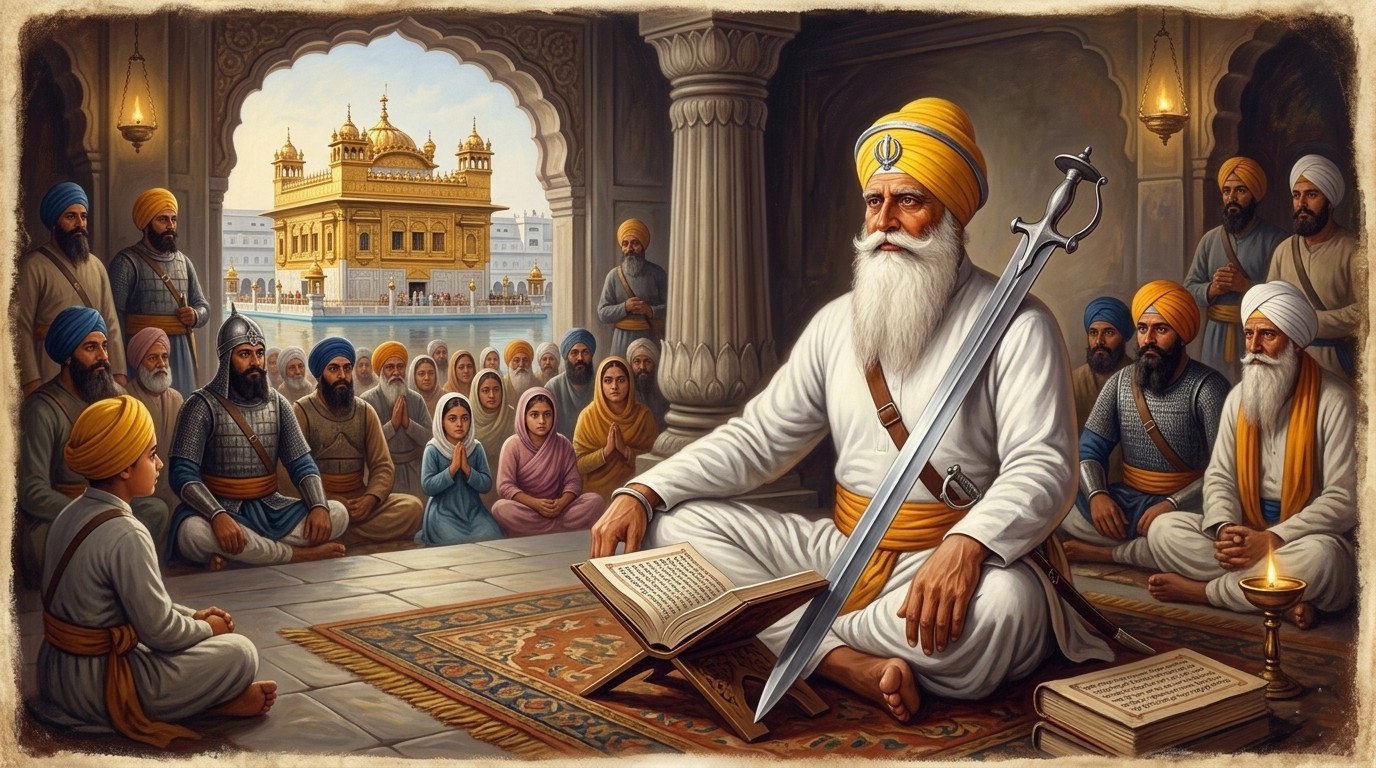
Baba Deep Singh Ji: The Eternal Saint-Soldier of the Khalsa
Among the countless figures who illuminate the vast landscape of Sikh history, few command the same reverence, admiration, and emotional devotion as Baba Deep Singh Ji. His name transcends the boundaries of ordinary historical memory and enters the realm of sacred consciousness. For generations of Sikhs, Baba Deep Singh Ji has represented the ultimate embodiment of the Khalsa ideal: the perfect union of spiritual wisdom and martial courage. He was not merely a warrior who fought bravely on the battlefield, nor merely a scholar immersed in sacred texts. Rather, he was a complete Sant-Sipahi, a Saint-Soldier whose life demonstrated that spiritual enlightenment and righteous resistance are not opposing paths but complementary obligations. His extraordinary sacrifice during the struggle to liberate Sri Harmandir Sahib from Afghan desecration transformed him into one of the most enduring symbols of Sikh resilience, sovereignty, and devotion.
To understand Baba Deep Singh Ji is to understand the deeper currents that shaped eighteenth-century Punjab. His story is not simply about a legendary battle or a miraculous act of defiance. It is the story of a community determined to preserve its spiritual center against overwhelming odds. It is the story of a scholar who became a general, a scribe who became a martyr, and a humble servant of the Guru who became one of the most celebrated heroes in Sikh history. More than two and a half centuries after his death, his memory continues to inspire millions who visit the sacred places associated with his life and sacrifice.
The Early Life of Baba Deep Singh Ji
Baba Deep Singh Ji was born on January 26, 1682, in the village of Pahuwind near Amritsar. His parents, Bhai Bhagtu Ji and Mata Jeoni Ji, were devout Sikhs who raised their son in an environment deeply rooted in faith, humility, and service. From a young age, Deep Singh displayed remarkable discipline, intelligence, and spiritual inclination. His childhood coincided with a period of profound transformation within Sikh history as Guru Gobind Singh Ji was preparing the community for immense challenges ahead.
At the age of eighteen, Deep Singh traveled to Anandpur Sahib, where he came into direct contact with Guru Gobind Singh Ji. This encounter changed the course of his life forever. The young disciple became immersed in the spiritual and intellectual environment created by the Tenth Guru. He studied Sikh theology, learned Gurmukhi, mastered Persian and classical languages, and developed exceptional skills in martial arts and weaponry. When Guru Gobind Singh Ji established the Khalsa in 1699, Deep Singh was among those who embraced the new identity and committed himself completely to the Guru's vision of a sovereign and fearless community.
The Guru recognized the extraordinary qualities of the young Sikh and entrusted him with responsibilities that extended far beyond military service. Deep Singh possessed a rare combination of scholarly rigor and unwavering devotion. This dual capacity would define his legacy and ultimately shape the future of Sikh institutions.
The Scholar and Custodian of Sikh Learning
While popular imagination often remembers Baba Deep Singh Ji primarily as a warrior, historians must emphasize his equally important role as a scholar and guardian of Sikh knowledge. Following the events of Anandpur Sahib and the subsequent struggles faced by the Khalsa, Guru Gobind Singh Ji established himself at Talwandi Sabo, later known as Damdama Sahib. It was here that one of the most significant literary undertakings in Sikh history took place.
Baba Deep Singh Ji became a principal scribe during the preparation of the authoritative recension of the Guru Granth Sahib. Working closely with Guru Gobind Singh Ji, he participated in the meticulous process of preserving and reproducing the sacred scripture. This effort ensured the integrity of Sikh teachings during a period of immense political instability and military conflict.
His dedication to scriptural learning led to the establishment of what would later become known as the Damdami Taksal. As its first leader, Baba Deep Singh Ji cultivated generations of scholars trained in the accurate recitation, interpretation, and preservation of Sikh scripture. Through this institution, he helped safeguard the intellectual foundations of the Sikh faith. Long before he became immortalized on the battlefield, he had already secured a place among the greatest educators and theologians in Sikh history.
The Rise of the Shahidi Misl
The eighteenth century witnessed relentless persecution of the Sikhs. Following the martyrdoms of Guru Arjan Dev Ji and Guru Tegh Bahadur Ji, and the numerous military campaigns launched against the Khalsa after the death of Guru Gobind Singh Ji, the Sikh community endured immense hardship. Yet these trials forged a generation of leaders committed to preserving both faith and freedom.
During this turbulent era, the Sikhs organized themselves into autonomous military confederacies known as Misls. Among these, the Shahidi Misl occupied a unique position. Led by Baba Deep Singh Ji, it embodied the spirit of sacrifice and unwavering commitment to the Guru's principles. The warriors of the Shahidi Misl viewed martyrdom not as defeat but as the highest expression of devotion. Their objective was not conquest for personal gain but the defense of righteousness, religious liberty, and the Sikh way of life.
Baba Deep Singh Ji emerged as a respected leader whose authority rested not merely on military skill but on spiritual stature. His leadership united the qualities of a theologian, administrator, teacher, and commander. He inspired confidence among ordinary Sikhs because his life demonstrated complete consistency between belief and action.
The Afghan Threat and the Desecration of Harmandir Sahib
The defining chapter of Baba Deep Singh Ji's life unfolded in 1757 during one of the darkest periods in Sikh history. Ahmad Shah Durrani, commonly known as Ahmad Shah Abdali, had repeatedly invaded northern India. His campaigns brought widespread devastation across Punjab. Seeking to crush Sikh resistance permanently, Afghan forces targeted the most sacred center of Sikh faith: Sri Harmandir Sahib in Amritsar.
The Afghan commanders desecrated the shrine, damaged its structures, and filled the sacred sarovar with debris and the carcasses of slaughtered animals. Their actions were designed to inflict psychological and spiritual devastation upon the Sikh community. They believed that by defiling the heart of Sikhism, they could destroy the spirit of the Khalsa itself.
News of this sacrilege reached Baba Deep Singh Ji at Damdama Sahib. By this time he was approximately seventy-five years old. Most men of that age would have sought peace and retirement. Baba Deep Singh Ji responded differently. Deeply grieved by the desecration of the Guru's sanctuary, he drew a line in the ground with his massive khanda and declared that he would either liberate Harmandir Sahib or sacrifice his life in the attempt.
This vow electrified the Sikh community. What began as a small gathering of devoted followers rapidly grew into a force numbering several thousand warriors. Farmers, laborers, traders, and seasoned fighters joined the march toward Amritsar, inspired by the resolve of their elderly leader.
The March Toward Destiny
As Baba Deep Singh Ji advanced northward, his army became more than a military force. It became a spiritual movement united by a singular purpose. The volunteers who joined him understood the overwhelming odds they faced. Afghan forces possessed greater numbers, superior resources, and state backing. Yet the Sikhs were motivated by something far more powerful than political ambition. They believed they were defending the honor of the Guru and the sanctity of their faith.
The march itself assumed the character of a sacred pilgrimage. Warriors recited Gurbani, performed Ardas, and prepared themselves mentally and spiritually for martyrdom. The distinction between battlefield and place of worship disappeared. Every step toward Amritsar became an act of devotion.
Baba Deep Singh Ji led from the front. Despite his age, he carried a massive khanda and displayed extraordinary physical endurance. Contemporary accounts and oral traditions consistently emphasize the profound impact his presence had on morale. His determination convinced others that no sacrifice was too great when undertaken in service of the Guru.
The Battle of Gohalwar and Chabba
The decisive confrontation occurred near the villages of Gohalwar and Chabba, on the outskirts of Amritsar. Afghan forces moved to intercept the advancing Sikhs before they could reach Harmandir Sahib. What followed was one of the most ferocious battles in Sikh history.
The fighting quickly descended into brutal close-quarters combat. Swords, spears, and shields clashed amid chaos and bloodshed. Baba Deep Singh Ji fought at the forefront, cutting through enemy ranks with astonishing determination. His warriors, inspired by his example, launched repeated assaults against numerically superior forces.
During the battle, Baba Deep Singh Ji sustained a catastrophic wound to the neck. Historical records agree that the injury was mortal. Yet it is at this point that history and sacred tradition converge. According to cherished Sikh tradition, a fellow warrior reminded Baba Deep Singh Ji of his vow to reach Harmandir Sahib. Summoning extraordinary strength and devotion, he continued advancing despite his devastating injury.
The image that emerged from this moment would become one of the most iconic in Sikh memory: Baba Deep Singh Ji carrying his severed head in one hand while wielding his sword in the other. Whether interpreted literally, symbolically, or spiritually, the narrative captures a truth far deeper than conventional historical analysis. It expresses the Sikh conviction that unwavering faith transcends physical limitations and that spiritual determination can overcome even the certainty of death.
The Martyrdom and Legacy of Baba Deep Singh Ji
Baba Deep Singh Ji ultimately attained martyrdom near the sacred precincts of Amritsar. His sacrifice became a defining moment in Sikh collective memory. The site associated with his cremation and remembrance evolved into one of the most revered shrines in Punjab, drawing pilgrims from around the world.
His martyrdom carried significance far beyond the battlefield. It demonstrated that attempts to destroy Sikh institutions through violence would ultimately fail. The desecration of Harmandir Sahib did not break the Sikh spirit; instead, it inspired one of the greatest acts of devotion in the religion's history. Baba Deep Singh Ji transformed tragedy into triumph, proving that faith rooted in conviction cannot be extinguished through force.
In the decades that followed, Sikh power continued to grow. The Misls expanded their influence, eventually culminating in the establishment of the Sikh Empire under Maharaja Ranjit Singh. The courage displayed by Baba Deep Singh Ji and countless other martyrs helped create the foundation upon which later generations would build.
The Enduring Meaning of Baba Deep Singh Ji Today
Modern Sikhs continue to draw inspiration from Baba Deep Singh Ji because his life addresses timeless questions about courage, conviction, and sacrifice. He represents the ideal that scholarship must be accompanied by action, that spirituality must inspire service, and that devotion must remain steadfast even under the most severe tests. His example challenges believers to defend truth without hatred, to confront injustice without fear, and to remain faithful regardless of circumstances.
Across gurdwaras, educational institutions, martial arts academies, and Sikh households, his story continues to be retold. Paintings depicting him on the battlefield adorn countless walls. His memory lives in prayers, literature, historical discourse, and popular devotion. More importantly, it survives in the values he embodied: humility, discipline, scholarship, courage, and complete surrender to the Guru's will.
Baba Deep Singh Ji remains one of the most powerful examples of how a single life, rooted in faith and service, can influence centuries of history. His journey from village scholar to immortal martyr illustrates the extraordinary capacity of the human spirit when guided by conviction. In the grand narrative of Sikh history, he stands not merely as a hero of the past but as an eternal symbol of resilience whose example continues to illuminate the path for future generations.
Frequently Asked Questions About Baba Deep Singh Ji
1. Who was Baba Deep Singh Ji?
Baba Deep Singh Ji was a renowned Sikh scholar, warrior, theologian, and leader of the Shahidi Misl who lived from 1682 to 1757 and is celebrated as one of the greatest martyrs in Sikh history.
2. Where was Baba Deep Singh Ji born?
He was born in the village of Pahuwind near Amritsar in Punjab in 1682.
3. What was Baba Deep Singh Ji's relationship with Guru Gobind Singh Ji?
He was a devoted disciple of Guru Gobind Singh Ji, received Khalsa initiation, studied under the Guru, and participated in the preservation of Sikh scripture.
4. What is the Damdami Taksal?
Damdami Taksal is a historic Sikh educational institution traditionally traced to Baba Deep Singh Ji, who served as its first leader and helped preserve scriptural learning.
5. What was the Shahidi Misl?
The Shahidi Misl was one of the Sikh military confederacies and was known for its emphasis on sacrifice, devotion, and defense of Sikh sovereignty.
6. Why did Baba Deep Singh Ji march toward Amritsar in 1757?
He marched to liberate Harmandir Sahib after Afghan forces desecrated the shrine during Ahmad Shah Durrani's invasions of Punjab.
7. How old was Baba Deep Singh Ji during the final battle?
He was approximately seventy-five years old when he led the campaign toward Amritsar.
8. Did Baba Deep Singh Ji really fight with his severed head?
Sikh tradition preserves the account that he continued fighting after sustaining a mortal neck wound, carrying his head while advancing toward Harmandir Sahib. The story is revered as a symbol of supreme devotion and spiritual resilience.
9. Where did Baba Deep Singh Ji attain martyrdom?
He attained martyrdom near Amritsar during the battle fought against Afghan forces in 1757.
10. Why is Baba Deep Singh Ji important today?
He remains an enduring symbol of faith, courage, scholarship, sacrifice, and the Saint-Soldier ideal that lies at the heart of Sikh tradition.