Panthic Personalities · Origins & Gurus · Guru Amar Das Ji
Baba Mohri & Baba Mohan
Baba Mohan compiled the 'Goindwal Pothis' (manuscripts of Gurbani) which were later used by Guru Arjan Dev Ji for the Adi Granth.
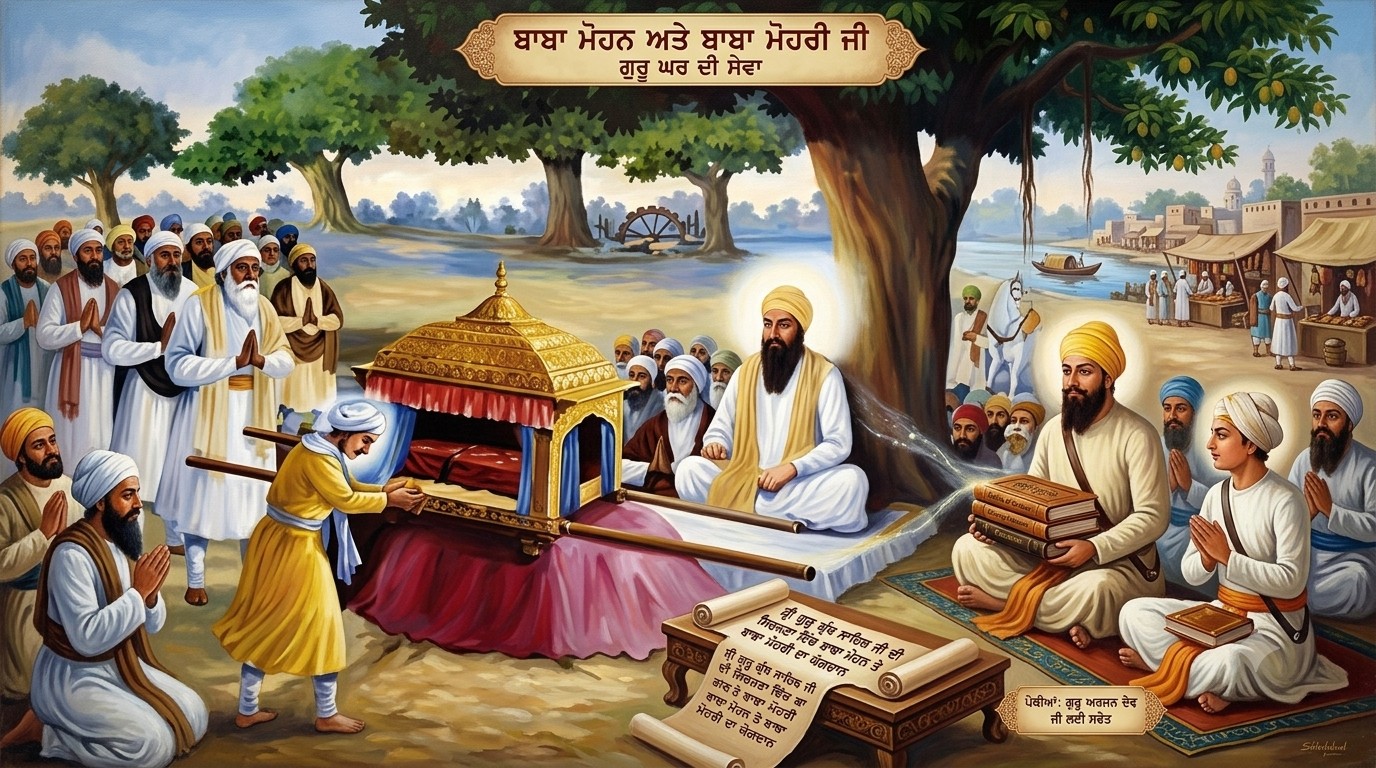
The Keepers of the Divine Word: Baba Mohri, Baba Mohan, and the Goindval Pothis
The compilation of the Adi Granth in 1604 CE by Guru Arjan Dev Ji stands as one of the most monumental milestones in the history of world religions. It was a painstaking, divinely inspired process of editing, sorting, and authenticating sacred verses to create an eternal, incorruptible spiritual guide for humanity. However, the path to compiling this sovereign scripture was paved by the quiet custodians of the early Sikh scribal tradition: Baba Mohri and Baba Mohan, the two sons of the third master, Guru Amar Das Ji. As a Sikh historian, looking back through the mists of the sixteenth century, we find in Goindval Sahib a profound narrative of spiritual legacy, familial testing, and textual preservation. The contributions of these two brothers have often been overshadowed by the grand narratives of the Gurus themselves, yet without their meticulous guardianship of the earliest written manuscripts—known to history as the Goindval Pothis or Mohan Pothis—the structural and textual reality of the Sri Guru Granth Sahib as we know it today might have taken a vastly different shape.
The Household of Guru Amar Das Ji: A Crucible of Divine Temperaments
To understand the historical significance of Baba Mohri and Baba Mohan, one must first appreciate the spiritual atmosphere of Goindval Sahib during the mid-to-late sixteenth century. Goindval was not merely a physical town; it was the active, vibrant headquarters of the Sikh faith, a bustling center of egalitarian community living, and a sanctuary of divine revelation. In this sacred crucible, Guru Amar Das Ji raised his family. His two sons, Baba Mohan and Baba Mohri, grew up in the direct light of the Guru's presence, witnessing the daily crystallization of Sikh theology, the institutionalization of the Langar, and the expansion of the Manji system. Despite sharing the same divine household, the two brothers developed markedly different spiritual temperaments. Baba Mohan, the elder, was drawn toward intense introspection, asceticism, and quietist contemplation, often withdrawing from the social affairs of the community to immerse himself in deep meditation. Baba Mohri, the younger son, possessed a temperament characterized by practical devotion, profound humility, and immediate surrender to the divine will. These contrasting natures would define their reactions to the transition of Guruship and dictate their respective roles in the custody of the sacred Word.
Baba Mohri: The Epitome of Humility and Unconditional Surrender
The ultimate test of any family member within the Guru-household was the moment of succession. In early Sikh history, succession was never a matter of hereditary right but of absolute spiritual merit, devotion, and alignment with the divine light of Guru Nanak. When Guru Amar Das Ji chose his son-in-law, Bhai Jetha (who became Guru Ram Das Ji), to succeed him as the fourth Guru, it was a moment of profound significance that challenged the egos of many within the immediate family. It is here that Baba Mohri shines as a beacon of unmatched humility and Gurmukh orientation. Historical sources, including the classical chronicle Sri Gur Pratap Suraj Granth, record that when Guru Amar Das Ji formally seated Guru Ram Das Ji on the spiritual throne and asked his family to bow before him, Baba Mohri did not hesitate for a single moment. He was the very first to step forward, prostrate before Guru Ram Das Ji, and declare his complete allegiance to the newly appointed Master. By doing so, Baba Mohri neutralized potential familial discord and demonstrated that the true measure of a Guru's son was not the claim to bloodline succession, but the capacity to recognize and submit to the divine light wherever it chose to reside. Throughout his life, Baba Mohri remained a dedicated pillar of the Goindval community, supporting the Gurus with quiet devotion and facilitating the transition of spiritual authority across three generations.
Baba Mohan: The Mystic Custodian of the Sacred Pothis
In contrast to his brother's active, supportive role, Baba Mohan Ji took a path of profound mystical withdrawal. Deeply affected by the passing of his father, Guru Amar Das Ji, Baba Mohan retreated into a life of intense contemplation, spending years in a quiet attic room—historically known as the Chaubara of Baba Mohan Ji in Goindval Sahib. Because of his ascetic leanings, he became the natural custodian of the family's spiritual treasures, which included the early physical compilations of Gurbani. Under the direct supervision of Guru Amar Das Ji, Baba Mohan, along with a dedicated scribe named Sahansar Ram (who was Baba Mohan's nephew, the son of Baba Mohri), had compiled two major volumes of sacred hymns. These volumes, which came to be known as the Goindval Pothis or Mohan Pothis, contained the compositions of Guru Nanak Dev Ji, Guru Angad Dev Ji, and Guru Amar Das Ji, alongside the verses of several Bhagats (saints) like Kabir, Namdev, and Ravidas. To Baba Mohan, these Pothis were not merely books; they were the physical embodiment of the divine wisdom, the living spirit of his father and the previous Gurus. He guarded them with an intense, almost fierce possessiveness, keeping them locked within his attic sanctuary as he spent days, weeks, and months in uninterrupted samadhi (deep meditation).
The Goindval Pothis: The Textual Foundation of the Sikh Canon
To fully grasp the historical weight of these manuscripts, we must examine the physical and intellectual nature of the Goindval Pothis. Compiled between 1570 and 1574 CE, these volumes represent the earliest systematized collection of Sikh scripture. They were written in an early form of Gurmukhi script, displaying a highly organized structural framework that laid the groundwork for the Raga system later perfected by Guru Arjan Dev Ji. The Pothis were organized according to specific musical measures (Ragas), such as Suhi, Prabhati, Dhanasri, and Ramkali, which indicates that the integration of music and metaphysics was already a mature concept during the time of the third Guru. Furthermore, the inclusion of Bhagat Bani in these Pothis proves that the egalitarian, inter-religious scope of Sikh scripture was envisioned from its very inception by Guru Nanak and formalised by Guru Amar Das. When Guru Arjan Dev Ji embarked on the monumental task of compiling the Adi Granth at Amritsar, his primary objective was to establish an authenticated, authorized version of the divine word to protect the community from apocryphal and corrupted verses being circulated by sectarian rivals. To achieve this, he needed access to the most authentic source materials in existence, and that search led him directly back to the Goindval Pothis held by Baba Mohan.
The Great Quest: Retrieving the Pothis from Goindval
The journey to retrieve the Goindval Pothis is one of the most dramatic and spiritually instructive episodes in Sikh history. Guru Arjan Dev Ji did not simply demand the manuscripts; he approached the task with immense diplomatic tact, spiritual humility, and reverence. Initially, the Guru dispatched senior, highly respected Sikhs to Goindval to request the Pothis. First, he sent Bhai Gurdas Ji, the preeminent scholar and scribe of the Sikh panth. Bhai Gurdas arrived at Baba Mohan's residence, but found the door locked. Baba Mohan was immersed in deep meditation and refused to answer or acknowledge the knocks. Bhai Gurdas returned to Amritsar empty-handed, noting the intensity of Baba Mohan's spiritual absorption. Next, Guru Arjan Dev Ji sent Baba Buddha Ji, the venerable patriarch who had been blessed by Guru Nanak himself. Baba Buddha Ji, thinking he could coax the door open, gently knocked and called out, but Baba Mohan remained unmoved. When Baba Buddha Ji attempted to open the door, Baba Mohan spoke from within, admonishing him for disturbing his contemplation, prompting Baba Buddha Ji to return to Amritsar with the realization that this deadlock could not be broken by ordinary means.
The Divine Melody of Humility: Guru Arjan's Visit to Goindval
Recognizing that the retrieval of the sacred texts required an outpouring of absolute humility and love, Guru Arjan Dev Ji decided to go to Goindval Sahib himself. Upon arriving at the Chaubara of Baba Mohan, the Guru did not knock or assert his authority as the reigning Guru. Instead, he sat barefoot on the dusty ground outside the door, took up a stringed instrument, and began to sing. The composition he sang is preserved in the Guru Granth Sahib under Gauri Rag (page 248), a masterpiece of double entendre that addresses both the Transcendent Divine (Mohan, meaning the Enchanter/God) and the earthly custodian of the texts (Baba Mohan):
"Mohan tere uche mandar mehal apara... Mohan tere bachan anup chal sant dharamsala..."
(O Mohan, Your temple is so lofty, Your mansion is infinite... O Mohan, Your words are incomparable, and Your lifestyle is that of a saintly place of worship...)
As Guru Arjan's sweet, divine voice echoed through the narrow streets of Goindval, the melody penetrated the thick walls of the attic and touched the heart of Baba Mohan. The song praised Mohan’s saintly devotion, his lofty dwelling, and his divine role in the cosmic play. Hearing this profound expression of love, Baba Mohan’s resolve melted. He opened the door, came down from his sanctuary, and looked upon Guru Arjan Dev Ji. Initially, Baba Mohan testily questioned the Guru's motives, but Guru Arjan responded with gentle grace, explaining that the Pothis were the heritage of the entire humanity and needed to be shared to save the world from spiritual darkness. Deeply moved by the Guru's humility, Baba Mohan brought down the sacred Pothis, bowed before Guru Arjan, and handed them over, blessing the great compilation project. Guru Arjan Dev Ji placed the Pothis reverently upon a palanquin and, accompanied by Baba Mohri and the local congregation, brought them in a grand procession back to Amritsar, where they served as the core source text for the creation of the Adi Granth.
The Comparative Context of the Goindval Pothis
To understand the immense contribution of Baba Mohan and Baba Mohri, it is useful to look at how the Goindval Pothis compare with the final structure of the Adi Granth compiled by Guru Arjan Dev Ji. The table below outlines the relationship between the early compilations held by the brothers and the final canon:
| Feature / Aspect | The Goindval Pothis (Mohan Pothis) | The Adi Granth (Compiled 1604 CE) |
|---|---|---|
| Primary Custodians | Baba Mohan & Baba Mohri (Goindval Sahib) | Guru Arjan Dev Ji & Bhai Gurdas Ji (Amritsar) |
| Scribe(s) | Sahansar Ram (son of Baba Mohri) | Bhai Gurdas Ji |
| Script Used | Early Gurmukhi (proto-Gurmukhi characteristics) | Standardized Gurmukhi Script |
| Ragas Included | Limited selection (primarily Suhi, Prabhati, Dhanasri, Ramkali, etc.) | Expanded to 30 Ragas (later 31 Ragas in Sri Guru Granth Sahib) |
| Scope of Authorship | First 3 Gurus, select Bhagats, and medieval poets | First 5 Gurus, 15 Bhagats, 11 Bhatts, and 4 Gursikhs |
| Structural Layout | Separated into distinct thematic and musical notebooks | Unified, strictly categorized, page-numbered volume (1430 Angs later) |
The Eternal Legacy of Goindval's Sons
From the analytical perspective of a historian, the lives of Baba Mohri and Baba Mohan present a fascinating study of how spiritual authority and textual custody operated in the nascent stages of the Sikh movement. They represent two halves of a complete devotion. Baba Mohri provided the structural and emotional stability that allowed the lineage of Guruship to transition smoothly from Guru Amar Das to Guru Ram Das without the fractures that ruined many other contemporary spiritual lineages. His son, Sahansar Ram, did the physical labor of putting pen to paper, preserving the divine utterances before they could be lost to time. On the other hand, Baba Mohan provided the protective shield. In an era when early Sikh texts were vulnerable to being copied, altered, or claimed by splinter groups like the Udasis or Minhans, Baba Mohan's fierce protective custody ensured that the Goindval Pothis remained pure, untampered, and intact until they could be delivered into the hands of Guru Arjan Dev Ji.
Ultimately, the story of Baba Mohri and Baba Mohan is a story of how the human ego must be surrendered to serve a larger, cosmic purpose. Whether through the active, joyful submission of Baba Mohri or the hard-won, musical capitulation of Baba Mohan, both brothers played indispensable roles in the preservation of the Gurus' teachings. When we bow before the Sri Guru Granth Sahib today, we are not only bowing to the divine wisdom of the Gurus and the Bhagats, but we are also reaping the spiritual fruits of the quiet, dedicated lives of the two brothers of Goindval, who kept the fire of the written Word burning brightly in the dawn of the Sikh faith.
Guru Amar Das Ji (1479–1574)
Baba Mohan compiled the 'Goindwal Pothis' (manuscripts of Gurbani) which were later used by Guru Arjan Dev Ji for the Adi Granth.
- Role
- Sons
- Group
- Family & Successors
- Period
- Guru Amar Das Ji (1479–1574)