Sikh Legends · Origins & Gurus · Guru Gobind Singh Ji
Banda Singh Bahadur
Met the Guru at Nanded (as Madho Das); he was baptized and sent to Punjab to lead the Khalsa army against the tyrannical rule of Wazir Khan.
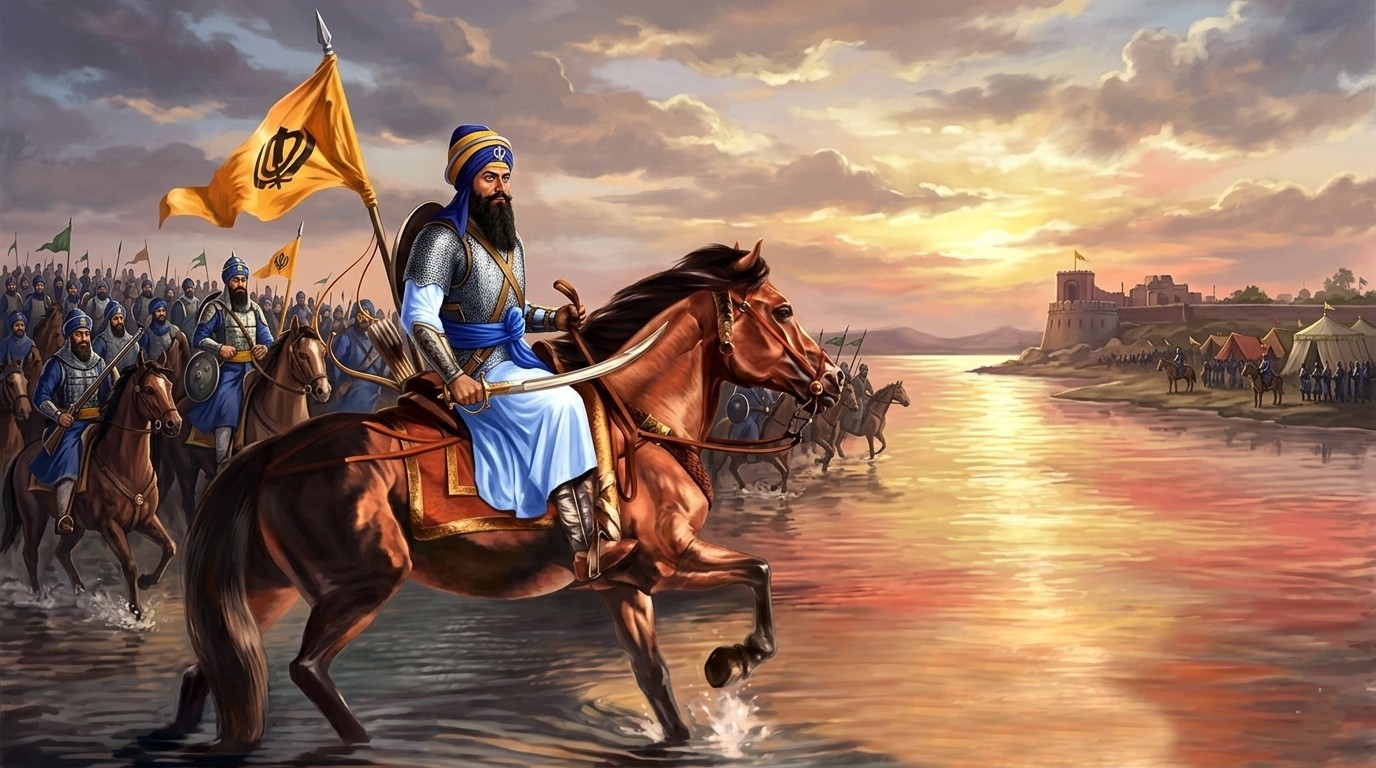
The Crucible of Nanded: The Meeting of Two Sovereigns
In the late summer of 1708, the dust-swept banks of the Godavari River in Nanded, located in the Deccan plateau, became the stage for one of the most transformative encounters in Indian history. Guru Gobind Singh, the tenth master of the Sikh faith, had traveled south after the grueling and tragic campaigns of Anandpur, Chamkaur, and Muktsar. Despite losing his four beloved sons (the Sahibzadas), his mother, and countless devoted warriors to Mughal treachery, the Guru’s spiritual resolve remained completely unbroken. It was here that he sought out an ascetic named Madho Das, a former Rajput warrior born Lachman Dev, who had abandoned the worldly path of arms after accidentally killing a pregnant doe during a hunt. Overwhelmed by grief, Lachman Dev had fled his home in Jammu, wandered across the subcontinent, and eventually settled in Nanded, where he mastered ancient yogic arts, occult practices, and physical austerities, building a formidable reputation as a powerful hermit who delighted in magically humiliating visiting sages and holy men.
When Guru Gobind Singh entered the hermitage of Madho Das in his absence, he calmly sat upon the ascetic’s intricately prepared couch—an act of supreme spiritual defiance. Upon his return, the prideful yogi unleashed his occult powers, summoning spirits and forces to overturn the couch and throw the intruder to the ground. Yet, despite his intense concentrations, the couch remained completely stationary, immovable under the spiritual weight of the Tenth Guru. Realizing that he was in the presence of an unparalleled spiritual giant, the yogi’s pride shattered. He threw himself at the feet of the Guru and uttered the historic words, "I am your Banda (slave)." The Guru replied, "If you are my Banda, perform the work of a Banda." In this singular moment of profound spiritual submission, the ascetic’s life was completely reoriented. The Guru recognized that beneath the layers of yogic detachment lay the dormant soul of a righteous warrior, waiting to be awakened for the preservation of justice and the liberation of the oppressed masses of Northern India.
The Alchemy of the Amrit: From Ascetic to Commander-in-Chief
The transformation of Madho Das into Baba Banda Singh Bahadur was not merely a change of temperament; it was a profound spiritual alchemy achieved through the administration of Khande di Pahul (the double-edged sword baptism). The Guru baptized him into the Khalsa brotherhood, giving him the name Gurbaksh Singh, though the name bestowed upon him by history would remain Banda Singh Bahadur—the brave slave of the Guru. To equip him for the monumental task of confronting the might of the Mughal Empire in Punjab, the Guru did not merely offer verbal blessings. He handed Banda Singh a council of five chosen Sikhs (the Panj Pyare counterpart for this mission), consisting of Baba Binod Singh, Baba Kahl Singh, Baba Baj Singh, Baba Ran Singh, and Baba Shardul Singh, ensuring that the democratic, collective decision-making framework of the Khalsa was preserved. Furthermore, the Guru armed him with five sacred arrows from his personal quiver, a battle drum (Nagara), and a royal standard (Nishan Sahib) as symbols of temporal authority.
Crucially, the Guru issued Hukamnamas (imperial edicts written in his own hand) addressed to the Sikh congregations of Punjab. These letters commanded the Khalsa to rally under the banner of Banda Singh Bahadur, recognizing him as their temporal commander appointed to exact justice for the unspeakable atrocities committed by the Mughal administration, most notably the brutal bricking-alive of the younger Sahibzadas, Baba Zorawar Singh and Baba Fateh Singh, by Wazir Khan, the subedar of Sirhind. Banda Singh was explicitly instructed by the Guru never to claim independent kingship, to remain celibate, to act solely in consultation with the Khalsa council, and to never turn his back on the battlefield. With these divine mandates, a highly disciplined ascetic was converted into an unstoppable military force, carrying with him the collective grief, resolve, and spiritual power of the Sikh faith to the fertile plains of the Punjab.
The March to Punjab: Mobilizing the Oppressed
As Banda Singh Bahadur marched northward from the Deccan, a journey spanning hundreds of miles, he operated with remarkable strategic patience, sending emissaries ahead to deliver the Guru's Hukamnamas to the Sikh heartland. By the time he reached the borders of Punjab near Delhi, his small band of followers began to swell exponentially. The peasantry of Punjab, who had suffered for generations under the crushing taxation of the Mughal zamindari (feudal) system and the religious persecution of local administrators, saw in Banda Singh a divine liberator. Men of all backgrounds—Sikhs, Hindus, and even down-trodden peasants seeking economic relief—assembled under his command. Unlike modern professional standing armies, this was a highly motivated, revolutionary volunteer militia driven by a deep desire for justice and spiritual devotion.
Banda Singh's initial military targets were strategically chosen to build momentum, secure finances, and punish key perpetrators of Mughal oppression. In November 1709, he launched a sudden and devastating attack on the heavily fortified town of Samana. This town was highly symbolic, as it was the ancestral home of Jalal-ud-din, the executioner of Guru Tegh Bahadur (the ninth Guru), as well as the executioners of the younger Sahibzadas. The swift fall of Samana, followed by the capture of Ghurram, Kapuri, and Sadhaura, sent shockwaves through the Mughal administration. At Sadhaura, Banda Singh punished the local ruler Usman Khan, who had notoriously tortured and executed the revered Muslim saint Pir Buddhu Shah for the crime of helping Guru Gobind Singh in the Battle of Bhangani. These rapid victories proved that the seemingly invincible Mughal state could be broken, and they served as a prelude to the ultimate confrontation with the regional seat of power: Sirhind.
The Epic Battle of Chappar Chiri and the Fall of Sirhind
The ultimate objective of the Khalsa army was the fortress of Sirhind, the administrative capital of Wazir Khan, who possessed a formidable garrison, modern artillery, and trained cavalry. In May 1710, the two armies met on the sandy plains of Chappar Chiri, a few miles outside Sirhind. The battle was a classic confrontation between a highly organized, heavily armed state apparatus and a passionate, highly mobile revolutionary force. Wazir Khan deployed his heavy artillery and armored elephants in the center, intending to decimate the oncoming Sikh infantry. Recognizing the danger, Banda Singh climbed a nearby hillock to survey the battlefield, orchestrating his forces with brilliant tactical precision. When the Sikh vanguard began to waver under the intense cannon fire, Banda Singh himself charged into the fray, revitalizing his men with a resounding war cry of "Sat Sri Akal."
The sheer ferocity of the Khalsa charge shattered the Mughal flanks. Baj Singh, a veteran Sikh commander, engaged in direct hand-to-hand combat with Wazir Khan's top generals, while Fateh Singh dealt the fatal blow to Wazir Khan himself, ending his tyrannical reign over the province of Sirhind. The Mughal army broke into a chaotic retreat, and the victorious Khalsa forces entered the city of Sirhind. Unlike the typical medieval conquerors who engaged in unchecked slaughter and plunder, Banda Singh focused on dismantling the structures of state tyranny. He established a new administrative order, appointing Baj Singh as the governor of Sirhind. The fall of Sirhind was not merely a military victory; it was a profound psychological turning point that shattered the myth of Mughal invincibility and announced the arrival of the Khalsa as the sovereign rulers of Northern India.
The Sovereign State: Revolutionary Agrarian and Administrative Reforms
Having cleared a vast swathe of territory between the Sutlej and Yamuna rivers, Banda Singh Bahadur moved to establish the first sovereign Sikh state, setting up his capital at the mountain fortress of Mukhlispur, which he renamed Lohgarh (the Iron Fort). In a move of profound symbolic importance, he struck the first Sikh coins in 1710. Rather than printing his own name or image on the currency, as was the custom of emperors, Banda Singh’s coins bore inscriptions dedicating all victory, power, and prosperity to Guru Nanak and Guru Gobind Singh. The Persian inscription on the coins translated to: "The sword of Nanak is the granter of all desires, and the victory is of Guru Gobind Singh, the king of kings." He also introduced a new solar calendar starting from the date of the victory at Sirhind, completely breaking away from the imperial Mughal calendar.
Beyond symbols of sovereignty, Banda Singh introduced revolutionary agrarian reforms that forever altered the socio-economic landscape of Punjab. He abolished the centuries-old, highly oppressive Zamindari system, which had kept the peasantry in a state of perpetual debt and serfdom to feudal landlords. Under Banda Singh's administration, the land was confiscated from these wealthy, corrupt feudal lords and distributed directly to the actual tillers of the soil, regardless of their caste, creed, or religious background. This act of economic liberation was the first of its kind in India, creating a class of self-respecting, independent landowners who would form the socio-political backbone of the future Sikh empire and the modern state of Punjab. Banda Singh proved that the Khalsa's mission of "Dharam Yudh" (righteous war) was not merely a military endeavor, but a holistic social revolution designed to uplift the poorest of the poor.
The Legacy and Martyrdom of the Great Commander
The rapid expansion of Sikh power deeply alarmed the Mughal Emperor Bahadur Shah I, who abandoned his southern campaigns to personally lead a massive, multi-divisional army of over one hundred thousand soldiers to crush the Sikh uprising. For several years, Banda Singh engaged in highly effective guerrilla warfare, constantly evading capture by melting into the Shivalik hills and launching surprise raids on Mughal garrisons. However, in 1715, after a long and agonizing eight-month siege at the fortress of Gurdas Nangal, where the Sikh defenders were reduced to eating grass, animal hides, and leaves to survive, Banda Singh and his remaining seven hundred starving warriors were captured. They were chained and paraded through the streets of Lahore and Delhi in a cruel spectacle, yet contemporary accounts by British and Mughal observers noted that not a single Sikh showed any sign of fear, grief, or willingness to renounce their faith to save their lives.
In June 1716, in Delhi, near the tomb of Sufi saint Qutbuddin Bakhtiyar Kaki, Banda Singh Bahadur was subjected to one of the most horrific martyrdoms in human history. The executioners placed his four-year-old son, Ajay Singh, in his lap and ordered him to kill the child. When Banda Singh refused, the executioners brutally slaughtered the child before his eyes, tore out the child's heart, and forced it into Banda Singh’s mouth. Throughout this unimaginable torture, Banda Singh remained in a state of absolute spiritual composure, meditating on the divine name. His eyes were then gouged out, his limbs amputated, his flesh torn with red-hot iron pincers, and he was finally decapitated. His martyrdom cemented his place in history as one of the ultimate icons of courage, faith, and sacrifice. By demonstrating that a determined people could rise up, defeat an empire, and establish a sovereign, egalitarian state, Baba Banda Singh Bahadur laid the structural, ideological, and psychological foundations that led directly to the establishment of the Sikh Misls and the eventual sovereign empire of Maharaja Ranjit Singh.
Frequently Asked Questions (FAQ) about Baba Banda Singh Bahadur
| No. | Question | Historical Answer |
|---|---|---|
| 1 | What was Banda Singh Bahadur’s original name? | He was born as Lachman Dev in a Rajput family in Rajouri (modern-day Jammu and Kashmir). He later took the name Madho Das when he became an ascetic (Bairagi) before being baptized as Gurbaksh Singh by Guru Gobind Singh. |
| 2 | Where and when did Banda Singh Bahadur meet Guru Gobind Singh? | They met in September 1708 at Nanded, located on the banks of the Godavari River in Maharashtra, where Madho Das had established his hermitage. |
| 3 | Why did the yogi call himself the Guru’s "Banda"? | After his occult and yogic powers failed to affect or intimidate Guru Gobind Singh, Madho Das realized the Guru's immense spiritual supremacy. He surrendered his ego, declaring himself the Guru’s "Banda" (slave/servant). |
| 4 | What tokens did Guru Gobind Singh give to Banda Singh Bahadur? | The Guru gave him five sacred arrows from his own quiver, a battle drum (Nagara), a royal standard (Nishan Sahib), and Hukamnamas (edicts) to mobilize the Sikhs of Punjab, along with a council of five prominent Sikhs. |
| 5 | Who was Wazir Khan, and why was he targeted? | Wazir Khan was the Mughal Subedar (Governor) of Sirhind. He was targeted because he was responsible for countless atrocities, including the brutal execution of Guru Gobind Singh's younger sons, Baba Zorawar Singh and Baba Fateh Singh. |
| 6 | What was the significance of the Battle of Chappar Chiri? | Fought in May 1710, this battle saw the newly formed Khalsa army defeat the heavily armed Mughal forces of Sirhind. Wazir Khan was killed, and the victory led to the establishment of the first sovereign Sikh territory. |
| 7 | Where was the capital of the first Sikh state established? | The capital was established at Mukhlispur, a mountain fortress in the foothills of the Himalayas, which Banda Singh Bahadur repaired and renamed Lohgarh (the Iron Fort). |
| 8 | How did Banda Singh Bahadur reform the land ownership system? | He completely abolished the oppressive Mughal Zamindari (feudal) system. He confiscated land from wealthy feudal landlords and distributed it directly to the peasant tillers, making them the actual landowners. |
| 9 | What inscriptions were on the coins struck by Banda Singh Bahadur? | The coins did not bear his own name. Instead, they bore Persian inscriptions dedicating all power, victory, and prosperity to the spiritual lineage of Guru Nanak Dev Ji and Guru Gobind Singh Ji. |
| 10 | How did Baba Banda Singh Bahadur die? | After being captured in 1715 at Gurdas Nangal, he was taken to Delhi where he was brutally tortured in June 1716. Even after his young son was slaughtered in his lap, he refused to convert to Islam and was executed with extreme cruelty, remaining steadfast in his faith. |
Guru Gobind Singh Ji (1666–1708)
Met the Guru at Nanded (as Madho Das); he was baptized and sent to Punjab to lead the Khalsa army against the tyrannical rule of Wazir Khan.
- Role
- Disciple & Military Commander
- Group
- Later Interactions
- Period
- Guru Gobind Singh Ji (1666–1708)