Sikh Legends · Origins & Gurus · Guru Tegh Bahadur Ji
Bhai Dayala Ji
Martyred by being boiled in a cauldron of water for his unwavering devotion to the Guru's cause.
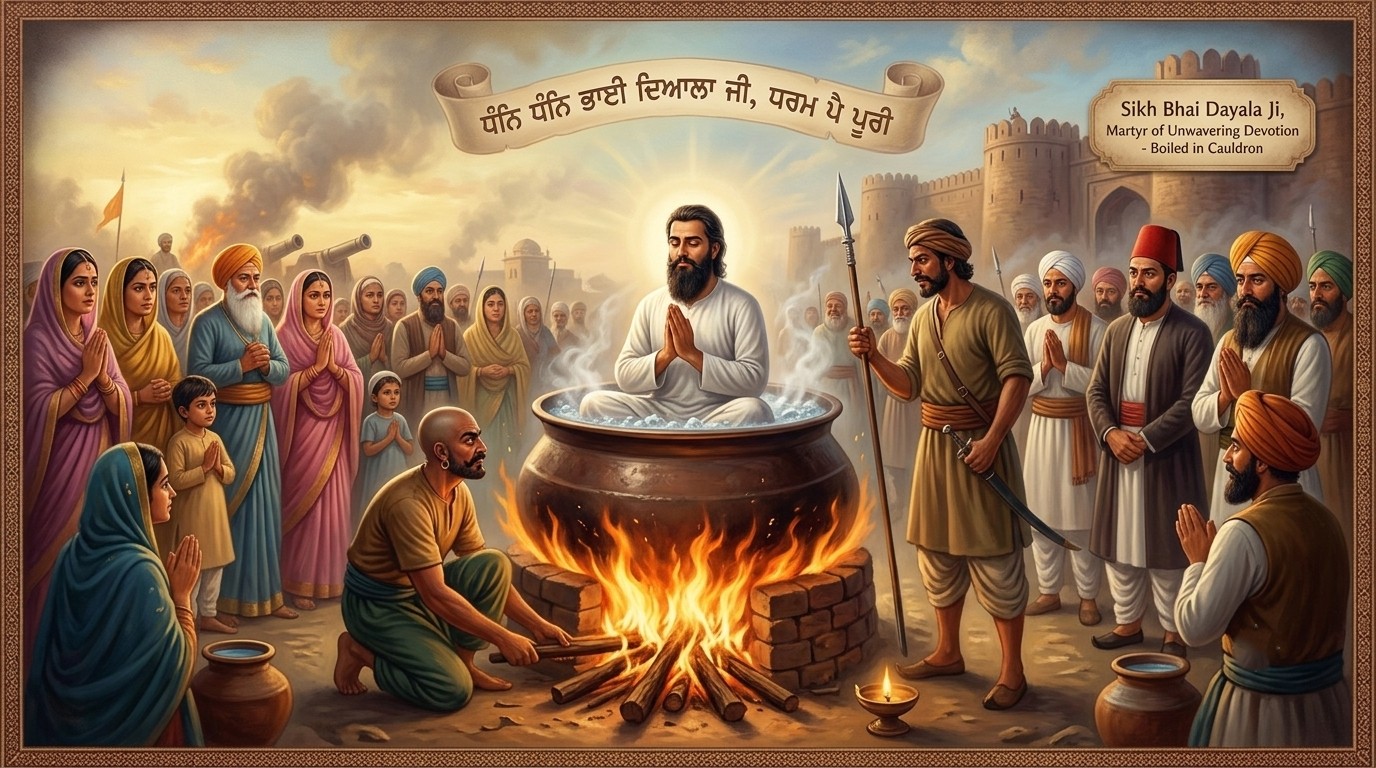
The Martyrdom of Bhai Dayala Ji
To understand the profound spiritual and historical gravity of the martyrdom of Bhai Dayala Ji, one must first look at the turbulent socio-political landscape of seventeenth-century India under the rule of the Mughal Emperor Aurangzeb. This period was marked by a fierce state-sponsored drive toward religious homogenization, where the diverse spiritual traditions of the Indian subcontinent faced an existential threat. In this crucible of systemic oppression, the Sikh Gurus stood as unwavering sentinels of conscience, human dignity, and spiritual freedom. The court of the ninth Guru, Guru Tegh Bahadur Ji, became a sanctuary for the persecuted, drawing those who refused to surrender their ancestral heritage to imperial decree. It was within this sacred crucible that Bhai Dayala Ji lived, breathed, and ultimately offered his life—not as a passive victim of imperial wrath, but as an active, defiant witness to the eternal truth of the Gurus' teachings.
Historians of the Sikh tradition recognize Bhai Dayala Ji as one of the closest and most trusted companions of Guru Tegh Bahadur Ji. While historical accounts offer varying details regarding his exact ancestral lineage—some identifying him as belonging to a family of devout Chhibber Brahmins who embraced the Guru's path, and others linking him to the family of the celebrated scholar-martyr Bhai Mani Singh Ji—there is absolute consensus on his spiritual standing. He served for years in the Guru's household, managing administrative duties, organizing the Sangat (congregation), and traveling extensively to propagate the message of universal love and spiritual sovereignty. His life was an embodiment of the Sikh ideal of "Seva" (selfless service) and "Simran" (meditative remembrance), forging a spirit that was entirely detached from worldly temptations and completely anchored in the Divine Will.
The turning point of this historical epoch arrived in May 1675, when a delegation of Kashmiri Pandits, led by Pandit Kirpa Ram, arrived at Anandpur Sahib in utter despair. They related the horrifying accounts of forced conversions, desecration of temples, and the systematic dismantling of their religious identity by the Mughal governor of Kashmir. Guru Tegh Bahadur Ji sat in deep contemplation, recognizing that a sacrifice of unparalleled magnitude was required to shake the conscience of the ruling elite and awaken the sleeping spirit of the masses. In this moment of cosmic decision, when the Guru resolved to offer his own head to defend the religious freedom of a community that was not even his own, Bhai Dayala Ji did not hesitate. Along with other close disciples like Bhai Mati Das Ji and Bhai Sati Das Ji, Bhai Dayala Ji volunteered to accompany the Guru on his journey to Delhi, knowing fully well that this path led directly to the jaws of imperial torture and death.
The journey from Anandpur Sahib to Delhi was a path of deliberate confrontation with temporal tyranny. Guru Tegh Bahadur Ji and his companions were arrested by Mughal authorities at Dhamtan Sahib and transported to Delhi, where they were thrown into the dark, damp, and suffocating dungeons of the Kotwali. The Mughal state deployed every mechanism of psychological warfare and physical coercion to break the resolve of the Guru and his disciples. Imperial theologians and grandees offered them immense wealth, prestigious titles, and estates if they would simply renounce their faith and embrace Islam. Alternatively, they were threatened with the most horrific methods of execution devised by the human mind. Throughout this grueling imprisonment, Bhai Dayala Ji remained in a state of "Chardi Kala" (unyielding high spirits), treating the dungeon as a sacred temple and finding complete liberation within the confines of his iron cage through the continuous recitation of the Guru's hymns.
In Sikh theology, the concept of "Shahadat" (martyrdom) is fundamentally different from a tragic end; it is viewed as the ultimate spiritual triumph, a joyful marriage of the individual soul with the Universal Divine. On November 11, 1675, the public square of Chandni Chowk in Delhi became the stage for this ultimate spiritual demonstration. The Mughal authorities decided to execute the Guru's companions first, hoping that witnessing their agonizing deaths would terrify Guru Tegh Bahadur Ji into submission. The crowd gathered, filled with hostile imperial soldiers and a weeping populace. The first to face martyrdom was Bhai Mati Das Ji, who was bound between two wooden planks and sawn alive from head to toe. This was followed by the martyrdom of Bhai Sati Das Ji, who was wrapped in highly flammable cotton and set ablaze. Throughout these unspeakable horrors, Bhai Dayala Ji stood witness, his heart filled not with terror, but with a deep, meditative peace, observing how his brethren departed this world with the Divine Name on their lips.
When Bhai Dayala Ji was brought forward, the Qazi (Islamic judge) offered him a final chance to save his life by accepting Islam, warning him that his end would be even more painful than those of his companions. Bhai Dayala Ji resolutely rejected the offer, proclaiming that his physical body was merely a temporary garment and that no earthly fire or water could destroy the eternal spirit that had been touched by the Guru's grace. The executioners then prepared a massive iron cauldron ("Degh") filled with water, placing it over a roaring fire. Bhai Dayala Ji was bound and lowered into the cold water. As the heat intensified and the water began to boil, Bhai Dayala Ji sat cross-legged in the posture of meditation. While his physical flesh was subjected to the absolute limits of human agony, his consciousness remained detached, his lips softly reciting the "Japji Sahib"—the morning prayer of the Sikhs. He did not let out a single cry of pain, maintaining a serene countenance until his breath merged with the eternal light.
The martyrdom of Bhai Dayala Ji by being boiled alive in a cauldron represents a profound theological subversion of physical torment. The boiling water, meant by the state to represent the absolute power of imperial terror, was transformed by Bhai Dayala Ji's unshakeable faith into a holy bath of spiritual purification. By enduring this torture without rancor, hatred, or fear, he demonstrated that the spiritual sovereignty of a realized soul is infinitely superior to the physical might of an empire. This sacrifice shattered the moral authority of the Mughal court and exposed the spiritual bankruptcy of the state. The fire that boiled the water in that cauldron did not extinguish the Sikh movement; instead, it ignited a spiritual and revolutionary fire across the subcontinent, establishing a legacy of resistance that would forever alter the course of Indian history.
The immediate historical consequence of these martyrdoms was the total alienation of the populace from the Mughal state and the rapid consolidation of the Sikh community into a formidable force for social justice. The sacrifice of Guru Tegh Bahadur Ji, Bhai Mati Das Ji, Bhai Sati Das Ji, and Bhai Dayala Ji sowed the seeds of the Khalsa. A quarter-century later, in 1699, Guru Gobind Singh Ji (the tenth Guru) formalized this spirit of unyielding resistance by creating the Khalsa Panth—a community of Saint-Soldiers bound by an oath to fight tyranny, protect the weak, and never turn their backs on the battlefield of life, directly drawing inspiration from the absolute surrender demonstrated by martyrs like Bhai Dayala Ji.
For the global Sikh community today, the memory of Bhai Dayala Ji is not a relic of a distant past, but a living, breathing component of daily spiritual practice. In the "Ardas" (the congregational prayer recited by Sikhs every day), a solemn tribute is paid to "those who were sawn in pieces, boiled in cauldrons, and scalped alive, yet did not abandon their faith." Bhai Dayala Ji's martyrdom stands as a timeless reminder of the cost of religious freedom and the supreme value of living a life of moral integrity. As historians, we look back at the cauldron of Chandni Chowk not just as a site of historical tragedy, but as the birthplace of an indestructible spiritual resolve that continues to inspire humanity to stand upright in the face of tyranny, injustice, and oppression.
Frequently Asked Questions
| 1. Who was Bhai Dayala Ji? |
| Bhai Dayala Ji was a devout and prominent seventeenth-century Sikh scholar, administrator, and companion of the ninth Sikh Guru, Guru Tegh Bahadur Ji. He is highly revered in Sikh history for his unwavering devotion and his supreme sacrifice for the cause of religious freedom. |
| 2. When and where did Bhai Dayala Ji's martyrdom take place? |
| Bhai Dayala Ji was martyred on November 11, 1675, at Chandni Chowk in Delhi, India, under the direct orders of the Mughal Emperor Aurangzeb. |
| 3. Why was Bhai Dayala Ji martyred? |
| He was martyred because he refused to convert to Islam and stood firmly by Guru Tegh Bahadur Ji's side in defending the fundamental right to religious freedom and conscience, specifically protesting against the forced conversion of Kashmiri Pandits. |
| 4. How was Bhai Dayala Ji executed? |
| Bhai Dayala Ji was executed by being boiled alive. He was tied and lowered into a massive iron cauldron (Degh) filled with water, which was then gradually brought to a furious boil over a raging fire. |
| 5. What was Bhai Dayala Ji's response to the executioners during his torture? |
| Bhai Dayala Ji remained completely calm and composed. Instead of showing pain or begging for mercy, he sat in a meditative posture and continuously recited the "Japji Sahib" (Sikh morning prayer), keeping his focus entirely on the Divine. |
| 6. Who were the other companions executed alongside him? |
| Two other close companions of Guru Tegh Bahadur Ji were martyred on the same day: Bhai Mati Das Ji (who was sawn alive) and Bhai Sati Das Ji (who was wrapped in cotton and burnt alive). Guru Tegh Bahadur Ji was beheaded shortly after them. |
| 7. What is the significance of the "Degh" (cauldron) in Sikh memory? |
| The cauldron symbolizes the ultimate test of physical endurance and spiritual devotion. In the daily Sikh prayer (Ardas), the memory of those who were "boiled in cauldrons" is invoked to inspire resilience, courage, and faithfulness under extreme adversity. |
| 8. What was the lineage or background of Bhai Dayala Ji? |
| Historical sources contain different traditions; some describe him as a Brahmin of the Chhibber clan who became a dedicated Sikh, while other accounts identify him as the brother of Bhai Mani Singh Ji, coming from a family of devoted Alipur-based Sikhs. Regardless of the genealogical debate, his status as a pillar of early Sikh history is undisputed. |
| 9. How did these executions impact the future of the Sikh faith? |
| The brutal executions shook the conscience of the region and catalyzed a massive spiritual and military transformation. It directly led to the creation of the Khalsa by Guru Gobind Singh Ji in 1699, establishing a community of Saint-Soldiers committed to resisting tyranny. |
| 10. How is Bhai Dayala Ji commemorated today? |
| Bhai Dayala Ji is commemorated through historical Gurdwaras built at the site of his martyrdom (such as Gurdwara Sis Ganj Sahib in Delhi), through paintings in Sikh museums, and in the daily recitation of the Ardas prayer by millions of Sikhs worldwide. |
Guru Tegh Bahadur Ji (1621–1675)
Martyred by being boiled in a cauldron of water for his unwavering devotion to the Guru's cause.
- Role
- Devoted Disciple
- Group
- Fellow Martyrs & Companions
- Period
- Guru Tegh Bahadur Ji (1621–1675)