Panthic Personalities · Origins & Gurus · Guru Ram Das Ji · Guru Arjan Dev Ji · Guru Hargobind Sahib Ji
Bhai Gurdas Ji
A key intellectual pillar of the Panth who began his significant missionary work during this era, traveling to Agra and beyond.
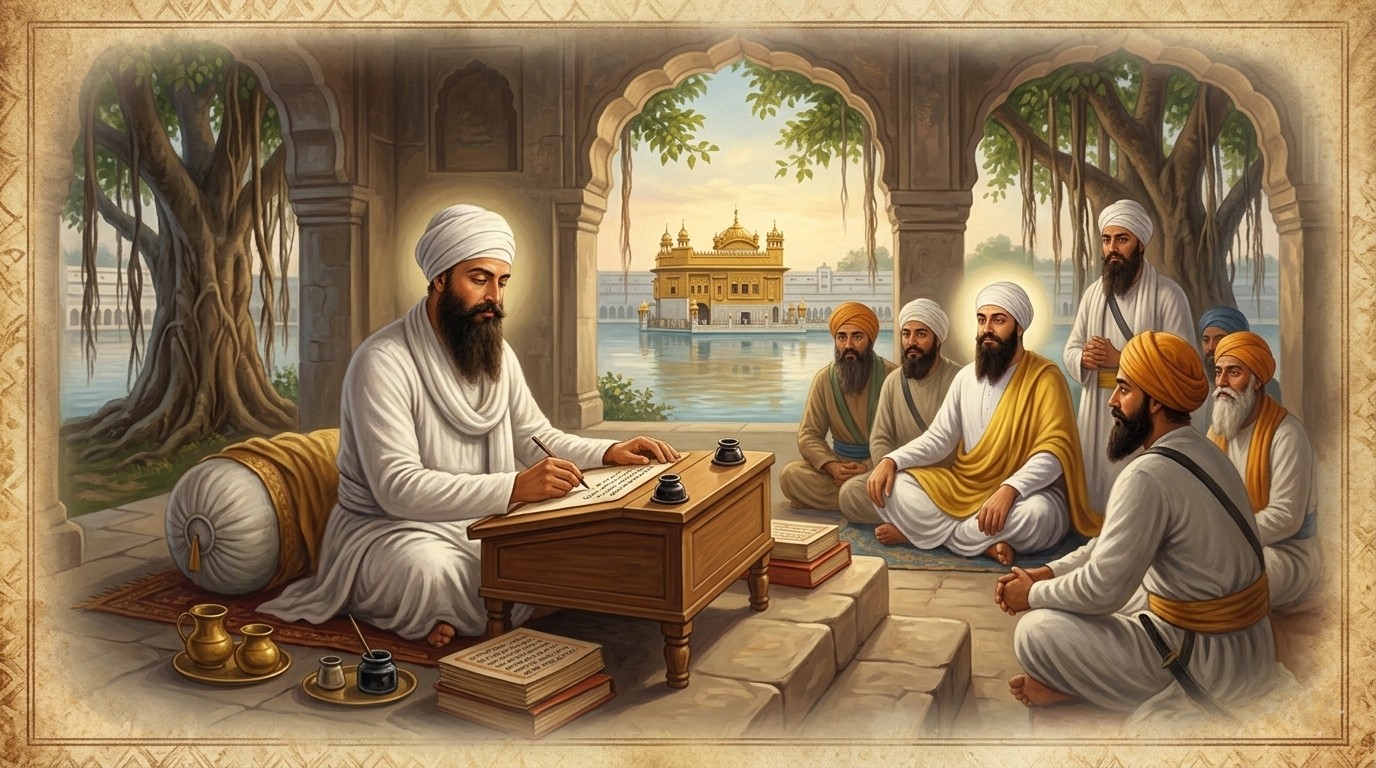
Bhai Gurdas Ji: the Intellectual Pillar of the Early Sikh Panth
To understand the structural, philosophical, and institutional consolidation of early Sikhism is to immerse oneself in the life and legacy of Bhai Gurdas Ji. Born in 1551 in the sacred town of Goindval, Bhai Gurdas Ji was not merely a contemporary to four of our Great Gurus—from Guru Amar Das Ji to Guru Hargobind Ji—but he was also the primary intellectual architect who translated the lived experience of the Gurus into a systematic, accessible, and deeply profound theological framework. As a Sikh historian, when we look back at the critical decades of the late sixteenth and early seventeenth centuries, we witness a young faith transitioning from a localized spiritual movement in the Punjab to a widespread, highly organized, and spiritually distinct global dispensation. It was Bhai Gurdas Ji who provided the foundational literature, the missionary zeal, and the administrative brilliance required to sustain this massive transition. His life represents the perfect synthesis of deep, introspective mysticism and active, outward-facing social engagement, establishing a template for the ideal Sikh scholar-soldier-citizen.
Bhai Gurdas Ji’s early years were spent in the direct presence of Guru Amar Das Ji, his maternal uncle, which allowed him to absorb the pristine essence of the Guru's house from his very childhood. Orphaned at a tender age, he was nurtured within the communal warmth of the Goindval Langar and the spiritual discourse of the early Sangat. This unique upbringing provided him with an unparalleled education, not only in the developing Gurmukhi script and Sikh philosophy but also in the prevailing classical languages of Sanskrit, Persian, Arabic, and Braj Bhasha. He became a master of classical Indian philosophy, studying the Vedas, Upanishads, and the various schools of Darshanas, while also developing a deep familiarity with Islamic Sufi metaphysics. This vast, comparative intellectual background allowed him to articulate the distinctiveness of Sikhism without hostility, framing the message of Guru Nanak Dev Ji as a universal, clarifying sun that had risen to dispel the dark, suffocating fog of ritualism, caste divisions, and spiritual decay that plagued the medieval world.
The Missionary Journeys: Establishing the Panth in Agra and Beyond
As the Sikh community expanded under Guru Ram Das Ji and subsequently Guru Arjan Dev Ji, there arose an urgent need to organize the far-flung congregations (Sangats) and to convey the authentic, unadulterated message of Gurmat to the major urban and intellectual centers of the Mughal Empire. Bhai Gurdas Ji was chosen as the premier missionary of the Guru’s house. His travels to Agra, Varanasi, Gwalior, Lucknow, and parts of Rajasthan and Kabul mark a glorious chapter in early Sikh history. Agra, then the magnificent capital of the Mughal Empire, was a bustling metropolis of scholars, mystics, courtiers, and traders from across the known world. When Bhai Gurdas Ji arrived in Agra, he did not merely preach; he established a sophisticated center for dialogue. He engaged in deep philosophical disputations with Mughal courtiers, high-ranking Sufis of various orders, and orthodox Hindu pundits. His mastery of languages and his gentle, highly logical presentation of Guru Nanak's vision of a classless, monotheistic, and active householder's path captured the imagination of the city's intellectual elite.
The significance of Bhai Gurdas Ji’s work in Agra and Varanasi cannot be overstated. Varanasi was the ultimate stronghold of Brahmanical orthodoxy, a city where classical learning was fiercely guarded and restricted by caste boundaries. By presenting the egalitarian teachings of the Gurus in highly refined Braj and classical poetic forms, Bhai Gurdas Ji challenged the spiritual hegemony of the priestly class. He established Sangats that served as egalitarian spaces where people of all castes, creeds, and genders sat on the same floor to sing the praises of the One Creator. These travel years consolidated the "Manji" and "Masand" systems, creating reliable channels of communication, resource collection, and ideological alignment between the distant diaspora Sangats and the spiritual center in Amritsar. Through his letters and his very presence, Bhai Gurdas Ji ensured that the diverse, geographically isolated pockets of Sikhs remained bound together by a singular, cohesive theology and a shared sense of panthic identity.
The Golden Pen: Scribing the Adi Granth at Ramsar Sahib
The defining moment of Bhai Gurdas Ji’s life—and indeed one of the most pivotal moments in world religious history—occurred in 1604 at the serene edge of Ramsar Sahib in Amritsar. Guru Arjan Dev Ji, the fifth Nanak, recognized that the growing Sikh community required an authenticated, definitive scripture to protect the purity of the Guru’s word (Gurbani) from spurious, sectarian compositions being circulated by rival factions. Guru Arjan Dev Ji selected Bhai Gurdas Ji to be his co-compiler and sole scribe for this monumental task. For months, under the shade of a ber tree, Guru Arjan Dev Ji dictated the divine revelations while Bhai Gurdas Ji, with absolute devotion and calligraphic precision, inscribed them onto paper. This compilation, known originally as the Adi Granth (and later consecrated as the Guru Granth Sahib Ji), was a masterpiece of editorial organization, categorized meticulously by musical measures (Ragas), authors, and spiritual themes.
The relationship between the Guru and the scribe during this process was one of sublime spiritual communion. It is recorded that Guru Arjan Dev Ji offered to include Bhai Gurdas Ji’s own highly revered poetic compositions within the Adi Granth. In an act of profound humility that characterizes his entire life, Bhai Gurdas Ji declined, arguing that his writings were merely commentaries and should never be elevated to the status of Dhur ki Bani (the direct, revealed Word of God). Deeply moved by this humility, Guru Arjan Dev Ji blessed Bhai Gurdas Ji’s writings, declaring his 40 Vars (ballads) to be the "Kunji" or the indispensable key to unlocking the deep spiritual treasures of the Guru Granth Sahib. To this day, in any formal Sikh congregation, the writings of Bhai Gurdas Ji are among the very few external compositions permitted to be recited alongside Gurbani, a testament to their absolute theological alignment with the Guru's vision.
The Theology of the Vars: Mapping the Sikh Worldview
The literary output of Bhai Gurdas Ji, primarily consisting of 40 Vars in Punjabi and 672 Kabitts (quatrains) in Braj Bhasha, constitutes the earliest and most authoritative exposition of Sikh philosophy written by a practicing Sikh. His Vars serve as a comprehensive encyclopedia of early Sikh history, ethics, sociology, and metaphysics. He provides us with the earliest extant biographical details of Guru Nanak Dev Ji’s life, including his miraculous journeys to Mecca, Baghdad, and Mount Sumeru. Through vivid, poetic metaphors, Bhai Gurdas Ji describes the state of the world before the advent of the Guru, comparing it to an untamed wilderness of spiritual darkness, social oppression, and endless sectarian conflict where the four castes had forgotten their shared humanity and the ruling classes had abandoned righteousness.
Beyond history, the Vars lay down the ethical code for a Sikh. Bhai Gurdas Ji deconstructs the concept of the "Gurmukh" (the Guru-oriented, self-realized individual) in contrast to the "Manmukh" (the self-centered, ego-driven individual). He writes extensively about the sanctity of the "Sadh Sangat" (the holy congregation), explaining that when individuals gather in selfless devotion, their collective consciousness reflects the divine light itself. He demystifies spirituality, steering the seeker away from asceticism, forest-dwelling, and severe self-mortification. Instead, he elevates the status of the "Grahsthi" (the householder), asserting that true liberation is achieved while actively engaging with the world, earning an honest living through hard labor (Kirat Karni), and sharing the fruits of that labor with the needy (Wand Chhakna). His verses are packed with practical wisdom, using everyday analogies of trees, rivers, metals, and domestic life to explain highly complex spiritual truths.
Miri and Piri: Navigating Transition Under Guru Hargobind Ji
The martyrdom of Guru Arjan Dev Ji in 1606 by the orders of Mughal Emperor Jahangir was a cataclysmic event that shook the foundations of the subcontinent. It forced the young Sikh community to confront the brutal reality of state tyranny and the necessity of self-defense. When the young Guru Hargobind Ji donned two swords at his coronation—representing Miri (temporal power) and Piri (spiritual authority)—it was a radical departure from the outwardly pacifist posture of the earlier Gurus. During this period of intense anxiety and skepticism among certain sections of the community, Bhai Gurdas Ji stood as an immovable pillar of strength and clarity. Alongside the venerable Baba Buddha Ji, he helped construct the Akal Takht (the Throne of the Timeless One) directly facing the Harmandir Sahib, symbolizing the inseparable nature of political sovereignty and spiritual purity.
Many older Sikhs and external observers were perplexed by Guru Hargobind Ji’s new lifestyle, which involved maintaining an army, hunting, and fighting battles. They wondered how the peaceful spiritual lineage of Guru Nanak could coexist with the clash of swords. Bhai Gurdas Ji addressed these doubts head-on in his later Vars. With brilliant theological precision, he explained that the martial path of Guru Hargobind Ji was not a contradiction of Guru Nanak’s teachings, but their logical culmination. He famously used the metaphor of an orchard, explaining that just as a fence of thorny bushes is required to protect a beautiful garden of fruit-bearing trees from wild beasts, the sword of justice was necessary to protect the fragile, saintly Sikh community from the predatory onslaught of tyrannical rulers. His intellectual defense of the Miri-Piri concept helped the Panth transition smoothly into its new, heroic identity without losing its core spiritual essence.
The Legacy of an Intellectual Giant
Bhai Gurdas Ji breathed his last in 1636 at Goindval, leaving behind a legacy that continues to illuminate the path of the Khalsa. He was a thinker who did not merely observe history but actively wrote, shaped, and preserved it. For modern Sikhs and historians alike, his writings are the ultimate bridge to the minds of the Gurus. He codified the language of Gurmat, defining terms like "Sewa" (selfless service), "Simran" (meditative remembrance), "Sangat", and "Hukam" with a clarity that prevented sectarian splinter groups from distorting the faith. His life teaches us that intellect and devotion are not mutually exclusive; rather, when combined, they create a formidable force for social justice and spiritual enlightenment. As we navigate the complex, often polarizing landscapes of the twenty-first century, the balanced, inclusive, and profoundly logical voice of Bhai Gurdas Ji remains as vital and refreshing as it was four centuries ago in the dusty, vibrant streets of Agra and Amritsar.
Frequently Asked Questions (FAQ)
| Q1: Who was Bhai Gurdas Ji, and what is his relationship to the Sikh Gurus? |
| A1: Bhai Gurdas Ji (1551–1636) was a highly revered Sikh scholar, poet, missionary, and scribe. He was the nephew of the third Guru, Guru Amar Das Ji (being the son of Guru Amar Das's brother, Bhai Ishar Das). He closely served and was a contemporary to four Gurus: Guru Amar Das Ji, Guru Ram Das Ji, Guru Arjan Dev Ji, and Guru Hargobind Ji. |
| Q2: Why is Bhai Gurdas Ji considered the "scribe" of the Adi Granth? |
| A2: In 1603–1604, Guru Mark Dev Ji (the fifth Guru, Guru Arjan Dev Ji) undertook the monumental task of compiling the sacred hymns of the Gurus and other saints into a definitive volume. He chose Bhai Gurdas Ji to be the sole scribe for this project. Bhai Gurdas Ji wrote down the entire scripture under the direct guidance and dictation of Guru Arjan Dev Ji at Ramsar Sahib in Amritsar. |
| Q3: Why are the writings of Bhai Gurdas Ji not included in the Guru Granth Sahib? |
| A3: Out of profound humility, Bhai Gurdas Ji requested Guru Arjan Dev Ji not to include his own compositions (the Vars and Kabitts) within the Adi Granth, stating that his writings were merely analytical commentaries and should not be equated with the direct, divinely revealed word of the Gurus (Dhur ki Bani). |
| Q4: What did Guru Arjan Dev Ji mean when he called Bhai Gurdas Ji's work the "Kunji" of the Guru Granth Sahib? |
| A4: "Kunji" means "key." Guru Arjan Dev Ji blessed Bhai Gurdas Ji's compositions and declared that they would serve as the essential key to unlocking the deep philosophical, theological, and spiritual treasures contained within the Guru Granth Sahib. His poetry explains complex spiritual concepts using simple, everyday analogies. |
| Q5: What was the significance of Bhai Gurdas Ji’s missionary work in Agra? |
| A5: Agra was the imperial capital of the Mughal Empire and a major center of diverse intellectual and religious currents. Guru Ram Das Ji and Guru Arjan Dev Ji sent Bhai Gurdas Ji there to preach the message of Sikhism. He successfully established a strong, organized Sikh Sangat, engaged in theological dialogues with Mughal courtiers, Sufi saints, and Hindu scholars, and spread the egalitarian principles of Gurmat far beyond Punjab. |
| Q6: How many compositions did Bhai Gurdas Ji write, and in what languages? |
| A6: His major works consist of 40 "Vars" (epic ballads written in Punjabi) which detail Sikh history, philosophy, and code of conduct. He also wrote 672 "Kabitts" (quatrains written in Braj Bhasha with some Sanskrit and Persian influences), which focus more on deep mystical experiences and the personal relationship between a Sikh and the Guru. |
| Q7: How did Bhai Gurdas Ji contribute to the early historical records of Guru Nanak Dev Ji? |
| A7: Bhai Gurdas Ji's first Var is considered one of the earliest and most authentic historical sources on the life of Guru Nanak Dev Ji. It provides vital, first-hand accounts of Guru Nanak’s extensive travels (Udasis) to far-off places like Mecca, Medina, Baghdad, Sri Lanka, and the Himalayas, as well as his dialogues with Yogis and Siddhas. |
| Q8: What role did Bhai Gurdas Ji play during the transition to the martial era of Guru Hargobind Ji? |
| A8: Following the martyrdom of Guru Arjan Dev Ji, the sixth Guru, Guru Hargobind Ji, adopted a militarized stance (Miri-Piri) to defend the faith against Mughal oppression. Bhai Gurdas Ji played a crucial role in defending this transition to skeptical Sikhs. He co-built the Akal Takht with Baba Buddha Ji and wrote powerful verses justifying the use of the sword as a protective shield for the saintly community. |
| Q9: Did Bhai Gurdas Ji hold any administrative roles within the Sikh Panth? |
| A9: Yes. Beyond being a chief missionary, Bhai Gurdas Ji was a key advisor to the Gurus. He was appointed as the first Jathedar (custodian) of the Akal Takht Sahib by Guru Hargobind Ji in 1606. He also helped manage the administrative affairs of the Darbar Sahib (Golden Temple) and oversaw the consolidation of various regional Sangats. |
| Q10: What are the main ethical themes discussed in the Vars of Bhai Gurdas Ji? |
| A10: The main ethical themes include the eradication of caste prejudice, the importance of keeping holy company (Sadh Sangat), the value of selfless service (Sewa), the supremacy of the householder’s life (Grahstha) over asceticism, the necessity of earning an honest living (Kirat), and the cultivation of humility, truthfulness, and devotion in daily life. |
Guru Ram Das Ji (1534–1581)
A key intellectual pillar of the Panth who began his significant missionary work during this era, traveling to Agra and beyond.
- Role
- Scholar & Relative
- Group
- Foundational Figures
- Period
- Guru Ram Das Ji (1534–1581)
Guru Arjan Dev Ji (1563–1606)
The visionary scholar who physically wrote the first volume of the Adi Granth under the Guru's dictation at Ramsar Sahib.
- Role
- Primary Scribe
- Group
- Foundational Pillars
- Period
- Guru Arjan Dev Ji (1563–1606)
Guru Hargobind Sahib Ji (1595–1644)
Helped the Guru build the Akal Takht (Throne of the Timeless) and continued to document the evolution of the Sikh identity in his 'Vaars'.
- Role
- Scholar-Statesman
- Group
- Key Companions & Warriors
- Period
- Guru Hargobind Sahib Ji (1595–1644)