Panthic Personalities · Origins & Gurus · Guru Amar Das Ji
Bhai Jetha (Guru Ram Das)
An orphan who sold boiled grains; his humility and tireless service at Goindwal earned him the Guruship.
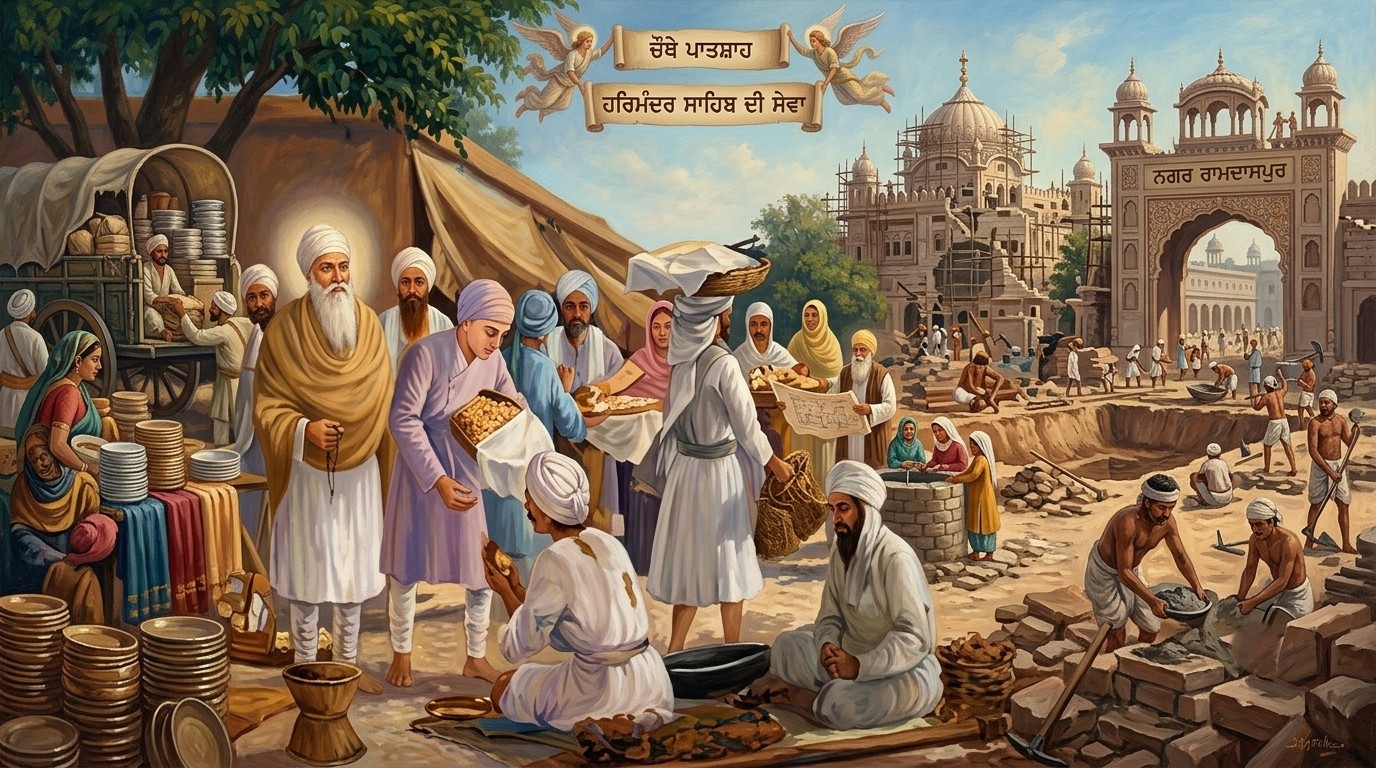
The Alchemical Transformation of Bhai Jetha: Guru Ram Das Ji's Ascent
In the study of early Sikh history, the transition of spiritual authority is not merely a chronicle of lineage or administrative succession, but a profound demonstration of spiritual alchemy. To understand the fourth manifestation of the divine light of Nanak, one must journey back to the dusty streets of Chuna Mandi in Lahore, where a young boy named Jetha faced the harsh winds of temporal existence. Born in 1534 to Hari Das and Mata Anup Devi, Jetha’s early life was marked by the acute pain of orphanhood and poverty. As a Sikh historian, one cannot help but observe the deliberate divine design in this suffering. The name "Jetha" translates to "the firstborn," yet his material circumstances were those of the last and the least. Selling boiled chickpeas, known as ghungnian, to earn a meager livelihood, Jetha’s early years were an crucible of humility. This was not a passive suffering, but an active, quiet endurance that laid the foundation for a spiritual capacity capable of carrying the weight of a growing, revolutionary socio-religious commonwealth.
The turning point in Jetha's life, and indeed in the trajectory of the Sikh faith, occurred when he traveled with a delegation of pilgrims to Goindval, the seat of the third Sikh Guru, Amar Das. Upon beholding Guru Amar Das, the historical accounts suggest an immediate, absolute surrender of Jetha’s ego. The young man did not merely seek a temporary spiritual sanctuary; he dissolved his entire identity into the service of the Guru. For years, Bhai Jetha engaged in the most strenuous physical labor. During the excavation of the Baoli Sahib—the historic stepwell at Goindval that served as a physical and spiritual center for the rejection of caste hierarchy—Bhai Jetha was seen carrying heavy baskets of earth on his head, covered in clay and sweat. This period of his life represents a critical historical theme in Sikhism: the elevation of manual labor (Kirt) and selfless service (Sewa) as the highest forms of worship, directly challenging the contemporary Brahmanical structures that segregated spiritual contemplation from physical toil.
The Crucible of Humility and the Platform Tests
Historical narratives, particularly those preserved in the Suraj Granth and early Janamsakhis, dwell extensively on the legendary trials Bhai Jetha underwent, which serve as a masterclass in the psychology of absolute surrender. The most famous of these is the test of the platforms. Guru Amar Das commanded his two sons-in-law, Bhai Rama and Bhai Jetha, to build clay platforms next to the Baoli Sahib so that he might sit and supervise the congregation. Upon inspecting Bhai Rama’s completed platform, the Guru declared it crooked and ordered it demolished and rebuilt. This process was repeated several times. Bhai Rama eventually grew frustrated, protesting that the Guru was old and perhaps his memory or sight was failing him, insisting his work was perfect. Conversely, when the Guru repeatedly rejected Bhai Jetha’s platforms, Jetha did not react with defensiveness or intellectual rationalization. Instead, he fell at the Guru’s feet, weeping, and declared that his own intellect was deficient, that he was an ignorant child, and begged for the wisdom to build it according to the Guru's true vision. This narrative illustrates the profound theological distinction between external obedience and the total annihilation of the ego (Haumai), which is the prerequisite for carrying the divine light of Nanak.
The marriage of Bhai Jetha to Bibi Bhani, the daughter of Guru Amar Das, further cemented his position within the inner sanctum of the early Sikh community. Bibi Bhani was herself a towering spiritual figure, characterized by an unparalleled devotion and an intuitive understanding of the divine mission. Together, their union was not a conventional alliance of convenience, but a merging of two souls entirely dedicated to the propagation of the Guru’s word. It was Bibi Bhani’s selfless service to her father, especially in his advanced age, that historically precipitated the consolidation of the Guruship. Yet, the historical record is clear: Bhai Jetha was not chosen as successor because of his marital alliance, but because he had successfully completed the grueling spiritual and ethical apprenticeship required to embody the divine light of the Guruship.
Founding Ramdaspur: The Socio-Economic Transformation of Punjab
Upon his formal coronation as Guru Ram Das in 1574, the fourth Guru initiated a monumental project that would forever alter the geopolitical, economic, and spiritual map of Punjab: the founding of the city of Ramdaspur, which would later be known as Amritsar. Recognizing the need for an autonomous space that could serve as a centralized hub for the rapidly expanding Sikh panth, Guru Ram Das selected a site surrounded by dense forests and natural pools. This was not merely an aesthetic choice, but a strategic masterstroke. The Guru invited traders, artisans, and craftsmen from fifty-two different guilds to settle in the new township, establishing the historic market known as Guru ka Bazar. This economic mobilization was revolutionary. Below is a historical breakdown of the key structural developments initiated by Guru Ram Das during this phase:
| Project / Institution | Historical Significance | Socio-Religious Impact |
| Excavation of Santokhsar & Amritsar Sarovars | Created permanent water reservoirs in an arid region. | Symbolized spiritual cleansing and egalitarian access to water, rejecting caste-based water segregation. |
| Establishment of Guru ka Bazar | Invited diverse professional guilds to settle in the new city. | Fostered economic independence and broke the caste monopoly on commerce and trade. |
| The Masand System | Organized a network of spiritual and administrative representatives. | Systematized the collection of tithes (Dasvandh) and disseminated Gurbani to distant congregations. |
The creation of Ramdaspur was a physical manifestation of the Sikh theological concept of Halemi Raj—a benign, just, and egalitarian regime where no one suffers or is subjected to fear. By creating a thriving economic center, Guru Ram Das ensured that the spiritual community was grounded in material reality, capable of sustaining itself without relying on state patronage or monastic isolation. The Masand system, a highly organized network of deputies, was established to collect the voluntary tithes of the faithful and teach the Guru's path to far-flung communities. This administrative apparatus transformed a localized spiritual movement into a highly organized, self-sustaining trans-regional commonwealth, setting the stage for the sovereign developments under his successors.
The Theology of Love, Longing, and the Lavan
As a poet and theologian, Guru Ram Das contributed 679 hymns to the Adi Granth, spanning thirty musical measures (Raags). His compositions are characterized by an intense, deeply emotional yearning for union with the Divine, marked by the metaphor of the bride longing for her beloved. This was not abstract mysticism, but a highly accessible theology designed to be sung in congregation, binding the community together through shared emotional and spiritual experiences. His verses carry a distinct musicality that resonates with the rhythms of folk traditions, making the profound truths of Gurmat accessible to the common peasant, artisan, and laborer.
Among his most significant liturgical contributions is the composition of the Lavan in Raag Suhi. These four circumambulations, or hymns of marriage, redefined the traditional Vedic marriage ceremony. Rather than viewing marriage as a social contract or a ritualistic union overseen by a priestly caste, Guru Ram Das cast the matrimonial bond as a profound metaphor for the soul’s journey toward union with the Creator. The four stages of the Lavan describe this spiritual evolution:
- The First Laav (Contemplation): The divine command to perform the duties of the householder’s life (Grahast), establishing a firm moral foundation through the contemplation of the Guru's word.
- The Second Laav (Detachment): The awakening of the mind to the pervasive presence of the Divine, leading to the eradication of fear and the dissolution of worldly illusions.
- The Third Laav (Divine Love): The sweet longing of the mind, where the heart is filled with the love of the Divine, and the soul is blessed with the company of the holy congregation (Sadh Sangat).
- The Fourth Laav (Union): The realization of the ultimate state of Sahaj (spiritual poise), where the soul-bride and the Divine Groom merge into an eternal, indistinguishable oneness.
Through this liturgy, Guru Ram Das elevated the status of the householder's life, firmly rejecting the asceticism and monastic renunciation that had dominated the religious landscape of India for centuries. He established that the highest spiritual heights could be achieved while living in the world, raising a family, and contributing to the socio-economic welfare of society.
The Succession and the Transference of the Divine Light
The final years of Guru Ram Das’s earthly journey were marked by the critical task of choosing a successor who could navigate the increasingly complex socio-political landscape of Mughal India. The Guru had three sons: Prithi Chand, Mahadev, and Arjan Dev. Prithi Chand, the eldest, possessed administrative acumen but was driven by worldly ambition, jealousy, and a sense of entitlement, viewing the Guruship as a hereditary property. Mahadev was a reclusive ascetic, lacking the engagement required to lead a dynamic socio-spiritual movement. It was the youngest, Arjan Dev, who inherited the deep devotion, humility, and poetic genius of his father.
The historical narrative of the letters sent by Arjan Dev from Lahore to his father in Ramdaspur reveals the depth of their spiritual connection. Denied access to his father by the scheming Prithi Chand, Arjan Dev wrote three letters of profound longing and devotion, which Prithi Chand intercepted. When the fourth letter finally reached Guru Ram Das, along with the recovered previous letters, the Guru recognized the absolute purity of Arjan Dev's soul. In 1581, Guru Ram Das formally passed the Guruship to Guru Arjan Dev, bypassing his eldest son and demonstrating once again that the divine light of Nanak is not a matter of biological birthright, but of spiritual alignment and total self-transcendence. Guru Ram Das merged his physical form back into the elements shortly thereafter, leaving behind a legacy that had transformed a growing spiritual community into a highly organized, culturally distinct, and economically vibrant nation.
Guru Amar Das Ji (1479–1574)
An orphan who sold boiled grains; his humility and tireless service at Goindwal earned him the Guruship.
- Role
- Son-in-law & Successor
- Group
- Family & Successors
- Period
- Guru Amar Das Ji (1479–1574)