Sikh Legends · Origins & Gurus · Guru Nanak Dev Ji · Guru Ram Das Ji · Guru Arjan Dev Ji · Guru Hargobind Sahib Ji
Bhai Kanhaiya Ji
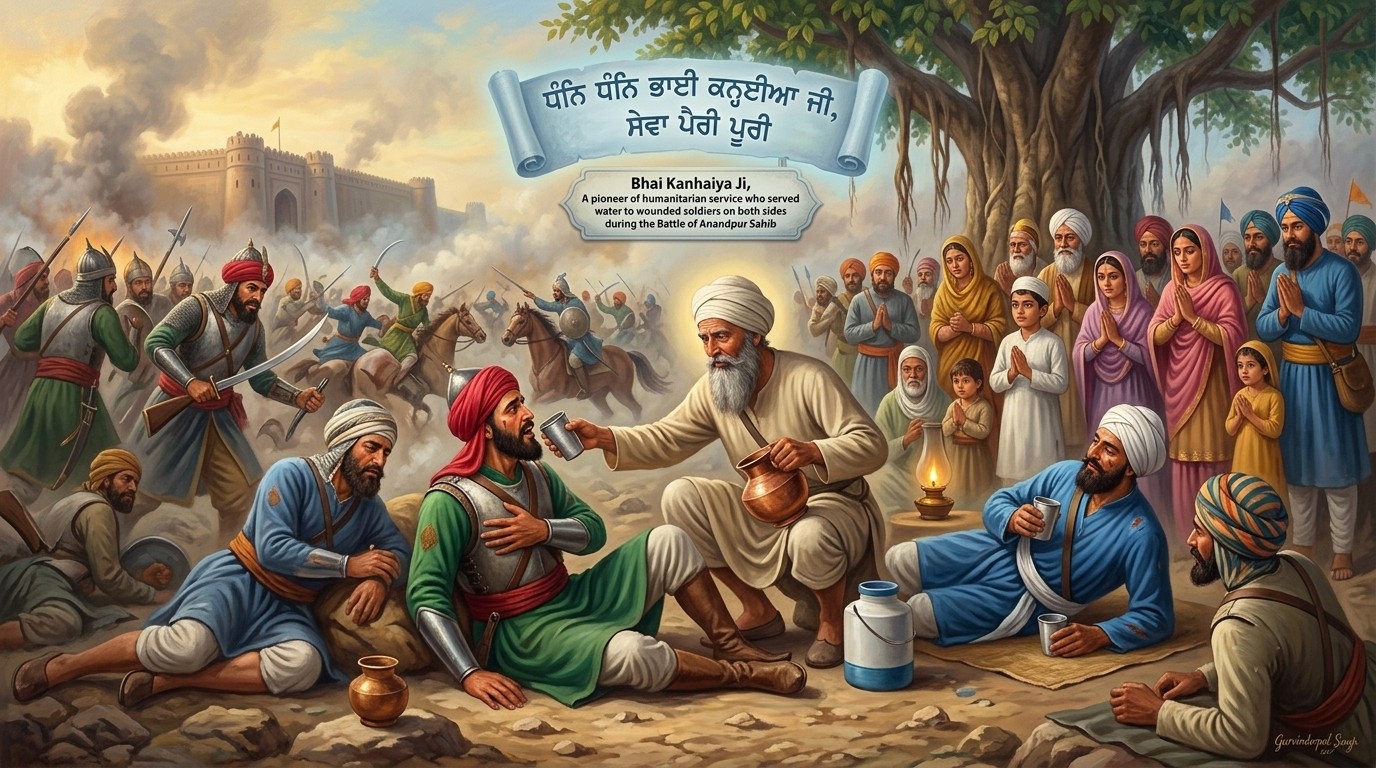
A pioneer of humanitarian service who served water to wounded soldiers on both sides (Sikhs and Mughals) during the Battle of Anandpur Sahib, seeing the divine light in everyone
The Legacy of Bhai Kanhaiya Ji at Anandpur Sahib
To traverse the annals of Sikh history is to encounter an extraordinary tapestry woven with threads of unmatched martyrdom, fierce warrior ethics, and an uncompromising commitment to justice. Yet, nestled within this epic saga of defensive warfare and spiritual sovereignty lies a chapter that represents the very pinnacle of human consciousness—the life and legacy of Bhai Kanhaiya Ji. Born in 1648 in the prosperous town of Sodhra, near Wazirabad in present-day Pakistan, Kanhaiya Ji was the son of a wealthy trader. From his earliest years, his spirit remained untouched by material abundance; he possessed a deeply contemplative mind that constantly sought the underlying unity of existence. His spiritual quest eventually led him to the court of the ninth master, Guru Tegh Bahadur Ji, whose teachings on detachment, compassion, and the illusory nature of worldly distinctions laid the foundation for Kanhaiya Ji’s lifelong mission of selfless service. Following the martyrdom of the ninth Guru, Kanhaiya Ji transitioned his devotion to the tenth master, Guru Gobind Singh Ji, establishing a dharamsala (a spiritual sanctuary) in the mountainous terrain of Anandpur, where he served travelers, seekers, and the destitute with equal fervor.
The dawn of the eighteenth century brought unparalleled geopolitical turbulence to the Shivalik hills. Anandpur Sahib, the "City of Bliss," became the epicentre of a brutal clash between two diametrically opposed worldviews: the imperialist expansionism of the Mughal Empire under Aurangzeb, allied with the conservative Hindu hill chieftains, and the newly minted Khalsa Panth, which stood for egalitarianism, spiritual freedom, and resistance against tyranny. In 1704, this tension culminated in the fateful Siege of Anandpur Sahib. It was a war characterized by extreme deprivation, where the fortress of the Guru was cut off from vital supplies for months. In this crucible of blood, iron, and dust, the physical suffering of the combatants reached unimaginable proportions. In the searing heat of the Punjab plains and the jagged, unforgiving terrain of the foothills, wounded soldiers from both camps lay scattered across the battlefields, gasping for breath, their mouths parched, slowly succumbing to dehydration and fatal wounds under the merciless sun.
The Battlefield as a Sanctuary of the Divine
It was against this grim backdrop of carnage and suffering that Bhai Kanhaiya Ji emerged not as a combatant wielding steel, but as a silent savior carrying a simple leather water pouch, known as a mashaq. Driven by an inner realization of the oneness of all creation, he walked fearlessly through the crossfire, stepping over the fallen, and knelt beside the dying. To the wounded Sikh warriors, he gave water to soothe their parched throats and sustain their resolve. But profoundly, to the fallen Mughal soldiers—the very adversaries who had sought to annihilate the Guru's household—he administered the exact same life-giving water, cradling their heads in his lap as they drank. In the eyes of Bhai Kanhaiya Ji, the battlefield was not a theater of hatred, but a temple of the Divine. He did not see uniforms, religions, castes, or alliances; he saw only the one divine spark, the Jyot, radiating from every face that looked up at him in agony. His actions were the physical embodiment of the Guru's teachings: that the same Creator resides within the oppressor and the oppressed alike.
This radical, unconditional altruism was not understood by all. To the battle-hardened Khalsa warriors, who had watched their brothers-in-arms fall to Mughal arrows and swords, Bhai Kanhaiya Ji’s actions appeared to be nothing short of high treason. They witnessed him reviving enemy soldiers who, once restored, could easily pick up their weapons and fight again. Filled with righteous indignation and grief, a delegation of Sikh soldiers approached Guru Gobind Singh Ji to lodge a formal complaint. They accused Bhai Kanhaiya Ji of aiding and abetting the enemy, arguing that his actions were undermining the defensive efforts of the Khalsa army and prolonging the bloody siege. The Guru, who possessed a profound understanding of spiritual depths, listened patiently to their grievances and summoned Bhai Kanhaiya Ji to the court to answer the charges of treason.
The Divine Confrontation and the Ointment of Mercy
When Bhai Kanhaiya Ji stood before Guru Gobind Singh Ji, the court was filled with an expectant silence. The Guru asked him directly if the allegations were true—had he indeed been serving water to the enemy soldiers who sought the destruction of the Khalsa? Bhai Kanhaiya Ji’s response remains one of the most sublime utterances in the history of global spirituality. With deep humility and eyes overflowing with tears of divine love, he replied: "My beloved Guru, since I have taken refuge at your holy feet, my eyes have lost the ability to distinguish between friend and foe. I did not see a Sikh, nor did I see a Mughal on that battlefield. Wherever my eyes wandered, I saw only you, my Master, crying out in thirst. I only poured water into the mouths of the thirsty, and in doing so, I was only serving you."
Upon hearing these words, the face of Guru Gobind Singh Ji lit up with an immense, radiant smile. Turning to his warriors, the Guru declared that Bhai Kanhaiya Ji had understood the inner core of the Sikh philosophy far better than anyone else in the assembly. The Guru did not merely dismiss the charges; he blessed Bhai Kanhaiya Ji and presented him with a container of healing ointment and bandages. The Guru instructed him: "Kanhaiya, from this day forward, do not merely serve water to the wounded. Apply this ointment to their wounds as well, and bandage their injuries. Go forth and heal all, regardless of who they are." With this divine mandate, the Guru formalized the first-ever humanitarian medical corps, centuries before the establishment of the modern Red Cross or the codification of the Geneva Conventions on the treatment of wounded soldiers.
Historical Parallel: The Precursor to Modern International Humanitarian Law
To fully appreciate the revolutionary nature of Bhai Kanhaiya Ji’s mission, one must contrast his actions with the historical development of modern humanitarian law. The Western world credits Henry Dunant, the founder of the International Committee of the Red Cross, with pioneering the concept of neutral medical aid for wounded soldiers after witnessing the horrors of the Battle of Solferino in 1859. Yet, more than 150 years prior to Dunant’s realization, the Sikh Panth, under the guidance of Guru Gobind Singh Ji and through the hands of Bhai Kanhaiya Ji, had already established this very principle of universal, neutral, and compassionate care in the midst of active warfare. Below is a comparative table highlighting the foundational principles of both frameworks:
| Feature | Bhai Kanhaiya Ji's Mission (1704) | The Geneva Convention / Red Cross (1864 onwards) |
| Foundational Catalyst | Spiritual realization of the Divine Light in all human beings, stemming from Sikh theology. | Secular humanitarian response to the horrific suffering observed on European battlefields. |
| Scope of Neutrality | Absolute and unconditional; applied dynamically in the heat of a religious and political siege. | Codified legal neutrality, subject to international treaties, military agreements, and state ratifications. |
| Spiritual Dimension | Service (Sewa) viewed as a direct path to spiritual liberation and the practical realization of God. | Primarily ethical and social service aimed at minimizing human suffering and upholding human rights. |
| Scope of Care | Included hydration (water), medical treatment (ointment/bandaging), and spiritual comfort. | Focused on medical triage, evacuation, shelter, and basic human rights protection for prisoners of war. |
The Sewa Panthi Legacy and its Modern Relevance
The path carved out by Bhai Kanhaiya Ji did not end with his earthly departure in 1718. He established a distinct lineage of selfless servants known as the Sewa Panthis (the Pathfinders of Service) or Addan Shahis, who dedicated their entire lives to the service of humanity. These spiritual nomads wore simple, unadorned clothing, remained celibate, and traveled from village to village, dug wells, opened schools, established dispensaries, and ran community kitchens (langar) without expecting any reward or recognition. They avoided political entanglements and focused solely on relieving human suffering, embodying the true spirit of Nishkam Sewa (selfless service). In a modern world fractured by deep sectarian divisions, escalating geopolitics, and humanitarian crises where medical neutrality is routinely violated, the philosophy of Bhai Kanhaiya Ji offers a powerful, healing alternative. It challenges us to look past the superficial outer garments of nationality, race, and creed, and to recognize the shared, sacred humanity that binds us all together as one global family.
Frequently Asked Questions (FAQs)
1. Who was Bhai Kanhaiya Ji?
Bhai Kanhaiya Ji (1648–1718) was a devoted disciple of the ninth Sikh Guru, Guru Tegh Bahadur Ji, and the tenth Sikh Guru, Guru Gobind Singh Ji. He is highly revered in Sikh history as a pioneer of humanitarian service, celebrated for his selfless act of serving water and medical aid to wounded soldiers from both the Sikh and Mughal armies during the Battle of Anandpur Sahib.
2. In which historical battle did Bhai Kanhaiya Ji serve water to both sides?
His legendary service took place during the Siege of Anandpur Sahib in 1704. This was a prolonged and intense battle where a coalition of Hindu hill Rajas and the Mughal imperial army laid siege to the fortress of Anandpur Sahib, which was defended by Guru Gobind Singh Ji and his Khalsa warriors.
3. Why did the Sikh soldiers complain about him to Guru Gobind Singh Ji?
The Sikh soldiers complained because they saw Bhai Kanhaiya Ji giving water to wounded Mughal soldiers. In the heat of battle, the soldiers viewed the Mughals as mortal enemies who were trying to destroy the Khalsa. They believed that reviving enemy combatants with water was an act of treason that helped the enemy recover and fight against the Sikhs once again.
4. What was Bhai Kanhaiya Ji’s famous response to the Guru’s inquiry?
When questioned by Guru Gobind Singh Ji, Bhai Kanhaiya Ji humbly explained: "My beloved Guru, since I have taken refuge at your feet, I do not see any difference between a Sikh and a Mughal. I only see you in every single person on the battlefield. I did not give water to the enemy; I gave water to you."
5. How did Guru Gobind Singh Ji react to Bhai Kanhaiya Ji’s explanation?
Guru Gobind Singh Ji was deeply pleased and overjoyed by his response. He confirmed that Bhai Kanhaiya Ji had truly understood the essence of the Sikh spiritual teachings. Rather than punishing him, the Guru blessed him, gave him a container of healing ointment and bandages, and instructed him to heal the wounds of all soldiers alongside giving them water.
6. What is the historical connection between Bhai Kanhaiya Ji and the Red Cross?
Bhai Kanhaiya Ji’s actions in 1704 established the principles of medical neutrality and humanitarian aid on the battlefield more than 150 years before Henry Dunant founded the International Committee of the Red Cross in 1863. He is widely recognized as the spiritual precursor to the modern Red Cross movement.
7. Who are the Sewa Panthis?
The Sewa Panthis (literally "the Travelers of Service") are a traditional Sikh order founded by Bhai Kanhaiya Ji. They are dedicated to selfless service (Nishkam Sewa), peace, and spiritual devotion. Historically, they traveled across regions establishing water wells, schools, and hospitals, carrying forward the mission of universal compassion.
8. What Sikh scriptures support the actions of Bhai Kanhaiya Ji?
His life is the practical application of the core principles found in the Sri Guru Granth Sahib Ji. Specifically, it embodies the shabad (hymn) by Guru Arjan Dev Ji: "Na ko bairi nahi bigana, sagal sang hum ko ban aayi" (None is my enemy, and no one is a stranger; I am friendly with all). It also aligns with Guru Gobind Singh Ji's declaration: "Manas ki jaat sabhe eke paihchanbo" (Recognize the entire human race as one).
9. Did Bhai Kanhaiya Ji participate in the fighting during the battles?
No, Bhai Kanhaiya Ji did not bear weapons or engage in combat. His duty, assigned by his spiritual inclination and approved by the Guru, was strictly humanitarian. He served as a peaceful, neutral caregiver, bringing life, relief, and comfort to those caught in the horrors of war.
10. Where is Bhai Kanhaiya Ji’s contribution commemorated today?
Bhai Kanhaiya Ji's legacy is celebrated globally by Sikhs and humanitarians alike. He is remembered in daily Sikh prayers and discourse as an icon of selfless service. Several institutions, charitable hospitals, and humanitarian organizations worldwide are named in his honor, and a memorial Gurdwara, Gurdwara Bhai Kanhaiya Ji, stands near Anandpur Sahib to mark the sacred ground where he carried out his legendary service.