Sikh Sakhis · Origins & Gurus · Guru Nanak Dev Ji
Bhai Lalo and Malik Bhago
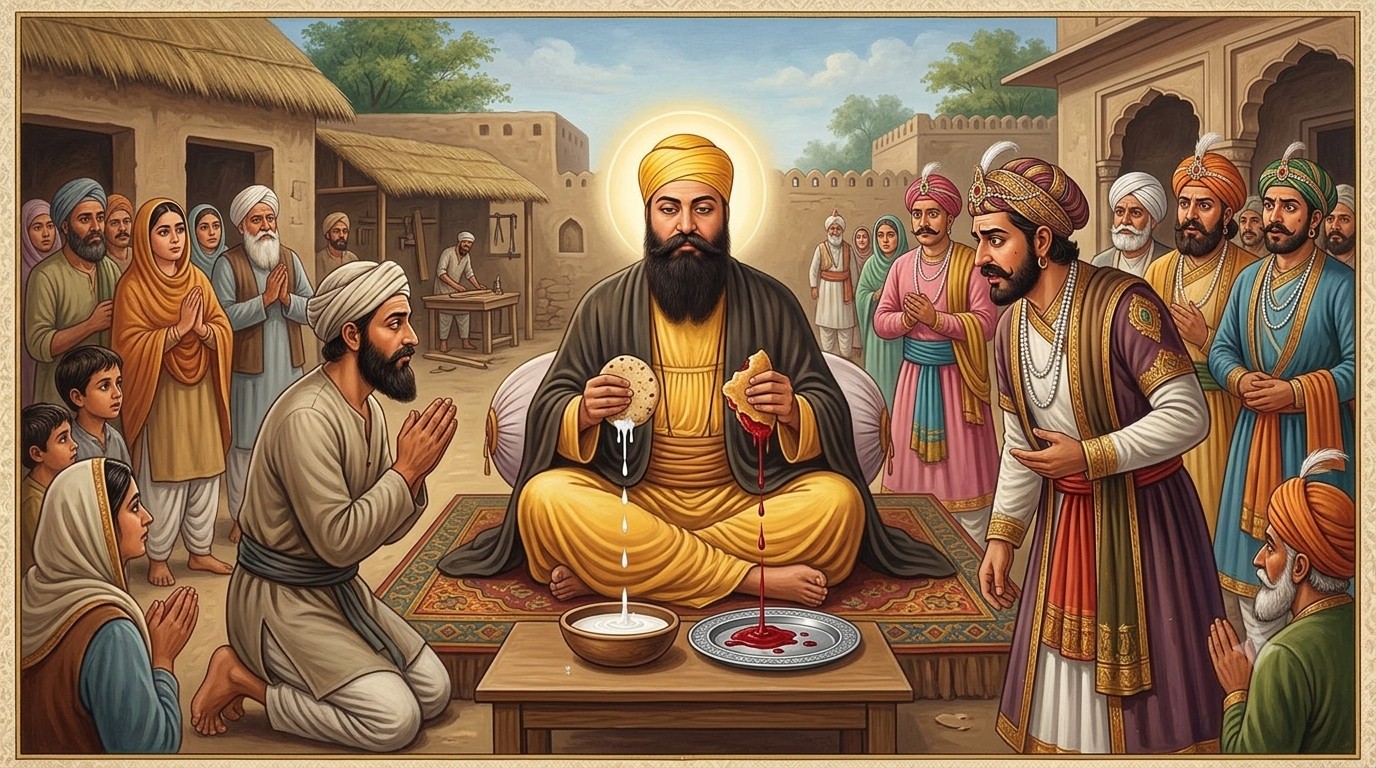
Nanak chose to stay with Lalo, a poor carpenter, instead of the wealthy official Malik Bhago. When challenged, Nanak squeezed Lalo’s coarse bread, and milk flowed out (honest labor); he squeezed Bhago’s rich food, and blood dripped out (exploitation). He taught that God resides in honest work.
The Radical Social Revolution of Saidpur: An Introduction to Bhai Lalo and Malik Bhago
In the early sixteenth century, the Indian subcontinent was caught in the grip of a dual oppression: the rigid, ritualistic hegemony of the Brahmanical caste hierarchy and the tyrannical, exploitative administrative machinery of the ruling Lodhi dynasty. It was into this fractured socio-political landscape that Guru Nanak Dev Ji, the founder of Sikhism, launched his radical spiritual campaign. During his first extensive travels, known in Sikh history as the first Udasi, the Guru, accompanied by his faithful companion Bhai Mardana, bypassed the grand regional centers of power and chose instead to visit the small town of Saidpur, modern-day Eminabad in Pakistan. This geographic choice was not accidental; it was a deliberate, subversive act designed to challenge the status quo. In Saidpur, the Guru bypassed the opulent estates of the wealthy elite and sought shelter in the humble, mud-walled dwelling of a low-caste carpenter named Bhai Lalo. This choice laid the foundation for one of the most profound theological and sociological lessons in human history, redefining the relationship between labor, spirituality, and human dignity.
For a Sikh historian, the encounter that unfolded in Saidpur between Guru Nanak, Bhai Lalo, and the corrupt local official Malik Bhago is not merely a quaint moral fable; it is the definitive manifesto of Sikh economics and social ethics. It marked the moment when the Guru practically demonstrated that spiritual enlightenment is inextricably linked to honest livelihood, a concept later formalized as Kirat Karni. By choosing the coarse, dry barley bread of an impoverished laborer over the luxurious, multi-course feast of an imperial tax collector, Guru Nanak shattered the ancient theological delusion that purity was determined by caste and ritual cleansings. Instead, he established a new spiritual paradigm: that true purity resides in the sweat of honest toil, while the wealth accumulated through exploitation is spiritually contaminated. The physical confrontation that ensued, and the miraculous visual demonstration of this truth, remains a towering beacon of inspiration for anyone fighting against systemic oppression and economic injustice today.
Bhai Lalo: The Exemplar of Kirat Karni and Spiritual Sovereignty
To fully appreciate the gravity of Guru Nanak’s choice, one must understand the social reality of Bhai Lalo. Historically, Lalo belonged to the Ghataura or Tarkhan (carpenter) caste, which placed him near the bottom of the oppressive Hindu caste pyramid, categorized as a Shudra. In the eyes of the contemporary socio-religious elite, even his shadow was considered polluting, and his food was deemed spiritually defiled. Yet, in his daily life, Bhai Lalo was the living embodiment of the highest spiritual ideals. He was a craftsman who spent his days carving wood, forging iron, and repairing tools for the local agrarian community, earning just enough to sustain his modest household. His labor was not merely a means of physical survival but a form of active meditation; with every strike of his hammer and pull of his saw, his mind remained attuned to the Divine Creator, practicing the primordial form of Naam Japna (meditation on the Divine Name).
When Guru Nanak arrived at Lalo's doorstep, he did not see a degraded, untouchable laborer; he saw a sovereign, self-actualized soul who lived in absolute harmony with the universe. The Guru’s decision to stay at Lalo's home for several days was a revolutionary reclamation of human worth. By sleeping on a simple straw mat and eating Lalo's dry, unrefined Kodre di Roti (coarse finger-millet bread), Guru Nanak declared that the home of an honest laborer is the true temple of God. This act of radical solidarity elevated Bhai Lalo from a marginalized outcaste to the first prominent leader of the nascent Sikh congregation, demonstrating that spiritual realization was accessible to all, completely independent of aristocratic birth or priestly initiation.
Malik Bhago: The Architecture of Exploitation and Ritualistic Piety
In stark contrast to the quiet, dignified existence of Bhai Lalo stood Malik Bhago, a high-caste Kshatriya Hindu who served as the chief administrative official and tax collector for Zalim Khan, the brutal Mughal governor of Saidpur. Malik Bhago represented the complicit administrative class that facilitated the ruthless extraction of wealth from the local peasantry to feed the imperial treasury in Delhi and enrich their own pockets. His wealth was built on the backs of the poor, accumulated through heavy taxation, forced labor, bribery, and the violent subjugation of the local population. To legitimize his ill-gotten wealth and project an image of supreme piety, Bhago organized a grand, ostentatious religious festival known as a Brahmbhojan, a sacrificial feast to which all holy men, sadhus, ascetics, and religious scholars of the region were invited.
In the socio-religious logic of medieval India, sponsoring such a feast was believed to cleanse a wealthy patron of all sins and earn immense spiritual merit (*punya*). It was a transaction where material wealth, regardless of how it was acquired, was converted into religious capital through the agency of the priestly class. When Malik Bhago learned that a renowned, holy dervish named Guru Nanak was staying in the town but had chosen to reside with a low-caste carpenter and ignore the grand feast, his pride was deeply wounded. To Bhago, the Guru's absence was not just a personal insult but a public challenge to the very social and religious hierarchy that validated his authority. He immediately dispatched his armed guards to summon Guru Nanak to his palace, demanding that the Guru explain his refusal to partake in the sanctified, luxurious food of the high-born.
The Confrontation: Squeezing the Essences of Labor and Loot
The confrontation that took place at Malik Bhago’s opulent courtyard is one of the most dramatic and highly charged episodes in Sikh history. Surrounded by the religious elite, priests, and local nobility, Malik Bhago arrogantly demanded to know why Guru Nanak preferred the coarse, dirty bread of a low-caste Shudra over the pure, delicious, butter-rich delicacies prepared by holy Brahmins at his feast. Guru Nanak, maintaining his characteristic serene composure, asked Bhai Lalo to bring a piece of his dry millet bread from his home. Simultaneously, the Guru ordered a portion of the rich, fried food from Bhago’s feast to be brought forward. Standing in the center of the court, before the astonished eyes of the gathered assembly, the Guru took Bhai Lalo’s dry, coarse bread in his right hand and Malik Bhago’s rich, ghee-dripping puri in his left.
With deliberate, profound gravity, Guru Nanak squeezed both hands. From Bhai Lalo's coarse, humble bread, there flowed a stream of pure, white, sweet milk. From Malik Bhago's rich, luxurious food, there dripped thick, dark, human blood. The visual shock of this miracle reverberated through the courtyard, silencing the arrogant officials and priests. The spiritual physics of the universe had been laid bare by the Guru's hands: the carpenter's bread, earned through honest physical labor, love, and devotion, was overflowing with the life-giving milk of purity and divine grace. The official’s feast, funded by the systematic starvation, extortion, and blood of the defenseless peasantry, was physically dripping with the blood of the exploited. Through this undeniable display, Guru Nanak showed that physical food carries the spiritual vibration of its acquisition, and no amount of ritual chanting or priestly blessings can wash away the blood of oppression from the wealth of a tyrant.
Sikhism's Decisive Critique of Exploitative Capitalism and Caste Hierarchy
The theological implications of the encounter between Bhai Lalo and Malik Bhago are revolutionary and form the core of the Sikh socio-economic model. First, it completely dismantled the traditional Brahmanical notion of Sutak (ritual impurity). In the orthodox view of the time, Bhai Lalo's home and food were intrinsically impure due to his caste. Guru Nanak inverted this logic entirely, declaring that the only real impurity is that of the mind and the means of livelihood. The Guru famously proclaimed in his compositions that "evil is the mind, evil the tongue, and evil the eyes that look upon another's wealth; the greatest impurity is the exploitation of others." By squeezing blood from Malik Bhago's food, the Guru demonstrated that the high-caste official was the one who was truly untouchable and spiritually defiled, while the low-caste carpenter was holy and pure.
Second, this Sakhi (historical narrative) establishes a profound critique of exploitative economic structures. In modern sociological terms, Guru Nanak was exposing the concept of surplus value extraction in its most raw, moral form. Malik Bhago’s wealth was accumulated through the systemic exploitation of the working class—the farmers, weavers, and carpenters of Saidpur. The Guru’s refusal to participate in the *Brahmbhojan* was a refusal to legitimize this exploitation. It sent a clear message to the ruling classes that charity funded by injustice has no place in the court of God. In Sikh theology, the act of giving to the poor, known as Dasvandh (tithing), is only valid if the wealth is earned through honest, righteous means. If the wealth is tainted by the blood of the poor, any act of charity performed with it is merely an exercise in ego and hypocrisy.
Historical Table of the Saidpur Encounter
To summarize the stark, structural contrasts between the two historical figures and the theological concepts they embody in Sikh historiography, we can examine the following table:
| Dimension | Bhai Lalo (The Saint-Laborer) | Malik Bhago (The Imperial Exploiter) |
| Social & Caste Status | Low-caste Shudra (Tarkhan/Carpenter); marginalized and deemed ritually impure by the elite. | High-caste Kshatriya; occupies a dominant, privileged position in the social hierarchy. |
| Source of Livelihood | Honest, physical craftsmanship (Kirat Karni); making and repairing tools for the public. | Extortion, high taxation, bribery, and systematic exploitation of the local peasantry. |
| Socio-Economic Philosophy | Sovereign self-reliance, sharing of humble resources, and living in complete economic honesty. | Imperial extraction, hoarding of wealth, and using ostentatious charity to mask structural violence. |
| The Miracle's Revelation | Squeezing his coarse Kodre di Roti yielded pure, sweet milk (life-giving grace of honest toil). | Squeezing his rich, fried delicacies yielded human blood (the life-force drained from the poor). |
| Sikh Spiritual Legacy | Appointed as the first regional representative of the Guru's path; epitomizes the ideal of the householder-saint. | Serves as the eternal warning against hypocrisy, spiritual corruption, and the exploitation of humanity. |
The Living Legacy: From Saidpur to the Modern World
The lessons of Bhai Lalo and Malik Bhago are not historical relics of the sixteenth century; they are highly relevant, urgent principles for the contemporary world. Today, as we grapple with global economic inequality, corporate exploitation, and the systemic devaluation of manual labor, Guru Nanak's voice echoes through the centuries, demanding a return to ethical economics. The modern equivalent of Malik Bhago can be seen in corporations and systems that maximize profits by underpaying workers, exploiting child labor, and destroying the environment, only to attempt to cleanse their public image through massive, tax-deductible philanthropic donations. Guru Nanak’s theological verdict remains unchanged: such philanthropy is dripping with the blood of the exploited, and true spirituality cannot be bought with the proceeds of injustice.
Conversely, the modern-day Bhai Lalos are the millions of underpaid workers, farmers, and laborers whose essential work sustains our societies, yet who are pushed to the margins of economic and social power. The Sikh Panth continues to honor this legacy through the institution of Langar (the free community kitchen), which was nurtured in the humble home of Bhai Lalo. In every Gurdwara across the world, people of all backgrounds, rich and poor, high-caste and low-caste, sit together on the floor to eat the same simple, blessed vegetarian food, demonstrating the absolute equality of humanity. By visiting historical sites like Gurdwara Bhai Lalo Di Khuhi in Eminabad, Sikhs renew their vow to stand with the oppressed, to earn their living through honest means, and to recognize that the Divine Light dwells most vibrantly in the simple, honest hearts of those who labor with love.
Frequently Asked Questions
1. Who was Bhai Lalo, and why did Guru Nanak Dev Ji choose to stay with him?
Bhai Lalo was an impoverished carpenter belonging to the low-caste Shudra community, living in the town of Saidpur (modern-day Eminabad, Pakistan). Guru Nanak Dev Ji chose to stay with him because Lalo was a highly spiritual, honest householder who earned his living through righteous physical labor (Kirat Karni) and lived in constant remembrance of God. The Guru wanted to demonstrate that spiritual purity has nothing to do with social status or wealth, and that God resides in the humble homes of those who work honestly and with love.
2. Who was Malik Bhago, and what did he represent?
Malik Bhago was a wealthy, high-caste Kshatriya Hindu who served as the chief government official and tax collector for the local Mughal governor in Saidpur. He represented the corrupt administrative class that amassed wealth by exploiting, over-taxing, and robbing the poor peasantry. He also represented ritualistic hypocrisy, believing that sponsoring grand religious feasts (Brahmbhojan) could wipe away his sins and buy spiritual salvation.
3. What was the significance of the "Kodre di Roti" that Bhai Lalo offered to Guru Nanak?
Kodra (finger-millet) is a coarse, cheap, and unrefined grain that was eaten only by the poorest segments of society in medieval Punjab. The "Kodre di Roti" offered by Bhai Lalo symbolized absolute humility, honest labor, and self-reliance. By eagerly eating this simple, coarse bread, Guru Nanak demonstrated that food earned through honest, hard work is far sweeter and spiritually superior to the finest delicacies obtained through exploitation or deceit.
4. What miracle did Guru Nanak perform during his encounter with Malik Bhago?
When challenged by Malik Bhago for refusing his grand feast, Guru Nanak took a piece of Bhai Lalo’s dry, coarse bread in one hand and a rich, fried delicacy from Malik Bhago’s feast in the other. When he squeezed both, pure white milk flowed out of Bhai Lalo’s bread, symbolizing the purity of honest labor. From Malik Bhago’s rich food, dark human blood dripped out, symbolizing that his wealth was built on the pain, suffering, and exploitation of the poor.
5. Is the squeezing of milk and blood a literal miracle, or should it be understood metaphorically?
In the Sikh tradition, this event is revered as a historical miracle that physically manifested a profound spiritual reality. Metaphorically and philosophically, it represents the absolute truth of human existence: that the energy and intent behind how we earn our livelihood directly impact our spiritual consciousness. Whether viewed as a literal physical miracle or a powerful metaphysical metaphor, the core lesson remains unchanged: honest work brings divine grace (milk), while exploitation brings spiritual corruption (blood).
6. How did Malik Bhago react when he saw blood dripping from his food?
Historical accounts record that Malik Bhago was utterly shocked, humiliated, and deeply shaken by the visual revelation of his exploitation. The sight of blood dripping from his food shattered his spiritual arrogance and forced him to confront the moral reality of his corrupt life. He fell at Guru Nanak's feet, begged for forgiveness, and promised to reform his ways, distribute his ill-gotten wealth to the needy, and live an honest life of service.
7. How does this Sakhi challenge the traditional Indian caste system?
The traditional Hindu caste system (Varna) dictated that a high-caste Hindu must never eat food prepared by or touched by a low-caste Shudra, as it was believed to cause spiritual pollution. Guru Nanak completely rejected this system by staying with Bhai Lalo, eating his food, and declaring that the low-caste carpenter was spiritually pure, while the high-caste official Malik Bhago was spiritually polluted. The story established that a person's worth is defined by their actions (Karma) and the honesty of their life, not by their birth.
8. What are the core pillars of Sikhism established through this narrative?
This narrative directly establishes two of the three foundational pillars of the Sikh faith: Kirat Karni (earning an honest, truthful living through physical and mental effort) and Wand Chhakna (sharing one's earnings with the needy). It teaches that true charity can only come from honest earnings, and that a life of devotion is incomplete without ethical, socially responsible economic practices.
9. What is the historical site that commemorates this encounter?
The historic town of Saidpur is now known as Eminabad, located in the Gujranwala District of Punjab, Pakistan. The site of Bhai Lalo's home, where Guru Nanak stayed, is marked by the historical shrine Gurdwara Bhai Lalo Di Khuhi (The Well of Bhai Lalo), which still contains the old well from which the Guru and Bhai Lalo drank. Another nearby site, Gurdwara Rori Sahib, commemorates the place where Guru Nanak sat on a bed of pebbles to meditate during his stay in Saidpur.
10. How does this story apply to modern global issues like capitalism and labor rights?
This story provides an incredibly modern critique of exploitative capitalism and labor abuse. It teaches us that corporate social responsibility and philanthropy are meaningless if they are funded by underpaying workers, exploiting natural resources, or perpetuating systemic economic violence. It calls for an economic system that respects the dignity of manual labor, pays fair wages, and ensures that the wealth of a society is built on ethical, transparent, and humane practices.
Nanak chose to stay with Lalo, a poor carpenter, instead of the wealthy official Malik Bhago. When challenged, Nanak squeezed Lalo’s coarse bread, and milk flowed out (honest labor); he squeezed Bhago’s rich food, and blood dripped out (exploitation). He taught that God resides in honest work.
- When
- 1500
- Where
- Eminabad