Panthic Personalities · Origins & Gurus · Guru Amar Das Ji
Bhai Lalo (of Dalla)
A prominent convert who helped establish the local Sangat in the Dalla region.
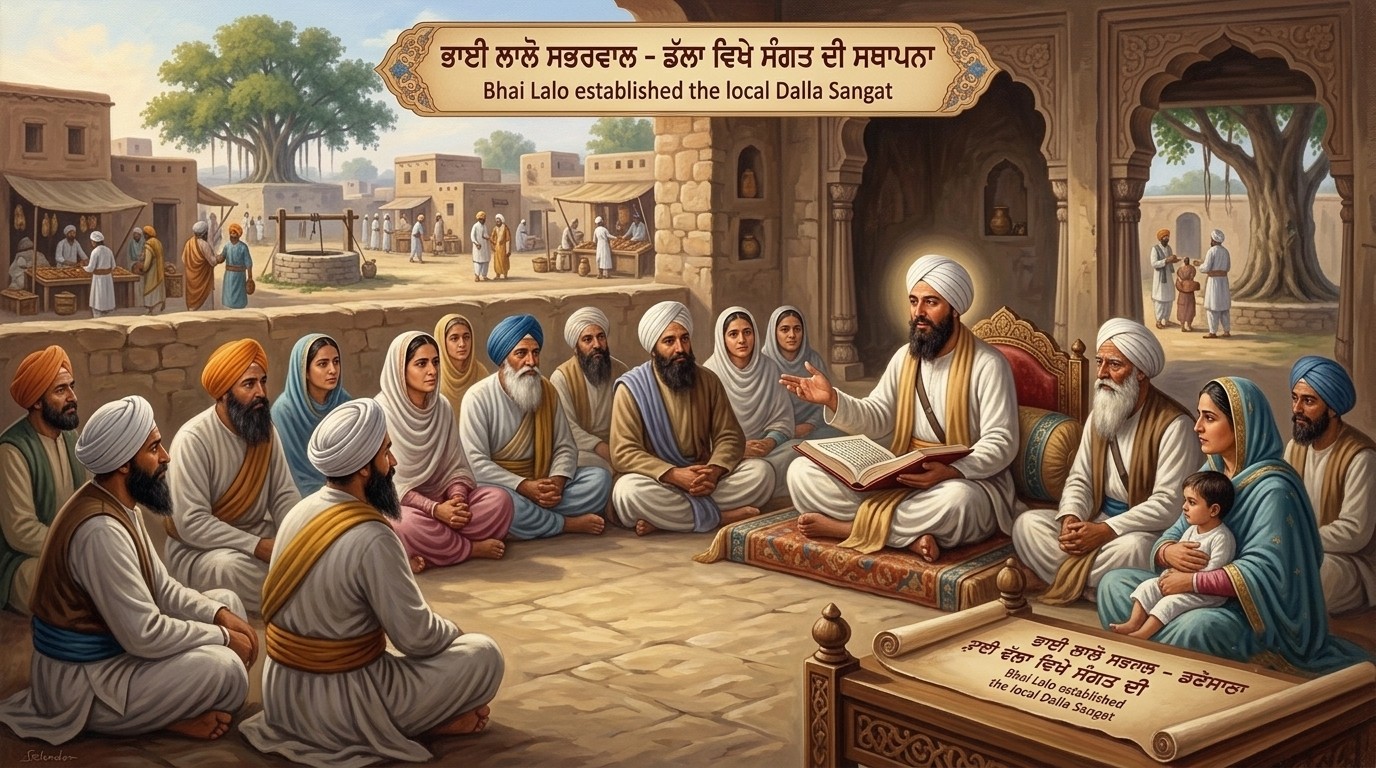
The Ruby of Dalla: Bhai Lalo Sabharval and the Territorial Sovereignization of the Early Sikh Panth
To examine the expansion of the early Sikh movement during the pontificate of Guru Amar Das Ji (1479–1574) is to observe a masterclass in organic institutionalization. While the Mughal state under Akbar was centralizing its authority through the military-bureaucratic Mansabdari system, the third Sikh Master was quietly designing an alternative, spiritual-democratic network of self-governing congregations known as the Manjis (spiritual seats). This administrative revolution was not merely about geographical outreach; it was about cultivating local, self-sustaining centers of divine sovereignty that could withstand the socio-political pressures of medieval India. At the heart of this regional consolidation stood the historical village of Dalla, located in the fertile Doaba region of Punjab. While history often remembers Bhai Lalo the carpenter of Eminabad from Guru Nanak Dev Ji’s travels, the Sikh chronicles preserve the equally monumental legacy of another Bhai Lalo—Bhai Lalo Sabharval of Dalla. A wealthy banker’s son who surrendered his material privilege to become an apostle of the soil, Bhai Lalo of Dalla emerged as one of the most trusted lieutenants of the Gurus, transforming his native region into an impregnable fortress of the early Sikh faith.
The spiritual landscape of sixteenth-century Punjab was highly fragmented, dominated by ascetic sects like the Udasis, the ritualistic orthodoxy of Brahmanical institutions, and the localized political dominance of feudal landlords. For a mercantile family of the Sabharval Khatri clan in Dalla, life was defined by the strict maintenance of caste boundaries, economic accumulation, and adherence to safe, conventional religious practices. Bhai Lalo inherited a vast fortune upon his father's passing and succeeded in expanding his banking business through diligent trade and financial acumen. Yet, despite his worldly success and reputation for localized charity, Lalo experienced a profound inner void. The ritualistic offerings and pilgrimages prescribed by the traditional clergy failed to quench his thirst for existential truth. This restlessness persisted until he crossed paths with Bhai Paro Julka, a legendary Gursikh from his own village who had already experienced the transformative grace of the second and third Gurus. Bhai Paro, known in Sikh history as the 'Paramhans' (the supreme swan of spiritual discrimination), became the catalyst for Lalo's radical departure from his ancestral lifestyle.
The Goindwal Confluence: Transmuting Stone into Ruby
The turning point in Bhai Lalo’s life occurred when he accompanied Bhai Paro on one of the latter’s regular pilgrimages to Goindwal Sahib, the thriving spiritual headquarters of Guru Amar Das Ji. At Goindwal, Lalo did not find a quietist monastery of detached ascetics; instead, he witnessed a bustling, egalitarian commonwealth centered around the Baoli Sahib (sacred stepwell) and the Guru’s Langar. Here, the rigid hierarchies of his banking world were systematically inverted. To gain an audience with the Guru, the wealthy banker had to sit on the floor of the Langar hall side-by-side with outcasts, peasants, and manual laborers, partaking in the same simple vegetarian fare. This radical socialization dismantled Lalo's residual caste pride before he even stood in the Guru’s physical presence.
When Bhai Lalo was finally presented to Guru Amar Das Ji, the Master looked deep into his consciousness and remarked on his name. In Punjabi, Lal translates to a precious ruby, while also signifying the deep red color associated with spiritual intoxication. The Guru famously proclaimed, "Lalu har rang rangia gaya"—a multi-layered spiritual pun meaning both "Lalo is completely imbued with the love of the Divine" and "The ruby now glows with the ultimate, eternal color." This was not merely a complimentary statement; it was an ontological transformation. By placing his hand upon Lalo's forehead, the Guru awakened his latent spiritual consciousness, transmuting his worldly mercantile focus into a profound commitment to the Shabad (the divine Word). Bhai Lalo did not renounce his wealth or abandon his family; instead, he revolutionized his relationship with his resources, viewing them no longer as personal possessions but as a sacred trust to be deployed for the upliftment of humanity.
The Spiritual Relay: The Mechanics of the Dalla Sangat
Returning to Dalla, Bhai Lalo did not rest in passive contemplation. He understood that the radical equality taught at Goindwal had to be localized and institutionalized if it were to survive. Alongside Bhai Paro, he began organizing the local Sangat (congregation) of Dalla. What distinguished Bhai Lalo's missionary methodology was his highly structured "spiritual relay" system. He committed to visiting Guru Amar Das Ji at Goindwal Sahib on the first day of every lunar month (Sangrand). However, he refused to travel alone. Every month, he would persuade one or two seekers, skeptics, or local residents from Dalla and its surrounding villages to accompany him to the Guru's court.
Upon completing their spiritual recharge at Goindwal, Bhai Lalo would return to Dalla, but he would leave his travel companions there for a longer period of immersion, or he would bring them back as fully initiated Gursikhs. In their place, he would select a new group of individuals to accompany him on his next monthly journey. This continuous, cyclical movement of people between the spiritual epicenter of Goindwal and the regional hub of Dalla created a highly dynamic network of transmission. The dusty roads of Doaba became highways of spiritual transformation. Through this relentless grassroots mobilization, the Dalla Sangat rapidly expanded, drawing in diverse demographic groups—from wealthy traders to marginalized peasants—shattering localized communal divisions and establishing Dalla as a primary administrative base for the expanding Panth.
The Manji Commission: Sovereign Preaching and Decentralized Governance
As the number of seekers swelled, Guru Amar Das Ji realized that a centralized leadership structure at Goindwal alone could not adequately shepherd a trans-regional movement. To address this challenge, the Guru formally established the Manji system, appointing twenty-two of his most spiritually realized and organizationally competent disciples to serve as regional governors of the faith. Bhai Lalo Sabharval was naturally selected as one of the primary leaders of this system, formally invested with the authority of a Manji-holder over the Dalla region. The term Manji refers to a low wooden cot upon which the missionary sat to preach, symbolizing the delegated spiritual and temporal authority of the Guru himself.
The responsibilities of Bhai Lalo as a Manji-holder were extensive and revolutionary for the medieval period:
- Theological Instruction: He was empowered to interpret the compositions of Guru Nanak, Guru Angad, and Guru Amar Das, conducting daily congregations, singing Kirtan, and teaching the Gurmukhi script to break the monopoly of the priestly class over spiritual literacy.
- Initiation of Seekers: He had the authority to formally initiate new seekers into the Sikh fold through the ceremony of Charan Amrit (foot-touching nectar, which was the initiation method of the early Gurus), expanding the borders of the parallel spiritual commonwealth.
- Financial Administration (Dasvandh): He collected and managed the voluntary communal tithes and offerings from the local congregations, ensuring these resources were transparently utilized for local welfare projects, traveler lodgings, and the maintenance of the free kitchen.
- Social Dispute Resolution: Operating from his Manji, Bhai Lalo acted as a sovereign mediator, resolving civil and communal disputes among his congregation, thereby reducing their dependence on the corrupt feudal courts of the Lodhi and Mughal administrations.
Socio-Spiritual Paradigms: The Householder vs. The Ascetic
To fully grasp the socio-theological brilliance of Bhai Lalo's missionary work under the Manji system, it is valuable to compare the early Sikh structural design with contemporary medieval religious pathways:
| Socio-Spiritual Dimension | The Sikh Manji System (e.g., Bhai Lalo of Dalla) | The Udasi Sect (Siri Chand's Lineage) | The Natha Jogi Monastic Order | Traditional Brahmanical Priesthood |
| Socio-Economic Model | Active Householder (Gristi): Integration of honest labor (Kirat Karni), family life, and active trade with spiritual leadership. | Ascetic Renunciation: Withdrawal from family life, vow of celibacy, and reliance on alms or monastic properties. | Monastic Isolation: Physical withdrawal to mountain retreats or forest ashrams; rejection of societal obligations. | Hereditary Clergy: Reliance on ritual fees, royal land grants, and hereditary privilege without physical labor. |
| Social Structure & Inclusivity | Radical Egalitarianism: Complete rejection of caste and gender barriers; open to all classes who sit together in Langar. | Focus on Piety: Open to all but maintained a highly ascetic, specialized inner circle that separated itself from the masses. | Esoteric Hierarchies: Access restricted to initiated disciples who mastered complex physical and psychological yogic disciplines. | Rigid Caste Stratification: Preservation of the Varna system; strict exclusion of Shudras and outcasts from scriptural study. |
| Geographical & Civil Engagement | Decentralized Communes: Establishment of local Sangats deeply integrated into the local agrarian and mercantile economy. | Nomadic Wandering: Preachers traveled extensively but did not establish local socio-economic centers of governance. | Isolated Monasteries (Mathas): Center of mystical practices, largely detached from the day-to-day struggles of the local populace. | Temple Centers: Heavily centralized around urban pilgrimage sites, maintaining the status quo of local rulers. |
The Legacy of Healing and the Sacred Geography of Dalla
Sikh historical chronicles, such as Sarup Das Bhalla's Mahima Prakash, frequently attribute remarkable healing powers to Bhai Lalo of Dalla. While modern rationalists might view these accounts symbolically, they reflect a deeper historical reality: Bhai Lalo's home in Dalla was not merely a preaching center, but a sanctuary for the physically destitute, the sick, and the socially ostracized. In an era when disease was often viewed as a divine curse and those suffering from chronic illnesses were cast out of villages due to fear of contamination, Bhai Lalo practiced a theology of radical empathy. He used his wealth to buy medicines, personally tended to the wounds of the sick, and integrated them into the warm embrace of the Dalla Sangat. His healing was holistic—restoring both physical health and social dignity through the power of the Shabad and selfless service (Sewa).
The spiritual foundations laid by Bhai Lalo and Bhai Paro turned Dalla into a vibrant spiritual nursery for generations to come. The historical importance of the village is highlighted by the fact that when the fifth Master, Guru Arjan Dev Ji, sought a suitable bride for his son, the future sixth Master Guru Hargobind Sahib Ji, he turned to the noble Gursikh families of Dalla. It was here that the historic wedding of Guru Hargobind Ji and Mata Damodari Ji (the daughter of Bhai Narain Das and granddaughter of Bhai Paro Julka) was celebrated in 1604. To accommodate the massive wedding procession, which included legendary figures like Baba Buddha Ji, Bhai Gurdas Ji, and Baba Bidhi Chand Ji, the Guru established Gurdwara Sri Vivah Asthan Mata Damodari. Furthermore, to provide a sustainable water source for the growing local community, Guru Arjan Dev Ji personally supervised the digging of a sacred Baoli (stepwell) in Dalla, commemorated today by Gurdwara Sri Baoli Sahib. The presence of these monuments, alongside Gurdwara Bhai Lalu Ji which houses his historical memorial (Samadh), stands as a physical testament to the golden era of spiritual and temporal empowerment initiated by a single banker’s son who dared to become a ruby of the Guru’s court.
Frequently Asked Questions (FAQs) About Bhai Lalo of Dalla
1. Who was Bhai Lalo of Dalla, and how is he different from the Bhai Lalo mentioned in Guru Nanak's history?
Bhai Lalo of Dalla was a wealthy Sabharval Khatri banker's son from the village of Dalla (Kapurthala district) who lived during the times of Guru Angad Dev Ji and Guru Amar Das Ji. He is a completely different historical figure from the famous Bhai Lalo of Eminabad (modern-day Pakistan), who was a poor carpenter belonging to the Ghataura Ramgarhia clan and was a contemporary of Guru Nanak Dev Ji. While the carpenter Bhai Lalo represents honest manual labor (Kirat), Bhai Lalo of Dalla represents the transformation of material wealth and mercantile power into selfless communal service and regional leadership.
2. What is the historical origin and meaning of the name "Lalo" in his spiritual journey?
The name "Lalo" or "Lalu" is derived from the word Lal, which means a highly polished red ruby, and metaphorically represents spiritual intoxication and divine love. When Bhai Lalo of Dalla first visited Guru Amar Das Ji at Goindwal Sahib, the Guru utilized his name to deliver a profound blessing: "Lalu har rang rangia gaya" (Lalo has been completely dyed in the divine color of God's love). This play on words signified that Bhai Lalo had transitioned from valuing physical, material rubies to becoming a spiritual ruby himself, radiating the light of the Shabad to his entire community.
3. How did Bhai Lalo first come into contact with the Sikh Gurus?
Bhai Lalo's introduction to Sikhism came through his fellow villager, Bhai Paro Julka. Bhai Paro was already an exceptionally devoted disciple of Guru Angad Dev Ji and Guru Amar Das Ji, renowned for his high spiritual state and affectionately referred to as 'Paramhans' by the congregation. Seeing the profound peace, humility, and radiant joy in Bhai Paro's life, Bhai Lalo was inspired to accompany him on his monthly journey to Goindwal Sahib, where he met Guru Amar Das Ji and underwent a life-changing spiritual conversion.
4. What was the "spiritual relay" system that Bhai Lalo initiated?
The spiritual relay was an innovative grassroots missionary strategy developed by Bhai Lalo. He committed to visiting Goindwal Sahib on the first day of every lunar month (Sangrand). Each time he traveled, he would bring a new group of seekers, skeptical neighbors, or curious villagers from Dalla. He would introduce them to the Guru and the egalitarian practice of Langar. When he returned to Dalla, he would leave some of these individuals at Goindwal for further immersion, or bring them back to Dalla as active missionaries, while preparing a fresh group of people for his next monthly trip. This maintained a continuous, dynamic flow of divine wisdom between the Guru’s court and the Dalla region.
5. Why was Bhai Lalo appointed as a Manji-holder, and what were his responsibilities?
Guru Amar Das Ji established the Manji system (twenty-two provincial seats of authority) to manage the rapidly expanding Sikh population and decentralize administrative and spiritual leadership. Due to Bhai Lalo’s deep theological understanding, administrative capacity, and exceptional humility, the Guru appointed him to lead the Manji of the Dalla region. His responsibilities included preaching Gurmat theology, teaching the Gurmukhi script, organizing local community kitchens (Langar), initiating new seekers, collecting the communal tithe (Dasvandh) for central welfare projects, and resolving local disputes.
6. What is the significance of the village of Dalla in Sikh history?
Dalla is a highly historic village in the Kapurthala district of Punjab. It served as a major regional headquarters for the early Sikh movement. It is the birthplace of Bhai Paro Julka and Bhai Lalo Sabharval, and it hosted seventy-two prominent Gursikhs whose names are recorded in classical texts like the Mahima Prakash. Dalla is also the location where Guru Arjan Dev Ji brought the wedding procession of his son, the future Guru Hargobind Sahib Ji, to marry Mata Damodari Ji. This event brought together legendary Sikh figures including Baba Buddha Ji, Bhai Gurdas Ji, and Baba Bidhi Chand Ji in the village.
7. How did Bhai Lalo utilize his immense personal wealth after converting to Sikhism?
Unlike traditional Indian ascetics who believed that spiritual progress required the total renunciation of material wealth, Bhai Lalo practiced the Sikh concept of being a householder (Gristi). He did not abandon his banking business; instead, he sanctified it. He used his substantial financial resources to establish and maintain a massive, free community kitchen (Langar) in Dalla, fund local infrastructure, build lodgings for travelers, and provide medical care and food for the poor, sick, and socially marginalized. He proved that wealth, when earned honestly and shared selflessly (Vand Chhako), is a powerful tool for social liberation.
8. Why does Sikh tradition refer to Bhai Lalo as a "healer"?
Sikh historical chronicles attribute miraculous healing properties to Bhai Lalo, recording that many sick and diseased individuals were cured through his blessings. Historically, this points to the fact that Bhai Lalo established a comprehensive system of social care and physical relief in Dalla. During an era when chronic illnesses like leprosy or tuberculosis led to complete social banishment, Bhai Lalo personally welcomed these outcasts, tended to their physical ailments with medicines purchased from his wealth, and restored their human dignity by integrating them into the egalitarian Sikh Sangat.
9. How does Bhai Lalo’s lifestyle illustrate the Sikh concept of "Gristi Jeevan" (the householder’s path)?
Sikhism rejects the traditional dichotomy between the worldly householder and the spiritual ascetic. Bhai Lalo’s life is a perfect embodiment of this synthesis. He did not retreat to the jungles, practice extreme self-mortification, or take vows of celibacy. He remained a devoted husband, a caring father, and a successful banker. By keeping his consciousness anchored in Naam Simran (meditation on the Divine Name) while actively participating in the socio-economic life of Dalla, he demonstrated that one can achieve the highest state of spiritual liberation (Brahm Gyan) while living actively in the world.
10. What Gurdwaras exist in Dalla today to commemorate this era?
Dalla is home to three major historical Gurdwaras that preserve the legacy of this golden era:
- Gurdwara Bhai Lalu Ji: Built in memory of Bhai Lalo Sabharval, housing his historical memorial (Samadh) and commemorating his spiritual ministry and healing works.
- Gurdwara Sri Vivah Asthan Mata Damodari Ji: Marking the exact spot where the marriage ceremony of Guru Hargobind Sahib Ji and Mata Damodari Ji took place in 1604.
- Gurdwara Sri Baoli Sahib Dalla: Commemorating the sacred stepwell dug under the personal supervision of Guru Arjan Dev Ji and managed by Bhai Shalo Ji to provide clean water to the local Sangat.
Guru Amar Das Ji (1479–1574)
A prominent convert who helped establish the local Sangat in the Dalla region.
- Role
- Village Leader
- Group
- Institutional Leaders (Manjis)
- Period
- Guru Amar Das Ji (1479–1574)