Gurus and Bhagats, Bani Contributors · Origins & Gurus · Guru Nanak Dev Ji
Bhai Mardana
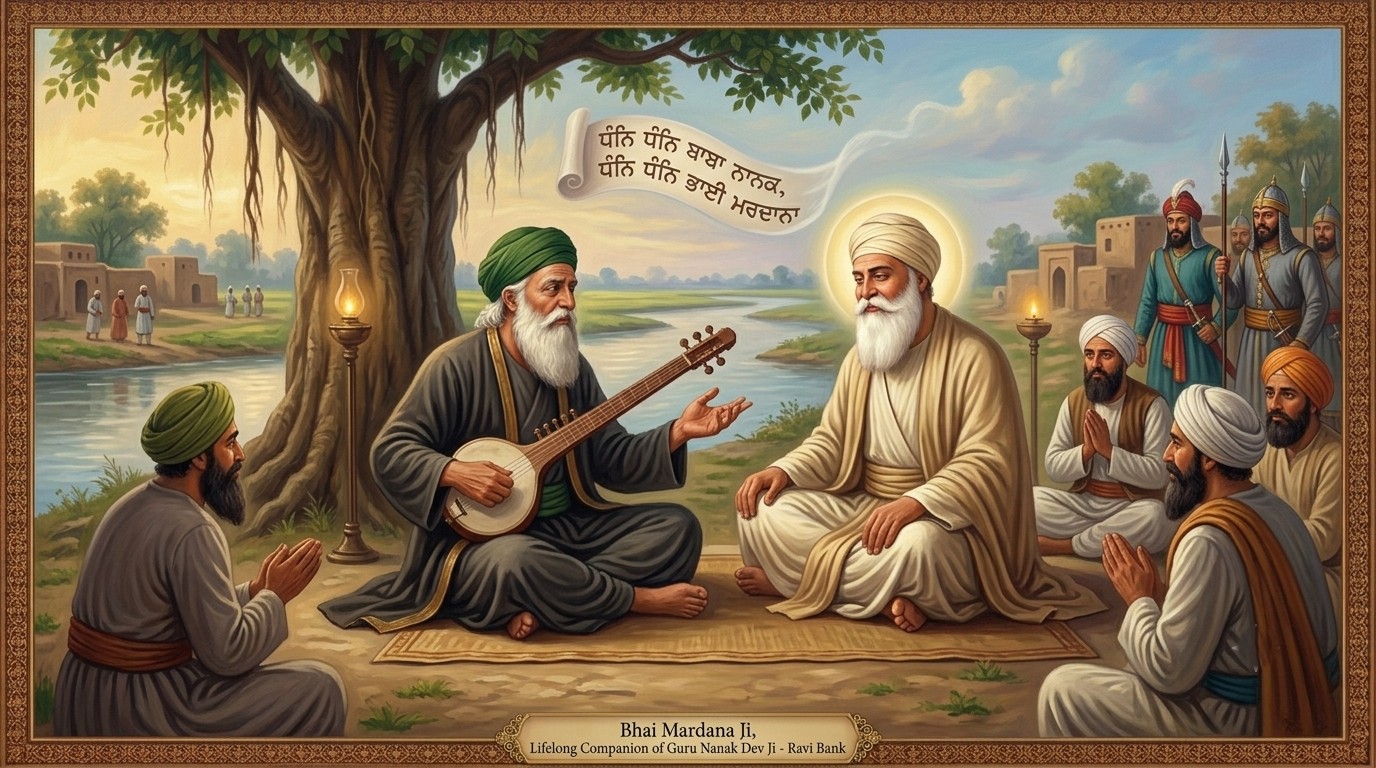
Lifelong companion of Guru Nanak Dev Ji; played the Rabab.
Sloks: 3
The Shadow of the Sun: The Cinematic Journey of Bhai Mardana Ji, the First RababiThe night air in the deserts of Mesopotamia is bone-chilling, yet the small fire crackling between two figures offers a warmth that is more than physical. One man, wrapped in a simple robe, sits in a meditative trance. Beside him, an elderly companion cradles a wooden instrument—the Rabab—as if it were a fragile child. As his fingers pluck the gut strings, a haunting, resonant melody rises to meet the stars. There is no audience here but the shifting sands and the Infinite. This is the world of Bhai Mardana Ji: the man who walked fifty-four years in the shadow of the Sun, transforming the "pale prose" of human existence into the "divine poetry" of the soul.
The Historical Background of 15th-Century Punjab
The Punjab of the late 1400s was a land of profound paradox. It was the gateway to India, a fertile plain caught between the fading embers of the Lodhi Sultanate and the rising tide of Mughal ambition. Socially, it was a landscape fractured by rigid caste hierarchies and religious animosity. The common man was caught between the ritualistic dry-rot of the Brahminical order and the occasional fanaticism of the ruling elite. It was into this atmosphere of spiritual yearning and social darkness that two boys were born in the village of Rai Bhoi di Talwandi—one a Khatri destined to be the Guru, and the other a Mirasi destined to be his voice.
Birth and Early Life: From "Mar-Jana" to "Mardana"
Bhai Mardana Ji was born in 1459, a decade before Guru Nanak Dev Ji, into the Muslim Mirasi community. His heritage was that of the Miras—the custodians of oral history and music. Yet, his birth was shrouded in tragedy. His mother, Mai Lakho, had seen six children perish in infancy. When the seventh child arrived, she named him "Mar-Jana" (the one who is about to die) out of sheer desperation.
The legend tells of a young Nanak visiting the grieving family and declaring that this child would not die. He renamed the boy Mardana—a name that meant "the manly one" or "the warrior," but in the Guru’s mouth, it carried a spiritual assurance: "Marda-Na" (the one who does not die). Thus, the bond was sealed before they could even articulate its depth.
The First Meeting and the Divine Call
Though they grew up in the same village, their professional journey began in Sultanpur Lodi. While Nanak worked in the government storehouse (Modikhana), Mardana was sent by Nanak’s father, Mehta Kalu, to bring news of his son. When they met, Guru Nanak saw not just a childhood friend, but a spiritual vessel. He told Mardana, "If you become my companion and add the words of God to your music, I can give you liberation in this world and the next."
Mardana, ever the pragmatist, initially hesitated. He had a wife, Bibi Rakhi, and two sons, Shahzada and Rajada, to support. He asked who would sustain them. The Guru’s answer was a lesson in total surrender: "God, who sustains the whole world, will also sustain your family."
The Spiritual Meaning of Rabab and Kirtan
Before the first Udasi (missionary journey), the duo needed a voice. This voice came in the form of the Firandia Rabab. Guru Nanak’s sister, Bebe Nanaki, gifted seven rupees to Mardana to purchase a specially crafted Rabab from a carpenter-musician named Bhai Firanda.
This instrument was unlike any other. It was approximately three feet long, carved from Tunn wood, with a hollow base covered in animal skin to produce a sound that was "mellow yet piercing." It was designed to be the "paintbrush of the soul." Whenever the Word (Shabad) descended upon Guru Nanak, he would exclaim, "Mardaneya! Play the Rabab; the Word is coming!" This established the foundation of Kirtan: the marriage of divine wisdom and musical melody.
The Great Udasis: Travels Through Empires and Wilds
For 28 years, Bhai Mardana Ji was the Guru's shadow. Together, they walked thousands of miles, crossing the burning deserts of Arabia, the snowy peaks of Tibet, and the dense jungles of Assam.
Significant Miracles and Encounters
- The Transformation of Sajjan Thug: In Multan, they encountered a man who built temples and mosques to lure and kill travelers. Through the sound of the Rabab and a Shabad about "bright bronze that stains the hand," Sajjan was transformed from a murderer into a saint, establishing the first Sikh Dharamsal.
- The Magic of Kamrup: In the land of sorcery (Assam), Mardana was reportedly "transformed into a ram" by Queen Noorshah’s magic after wandering off for food. The Guru didn't use counter-magic; he used the Name of God to break the spell of ego and illusion.
- Panja Sahib and Wali Kandhari: Thirsty in the heat of Hasan Abdal, Mardana was sent thrice to a proud Sufi pir, Wali Kandhari, for water. Denied each time, the Guru uncovered a spring at his own feet, causing the Pir’s well to dry up. In a rage, the Pir rolled a rock down the hill, which the Guru stopped with his hand, leaving the palm print (Panja) that remains a shrine today.
Personality, Humor, and Humanity
Bhai Mardana Ji is perhaps the most "human" figure in Sikh history. While the Guru represents the Infinite, Mardana represents the Seeker. The Janamsakhis (life stories) are filled with his honest questions about hunger, fatigue, and fear.
In one famous anecdote, after being treated poorly by one village and warmly by another, Guru Nanak "blessed" the rude village to "continue to stay" and "blessed" the kind village to "scatter." Mardana was outraged by this apparent injustice until the Guru explained: "The good people must scatter so they can spread their fragrance to the world, while the bad should stay contained in one place." Mardana’s role was to be the catalyst for these deep philosophical insights.
Final Days and Passing: Two Traditions
There are two primary accounts of Bhai Mardana Ji’s final journey:
- Baghdad/Afghanistan: Some records state he passed away in 1520 on the banks of the River Kurram in Afghanistan or during their stay in Baghdad. An inscription in Baghdad marks the site where "Guru Murad" (as he was known there) resided.
- Kartarpur: Other traditions maintain he returned to the village of Kartarpur and passed away in 1534, shortly before the Guru.
When the Guru asked how he wished his body to be disposed of—buried as a Muslim or cremated as a Hindu—the enlightened Mardana replied: "Master, you have released my soul from the body; why imprison my body in stone or earth again? Dispose of it as you wish." The Guru personally consigned his body to the River Ravi, symbolizing his soul’s merger into the Flow of the Divine.
Legacy: The Birth of the Rababi Tradition
Bhai Mardana Ji was more than a companion; he was the founder of a musical lineage. His descendants and clan members were given the title of Rababis. This tradition of Muslim musicians singing Sikh hymns continued for nearly 500 years, with families serving as Hazoori Ragis at the Golden Temple until the Partition of 1947. Famous descendants include Bhai Satta and Bhai Balwand, who authored the Ramkali Ki Vaar in the Guru Granth Sahib.
Timeline of Bhai Mardana Ji’s Life
Year Event 1459 Born in Rai Bhoi di Talwandi to Badra and Lakho. 1480s Childhood friendship with Guru Nanak; early training in Rabab. 1496 Joins Guru Nanak in Sultanpur Lodi; formalizes companionship. 1497–1521 The four Udasis; travels across the known world. 1521 Arrest and imprisonment with Guru Nanak by the Mughal invader Babur. 1522–1534 Settles in Kartarpur; formalizes the daily routine of Kirtan. 1534 Passing at Kartarpur (or earlier in 1520 in Afghanistan/Baghdad).Life Lessons for Modern Readers
- Friendship Beyond Boundaries: Mardana and Nanak proved that a Muslim and a Hindu-born Guru could share a soul, predating modern concepts of interfaith harmony by centuries.
- The Power of Devotion through Art: He taught that music is not just entertainment but a "surgical tool" for spiritual awakening.
- Vulnerability is a Path to Growth: By being honest about his hunger and fear, Mardana showed that one doesn't have to be perfect to be a "Gurmukh" (Guru-oriented).
Major Contributions
- The First Sikh Musician: Established the Rabab as the foundational instrument of Sikhism.
- Preservation of Gurbani: He was the primary archive for the Guru’s first compositions, ensuring they were set to the correct Raags (melodies).
- The Three Saloks: Three of his hymns (or hymns dedicated to him) are preserved in the Guru Granth Sahib (Ang 553), where he is permitted to use the name "Nanak," a singular honor.
Frequently Asked Questions (FAQ)
Q: Did Bhai Mardana Ji convert to Sikhism?
A: He was one of the first to identify as a Sikh (disciple) of the Guru, though he maintained his Muslim cultural roots. In the 15th century, the "Sikh" identity was a movement centered on the Guru's teachings rather than a rigid legal category.
Q: What is the significance of the name "Bhai"?
A: Guru Nanak gave him the title "Bhai" (Brother) to destroy the social stigma of his "low-caste" Mirasi background, elevating him to an equal status.
Q: Are there any Rababis left today?
A: After the 1947 Partition, most Rababi families migrated to Pakistan. Today, figures like Bhai Ghulam Muhammad Chand (d. 2015) were among the last to carry the oral traditions, though there are modern efforts to revive the tradition.
Narrative Conclusion
The final image of Bhai Mardana Ji is not one of a man dying, but of a man finally going "Home." As he sat on the banks of the Ravi, the Guru himself whispered the final instructions: "Repeat the Name of God at every breath, and your soul shall be absorbed in the Light." As the sun rose over the river, the Rabab fell silent, but the melody it had started—a melody of equality, companionship, and divine love—would echo through every Gurdwara for the next five hundred years. For as long as a Shabad is sung, Mardana lives.