Panthic Personalities · Origins & Gurus · Guru Amar Das Ji
Bhai Paro Ji
Known as 'Paramhans'; he was the first to be appointed to the Manji system to spread the Guru's message.
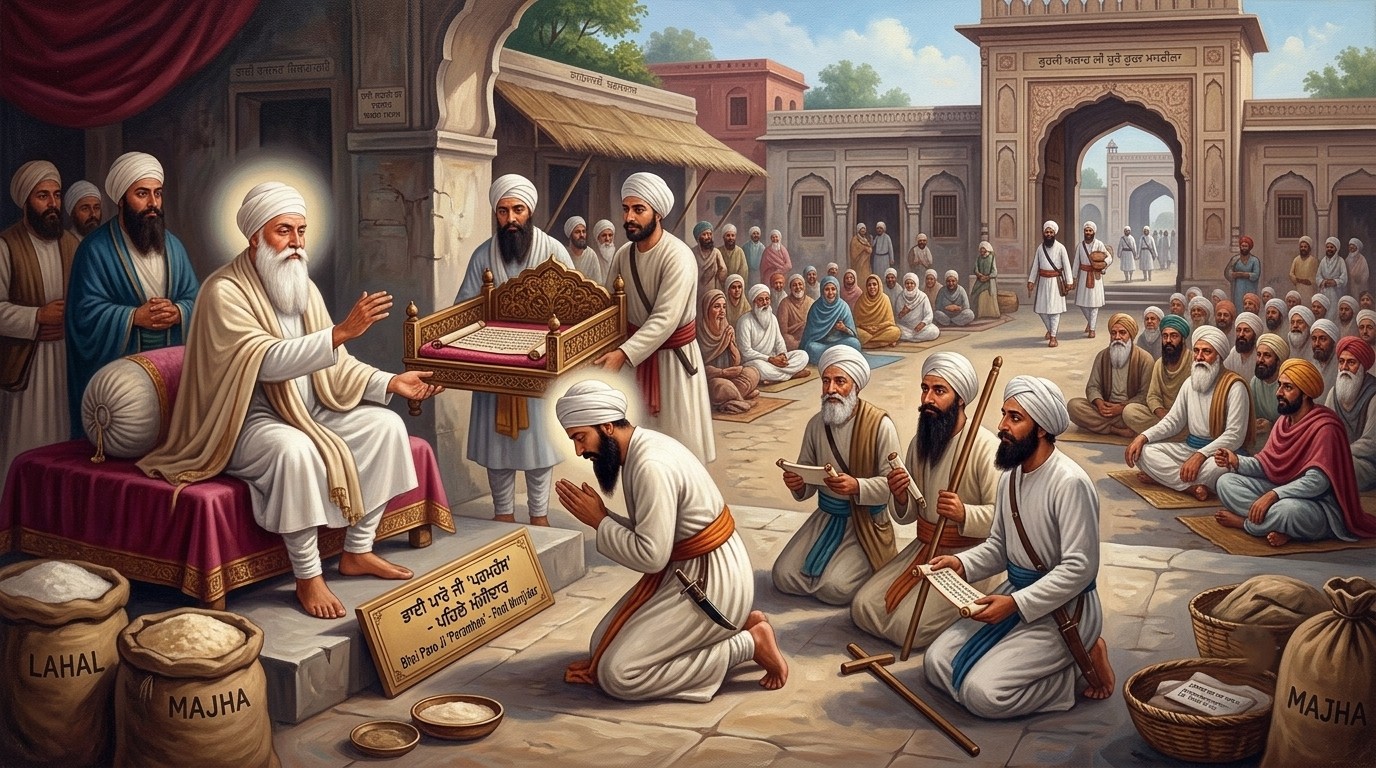
The Supreme Swan: Bhai Paro Paramhans and the Awakening of the Manji System
To trace the early topography of the Sikh faith is to map a sequence of quiet revolutions, each engineered not by the sword or structural edicts, but by the radical transformation of the human heart. In the sixteenth century, as the light of Guru Nanak Dev Ji traveled through its second and third bodily vessels—Guru Angad Dev Ji and Guru Amar Das Ji—the nascent community faced a critical challenge: how to expand a localized spiritual movement into a vast, self-sustaining, and decentralized spiritual commonwealth without losing its pure, unadulterated essence. This expansion demanded pioneers who were not merely administrative leaders, but living embodiments of the Guru’s Shabad—individuals whose personal ego had been so utterly dissolved that they could serve as perfect mirrors of the divine. Among these early stalwarts, none occupies a more luminous position than Bhai Paro Julka of Dalla, affectionately known in historical chronicles as 'Paramhans' (the Supreme Swan). As the first disciple formally appointed to the revolutionary Manji system by the third Master, Bhai Paro’s life stands as a brilliant monument to absolute devotion, fearlessness, and the institutionalization of the Sikh mission.
The Anatomy of a Swan: The Discourse on Paramhans at Khadur Sahib
The spiritual title of 'Paramhans' is not a worldly accolade; it is a profound cosmological descriptor rooted in ancient Indic philosophy and elevated to its zenith within early Gurmat theology. The term itself evokes the image of the mythological swan (Hans) residing on the pristine waters of Lake Mansarovar, possessing the legendary capability of 'Neer-Ksheer Viveka'—the unique ability to dip its beak into a mixture of milk and water, curdle the milk with its innate acids, consume the rich substance, and leave the water behind. In the context of early Sikh history, this metaphorical concept was brought into sharp relief during a historic morning congregation at Khadur Sahib under the second Master, Guru Angad Dev Ji. Bhai Paro Julka, then a deeply devoted seeker who traveled regularly from his native village of Dalla in the Jalandhar Doab to immerse himself in the Guru's darbar, stood up with a burning existential query. He asked the second Master to define the true qualities of a Paramhans—the supreme swan of the spiritual realm—and how a mortal soul might attain such an exalted state of constant discernment.
Guru Angad Dev Ji smiled at the sincerity of the seeker and proceeded to deliver a discourse that would redefine the boundaries of discipleship. The Guru explained that while a standard 'Hans' is a righteous, honest person who journeys through life with moral integrity, they lack the capacity to transform others; they can swim across the worldly ocean but cannot turn a common crane (Bugla) into a swan. In contrast, a 'Paramhans'—a true Gursikh—is a supreme vessel of the Shabad. This individual possesses an intellect sharpened by divine wisdom (Bibek Budh) that acts as the metaphorical beak, constantly separating the eternal truth (Sat) from the transient, perishable illusion of the material world (Asat). Furthermore, the Paramhans is not a passive consumer of truth; they are an active, transformative force in the universe. Wherever they walk, their holy association (Sadh Sangat) possesses such intense spiritual gravity that even the most corrupted minds, likened to crows or cranes chasing frogs in the mud, are instantly purified and transformed into swans of the highest order. Bhai Paro listened to this exposition with a heart overflowing with reverence, declaring 'Sat Bachan' (True are your words) and committing his entire being to realizing this state. The second Guru, perceiving the depth of his surrender, blessed him and instructed him to continue his spiritual apprenticeship at Goindwal Sahib under the guidance of Baba Amar Das Ji, foretelling that the day would soon arrive when he would indeed manifest the absolute qualities of the Paramhans.
The Daily Crucible: Crossing the Beas and the Anatomy of Absolute Devotion
Following the command of Guru Angad Dev Ji, Bhai Paro made Goindwal Sahib the center of his universe. Though he remained a householder, fulfilling his domestic duties in Dalla, his spirit resided permanently at the feet of Guru Amar Das Ji, who assumed the Guruship in 1552. The journey from Dalla to Goindwal required crossing the Beas River, a geographical barrier that became the daily crucible of Bhai Paro’s faith. Rain or shine, summer heat or freezing winter winds, Bhai Paro would saddle his horse every second day, carrying freshly prepared communal kitchen offerings (Langar), including milk, yogurt, and simple bread (Prashada), to present to the Guru and the congregation. This was not a ritualistic duty but an ecstatic act of love, performed with such intense focus that the physical obstacles of the journey seemed to dissolve before his eyes. His horse, attuned to the spiritual urgency of its master, became an active participant in this regular pilgrimage, showing no fear even when the Beas River was in full, roaring flood.
The climax of this daily devotion is captured in one of the most celebrated episodes in early Sikh history. On a day when the Beas was experiencing a catastrophic, violent flood, the currents swirling with tree trunks and debris, the regular ferrymen refused to launch their boats, warning that attempting to cross would mean certain death. Camped on the riverbank was Abdullah, the powerful Mughal Nawab of Jalandhar, who was traveling with a large military detachment and had been forced to halt, waiting for the treacherous waters to recede. As the Nawab and his soldiers watched the churning torrent in frustration, they were stunned to see a solitary rider approach the bank. Without a moment's hesitation, reciting the Divine Name and anchoring his mind on the form of Guru Amar Das Ji, Bhai Paro spurred his horse directly into the raging vortex. The animal struggled against the massive waves, but guided by a force that transcended physical mechanics, it sliced through the flood and safely reached the opposite bank in Goindwal Sahib. The Nawab and his entire army watched in absolute disbelief, realizing they had witnessed a miracle of pure, fearless willpower born of spiritual alignment.
The Confrontation of Sovereign Spirits: Bhai Paro and Nawab Abdullah
The impact of Bhai Paro's fearlessness did not end with his crossing. On his return journey later that evening, as he rode back across the calmer channels of the river, he was intercepted by Nawab Abdullah, who had waited all day to meet this extraordinary horseman. The Nawab, accustomed to the obsequious bowing of subjects, was struck by the calm, dignified, and entirely unawed demeanor of Bhai Paro. He demanded to know in whose service the rider underwent such terrifying physical danger, and what worldly treasure could possibly motivate a man to risk his life for a daily river crossing. Bhai Paro, looking directly into the eyes of the imperial governor, replied with serene confidence, "My true sovereign is Guru Amar Das, the third manifestation of Guru Nanak. He has opened my eyes to the eternal treasury of Naam. When I contemplate his holy presence, all temporal fears—including the fear of death and the fury of the elements—simply vanish into nothingness."
This response, entirely devoid of political posturing or personal arrogance, deeply intrigued the Nawab. The contrast between his own heavily armed, yet fearful and stalled army, and this solitary, fearless rider of the Guru was too profound to ignore. Recognizing a rare spiritual authority, the Nawab asked if he could be granted an audience with this great Master. Bhai Paro, acting as a true Paramhans, agreed but placed a crucial condition that challenged the very foundations of Mughal social stratification: "You may certainly meet the Guru, but you cannot enter his court as a conquering Nawab with your army, your weapons, and your pride. You must leave your royal retinue behind, strip yourself of your worldly titles, and approach the Guru as a humble, ordinary seeker of truth." The Nawab, completely disarmed by Bhai Paro's spiritual authority, accepted. He handed command of his forces to his son, dressed in simple attire, and rode alongside Bhai Paro across the Beas. Upon entering the egalitarian presence of Guru Amar Das Ji and tasting the Langar while sitting on the ground alongside commoners of all castes, the Nawab’s pride shattered. Guru Amar Das Ji, looking at the two men, declared that Bhai Paro’s prophecy had been fulfilled: he had truly become the Paramhans who, through his pure association, had pulled a worldly ruler out of the mud of ego and guided him across the ocean of existence.
The Institutionalization of Grace: The Foundation of the Manji System
As the fame of Guru Amar Das Ji’s court at Goindwal Sahib spread across the Indian subcontinent, pilgrims began to arrive in unprecedented numbers, creating an urgent need for structural organization. The young Sikh Panth was no longer a localized group of disciples in the Punjab; it was rapidly expanding into Kashmir, Rajputana, Delhi, and beyond. To manage this sprawling community, to preserve the purity of Guru Nanak’s theological message from local distortions, and to ensure the systematic distribution of the communal kitchen (Langar) resources, Guru Amar Das Ji introduced a revolutionary administrative and spiritual framework: the Manji system. Mimicking the twenty-two administrative provinces (Subahs) of the Mughal Empire, the Guru divided the Sikh spiritual territory into twenty-two distinct zones, known as Manjis. The word 'Manji' literally refers to a low wooden cot, which served as the seat of delegated authority from which the appointed representative would preach, resolve local disputes, and organize the congregation.
The establishment of this system was a radical departure from the centralized, hierarchical religious models of medieval India. Unlike the Hindu priestly class (Brahmins) or the Islamic clergy (Ulema), the positions within the Manji system were entirely non-dynastic, non-hereditary, and based strictly on spiritual merit and character. The appointed leaders, known as Manjidars or Sangatias, were expected to live as active householders, earning an honest livelihood (Kirat Karni) rather than living off the offerings of the congregation. Out of the vast community of seekers, Guru Amar Das Ji selected 146 highly trained missionaries, including 94 men and 52 women—a remarkable testament to the gender equality championed by early Sikhism. When the time came to appoint the very first Manjidar to inaugurate this historic system, the Guru’s choice fell naturally upon Bhai Paro Julka. Appointed to head the highly critical Manji of Jalandhar, Bhai Paro was tasked with carrying the light of Goindwal Sahib to the vast population of the Doab region, formalizing his role as the premier missionary of the early Panth.
The following analytical table details the structural innovation of the Manji system, contrasting its egalitarian, decentralized design with the prevailing imperial and orthodox religious structures of the sixteenth century:
| Structural Dimension | The Sikh Manji System | The Imperial Mughal Subah System | Orthodox Clerical Hierarchies |
| Core Objective | Spiritual liberation, social equality, decentralized community care, and propagation of Naam. | Tax extraction, military control, political pacification, and imperial consolidation. | Ritual preservation, social control, enforcement of caste boundaries, and institutional survival. |
| Selection Basis | Spiritual merit, absolute selflessness, and practical commitment to Sewa. | Aristocratic lineage, military prowess, and loyalty to the Emperor. | Hereditary succession, caste purity, and formal scriptural memorization. |
| Gender Inclusivity | Radically inclusive; both men and women (Piri system) held seats of authority. | Strictly patriarchal; administrative and military roles restricted to males. | Strictly patriarchal; women barred from performing core rituals or holding authority. |
| Economic Model | Self-sustaining householders; voluntary tithes (Dasvandh) sent directly to the communal kitchen. | Forced taxation; state-sanctioned extraction of agricultural surplus. | Ritual fees (Dakshina) and land grants used for personal and institutional enrichment. |
The Preacher of Dalla: Bhai Paro’s Ministry and Spiritual Legacy
Upon his formal appointment, Bhai Paro established Dalla as a vibrant center of spiritual awakening. Sitting on his simple wooden Manji, he did not project himself as a divine figure or a mediator between God and man; instead, he acted as a transparent conduit for the Guru's Shabad. His preaching style was characterized by profound simplicity, intense emotional depth, and a complete absence of dogmatism. He taught the local peasants, merchants, and artisans that the path to liberation did not lie in ascetic self-mortification, pilgrimages to holy rivers, or the performance of complex rituals. Rather, it lay in the constant remembrance of the Divine Name (Naam Simran), honest labor, and the sharing of one's earnings with the needy (Vand Chhako). Through his exemplary personal life, he demonstrated that one could remain deeply involved in the world—managing family, fields, and horses—while keeping one's consciousness completely detached from material illusion, living like a lotus flower in muddy waters.
Bhai Paro's influence transformed the Jalandhar Doab into a fortress of the Sikh faith. His home in Dalla became a secondary Goindwal, where seekers from all walks of life gathered to sing the Guru’s hymns, discuss theology, and eat together in the egalitarian Langar. He possessed a unique pastoral sensitivity, frequently visiting the homes of the poorest disciples, comforting the sick, and resolving communal disputes with a gentle, unifying wisdom that bypassed caste lines. This active, living demonstration of the Sikh way of life proved incredibly potent, drawing thousands of souls into the fold of the Panth. The legacy of his devotion was so profound that it echoed through generations of his descendants. Bhai Paro’s bloodline would yield some of the most historic figures in Sikh history, including Bhai Daya Singh Ji—the first of the Panj Pyare (the Five Beloved Ones) who offered his head to Guru Gobind Singh Ji during the historic creation of the Khalsa in 1699—and Mata Damodari Ji, the revered consort of the sixth Master, Guru Hargobind Sahib Ji, thus permanently weaving the spirit of the Paramhans into the foundational fabric of the Sikh lineage.
The Historical and Theological Significance of the Paramhans
From the analytical perspective of a Sikh historian, the life of Bhai Paro Paramhans is far more than an inspiring narrative of personal piety; it is an essential case study in the successful institutionalization of a revolutionary spiritual movement. The transition of Sikhism from a charismatic movement centered around a living Master to an organized, self-sustaining community was a delicate and perilous journey. Had the propagation of the faith remained entirely centralized in Goindwal, the message may have withered under the weight of sheer distance and numbers. Conversely, had the regional representatives been allowed to establish personal fiefdoms or claim independent divine authority, the movement would have fractured into a chaotic collection of localized, competing sects. By appointing a man of Bhai Paro’s absolute humility and ideological clarity as the first Manjidar, Guru Amar Das Ji set an exacting, unyielding standard for all future leadership within the Panth.
Ultimately, Bhai Paro’s life reminds us that the true strength of a spiritual revolution lies in its ability to produce individuals who are completely fearless because they have conquered their own ego. In crossing the flooded Beas, in confronting the Mughal governor, and in sitting humbly on the Manji to serve the marginalized, Bhai Paro demonstrated that the Shabad is not a mere philosophical theory, but a practical, living power capable of elevating ordinary mortals to the status of the supreme swan. As we look back across the centuries, his memory remains a radiant beacon, challenging every seeker to cultivate that sharp, divine intellect which can separate the transient from the eternal, and to live with that supreme, fearless poise that characterizes the true Paramhans.
Guru Amar Das Ji (1479–1574)
Known as 'Paramhans'; he was the first to be appointed to the Manji system to spread the Guru's message.
- Role
- Devoted Disciple
- Group
- Institutional Leaders (Manjis)
- Period
- Guru Amar Das Ji (1479–1574)