Historical Turning Points · Living Heritage
Colonial Military Policy
The British Raj initiated a preferential recruitment policy, classifying Sikhs as a "martial race". This led to early Sikh migration as soldiers, police, and laborers throughout the British Empire in East Africa, Southeast Asia, and Canada.
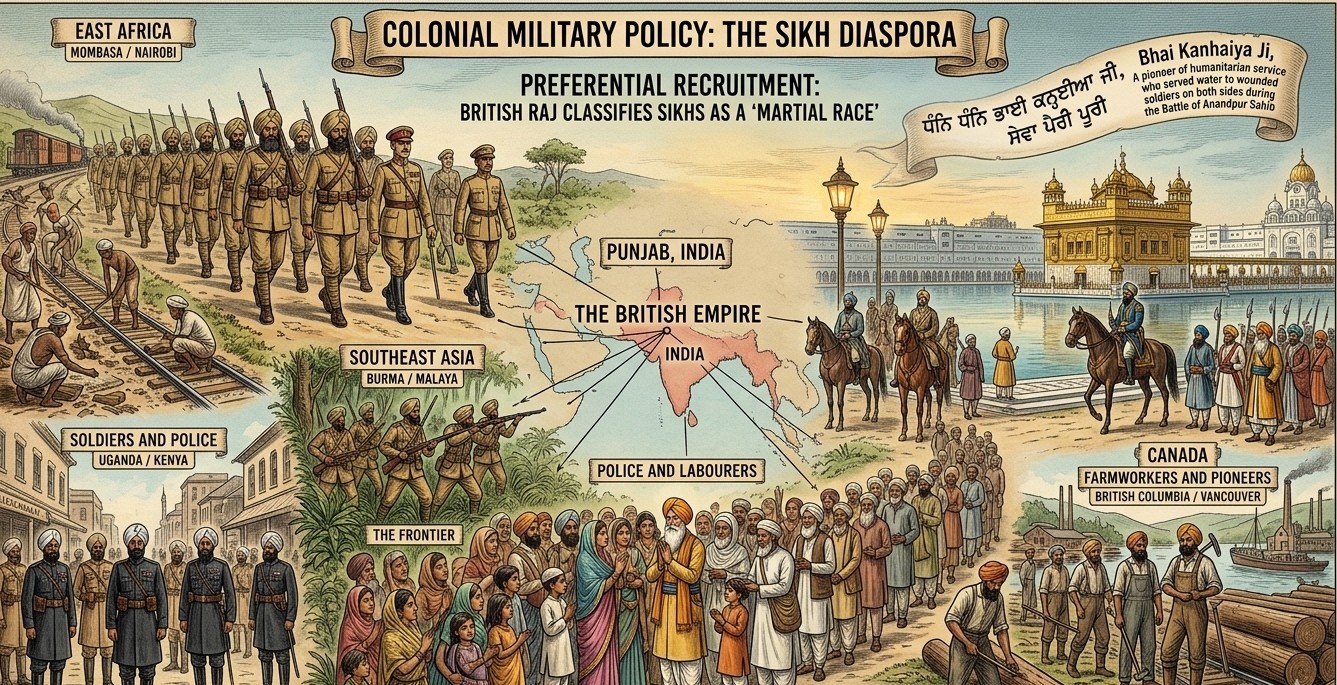
Colonial Military Policy and the Sikh Diaspora: How the British "Martial Race" Theory Shaped Global Sikh Migration
The history of the Sikh diaspora cannot be fully understood without examining the colonial military policies of the British Raj during the nineteenth and early twentieth centuries. Among the most influential of these policies was the British classification of Sikhs as a "martial race," a theory that profoundly shaped Sikh society, migration patterns, economic opportunities, and global identity. Following the annexation of Punjab in 1849, the British Empire embarked upon a deliberate strategy of recruiting large numbers of Sikhs into its military and security forces. What began as a colonial administrative policy eventually transformed the Sikh community into one of the most globally dispersed populations of South Asian origin. Through military service, police work, infrastructure projects, and labor migration, Sikhs established communities across East Africa, Southeast Asia, Hong Kong, China, Australia, New Zealand, Britain, and North America. The consequences of this policy extended far beyond military recruitment. It altered social structures within Punjab, created new economic opportunities, facilitated international migration, and laid the foundations for the modern global Sikh presence that exists today.
As a Sikh historian, it is important to recognize that the British martial race policy was both an opportunity and a constraint. On one hand, it opened pathways to employment, travel, and advancement within the British Empire. On the other hand, it reduced a complex and diverse community to a colonial stereotype designed to serve imperial interests. The story of Sikh recruitment under British rule is therefore not merely a military history. It is a story of empire, migration, identity, adaptation, and the unintended emergence of a worldwide Sikh diaspora.
The Aftermath of the Annexation of Punjab
The British annexation of Punjab in 1849 fundamentally altered the political and social landscape of the region. The fall of the Sikh Empire ended nearly half a century of independent Sikh rule and brought Punjab under direct colonial administration. British officials faced the challenge of governing a province with a strong military tradition, a proud history of resistance, and a population that had only recently fought two major wars against the East India Company. Rather than marginalizing the Sikh population entirely, British administrators adopted a strategy that sought to integrate influential segments of Punjabi society into the colonial system.
The rebellion of 1857, often referred to as the Indian Mutiny or the First War of Independence depending on historical interpretation, played a crucial role in shaping British attitudes toward recruitment. During the uprising, many Sikh soldiers, chiefs, and communities either remained loyal to the British or actively assisted colonial authorities. British officials interpreted this support as evidence of Sikh reliability and military value. In the years following the rebellion, they increasingly favored Sikhs for military service while reducing recruitment from regions and communities they considered politically unreliable. This decision would have far-reaching consequences for both the British Empire and Sikh society.
The Origins of the Martial Race Theory
The concept of the "martial race" emerged from colonial attempts to categorize and manage the diverse populations under British rule. British military theorists argued that certain ethnic, religious, and regional groups possessed innate martial qualities that made them particularly suitable for military service. These supposed characteristics included physical strength, bravery, discipline, endurance, and loyalty. While presented as scientific or anthropological observations, such classifications were largely shaped by political considerations and colonial assumptions.
Sikhs became one of the communities most strongly associated with this theory. British officials frequently described Sikhs as natural soldiers whose historical experiences had prepared them for military service. They pointed to the military traditions of the Khalsa, the achievements of Maharaja Ranjit Singh's army, and Sikh participation in various conflicts as evidence supporting their claims. In reality, the theory simplified a highly diverse community and ignored the complexity of Sikh history. Nonetheless, the classification carried practical benefits for those who qualified for recruitment and became a defining feature of colonial policy.
The martial race theory served imperial interests by creating a steady supply of soldiers while fostering loyalty among selected communities. By offering employment, status, and economic rewards, the British cultivated relationships with groups they considered valuable to maintaining imperial stability. Sikhs became one of the most prominent beneficiaries of this system.
Sikhs in the British Indian Army
Military recruitment expanded dramatically during the second half of the nineteenth century. Sikh soldiers became a highly visible presence within the British Indian Army, serving in infantry, cavalry, and specialized units throughout the empire. Recruitment campaigns often targeted rural areas of Punjab, where military service provided stable income and social prestige. Entire villages developed strong connections to the army, with multiple generations serving in uniform.
Service in the British military offered opportunities unavailable to many rural families. Soldiers received regular salaries, pensions, land grants, and access to broader imperial networks. These benefits contributed to the economic development of many Punjabi communities and strengthened the social standing of military families. At the same time, military service exposed Sikhs to distant regions and diverse cultures, fostering a global outlook that would later facilitate migration.
The image of the Sikh soldier became one of the most recognizable symbols of the British Empire. Photographs, postcards, newspapers, and military exhibitions frequently featured Sikh troops wearing turbans and displaying martial bearing. These representations reinforced colonial narratives while simultaneously increasing international awareness of Sikh identity. Across the empire, the Sikh soldier became a familiar and respected figure.
Military Service and Global Mobility
One of the most significant consequences of military recruitment was the creation of unprecedented opportunities for travel. Sikh soldiers served across Asia, Africa, the Middle East, and Europe. They participated in campaigns in Afghanistan, Burma, China, East Africa, Egypt, South Africa, and numerous other regions. Through these deployments, thousands of Sikhs encountered parts of the world that previous generations could scarcely have imagined.
These experiences transformed perceptions of geography and opportunity. Soldiers returning to Punjab brought stories of foreign lands, economic possibilities, and new communities. Many established networks that later facilitated civilian migration. Military service therefore functioned as both a source of employment and a mechanism for expanding global awareness. It connected rural Punjab to an increasingly interconnected imperial world.
The movement of Sikh soldiers also introduced local populations throughout the empire to Sikh customs, religious practices, and cultural traditions. Temporary military deployments often evolved into permanent settlements as veterans chose to remain abroad or encouraged relatives to join them. In this way, military service became one of the earliest pathways for the formation of overseas Sikh communities.
Sikhs in East Africa
East Africa became one of the most important destinations for Sikh migration during the colonial period. British imperial expansion in the region created a demand for soldiers, police officers, administrators, and skilled laborers. Sikhs played a vital role in the construction and maintenance of colonial infrastructure, most notably the Uganda Railway. This ambitious project connected coastal regions with the interior and became a cornerstone of British ambitions in East Africa.
Many Sikhs who initially arrived as laborers or security personnel chose to settle permanently. Communities emerged in Kenya, Uganda, Tanzania, and other territories. Gurdwaras were established, businesses flourished, and social organizations developed to support growing populations. These communities maintained strong connections to Punjab while adapting to local conditions and contributing to regional economic development.
The presence of Sikhs in East Africa demonstrates how colonial military and labor policies could produce enduring demographic transformations. What began as temporary migration linked to imperial projects evolved into vibrant communities that persisted for generations. Even after decolonization, Sikh families continued to play important roles in East African society while maintaining connections to their ancestral homeland.
Sikhs in Southeast Asia and Hong Kong
Southeast Asia became another major center of Sikh migration under British rule. Sikhs served as soldiers, police officers, prison guards, customs officials, and civil servants in territories such as Malaya, Singapore, Burma, and Hong Kong. Colonial authorities often regarded Sikh personnel as reliable enforcers of law and order, leading to their widespread deployment throughout the region.
These assignments created opportunities for permanent settlement and community formation. Gurdwaras became focal points of religious and social life, providing support for newcomers and preserving cultural traditions. Over time, Sikh communities established schools, charitable organizations, and commercial enterprises. Their contributions extended beyond security services into trade, education, transportation, and professional sectors.
The Sikh presence in Southeast Asia also facilitated the development of transnational networks. Families maintained connections across multiple countries, creating patterns of migration that linked Punjab with Singapore, Kuala Lumpur, Rangoon, and Hong Kong. These networks would later support further migration to Europe, Australia, and North America.
The Journey to Canada and North America
Perhaps no migration route better illustrates the long-term consequences of colonial military policy than the movement of Sikhs to Canada and the United States. Many of the earliest Sikh immigrants to North America were former soldiers or individuals influenced by military networks. Having traveled extensively through imperial service, they were more willing and able to undertake long-distance migration.
The first Sikh arrivals in Canada appeared in significant numbers during the early twentieth century. Most settled in British Columbia, where they found employment in lumber mills, agriculture, railway construction, and industrial labor. Their military backgrounds often contributed to perceptions of discipline and reliability, although they also faced severe discrimination and exclusion.
Despite these challenges, Sikh immigrants established enduring communities. Gurdwaras became centers of religious life, political activism, and mutual support. The experiences of racism and exclusion in North America would later contribute to movements such as the Ghadar Movement, demonstrating how migration initially facilitated by imperial structures could eventually generate resistance to colonial rule.
The Economic Impact on Punjab
The recruitment of Sikhs into military and imperial service had significant economic consequences for Punjab. Salaries, pensions, and remittances flowed back to villages, supporting agricultural development, education, and infrastructure. Families with military connections often enjoyed greater economic stability than those without access to similar opportunities.
Military service also encouraged investment in land and community institutions. Veterans frequently used their earnings to purchase property, support religious organizations, and improve local infrastructure. These developments contributed to the emergence of relatively prosperous rural communities in parts of Punjab.
At the same time, dependence on military employment created vulnerabilities. Economic opportunities became tied to colonial structures that prioritized imperial interests rather than local development. While many individuals benefited materially, the broader system remained designed to serve the needs of the British Empire.
The Contradictions of the Martial Race Narrative
The British portrayal of Sikhs as a martial race contained significant contradictions. While it elevated Sikh status within certain colonial institutions, it also reduced a complex religious community to a narrow stereotype. Sikh history encompasses spiritual teachings, agricultural traditions, scholarship, commerce, philanthropy, and artistic achievement in addition to military service. The martial race theory ignored this diversity in favor of characteristics useful to imperial governance.
Moreover, the policy encouraged selective recruitment practices that privileged certain social groups and regions. Not all Sikhs benefited equally from military opportunities, and the emphasis on martial identity sometimes overshadowed other dimensions of Sikh life. Historians today recognize the theory as a colonial construct rather than an objective description of community characteristics.
Nevertheless, many Sikhs successfully adapted these circumstances to their advantage. They used opportunities created by recruitment policies to pursue education, migration, entrepreneurship, and community development. In doing so, they transformed a colonial classification into a foundation for global mobility and achievement.
The Legacy of Colonial Recruitment and the Modern Sikh Diaspora
The long-term legacy of British military recruitment policies can be seen in the global distribution of Sikh communities today. Countries that first received Sikh soldiers, police officers, and laborers during the colonial era often became centers of permanent settlement. Generations later, thriving Sikh populations exist in East Africa, Southeast Asia, Britain, Canada, Australia, New Zealand, and beyond.
These communities have contributed significantly to their adopted societies while preserving strong cultural and religious ties. Gurdwaras, educational institutions, charitable organizations, and business networks continue to connect Sikhs across continents. The foundations of many of these global connections can be traced directly to the migration pathways established during the colonial period.
Ironically, a policy originally designed to strengthen imperial control ultimately contributed to the emergence of a highly mobile and globally connected Sikh population. The descendants of soldiers, police officers, and laborers recruited under colonial rule became entrepreneurs, professionals, political leaders, scholars, and activists who reshaped the meaning of Sikh identity in a globalized world.
Conclusion
The British colonial policy of classifying Sikhs as a martial race had profound and lasting consequences for Sikh history. While rooted in imperial objectives and colonial assumptions, the policy opened pathways to military service, international travel, and economic opportunity that transformed the Sikh community. Through recruitment into the army, police forces, and labor projects, Sikhs established communities across East Africa, Southeast Asia, Canada, and numerous other regions of the world. These migrations laid the foundations for the modern Sikh diaspora and connected Punjab to a vast network of global relationships. Although the martial race theory itself was a colonial construct, the opportunities and migrations it generated became central to the development of Sikh communities worldwide. The story serves as a reminder that historical processes often produce outcomes far beyond the intentions of those who initiate them, shaping identities and destinies across generations.
Frequently Asked Questions (FAQ)
1. What was the British martial race theory?
The martial race theory was a colonial belief that certain communities possessed natural military qualities and were therefore especially suited for military service.
2. Why did the British classify Sikhs as a martial race?
British officials pointed to Sikh military traditions, the legacy of the Khalsa, and Sikh participation in various conflicts as reasons for preferential recruitment.
3. When did large-scale Sikh recruitment begin?
Recruitment expanded significantly after the annexation of Punjab in 1849 and increased further following the rebellion of 1857.
4. How did military service affect Sikh migration?
Military service exposed Sikhs to different regions of the world and created networks that facilitated later migration and settlement abroad.
5. Why did Sikhs migrate to East Africa?
Many were recruited as soldiers, police officers, administrators, and laborers for British colonial projects, including railway construction.
6. What role did Sikhs play in Southeast Asia?
Sikhs served as soldiers, police officers, prison guards, customs officials, and civil servants throughout British-controlled territories.
7. How did Sikhs first arrive in Canada?
Many early Sikh immigrants had military backgrounds or connections to imperial networks that enabled long-distance migration.
8. Did all Sikhs benefit equally from the martial race policy?
No. Opportunities were distributed unevenly, and the policy often favored specific regions and social groups within the Sikh community.
9. Why do historians criticize the martial race theory?
Historians view it as a colonial stereotype that oversimplified diverse communities and served imperial interests rather than reflecting objective reality.
10. What is the lasting legacy of this policy?
The policy contributed significantly to the formation of the global Sikh diaspora and helped establish Sikh communities across multiple continents.