Panthic Personalities · Origins & Gurus · Guru Angad Dev Ji
Dasu Ji & Datu Ji
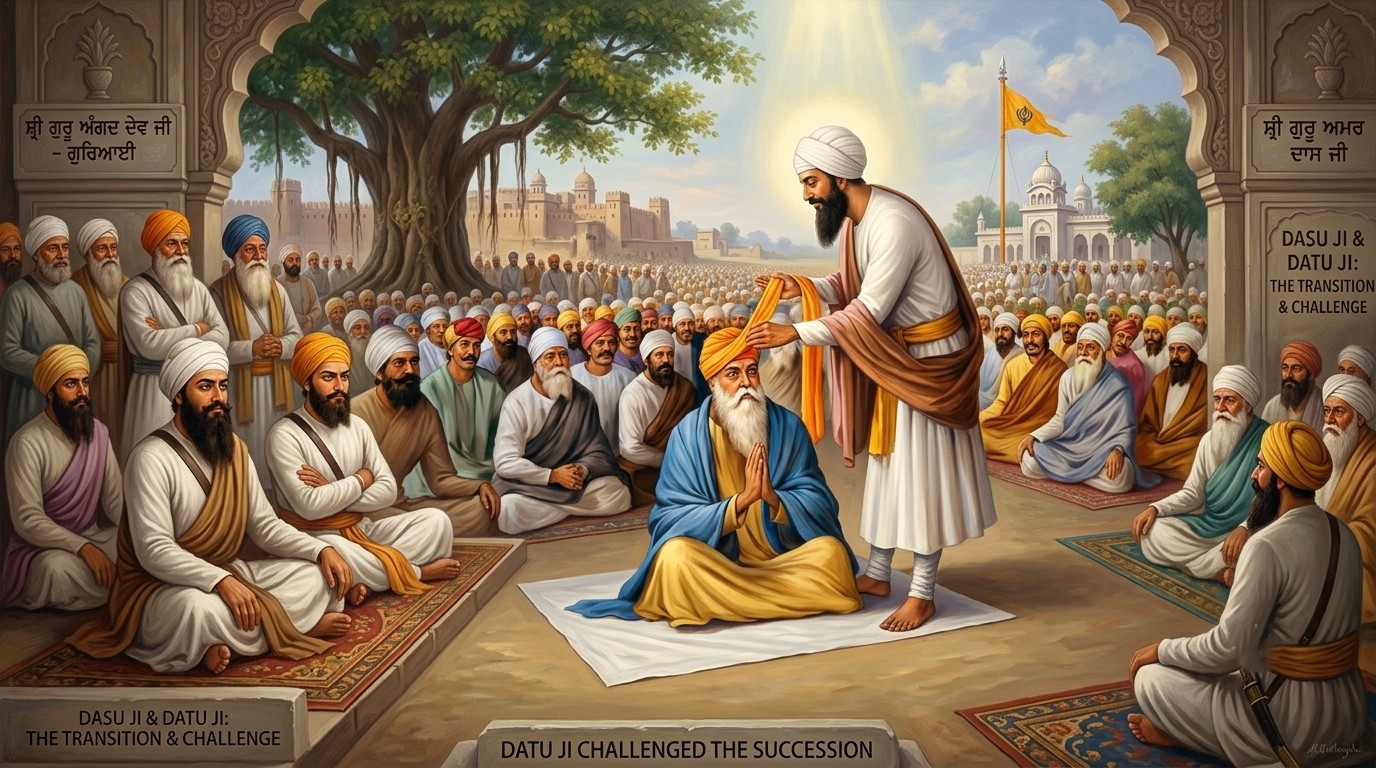
Witnessed the transition of Guruship; Datu Ji famously challenged Guru Amar Das Ji's succession later on.
The Sons of Khadur: Dasu, Datu, and the Crucible of Guruship
To understand the early evolution of the Sikh faith is to understand a spiritual revolution that consistently challenged the deeply entrenched social, familial, and political paradigms of sixteenth-century India. At the heart of this revolution lay the concept of Guruship—not as an earthly kingdom to be inherited through dynastic bloodlines, but as a divine, indivisible light (Joti) passed from one vessel to another based entirely on spiritual alignment, absolute surrender, and selfless service. The transition of this light from the second Master, Guru Angad Dev Ji, to the third Master, Guru Amar Das Ji, represents one of the most critical testing grounds of this principle. Witnessing this transition from the closest possible proximity were Baba Dasu Ji and Baba Datu Ji, the sons of Guru Angad Dev Ji and Mata Khivi Ji. Their lives, choices, and eventual conflicts serve as a profound historical mirror, reflecting the intense human struggle between familial entitlement and divine decree, a struggle that reached its historical climax in Baba Datu Ji's infamous physical confrontation with Guru Amar Das Ji at Goindwal Sahib.
The Household of the Second Master and the Weight of Lineage
Baba Dasu Ji and Baba Datu Ji were born into a household that was itself the epicenter of a massive spiritual transformation. Their father, Bhai Lehna Ji, had completely surrendered his identity to become Guru Angad Dev Ji, the second Guru of the Sikhs, having been chosen by Guru Nanak Dev Ji over his own sons, Baba Sri Chand Ji and Baba Lakhmi Das Ji. Growing up in Khadur Sahib, Dasu Ji and Datu Ji witnessed firsthand the construction of a new egalitarian community. They watched their mother, Mata Khivi Ji, manage the communal kitchen (Langar) with unparalleled dedication, infusing the institution with love, respect, and rich sustenance. Yet, despite being nurtured in an environment of sublime devotion, the two brothers were also subject to the prevailing socio-cultural expectations of their era. In medieval Punjab, the eldest son was traditionally viewed as the rightful heir to his father’s status, property, and spiritual authority. The concept of a spiritual meritocracy, though demonstrated by Guru Nanak’s bypass of his own progeny, was still a radical and difficult truth for the immediate families of the Gurus to fully internalize.
As Guru Angad Dev Ji’s earthly journey neared its end, the question of succession loomed large over Khadur Sahib. Both Dasu Ji and Datu Ji, by virtue of their birth, naturally anticipated that the mantle of spiritual leadership would remain within their family. They had observed the aging Baba Amar Das Ji, a man older than their own father, performing what appeared to be menial tasks—carrying water from the Beas River, gathering firewood, and serving the congregation with quiet, unceasing humility. To the untrained eye, Amar Das Ji was merely an elderly disciple of advanced years and low social preeminence. However, Guru Angad Dev Ji perceived the boundless ocean of devotion within Amar Das Ji, recognizing that his complete erasure of ego made him the only fit vessel to carry the divine light of Guru Nanak. When the second Master formally bestowed the Guruship upon Guru Amar Das Ji in 1552, it sent shockwaves through the immediate household, igniting a silent but fierce tempest of resentment, jealousy, and existential crisis in the hearts of the two biological sons.
The Spatial Separation: Establishing Goindwal Sahib
Conscious of the inevitable friction that would arise from this decision, and acting on the explicit instructions of Guru Angad Dev Ji, the newly anointed Guru Amar Das Ji did not remain in Khadur Sahib. Instead, he shifted his base of operations to Goindwal Sahib, a newly founded settlement on the banks of the Beas River. This geographic relocation was a deliberate and strategic move designed to give the sons of the second Master their space and to prevent an immediate, ugly schism within the young Sikh community. By establishing Goindwal Sahib, Guru Amar Das Ji created a fresh canvas upon which the institutions of Sikhism could expand, including the construction of the Baoli Sahib (a stepwell with eighty-four steps) and the formalization of the Manji system of administrative and spiritual districts. Meanwhile, Khadur Sahib remained under the domestic influence of Baba Dasu Ji and Baba Datu Ji, creating two distinct centers: one of hereditary memory and the other of active, living spiritual authority.
This physical separation, however, did not instantly cure the resentment breeding in Khadur Sahib. For Baba Dasu Ji, the eldest, the pressure to assert his authority was immense. Under the influence of local associates and his own lingering sense of entitlement, Dasu Ji declared himself the rightful successor to his father and sat on a seat of authority in Khadur Sahib. Yet, the Sikh congregation (Sangat), guided by the spiritual intuition that defines the community, largely bypassed his claims, traveling instead to Goindwal Sahib to seek the true warmth of Guru Nanak’s light. This initial period of self-proclaimed guruship was short-lived. Through the gentle, firm intervention of his mother, Mata Khivi Ji—who held immense respect for the decision of her late husband and recognized the divine status of Guru Amar Das Ji—Baba Dasu Ji was guided back to the path of humility. Realizing the futility and spiritual danger of his rebellion, Dasu Ji traveled to Goindwal Sahib, bowed before Guru Amar Das Ji, and renounced his claims, choosing instead to live out his days in quiet contemplation, reconciling his heart with the divine will (Hukam).
The Unyielding Pride of Baba Datu Ji
While Baba Dasu Ji found peace in surrender, his younger brother, Baba Datu Ji, remained consumed by a burning sense of injustice. Datu Ji possessed a temperament that was highly sensitive to perceived slights and fiercely protective of what he believed to be his birthright. He viewed Guru Amar Das Ji’s mounting influence and the rapid growth of Goindwal Sahib not as the glory of the Guru’s path, but as a direct usurpation of his family's legacy. As pilgrims from across the subcontinent began to flock to Goindwal, bypassing Khadur Sahib entirely, Datu Ji’s financial and social standing diminished, further fueling his bitterness. He began to openly voice his grievances, arguing that an outsider, a former disciple who had joined their household late in life, had stolen the spiritual estate that rightfully belonged to the bloodline of Guru Angad Dev Ji.
This internal conflict was not merely a personal dispute; it represented a fundamental theological clash during the formative years of the Sikh faith. The early community was being forced to choose between the ancient, deeply ingrained tradition of hereditary priesthood and the new, revolutionary doctrine of spiritual election based on character and divine grace. Baba Datu Ji became the focal point for those elements within Punjabi society who found the egalitarianism and non-lineal succession of the Sikh Gurus to be deeply disruptive. Encouraged by these conservative forces and driven by his own unresolved ego, Datu Ji decided to take matters into his own hands. He resolved to travel to Goindwal Sahib to personally confront the elderly Master and reclaim what he believed was his stolen throne.
The Confrontation at Goindwal: A Study in Contrast
The historical encounter that followed at Goindwal Sahib remains one of the most poignant, dramatic, and analyzed episodes in Sikh history, perfectly illustrating the stark contrast between worldly pride and spiritual detachment. Baba Datu Ji arrived at Goindwal Sahib accompanied by a small retinue of supporters, entering the congregation where Guru Amar Das Ji was seated on the high platform (Gaddi), addressing a vast assembly of devoted Sikhs. The atmosphere of serene devotion and spiritual ecstasy only served to further inflame Datu Ji’s rage. Seeing the elderly Guru receiving the deep reverence of the Sangat, Datu Ji lost all self-control. He marched through the assembly, confronted the seventy-three-year-old Guru, and in a shocking display of physical violence and disrespect, kicked Guru Amar Das Ji off his seat, declaring, "Yesterday you were a mere water-carrier in our house, and today you sit here pretending to be the Master!"
The response of Guru Amar Das Ji to this physical assault is a masterclass in the core Sikh virtue of Sahaj (spiritual poise) and extreme humility. Instead of expressing anger, summoning his followers to defend him, or retaliating in kind, the elderly Guru immediately fell to the ground, took Datu Ji’s feet in his hands, and began to gently massage them. With a voice filled with genuine concern and devoid of a single trace of sarcasm, Guru Amar Das Ji whispered, "O honored prince, please forgive me. My bones are old, dry, and hard. Your tender youth must have been hurt by kicking me." This profound display of ego-less love and absolute surrender stunned the assembly and momentarily disarmed Datu Ji. The physical kick, meant to humiliate the Guru, instead served to elevate the Guru’s spiritual stature to incomprehensible heights in the eyes of the Sangat, while exposing the deep spiritual poverty of the assailant.
The following table illustrates the profound contrasts manifested during this historic event, highlighting the divergent spiritual paths taken by the claimant of bloodline and the receiver of the divine light:
| Dimension | Baba Datu Ji (Worldly Claim) | Guru Amar Das Ji (Divine Light) |
| Source of Authority | Biological lineage, dynastic entitlement, and social hierarchy. | Absolute surrender, selfless service (Sewa), and divine selection. |
| Response to Conflict | Aggression, physical violence, verbal abuse, and public humiliation. | Humility, gentle physical embrace, concern for the aggressor, and peace. |
| Core Motivation | Preservation of ego, material wealth, and worldly recognition. | Submission to the Divine Will (Hukam) and preservation of community peace. |
| Ultimate Spiritual State | Restlessness, anger, and alienation from the core of the Sangat. | Sahaj (spiritual poise), eternal grace, and undisputed spiritual leadership. |
The Departure, the Bandits, and the Lesson of Hukam
Unable to bear the overwhelming humility of the Guru and the silent, disapproving stares of the gathered congregation, Baba Datu Ji refused to stay in Goindwal. He quickly plundered the Guru's immediate living quarters, seizing whatever valuables, offerings, and administrative items he could find. Loading these worldly treasures onto a mule, Datu Ji and his followers departed Goindwal to return to Khadur Sahib, convinced that they had successfully asserted their dominance and stripped the Guru of his authority. However, the spiritual authority of the Guru’s house was never tied to material possessions or physical seats. By taking the physical items, Datu Ji had only burdened himself with dead weight, leaving the living, breathing essence of Guruship untouched in the heart of Guru Amar Das Ji.
The journey back to Khadur Sahib proved to be both physically and spiritually disastrous for Datu Ji. Along the way, his small caravan was ambushed by a band of robbers who had caught wind of the treasure he was transporting. The bandits not only seized all the plundered wealth but also beat Datu Ji and his companions. In a striking twist of historical irony and cosmic justice, one of the blows struck Datu Ji directly on the very foot and leg he had used to kick Guru Amar Das Ji. The injury was severe, leaving him in excruciating physical pain and causing a permanent ailment that would plague him for years. This physical affliction became a constant, painful reminder of his spiritual transgression, forcing him into a long period of isolation and deep introspection within the quiet confines of Khadur Sahib.
The Self-Exile of Guru Amar Das Ji and the Recall of the Sangat
In the immediate aftermath of the confrontation, Guru Amar Das Ji chose to demonstrate the ultimate lesson of non-attachment. To avoid further dividing the community and to allow the dust of Datu’s rebellion to settle, the Guru quietly slipped away from Goindwal Sahib in the dead of night. He returned to his ancestral village of Basarke, where he locked himself inside a small, secluded hut. On the door of the hut, he wrote a strict warning: "He who opens this door is no Sikh of mine, and I am no Guru of his." The Guru’s absence plunged the Sikh community into a state of profound grief and directionless wandering. Goindwal Sahib felt empty, and the institutions of the faith threatened to stall without their living guide.
The resolution of this crisis came through the wisdom of Baba Buddha Ji, the venerable high priest of the Sikh court who had witnessed the Guruship of Nanak and Angad. Recognizing that they could not violate the Guru’s command by opening the front door, Baba Buddha Ji utilized his deep spiritual intuition. He led the Sangat to the back of the hut and broke through the mud wall, creating a circular opening (now preserved as the historic shrine of Sanhh Sahib). When they entered, they found the Guru immersed in deep meditation. Baba Buddha Ji pleaded on behalf of the entire Panth, explaining that while the sun may hide itself, the world cannot survive without its light. Yielding to the collective love and devotion of the Sangat, Guru Amar Das Ji agreed to return to Goindwal Sahib, firmly cementing his position as the undisputed leader of the Sikh world, while Datu Ji’s influence continued to wane in Khadur Sahib.
The Path to Reconciliation: Datu Ji’s Later Years
History is rarely simple, and the story of Baba Datu Ji does not end with his bitter defeat and physical injury. One of the most beautiful aspects of the Sikh historical narrative is the capacity for redemption, transformation, and the eventual melting of the hardest egos when confronted with genuine spiritual majesty. As the years rolled on, Guru Amar Das Ji passed the light of Guruship to Guru Ram Das Ji, who in turn passed it to Guru Arjan Dev Ji. Throughout these decades, the wounds of the past slowly began to heal. The sheer consistency, moral clarity, and spiritual depth of the Guru’s house gradually eroded the skepticism and anger that had once consumed the descendants of the second Master.
During the Guruship of Guru Ram Das Ji and the subsequent construction of the Harmandir Sahib under Guru Arjan Dev Ji, Baba Datu Ji, now an old man himself, began to visit the Guru’s court. The pain in his leg, which had troubled him since the bandit attack, serves as a physical metaphor for his long, painful journey toward humility. When he finally came into the presence of Guru Ram Das Ji and later Guru Arjan Dev Ji, he was received not with cold reminders of his past misdeeds, but with the profound respect due to the son of the second Master. This unconditional love and honor finally broke the remaining walls of Datu Ji's pride. He recognized that the light residing in Guru Arjan Dev Ji was the exact same light that had shone through his father, Guru Angad Dev Ji. In his final years, Datu Ji became a respected elder figure within the community, frequently visiting Amritsar and counseling his own descendants to maintain a relationship of deep reverence and service toward the true Gurus.
Historical and Theological Reflections on the Transition
From the perspective of a Sikh historian, the saga of Baba Dasu Ji and Baba Datu Ji is not merely an interesting biographical footnote; it is a foundational narrative that helped define the very structure of the Sikh Panth. Had the Guruship passed easily to the sons of Guru Angad Dev Ji purely by virtue of their birth, the Sikh faith may have devolved into another localized, caste-bound, hereditary religious sect, mimicking the very structures of spiritual exploitation that Guru Nanak Dev Ji had so passionately sought to dismantle. By forcing the community to navigate the turbulence of Datu’s rebellion, the Gurus established once and for all that spiritual authority in Sikhism must be earned through the complete annihilation of the self (Haumai) and the cultivation of unconditional love and service.
Furthermore, this history underscores the critical, stabilizing role played by Mata Khivi Ji. As the matriarch of the Guru's household, her refusal to support her sons' unjust claims and her unwavering loyalty to Guru Amar Das Ji prevented a devastating family feud from permanently fracturing the infant faith. Her actions demonstrated that the loyalty of a true Sikh must always lie with the Guru's light rather than familial ties. Ultimately, the lives of Dasu Ji and Datu Ji remind us that the journey to spiritual surrender is highly individual. While Baba Dasu Ji recognized the light relatively quickly through quiet contemplation, Baba Datu Ji had to walk a long, painful road of physical suffering, public humiliation, and deep isolation before his ego finally shattered, allowing him to merge back into the collective warmth of the Sikh Sangat and find his peace at the feet of the Guru.
Guru Angad Dev Ji (1504–1552)
Witnessed the transition of Guruship; Datu Ji famously challenged Guru Amar Das Ji's succession later on.
- Role
- Sons
- Group
- Family & Lineage
- Period
- Guru Angad Dev Ji (1504–1552)