Panthic Personalities · Origins & Gurus · Guru Amar Das Ji
Datu Ji
Famously kicked Guru Amar Das Ji in a fit of jealousy; the Guru humbly massaged his foot, saying his old bones were too hard, demonstrating supreme patience.
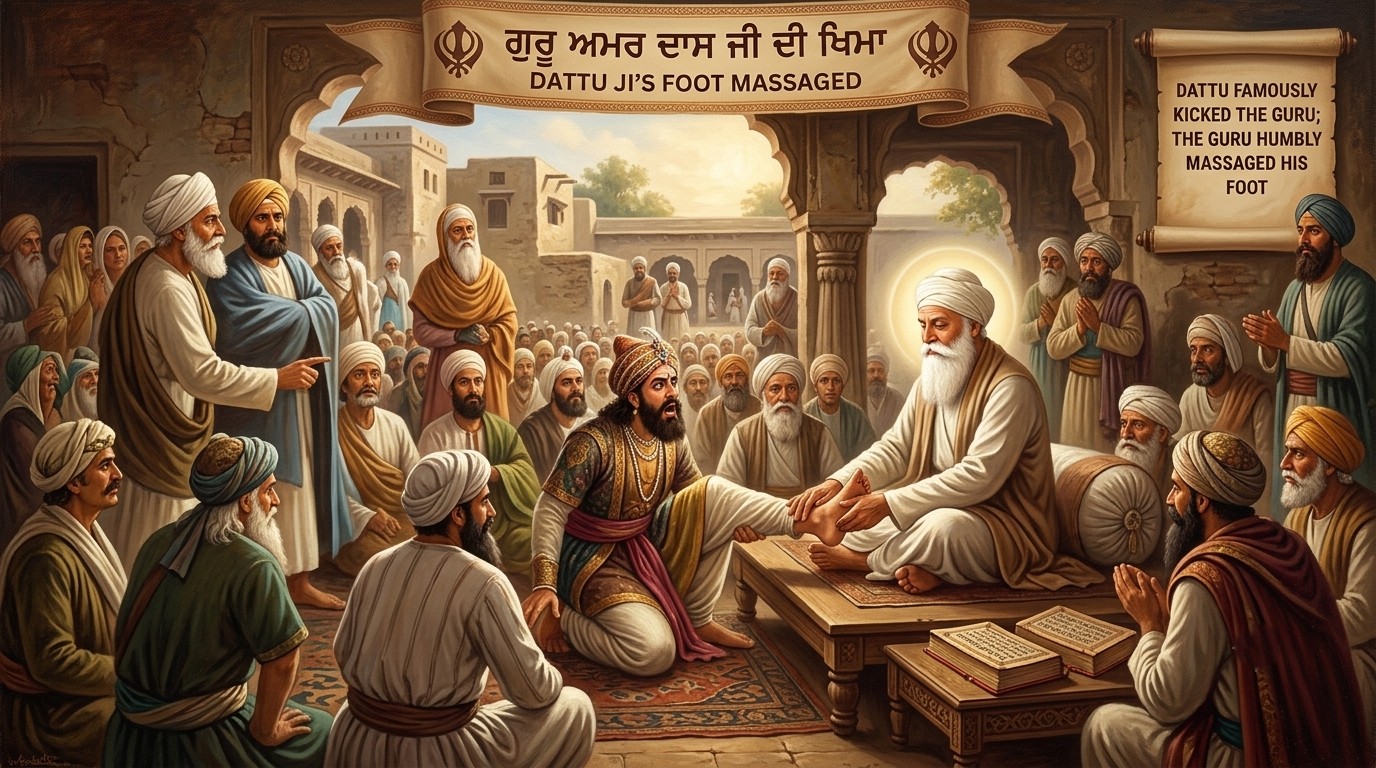
Datu ji: The Anatomy of Entitlement and the Grace of Goindwal
To understand the dramatic and spiritually pivotal encounter between Baba Datu Ji and Guru Amar Das Ji, one must first dissect the unique paradigm of spiritual succession established by the founders of the Sikh faith. Unlike the prevailing monarchical and spiritual traditions of sixteenth-century India, which heavily favored primogeniture and hereditary lineage, Guru Nanak Dev Ji introduced a revolutionary, merit-based system of succession. By bypassing his own sons, Baba Sri Chand and Baba Lakhmi Das, and appointing his devoted disciple, Bhai Lehna (who became Guru Angad Dev Ji), as his successor, Guru Nanak declared that the divine light of Guruship (the Jot) was not a physical inheritance to be passed down through blood, but a spiritual crown earned through absolute self-effacement, service, and love. When Guru Angad Dev Ji approached the sunset of his earthly journey, he faced a similar crucible. His sons, Baba Dasu Ji and Baba Datu Ji, had grown up in the aura of the Guruship, but they equated this spiritual authority with temporal royalty, mistaking the humble seat of service for a throne of dynastic power. When Guru Angad Dev Ji ultimately chose the septuagenarian disciple Baba Amar Das Ji—who had spent twelve years in rigorous, silent, and daily service of carrying water from the River Beas to Khadur Sahib—the decision shattered the biological entitlement of his biological heirs, setting the stage for a dramatic confrontation that would forever define the Sikh ethos of humility.
Baba Datu Ji’s resentment was not an isolated outburst, but the culmination of years of internalized social privilege and biological pride. In his eyes, Baba Amar Das Ji was not a divinely appointed guide, but an elderly interloper, a former Vaishnava pilgrim of advanced years who had come to their household as a servant and had now, inexplicably, ascended to the position of supreme spiritual authority. This psychological friction represents the eternal struggle between Haumai (the egoistic self-assertion) and Nimrata (absolute spiritual humility). Datu Ji’s refusal to accept the divine decree of his father was a rejection of the core tenets of the nascent Sikh faith. To Datu, the Gaddi (the spiritual throne) was property, a family heirloom that belonged to the direct descendants of Guru Angad. When Guru Amar Das Ji relocated the center of the Sikh community from Khadur Sahib to the newly established town of Goindwal, it was not merely a physical move, but an institutional boundary-marking that separated the pure, universal message of the Gurus from the localized dynastic claims of the Guru’s biological family. Goindwal quickly grew into a bustling spiritual metropolis, attracting seekers from all walks of life, which only served to fuel the burning embers of jealousy in Datu Ji's heart as he watched Khadur Sahib's influence diminish in comparison.
The Two Lineages: Biological Descent Versus Spiritual Absorption
As historians, we must examine the stark contrast between the lives of Baba Datu Ji and Guru Amar Das Ji to fully appreciate the gravity of the incident that occurred in the Goindwal Darbar. On one hand, Baba Datu Ji lived a life of relative comfort, shielded by the prestige of his father’s position, yet spiritually starved by his own refusal to submit to the transformative discipline of the Guru's path. He viewed the spiritual seekers who flocked to Goindwal through a lens of transaction, seeing them as subjects and sources of tribute rather than spiritual siblings. On the other hand, Guru Amar Das Ji’s path to the Guruship was forged in the fire of unparalleled physical and spiritual exertion. Despite his advanced age, he arose daily in the early hours of the morning, walked miles to the Beas River, filled a brass pitcher of water, and carried it on his shoulders back to Khadur Sahib for Guru Angad’s morning bath. He performed this grueling task in the freezing cold of winter, through heavy monsoon rains, and under the scorching summer sun, never once complaining, and never turning his back to his Master. This twelve-year-long masterclass in absolute surrender had completely dissolved Baba Amar Das's ego, making his body and mind a perfect, hollow vessel through which the divine light could flow unhindered. Thus, when the transition of Guruship took place, it was not a political appointment, but a recognition of ontological reality: Baba Amar Das had become spiritually identical to Guru Angad.
The tension between these two contrasting worldviews reached a boiling point when Baba Datu Ji, unable to bear the reports of Guru Amar Das Ji’s growing renown and the vast congregations gathering at Goindwal, decided to assert his claim by force. He traveled to Goindwal with a small cohort of supporters, determined to humiliate the elderly Guru and reclaim what he believed was his ancestral birthright. The historical records depict Datu Ji entering the Darbar (the court) not as a humble seeker of truth, but as an angry pretender to a temporal throne. He found Guru Amar Das Ji seated upon the low wooden platform, surrounded by devoted Sikhs who were absorbing the divine words of Gurbani. The sight of hundreds of men and women, including prominent nobles and long-time disciples, bowing their heads in deep reverence to the seventy-three-year-old Guru was a sight that Datu Ji’s fragile, entitlement-driven ego could not endure. In his mind, every bow directed at Guru Amar Das was a direct theft of the honor that belonged to him as the son of the second Guru.
The Incident at the Darbar: A Clash of Kingdoms
In a sudden, violent eruption of jealousy, Baba Datu Ji marched up to the elevated platform where Guru Amar Das Ji was seated. The congregation watched in stunned silence as Datu, his face flushed with rage, screamed words of vitriol, accusing the Guru of being a thief who had stolen his family's inheritance and deceived the masses. Then, in an act that shocked the entire assembly, Datu Ji raised his foot and kicked Guru Amar Das Ji squarely in the chest, knocking him completely off the low throne. This physical assault was not merely an attack on an elderly man; it was a violent desecration of the highest spiritual office of the Sikh faith. In any other court of the world, such an act of treason and violence would have met with immediate, lethal retaliation from the guards or the devoted followers present in the room. The Sikhs in the congregation, deeply protective of their beloved spiritual guide, instinctively reached for weapons or prepared to physically subdue the attacker, their hearts filled with righteous indignation at this unspeakable insult.
What followed, however, is one of the most sublime and transformative moments in human spiritual history. Instead of showing even a flicker of anger, indignation, or defensive posture, Guru Amar Das Ji immediately rose to his feet. He did not look at Datu with judgment or resentment; instead, his eyes were filled with the deep, maternal compassion that characterizes a true Knower of the Divine. Kneeling down before his young, aggressive assailant, Guru Amar Das Ji took Datu Ji's foot—the very foot that had just struck his chest—and began to gently, lovingly massage it with his hands. In a voice dripping with genuine sweetness and profound humility, the Guru spoke words that have echoed down through the centuries: "My old bones are hard and dry, my prince. Your tender feet must have been hurt when you kicked me."
The Theological Meaning of the Guru's Response
- The Dissolution of Dualism: By treating his attacker not as an enemy but as a precious guest whose comfort was paramount, Guru Amar Das Ji demonstrated the practical application of the Vedantic and Gurmat principle of non-duality—seeing the Divine in both the victim and the oppressor.
- Active Humility (Nimrata) as Spiritual Power: The Guru's response was not a sign of physical weakness, cowardice, or submissiveness. It was an active, explosive demonstration of spiritual sovereignty that disarmed the aggressor far more effectively than any physical weapon ever could.
- The Subversion of Social Hierarchy: In sixteenth-century India, a younger person kicking an elder, let alone a spiritual master, was a profound taboo. By reversing the roles and massaging the feet of the youth, the Guru completely dismantled the rigid social structures of pride and seniority.
The Aftermath: The Silence at Basarke and the Lessons of History
Baba Datu Ji, though momentarily stunned and deeply embarrassed by the Guru's lack of retaliation, was still too consumed by his pride to fully appreciate the divine grace he had just witnessed. He proceeded to loot the Goindwal treasury, seizing the gold, horses, and valuable offerings that had been brought by the Sangat, and began his journey back to Khadur Sahib, believing he had successfully asserted his dominance. However, history records a profound karmic irony. On his way back, Datu’s caravan was ambushed by a band of robbers who stripped him of all his stolen wealth. During the scuffle, Datu suffered a severe injury to the very same leg and foot with which he had kicked Guru Amar Das Ji. The wound turned gangrenous, causing him excruciating pain for many years—a physical manifestation of the spiritual sickness of his ego, which served as a stark reminder to the community of the spiritual consequences of insulting a true saint.
Meanwhile, Guru Amar Das Ji, in his infinite wisdom and desire to prevent further conflict within the family of his predecessor, quietly slipped away from Goindwal under the cover of night. He did not wish to be the cause of any division or bloodshed. He walked to his ancestral village of Basarke, where he locked himself inside a small, mud-walled cottage. On the door, he hung a written notice containing a strict, solemn warning: "He who opens this door is no Sikh of mine, and I am no Guru of his." The Guru wished to immerse himself in deep meditation, allowing the turbulent waters of familial jealousy to settle, and testing the devotion, resilience, and patience of the Sikh Sangat.
The disappearance of the Guru plunged the Sikh community into a state of deep grief and spiritual disorientation. The Sangat at Goindwal felt orphaned. Eventually, a delegation of prominent Sikhs, led by the venerable Baba Buddha Ji, set out to locate their master. Guided by the Guru's faithful mare, which they allowed to wander freely, they were led directly to the locked cottage in Basarke. Upon reading the severe warning on the door, the Sikhs were caught in a profound spiritual dilemma: they could not open the door without violating their Guru's command, yet they could not live without his darshan (presence). Showing the creative intelligence that comes from deep love, Baba Buddha Ji decided that they would not open the door; instead, they would break through the mud wall at the back of the house. By entering through a hole in the wall, they bypassed the literal command of the door-notice while fulfilling the higher spiritual law of devotion. This historic site is preserved to this day as Gurdwara Sanh Sahib, symbolizing the truth that when the door of grace seems closed due to our shortcomings, the wall of devotion must be broken through with love.
Ego Versus Humility: A Historical Comparison
To summarize the deep ideological differences between the path of the ego (represented by Baba Datu Ji) and the path of divine submission (represented by Guru Amar Das Ji), we can examine their characteristics through the following historical lens:
| Dimension | The Path of Baba Datu Ji (Haumai / Ego) | The Path of Guru Amar Das Ji (Nimrata / Humility) |
| Source of Authority | Biological descent, familial lineage, and physical inheritance. | Spiritual absorption, selfless service (Seva), and divine selection. |
| Response to Conflict | Physical violence, verbal abuse, public humiliation, and theft. | Gentle touch, sweet words, concern for the opponent's well-being, and quiet retreat. |
| Ultimate Outcome | Physical pain, loss of stolen wealth, and historical obscurity as an antagonist. | Consolidation of the Sikh community, institutional expansion, and eternal spiritual glory. |
In conclusion, as we look back across the centuries at this dramatic encounter, we see that the kick of Baba Datu Ji was not a historical tragedy, but a divine catalyst. It provided Guru Amar Das Ji with the ultimate stage upon which to demonstrate the true meaning of Gurmat. The Guru showed that patience is not a passive surrender to injustice, but a dynamic, active force that absorbs violence and transforms it into an opportunity for spiritual instruction. By massaging the foot of his attacker, Guru Amar Das Ji taught the infant Sikh community that the true conquest is not over others, but over one's own ego. This legacy of supreme patience, deep compassion, and absolute humility remains the bedrock of the Sikh character, reminding every generation of Sikhs that no matter how hard the bones of our trials may be, our hearts must remain soft enough to heal those who strike us.
Guru Amar Das Ji (1479–1574)
Famously kicked Guru Amar Das Ji in a fit of jealousy; the Guru humbly massaged his foot, saying his old bones were too hard, demonstrating supreme patience.
- Role
- Son of Guru Angad Dev Ji
- Group
- Family & Successors
- Period
- Guru Amar Das Ji (1479–1574)