Sikh Sakhis · Origins & Gurus · Guru Amar Das Ji · Guru Ram Das Ji
Emperor Akbar sat on the floor and eat in the Langar
Visited the Guru at Goindwal. He was famously asked to sit on the floor and eat in the Langar (Pangat) before meeting the Guru (Sangat), leading him to waive taxes on the region.
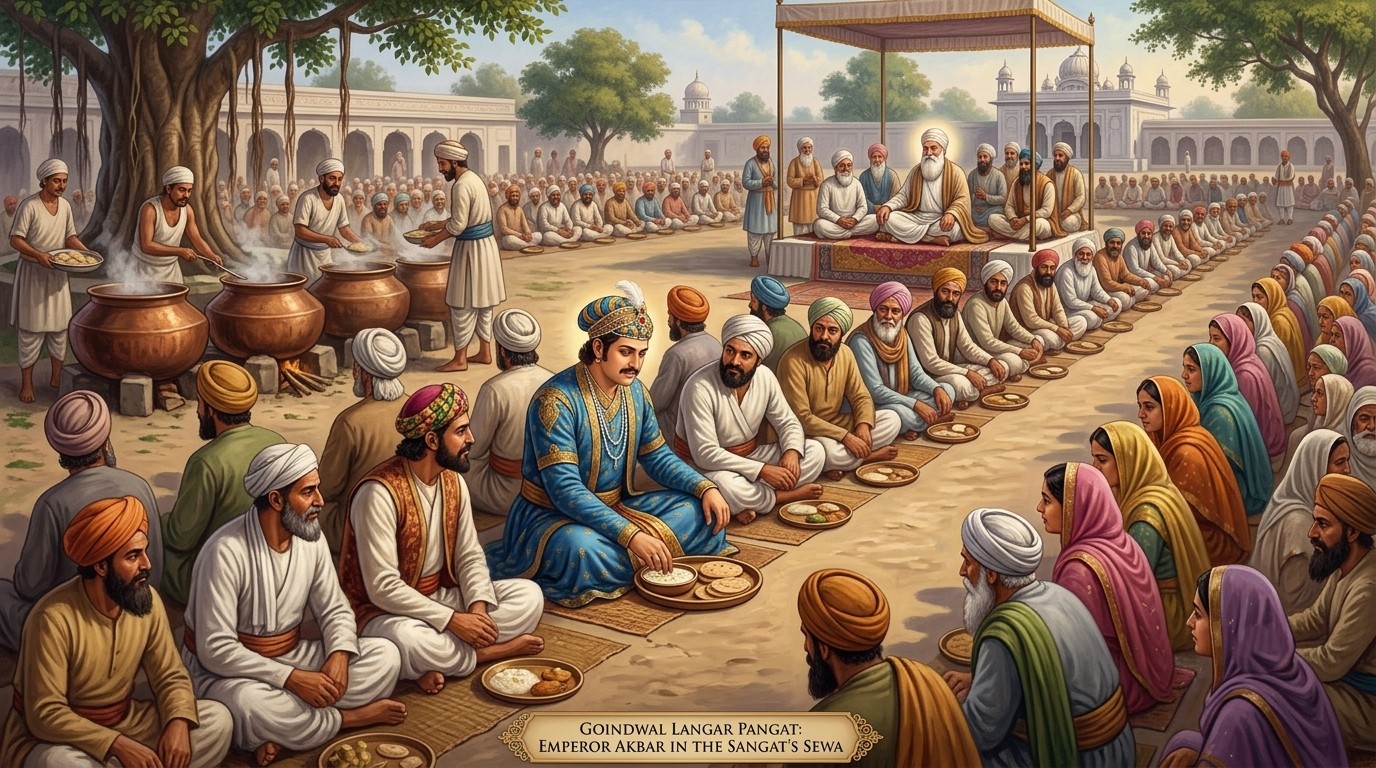
The Confluence of Sovereignties: Medieval India and the Goindwal Court
In the mid-sixteenth century, the Indian subcontinent stood at a critical historical crossroads. The Mughal Empire, under the ambitious and intellectually inquisitive leadership of Jalal-ud-din Muhammad Akbar, was consolidating its absolute political, military, and administrative hegemony over northern India. Yet, parallel to this expanding temporal empire, a radical spiritual and social revolution was silently taking root in the heart of Punjab. Under the guidance of Guru Amar Das Ji, the third Sikh Sovereign, the town of Goindwal Sahib had emerged not merely as a geographic center of the young Sikh faith, but as a revolutionary counter-cultural space that directly challenged the deeply entrenched hierarchies of medieval feudalism and the caste system. To the modern Sikh historian, the meeting between Emperor Akbar and Guru Amar Das Ji in 1569 is not a simple, isolated anecdote of royal curiosity; it represents a momentous ideological encounter between two distinct forms of sovereignty—the temporal, tribute-collecting power of the Mughal state and the spiritual, egalitarian sovereignty of the Guruship.
At Goindwal, Guru Amar Das Ji was systematically building the institutional infrastructure of the Sikh Panth, organizing the community into administrative zones called Manjis and establishing centralized protocols for communal gathering. The region was rapidly becoming a beacon for seekers, peasants, and outcasts who sought refuge from the dual oppressions of Hindu caste tyranny and Mughal tax exploitation. Emperor Akbar, who was actively seeking to understand the diverse religious landscape of his empire to stabilize his rule, heard reports of this flourishing, peaceful spiritual center. His journey to Goindwal was motivated by a mixture of genuine spiritual inquiry, administrative surveillance, and a desire to meet a master whose influence over the agrarian masses of Punjab was growing exponentially. However, upon his arrival at the gates of the Guru's court, the great Mughal Emperor—accustomed to absolute submissiveness and grand courtly rituals—was confronted with a revolutionary social directive that would level all temporal distinctions and redefine the nature of human equality.
The Radical Theology of Pangat: Equality Prior to Communion
Before Emperor Akbar could be granted a private audience with Guru Amar Das Ji, he was informed of a strict, non-negotiable protocol that governed the Guru’s court: "Pehle Pangat, Peeche Sangat"—which translates to "First sit in the communal kitchen line, and only then enter the holy congregation." For a modern observer, this might seem like a simple hospitality requirement, but in sixteenth-century India, it was a social earthquake. The concept of Pangat, established by Guru Nanak Dev Ji and vigorously institutionalized by Guru Amar Das Ji, required every single visitor, regardless of birth, creed, gender, wealth, or political power, to sit cross-legged on the bare floor in a straight, unbroken line and eat the same simple, vegetarian meal cooked in a communal kitchen (Langar).
In a society governed by the rigid, ritualistic purity laws of Brahmanical orthodoxy, communal dining was strictly forbidden. High-caste Brahmins and ruling Kshatriyas would never dine with Shudras or outcasts, believing that even the shadow of a low-caste person falling upon their food would render it impure. By mandating that everyone must sit together on the floor to eat before they could even speak to the Guru, Guru Amar Das Ji was not merely offering free food; he was actively dismantling the psychological and structural foundations of the caste system. By enforcing this rule on the Mughal Emperor himself, the Guru made a profound theological and political statement: in the court of the Divine, there are no emperors and no outcasts, no rulers and no subjects—only human beings sharing the bounty of the earth. Akbar’s willing compliance with this directive was a historic acknowledgement of the spiritual authority of the Sikh court, demonstrating that even the ruler of Hindustan had to strip himself of his imperial pride and sit as an equal among the common peasantry.
The Emperor on the Floor: A Visual Leveling of Imperial Grandeur
The visual spectacle of Emperor Akbar sitting on the dusty floor of the Goindwal Langar, flanked on either side by simple farmers, low-caste weavers, and untouchables, remains one of the most powerful images in Sikh historiography. Akbar’s royal retinue, consisting of proud mansabdars, generals, and court advisors, was forced to witness their supreme monarch abandon the gilded cushions of the imperial throne to sit cross-legged among the masses. They ate the simple, nutritious vegetarian fare—typically lentils, flatbread, and water—served by volunteers who themselves came from all walks of life. This act of dining together was a profound ritual of reconciliation, stripping away the artificial armor of social status and exposing the shared humanity of all participants.
Sikh historians emphasize that Akbar was deeply moved by the absolute serenity, order, and genuine humility that pervaded the Langar. He observed that the volunteers served the food with a sense of devotion that money could never buy, and that the attendees ate in a spirit of quiet gratitude, free from the fear and sycophancy that characterized his own imperial darbar. In this moment, the concept of the Pangat transcended its functional purpose and became a living, breathing model of the divine kingdom on earth. Akbar realized that the spiritual empire of Guru Amar Das Ji was built not on military subjugation or fiscal extraction, but on the unassailable foundation of love, equality, and mutual respect. This experience profoundly influenced Akbar's own philosophical outlook, contributing directly to his evolving policy of universal tolerance (Sulh-i-kul) and his later attempts to foster interfaith harmony across his empire.
The Sacred Dialogue: Spiritual Exchange and the Refusal of Royal Patrons
Following his participation in the Langar, Emperor Akbar was ushered into the presence of Guru Amar Das Ji. The physical contrast between the two figures was striking: the young, powerful Emperor in his rich silks and jewels sat before an eighty-year-old saint dressed in simple, home-spun coarse cotton. Yet, the spiritual authority that radiated from the Guru immediately commanded the Emperor's deepest respect. Akbar bowed before the Guru, and a long, profound dialogue ensued. Rather than discussing geopolitics, borders, or military alliances, their conversation centered on the nature of divine light, the spiritual duties of a ruler, and the path to inner peace. Akbar expressed his immense admiration for the Guru’s work, stating that he had never witnessed such peace, equality, and genuine communal harmony in any court, temple, or mosque throughout his vast travels.
In a gesture of royal patronage and goodwill, Akbar offered to grant a massive jagir—a multi-village estate consisting of fertile land revenues—to support the perpetual running of the Goindwal Langar. However, Guru Amar Das Ji politely but firmly declined the imperial gift. The Guru explained that the Langar was a sacred institution that belonged to the people, and it must survive solely on the voluntary, honest, and hardworking contributions of the devotees themselves—a principle known as Vand Chhako (share your honest earnings). The Guru maintained that if the Langar were to accept royal endowments, it would lose its independent, democratic character and become dependent on the shifting whims of temporal rulers. This refusal was a vital historical assertion of Sikh sovereignty, establishing that the institutions of the Panth would never become clients or dependencies of any earthly empire, remaining forever self-sustaining and accountable only to the Sangat.
The Waiving of Taxes: Statecraft, Benevolence, and Agrarian Relief
Though Guru Amar Das Ji steadfastly refused any direct imperial land grants or financial endowments for the Langar, Emperor Akbar remained desperate to show his profound respect and leave a lasting token of his reverence. Recognizing that the Guru's heart beat in unison with the struggles of the common people, Akbar asked how he could serve the community in a way that aligned with the Guru's teachings. The Guru pointed out that Punjab was currently suffering from a severe drought, and the local peasantry was facing extreme hardship, struggling to pay the heavy agricultural taxes (Lagaan) demanded by the Mughal imperial treasury. The Guru requested that the Emperor show mercy to the farmers who fed the nation but were currently facing starvation.
Deeply moved by the Guru's selfless advocacy for the agrarian masses, Akbar immediately issued an imperial decree waiving the land revenue taxes for the entire province of Punjab for that year. This act of statecraft brought immense, lifesaving relief to hundreds of thousands of peasant families, preventing a catastrophic famine. From a historical perspective, this event was of monumental significance: it demonstrated that the spiritual court of the Guru possessed the moral authority to influence the fiscal policies of the mightiest empire in the world. By successfully advocating for tax relief, Guru Amar Das Ji cemented his role as the protector of the poor and the marginalized, showing that the Sikh spiritual mission was intrinsically tied to the material welfare, social justice, and economic relief of the oppressed masses.
The Legacy of Goindwal: The Blueprint for a Sovereign and Just Society
The historic encounter between Emperor Akbar and Guru Amar Das Ji at Goindwal Sahib established a permanent blueprint for the social, political, and spiritual identity of the Sikh Panth. It proved that the theological principles of Sikhism were not abstract, cloistered philosophies, but active, lived realities that could confront and humanize even the most powerful temporal rulers. The strict enforcement of Pangat before Sangat sent a shockwave through the caste-ridden society of India, encouraging millions of low-caste individuals to reclaim their divine dignity and join the egalitarian fold of the Gurus. The Goindwal court became a living model of a parallel, just society where the only currency was selfless service, and the only hierarchy was spiritual humility.
For Sikh historians, this Sakhi is also a critical early chapter in the complex, century-long relationship between the Sikh Gurus and the Mughal state. While later emperors like Jahangir and Aurangzeb would abandon Akbar’s policies of tolerance and resort to brutal persecution, the meeting at Goindwal established an unassailable precedent of Sikh sovereign independence. It proved that the Guru's court did not exist by the grace of the Mughal emperor, but stood as a self-sustaining, divine institution that commanded the respect of monarchs while remaining fiercely independent of them. The legacy of Goindwal continues to shine brightly in every free kitchen operated in Gurdwaras worldwide today, serving as a constant reminder that true spiritual devotion is inseparable from radical social equality and active advocacy for the poor.
Comparative Analysis of Sovereignty: The Mughal State vs. The Sikh Panth
| Dimension of Sovereignty | The Mughal Empire (Temporal Sovereignty) | The Sikh Panth (Spiritual & Egalitarian Sovereignty) |
| Source of Authority | Military conquest, dynastic lineage, and divine right of kings. | Divine Revelation (Gurbani), internal spiritual purity, and selfless service. |
| Social Structure | Strictly hierarchical, aristocratic, divided into rigid nobility (mansabdars) and subjects. | Radically egalitarian, dismantling caste, gender, and economic barriers through Pangat. |
| Economic Basis | Taxation, agricultural extraction (lagaan), and tributary payments. | Voluntary, honest labor (Kirat Karni) and communal sharing (Vand Chhako). |
| Communal Eating (Langar) | Highly restricted; dining was a marker of royal favor, class division, and social exclusion. | Universal, unrestricted, and mandatory communal dining sitting on the floor as equals. |
| Incentive for Action | Territorial expansion, accumulation of imperial wealth, and dynastic glory. | Upholding social justice, spiritual liberation (Mukti), and the welfare of all (Sarbat da Bhala). |
Frequently Asked Questions
1. What is the historical significance of Emperor Akbar's visit to Goindwal Sahib?
Emperor Akbar’s visit to Goindwal Sahib in 1569 represents a critical historical encounter between the temporal sovereignty of the Mughal Empire and the spiritual sovereignty of the Sikh Guruship. It validated the growing social and spiritual influence of the Sikh Panth, demonstrated the universal appeal of the Gurus' teachings, and established a historic precedent of the Mughal crown bowing to the egalitarian principles of the Sikh faith.
2. What does "Pehle Pangat, Peeche Sangat" mean, and why was it enforced on the Emperor?
The phrase translates to "First sit in the communal kitchen line (Pangat), and only then enter the holy congregation (Sangat)." It was a non-negotiable rule established by Guru Amar Das Ji to ensure that every visitor stripped themselves of social pride, caste distinctions, and worldly power before meeting the Guru. Enforcing this on Emperor Akbar proved that in the house of the Guru, all human beings are radically equal.
3. Why did communal dining (Pangat) represent such a radical social revolution in sixteenth-century India?
During this era, Indian society was strictly divided by the Hindu caste system, which enforced severe ritual purity laws. High-caste individuals would never sit or eat with low-caste individuals or "untouchables," believing it polluted their food and souls. Pangat forced people of all castes, creeds, genders, and statuses to sit side-by-side on the floor as equals, effectively shattering the social and psychological foundations of caste tyranny.
4. How did Emperor Akbar react to being asked to sit on the floor and eat in the Langar?
Emperor Akbar, who possessed a deeply inquisitive mind and a respectful attitude toward spiritual masters, willingly and humbly accepted the protocol. He stripped himself of his royal grandeur, sat cross-legged on the dusty floor alongside commoners and peasants, and ate the simple, vegetarian food served in the Langar. He was deeply moved by the peace, humility, and absolute equality of the institution.
5. Why did Guru Amar Das Ji refuse Emperor Akbar's offer of a land grant (Jagir)?
Guru Amar Das Ji refused the Emperor's offer of a massive estate to support the Langar because he wanted the institution to remain entirely independent and democratic. The Guru believed that the Langar must run solely on the honest, voluntary, and hardworking contributions of the common devotees (Vand Chhako), ensuring it would never become a client or dependency of the state.
6. What alternative act of reverence did Emperor Akbar perform after the Guru refused his land grant?
After the Guru declined the land grant, Akbar asked how else he could serve. The Guru pointed out the severe drought in Punjab and the struggles of the local peasantry to pay agricultural taxes. In response, Akbar immediately issued an imperial decree waiving the land revenue taxes for the entire region of Punjab for that year, bringing lifesaving relief to hundreds of thousands of farmers.
7. How did this meeting influence Emperor Akbar's own state policies?
The absolute equality, harmony, and peace Akbar witnessed at Goindwal Sahib deeply influenced his philosophical and religious views. It contributed significantly to his policy of universal tolerance (Sulh-i-kul) and his later creation of the "Din-i-Ilahi," a syncretic philosophy aimed at bridging religious divides across his vast empire.
8. Who was the Guru during this historic visit, and what was his contribution to Sikh institutions?
The Guru during this visit was Guru Amar Das Ji, the third Sikh Sovereign. His major contributions include the rigorous institutionalization of Langar and Pangat, the creation of the 22 administrative zones (Manjis) to spread Sikhism, the excavation of the Baoli Sahib (stepped well) at Goindwal, and the active promotion of women's equality by banning the veil (Ghoonghat) and the practice of Sati.
9. How does this Sakhi relate to the modern practice of Langar in Gurdwaras?
This Sakhi is the foundational template for the modern practice of Langar. To this day, in every Gurdwara across the world, people of all faiths, backgrounds, and economic classes must sit together on the floor in straight lines to eat the same free vegetarian food, keeping the legacy of radical equality established at Goindwal alive.
10. What is the long-term historical legacy of the Goindwal encounter for the Sikh Panth?
The encounter solidified the sovereign, independent identity of the Sikh Panth. It proved that the Guru's court did not seek imperial patronage or validation, but stood as a self-sustaining spiritual state. It also established the Sikh tradition of social activism, showing that spiritual leaders must actively advocate for the economic and physical relief of the poor and oppressed against state exploitation.
Guru Amar Das Ji (1479–1574)
Visited the Guru at Goindwal. He was famously asked to sit on the floor and eat in the Langar (Pangat) before meeting the Guru (Sangat), leading him to waive taxes on the region.
- Role
- Mughal Emperor
- Group
- The Mughal Throne
- Period
- Guru Amar Das Ji (1479–1574)
Guru Ram Das Ji (1534–1581)
Maintained a deep respect for the Guru. He granted the land (or waived taxes on the purchase) where the city of Amritsar and the holy Sarovar were developed.
- Role
- Mughal Emperor
- Group
- The Mughal Administration
- Period
- Guru Ram Das Ji (1534–1581)