Sikh Sakhis · Origins & Gurus · Guru Angad Dev Ji
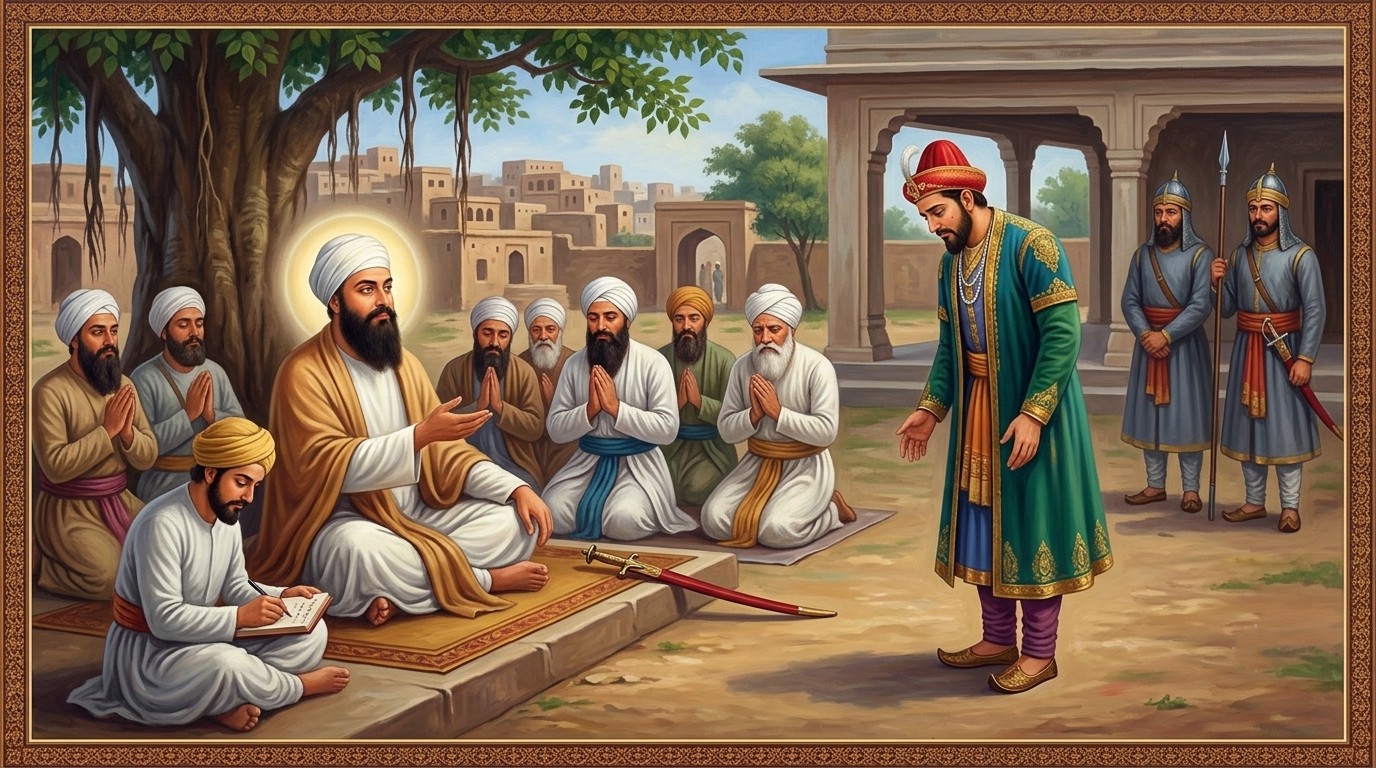
Emperor Humayun sought the Guru's blessing after his defeat by Sher Shah Suri
Sought the Guru's blessing after his defeat by Sher Shah Suri. When he grew angry at being ignored during meditation, the Guru reminded him of his cowardice on the battlefield.
The Illusion of the Crown: Setting the Stage of 1540 for the Modern Youth
Imagine losing everything you have worked for in a single day. Your status, your influence, your security, and your identity—gone in a flash of smoke and defeat. This was not just a theoretical nightmare; it was the harsh reality faced by Nasir-ud-din Muhammad Humayun in the spring of 1540. He was the absolute monarch of the Mughal Empire, inheriting a vast realm won by his father Babur's brutal military campaigns. Yet, in a stunning turn of events, a brilliant Afghan general named Sher Shah Suri completely dismantled Humayun’s armies at the battles of Chausa and Kannauj. Overnight, the Emperor of India was reduced to a desperate fugitive, fleeing for his life through the dust of Punjab with a handful of demoralized guards. For our young adults navigating the high-pressure world of today, Humayun’s crisis is highly relatable. We often tie our entire self-worth to external markers—grades, career titles, social media clout, and material wealth—forgetting how quickly these temporary crowns can slip from our heads. Humayun was about to learn that true, unshakeable sovereignty does not come from a throne of gold, but from the spiritual alignment of the soul.
As Humayun crossed the Punjab plains in a state of utter desperation, his advisors suggested he seek out the court of Guru Angad Dev Ji, the second spiritual sovereign of the Sikhs, who was then establishing a revolutionary community at Khadur Sahib. The rumor across Hindustan was that the successor of Guru Nanak Dev Ji possessed an immense, divine spiritual power that could alter destinies. Humayun, driven by a mixture of superstition, political desperation, and a lingering sense of entitlement, decided to visit. He believed that by securing a blessing from this famous dervish, he could miraculously reverse his military failures and reclaim his lost empire. But the young Emperor did not realize that the court of Guru Angad Dev Ji was not a place for transactional magic or political bargaining. It was an arena of absolute truth, where the illusions of worldly power were systematically stripped away, and where the only currency that mattered was humility, devotion, and selfless service to humanity.
Inside the Mal Akhara: The Revolutionary, Active Spirituality of Khadur Sahib
My dear young friends, let us paint a picture of what Khadur Sahib looked like when the Emperor of India rode into its streets. Humayun probably expected to find a solemn, quiet monastery filled with ascetic monks sitting in silent isolation, detached from the physical world. Instead, he stepped directly into a vibrant, high-energy revolution. Guru Angad Dev Ji had established the Mal Akhara—a community wrestling arena where the youth of Punjab gathered daily to train their bodies, build physical strength, and break down caste barriers through sport. In an era where spiritual seekers were told to starve their bodies and escape into the mountains, Guru Angad Dev Ji preached a radical, holistic theology: the physical body is the sacred temple of the Divine, and it must be kept strong, healthy, and ready for action. The Guru sat on the edge of this muddy wrestling ground, completely absorbed in watching the youth wrestle, while simultaneously teaching children the newly standardized Gurmukhi script.
This scene is a massive wake-up call for our generation, which often struggles to balance the physical, mental, and spiritual aspects of life. Guru Angad Dev Ji was actively dismantling the caste system by forcing Brahmins, Shudras, peasants, and merchants to strip down, wrestle in the same mud, and eat together in the communal Langar. It was a space of radical equality and physical empowerment. When the heavily armed Mughal Emperor and his royal entourage arrived, expecting the entire village to fall to their knees in fearful prostration, nothing changed. The wrestlers kept wrestling, the children kept learning their letters, and the Guru remained deeply focused on his disciples. There were no royal trumpets, no courtly bows, and no immediate welcomes. The spiritual court of Guru Nanak Dev Ji operated on its own sovereign frequency, completely independent of the political theater of Delhi.
The Flash of Steel: Wounded Pride and the Imperial Reflex
To stand ignored in the dust of a Punjabi village was an intolerable insult to Humayun's fragile, bruised ego. He was a man who had been raised to believe that his very breath was sacred, that his word was absolute law, and that entire populations existed merely to serve his dynasty. Having just lost his empire to Sher Shah Suri, his identity as a supreme ruler was incredibly vulnerable. When Guru Angad Dev Ji did not immediately rise, bow, or pause his holy work to acknowledge his imperial presence, Humayun’s psychological defense mechanism kicked in. How many of us, when faced with a perceived slight or a lack of validation, react with immediate anger and defensiveness? Humayun did exactly that, but with deadly stakes. His hand moved instinctively to the hilt of his heavy, gold-chased imperial sword, and he began to draw the sharp blade from its scabbard, intending to strike down the serene Guru who dared to ignore him.
This moment is one of the most dramatic and philosophically charged standoffs in human history. Imagine the sudden silence that fell over the Mal Akhara. The sound of wrestling ceased, the children gasped, and the Guru's close disciples stepped forward, ready to shield their beloved Master with their own bodies. Yet, Guru Angad Dev Ji did not flinch, look for a weapon, or call for help. The Guru’s face remained an ocean of absolute calm, reflecting a soul that had completely conquered the fear of death. Humayun’s drawn sword was the ultimate symbol of temporal tyranny—a physical tool designed to coerce, terrify, and destroy. But in the presence of the Guru, this sword was exposed as a pathetic, empty gesture of an insecure man trying to hide his own massive failures. The Guru turned his gaze directly toward the eyes of the trembling Emperor, preparing to deliver a spiritual lesson that would echo through the centuries.
The Searing Rebuke: Guru Angad Dev Ji Deconstructs False Power
With absolute poise, Guru Angad Dev Ji looked at the glinting steel of Humayun's sword and delivered a verbal strike that pierced deeper than any blade could ever go. The Guru calmly asked: "Where was this sword of yours when you were facing Sher Shah Suri on the battlefields of Chausa and Kannauj? Why did it remain sheathed when your kingdom was being wrested from you by an Afghan soldier? You fled the battlefield like a coward to save your own skin, yet today, you draw this very sword with great pride against a peaceful gathering of dervishes, saints, and children who have no weapons to fight you."
Let those words sink in, my friends. The Guru did not sugarcoat the truth. He called out the absolute hypocrisy that lies at the heart of all earthly tyranny. Humayun’s military power was a selective, cowardly force—incapable of defending his subjects or his throne when faced with a real challenger, yet quick to terrorize the unarmed and the spiritual. By highlighting his cowardice and defeat at the hands of Sher Shah Suri, the Guru forced Humayun to look into a mirror and see himself for what he truly was: a broken, defeated refugee clinging to a useless piece of steel. The Guru’s rebuke was not born out of hatred or spite, but out of a deep, compassionate desire to wake Humayun up from his spiritual slumber. The heavy sword suddenly felt incredibly useless in the Emperor's hand, and his imperial armor felt paper-thin under the weight of the Guru's moral authority.
The Chemistry of Humility: Repentance and the Prophecy of Return
What happens when we are confronted with our deepest, darkest flaws? We can either double down on our pride and strike out, or we can allow our ego to break and let grace enter. Humayun chose the path of grace. The Guru’s words acted like a spiritual lightning bolt, shattering the thick crust of arrogance that had blinded him for years. The sheer embarrassment of his action washed over him, followed by a profound wave of spiritual shame. Humayun slowly pushed the sword back into its scabbard, fell to his knees in the dust of Khadur Sahib, bowed his head to the holy feet of Guru Angad Dev Ji, and cried out for forgiveness. In that singular moment of absolute surrender, the Mughal Emperor acknowledged that his temporal sword was completely subordinate to the spiritual sceptre of the Guruship.
Seeing that the proud monarch had successfully undergone this painful spiritual ego-death, Guru Angad Dev Ji’s demeanor shifted from fierce justice to maternal compassion. The Guru explained to the weeping king that his defeat was actually a divine blessing in disguise, a spiritual medicine designed to teach him the essential qualities of a true leader. The Guru then blessed Humayun and made a prophetic declaration: "Go, find your refuge in exile. You must wander across the lands, endure hardships, and learn the lessons of true justice. When you have cultivated genuine humility and learned to rule with compassion rather than tyranny, you shall return to this land, regain your lost empire, and restore your throne." This was not a cheap political prediction; it was a spiritual covenant. The Guru was teaching Humayun—and indeed, all of us—that the only kingdom worth ruling is the one we govern with justice, mercy, and humility.
Two Dynasties, Two Paradigms: A Comparative Analysis of Power
To help us systematically understand the clash of values that occurred on that historic afternoon at Khadur Sahib, let us examine the fundamental differences between the transient power of the Mughal Empire and the eternal sovereignty of the Sikh Panth:
| Dimension of Power | The Temporal Mughal Empire (Humayun) | The Spiritual Sikh Panth (Guru Angad Dev Ji) |
| Primary Currency | Fear, military intimidation, dynastic lineage, and material wealth. | Love, selfless service (Seva), humility, and divine wisdom (Gyan). |
| Sovereign Symbol | The physical sword of steel, used to conquer and dominate others. | The pen of Gurmukhi and the arena of the Mal Akhara, used to elevate others. |
| Reaction to Failure | Defensiveness, wounded pride, and blaming external circumstances. | Unshakeable equanimity, radical honesty, and absolute composure. |
| Socio-Political Focus | Centralization of imperial power and extraction of agrarian taxes. | Eradication of caste divisions and democratization of education and fitness. |
| Theological Takeaway | Power is an external possession that can be lost at any moment. | Power is an internal state of soul-sovereignty that no one can steal. |
The Living Legacy: Why This Sakhi Matters to the Khalsa Youth Today
My beloved young adults, the story of Humayun and Guru Angad Dev Ji is not just a dusty historical record; it is a living blueprint for how we should carry ourselves in the modern world. Humayun’s return to power in 1555, after fifteen years of grueling exile, precisely fulfilled the Guru’s prophecy, setting a tone of deep, generational respect for the house of the Gurus within the early Mughal dynasty. This respect directly influenced Humayun’s son, Emperor Akbar, who famously visited Guru Amar Das Ji at Goindwal, sat on the floor with commoners to eat Langar, and exempted the region's peasants from heavy taxes. This Sakhi proves that when we stand firmly in our spiritual values, even the mightiest rulers of the world are forced to bow before the light of truth.
Today, as we navigate a world filled with peer pressure, mental health struggles, and the constant urge to conform, let us remember the Mal Akhara of Khadur Sahib. Let us build our bodies to be strong, our minds to be sharp through education, and our souls to be sovereign through the practice of Naam Simran. When life throws challenges at you, do not react with the defensive, fragile ego of a Humayun. Do not draw your mental swords of anger, arrogance, or despair. Instead, channel the unshakeable, royal composure of Guru Angad Dev Ji. Let us rise above the temporary, fleeting crowns of this world and strive to inherit the eternal, spiritual crown of the Khalsa—a crown that is won not by conquering others, but by conquering our own minds. Stay strong, stay humble, and let the light of the Gurus guide your path forever.
Frequently Asked Questions
1. What is the historical context of Emperor Humayun's visit to Guru Angad Dev Ji?
The visit occurred in 1540 after Humayun was decisively defeated by the Afghan ruler Sher Shah Suri at the Battle of Chausa and the Battle of Kannauj. Humayun was fleeing westward toward Sindh and stopped at Khadur Sahib to seek the spiritual blessings of Guru Angad Dev Ji in a desperate bid to reclaim his lost empire.
2. What was the "Mal Akhara" and why was it significant to this story?
The Mal Akhara was a community wrestling arena established by Guru Angad Dev Ji at Khadur Sahib to promote physical fitness, health, and equality. It was significant because it served as the physical setting for the encounter, showing that the Sikh Gurus promoted an active, physical, and highly disciplined lifestyle rather than passive asceticism.
3. Why did Guru Angad Dev Ji not immediately greet Emperor Humayun?
The Guru was deeply absorbed in teaching children the Gurmukhi script and supervising the young athletes wrestling in the arena. The Guru did not ignore the Emperor out of malice, but to demonstrate that in the house of the Guru, all human beings are equal, and the material titles and pride of a temporal king hold no special privilege.
4. Why did Emperor Humayun draw his sword against the Guru?
Humayun was struggling with a highly fragile imperial ego after losing his empire. When the Guru did not immediately rise to welcome him, Humayun felt deeply insulted and ignored. Driven by impulsive pride and the royal habit of resolving conflicts through immediate violence, he reached for his sword and began to draw it from its scabbard.
5. What was Guru Angad Dev Ji's reaction when the sword was drawn?
Guru Angad Dev Ji remained completely calm and untroubled. He did not show any fear, anger, or defensive posture. Instead, he looked directly into the Emperor’s eyes with absolute composure and spiritual authority, exposing the cowardice of Humayun’s threat.
6. What did the Guru say to shame the Emperor?
The Guru asked Humayun where his sword was when he was facing Sher Shah Suri on the battlefield. He pointed out that Humayun sheathed his sword and fled like a coward to save his own life against a real military threat, yet dared to draw it against a peaceful gathering of saints, dervishes, and children who carried no weapons.
7. How did Humayun respond to the Guru's rebuke?
The Guru's words shattered Humayun's pride and exposed his hypocrisy. Shaken to the core and deeply ashamed, the Emperor immediately sheathed his sword, fell to his knees on the ground, and bowed before the Guru’s feet, begging for forgiveness for his arrogance.
8. What prophecy did Guru Angad Dev Ji give to the repentant Emperor?
The Guru blessed him and prophesied that Humayun would eventually regain his lost empire, but only after enduring a long period of exile, wandering, and personal hardship. The Guru emphasized that these trials were necessary to teach him humility, justice, and compassion, which are the true foundations of righteous governance.
9. Did Guru Angad Dev Ji's prophecy actually come true?
Yes. Humayun spent fifteen years in exile in Persia and Sindh, facing immense struggles and gradually rebuilding his character and forces. In 1555, taking advantage of the political vacuum in Delhi, he returned to India, defeated the Suri successors, and successfully re-established the Mughal Empire, precisely as predicted.
10. What is the main lesson that modern young adults can learn from this Sakhi?
The core lesson is that true power does not lie in physical weapons, material wealth, or social status, which can be lost in an instant. True sovereignty is internal and spiritual, rooted in moral integrity, fearlessness, and humility. It teaches us to conquer our own egos and stand courageously for truth and justice in our daily lives.
Guru Angad Dev Ji (1504–1552)
Sought the Guru's blessing after his defeat by Sher Shah Suri. When he grew angry at being ignored during meditation, the Guru reminded him of his cowardice on the battlefield.
- Role
- Mughal Emperor
- Group
- Political Encounters
- Period
- Guru Angad Dev Ji (1504–1552)