Historical Turning Points · Empire & Struggle
February 1762 Vadda Ghallughara / The Great Holocaust
Afghan ruler Ahmad Shah Abdali caught the moving caravan of the Dal Khalsa near Malerkotla. Between 20,000 and 35,000 Sikh men, women, and children were slaughtered in a single day.
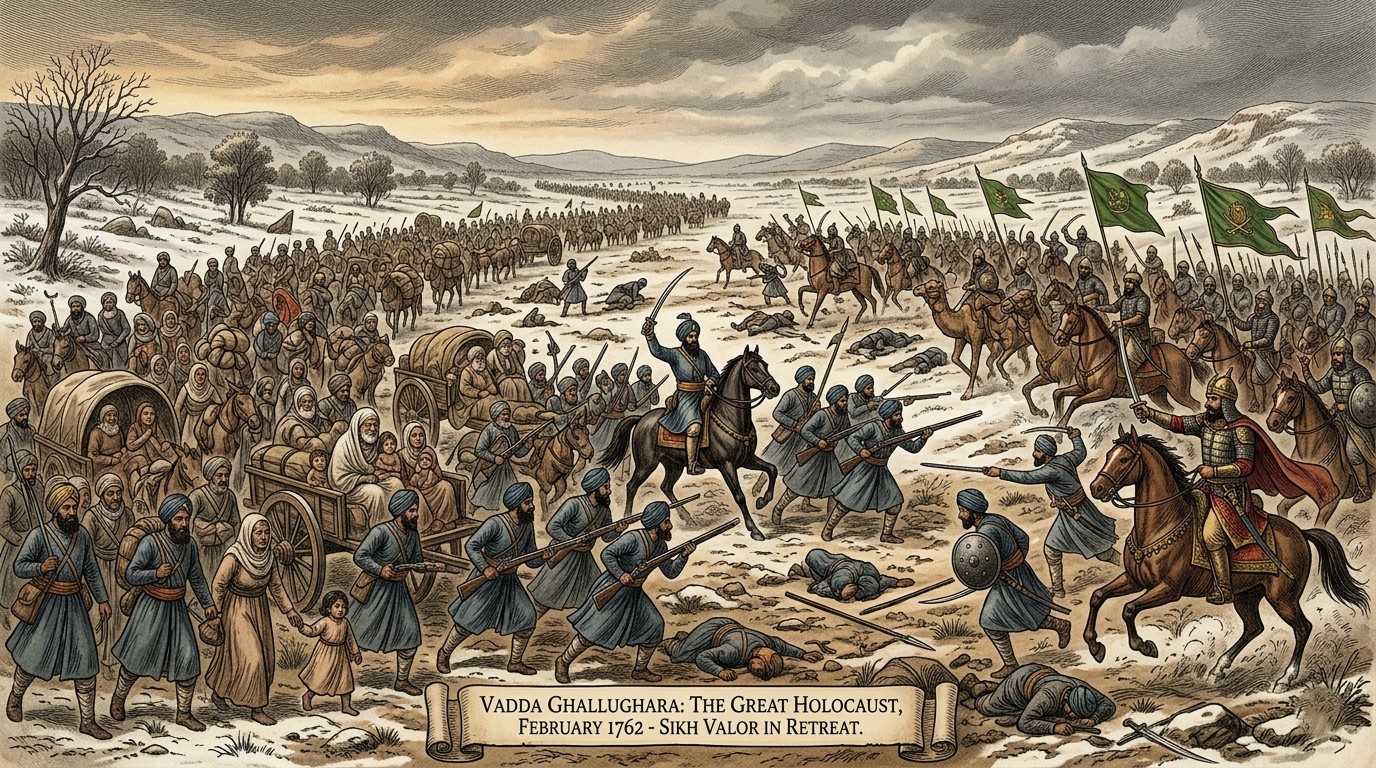
February 1762 CE: Vadda Ghallughara (The Great Holocaust) – Tragedy, Resistance, and the Survival of the Sikh Nation
The year 1762 occupies a deeply emotional and defining place in Sikh history. Among the many trials faced by the Sikh community during the eighteenth century, few events compare in scale, horror, and historical significance to the Vadda Ghallughara, or the Great Holocaust. On February 5, 1762, the Sikh community suffered one of the largest massacres in its history when the forces of Ahmad Shah Abdali, also known as Ahmad Shah Durrani, attacked a massive moving caravan of Sikhs near Malerkotla in Punjab. The attack resulted in the deaths of an estimated 20,000 to 35,000 Sikh men, women, and children within a single day. The scale of the slaughter was staggering, and the trauma it inflicted reverberated across generations. Yet the significance of the Vadda Ghallughara extends beyond the tragedy itself. It stands as one of history's most powerful examples of communal resilience. Despite enduring a catastrophe that might have destroyed many nations, the Sikh community not only survived but emerged stronger, more unified, and more determined than ever before.
As a Sikh historian, one cannot discuss the Vadda Ghallughara merely as a military event or a casualty statistic. It was a profound human tragedy involving families, children, elders, and entire communities caught in a campaign of destruction. At the same time, it became a defining moment that revealed the extraordinary endurance of the Khalsa. The massacre did not occur in isolation but formed part of a broader struggle involving political power, religious freedom, regional instability, and the determination of the Sikhs to preserve their identity despite repeated attempts at annihilation. The memory of the Vadda Ghallughara continues to occupy a sacred place in Sikh collective consciousness because it symbolizes both immense suffering and indomitable courage.
The Political Landscape Before the Great Holocaust
To understand the origins of the Vadda Ghallughara, it is essential to examine the political environment of Punjab during the mid-eighteenth century. The Mughal Empire, once dominant across much of the Indian subcontinent, had entered a period of significant decline. Imperial authority weakened as regional governors pursued independent ambitions and military effectiveness deteriorated. Into this vacuum emerged new powers seeking influence and control.
Among the most formidable of these was Ahmad Shah Abdali, the founder of the Durrani Empire. Based in Afghanistan, Abdali launched multiple invasions into northern India between 1748 and 1767. His campaigns aimed to acquire wealth, expand influence, and maintain strategic control over key territories. Punjab became one of the principal battlegrounds in these struggles.
During the same period, the Sikhs were experiencing remarkable growth despite relentless persecution. The formation of the Dal Khalsa in 1748 had strengthened organizational unity, while the emergence of the Misls created increasingly effective political and military structures. Sikh influence expanded across Punjab, challenging both Mughal and Afghan ambitions. This growing strength alarmed Abdali, who came to view the Sikhs as one of the most significant obstacles to his authority in the region.
The Rise of Sikh Power in Punjab
Following decades of persecution, the Sikhs demonstrated extraordinary resilience. The Chhota Ghallughara of 1746 had inflicted devastating losses, yet the community recovered with remarkable speed. The Dal Khalsa provided coordination, while the Misls offered local leadership and military organization. Sikh warriors became increasingly effective in guerrilla warfare, intelligence gathering, and rapid mobility.
Their influence extended beyond military matters. In many regions, Sikh groups protected local populations from exploitation, maintained order, and established systems of governance. Their growing popularity and effectiveness made them an increasingly important force within Punjab.
For Abdali, this development represented a serious challenge. Each invasion of India encountered growing Sikh resistance. Even when Afghan armies achieved battlefield victories, Sikh forces often re-emerged once the main army withdrew. This persistence frustrated Abdali and contributed to his determination to crush the Sikh movement.
Ahmad Shah Abdali's Determination to Destroy the Sikhs
By the early 1760s, Ahmad Shah Abdali viewed the Sikhs not merely as regional opponents but as a long-term threat to Afghan influence in Punjab. He recognized that their decentralized structure, strong communal identity, and military adaptability made them difficult to eliminate through conventional campaigns.
Abdali therefore sought an opportunity to inflict a decisive blow. His objective was not simply to defeat Sikh warriors in battle but to destroy the community's ability to sustain itself. Such a goal required targeting not only fighters but also the broader population that supported and constituted the Sikh nation.
This strategic calculation set the stage for one of the darkest episodes in Sikh history.
The Great Sikh Caravan
In early 1762, a large body of Sikhs was moving through Punjab. This was not merely a military force but a vast community caravan that included warriors, families, elders, women, and children. Such movements were common during periods of conflict, as Sikh populations often relocated to avoid hostile forces while maintaining communal cohesion.
The caravan represented both strength and vulnerability. Its size reflected the unity of the Sikh community, but it also created logistical challenges and limited mobility. Protecting thousands of non-combatants while navigating hostile territory was an immense undertaking.
Despite these difficulties, Sikh leaders believed they could successfully move the community to safety. They could not have anticipated the scale and speed of the attack that awaited them.
The Ambush Near Malerkotla
In February 1762, Ahmad Shah Abdali's forces intercepted the Sikh caravan near Malerkotla. The location became the site of one of the most devastating massacres in Sikh history. Afghan troops, supported by allies, launched a sudden and overwhelming assault against the moving column.
The Sikhs immediately recognized the danger. Warriors formed defensive positions and attempted to protect the vulnerable members of the caravan. Their objective was not necessarily to achieve battlefield victory but to create opportunities for families and non-combatants to escape.
What followed was a prolonged and desperate struggle characterized by extraordinary courage on the part of Sikh defenders and immense suffering throughout the community.
The Scale of the Massacre
The Vadda Ghallughara stands out not only because of its brutality but also because of the sheer number of casualties. Historical estimates vary, but many accounts place the number of Sikh deaths between 20,000 and 35,000. Men, women, and children were killed as the caravan was overwhelmed by superior forces.
The massacre unfolded over the course of a single day, making it one of the deadliest events in Sikh history. Entire families perished together. Communities that had survived decades of persecution suffered losses almost beyond comprehension.
The enormity of the tragedy left a lasting impression on Sikh memory and became a symbol of both suffering and resilience.
The Heroism of the Sikh Defenders
Despite facing overwhelming odds, Sikh warriors displayed extraordinary bravery throughout the battle. Many chose to stand and fight in order to protect the caravan rather than prioritize their own survival. Their actions reflected the Khalsa ideal of defending the vulnerable even at the cost of one's life.
Numerous accounts describe groups of Sikh fighters forming defensive circles around women, children, and elders. These warriors repeatedly charged enemy forces to create openings through which civilians might escape.
The courage demonstrated during the Vadda Ghallughara remains one of the most celebrated examples of self-sacrifice in Sikh history. The defenders understood the likely outcome yet continued fighting with determination and faith.
The Human Tragedy Beyond the Battlefield
While military histories often focus on commanders and tactics, the true impact of the Vadda Ghallughara can only be understood by considering its human dimension. The victims included mothers carrying children, elderly individuals unable to flee quickly, and families attempting to remain together amidst chaos.
The destruction of so many lives created immense emotional trauma. Entire lineages disappeared. Communities lost elders who preserved knowledge and traditions. Children were orphaned, and survivors carried memories that would shape Sikh identity for generations.
The tragedy therefore extended far beyond the immediate loss of life. It affected the social and cultural fabric of the Sikh nation.
Why the Sikhs Survived
Given the scale of the massacre, it is remarkable that the Sikh community recovered so rapidly. Several factors contributed to this resilience. First, Sikh identity was deeply rooted in shared religious principles rather than dependence upon a single leader or institution. The teachings of the Gurus provided a stable foundation that could endure even amidst catastrophe.
Second, the decentralized structure of the Misls ensured that leadership remained distributed across multiple regions. The loss of one group did not eliminate the capacity for collective action.
Third, the memory of earlier persecutions had prepared the Sikhs psychologically for adversity. Communities had developed traditions of mutual support, adaptability, and resistance that enabled recovery even after devastating losses.
The Immediate Aftermath
In the weeks following the massacre, survivors regrouped and assessed the extent of the damage. The losses were immense, yet the spirit of the Khalsa remained intact. Rather than surrendering to despair, Sikh leaders focused on rebuilding communities, supporting survivors, and restoring organizational effectiveness.
The rapidity with which the Sikhs recovered astonished many observers. Their ability to reorganize demonstrated the strength of the institutions developed through decades of struggle.
The Vadda Ghallughara thus became a testament not only to suffering but also to recovery and renewal.
Retaliation and Renewed Sikh Strength
One of the most remarkable aspects of Sikh history is that the Vadda Ghallughara did not permanently weaken the community. Within months, Sikh forces resumed operations across Punjab. Their determination convinced opponents that even the most devastating acts of violence could not destroy the Khalsa.
In subsequent years, Sikh influence expanded dramatically. The Misls strengthened their positions, captured territory, and increasingly challenged external powers. What had been intended as a decisive blow ultimately failed to achieve its strategic objectives.
The resilience displayed after 1762 remains one of the most extraordinary examples of communal recovery in world history.
The Vadda Ghallughara in Sikh Memory
The Great Holocaust occupies a sacred place within Sikh collective memory. The victims are remembered not merely as casualties but as martyrs whose sacrifices contributed to the survival of the Panth. Their suffering is commemorated through historical narratives, religious reflection, and community remembrance.
For Sikhs, the Vadda Ghallughara represents both a warning and an inspiration. It reminds future generations of the dangers of intolerance and persecution while also demonstrating the power of faith and collective resilience.
The event continues to shape Sikh identity by reinforcing awareness of the sacrifices made to preserve religious freedom and communal dignity.
From Tragedy to Sovereignty
The decades following the Vadda Ghallughara witnessed one of the most remarkable transformations in South Asian history. Despite repeated attempts at annihilation, the Sikhs expanded their influence across Punjab. The Misls evolved into powerful political entities, and eventually Maharaja Ranjit Singh unified many of them into the Sikh Empire.
This achievement would have been difficult to imagine in 1762 amidst the devastation of the massacre. Yet it demonstrates the extraordinary capacity of communities to recover and rebuild after catastrophe.
The eventual rise of Sikh sovereignty stands as a powerful tribute to those who perished during the Vadda Ghallughara and to the resilience of those who survived.
The Historical Legacy of the Great Holocaust
The Vadda Ghallughara remains one of the most significant events in Sikh history because it encapsulates the central themes of sacrifice, resilience, faith, and collective survival. It illustrates the severity of the challenges faced by the Sikh community during the eighteenth century while highlighting its extraordinary capacity to endure.
The massacre serves as a reminder that historical progress often comes at tremendous human cost. At the same time, it demonstrates that persecution can strengthen rather than destroy communities whose identity is grounded in deeply held values.
The legacy of the Vadda Ghallughara continues to inspire reflection on courage, justice, and the enduring power of communal solidarity.
Conclusion
The Vadda Ghallughara of February 1762 stands among the most tragic and defining events in Sikh history. Ahmad Shah Abdali's forces intercepted and attacked a large Sikh caravan near Malerkotla, resulting in the deaths of an estimated 20,000 to 35,000 men, women, and children in a single day. The massacre inflicted immense suffering upon the Sikh nation and left deep emotional scars that endure in collective memory. Yet the event also revealed the extraordinary resilience of the Khalsa. Sikh warriors fought courageously to protect their communities, survivors rebuilt with remarkable determination, and the Panth emerged stronger despite devastating losses. The Great Holocaust remains a powerful symbol of both human tragedy and the triumph of faith, courage, and perseverance. Its memory continues to inspire Sikhs around the world and serves as a testament to the enduring spirit of a community that refused to be destroyed.
Frequently Asked Questions (FAQ)
1. What does Vadda Ghallughara mean?
Vadda Ghallughara means “The Great Holocaust” and refers to the mass killing of Sikhs in February 1762.
2. When did the Vadda Ghallughara occur?
The massacre took place on February 5, 1762.
3. Who was responsible for the attack?
The attack was carried out by the forces of Afghan ruler Ahmad Shah Abdali, also known as Ahmad Shah Durrani.
4. Where did the massacre occur?
The massacre occurred near Malerkotla in Punjab.
5. How many Sikhs were killed?
Historical estimates generally range between 20,000 and 35,000 Sikh men, women, and children.
6. Why were so many non-combatants present?
The Sikhs were traveling as a large community caravan that included families, elders, women, and children.
7. What was the Dal Khalsa?
The Dal Khalsa was the unified Sikh military and political organization formed in 1748.
8. Did the massacre destroy Sikh power?
No. Despite immense losses, the Sikhs recovered and expanded their influence throughout Punjab in the following decades.
9. Why is the Vadda Ghallughara important in Sikh history?
It symbolizes both one of the greatest tragedies endured by the Sikh community and one of its greatest demonstrations of resilience.
10. How is the Vadda Ghallughara remembered today?
It is commemorated as a sacred chapter of sacrifice, martyrdom, and survival that continues to shape Sikh identity and historical memory.