Gurus and Bhagats, Bani Contributors · Origins & Gurus · Guru Arjan Dev Ji
Guru Arjan Dev Ji
Compiled the Adi Granth; built Harmandir Sahib; first Sikh martyr.
Hymns in Guru Granth Sahib: 2218
The Archer of Divine Love: The Immense Journey and Martyrdom of Guru Arjan Dev JiIn the grand tapestry of human history, there are moments where the ink is replaced by blood, and the paper is a heart made of unyielding peace. To look upon the life of Guru Arjan Dev Ji, the fifth Sovereign of the Sikhs, is to witness the arrival of a "heavenly bridge"—a soul sent not just to build temples of stone, but to construct a sanctuary for the human spirit that no fire could ever consume.
This is the story of a poet who compiled the world’s most inclusive scripture, a visionary who built the "Golden" heart of a nation, and a martyr who showed the world that when the soul is anchored in the Divine Will, even a burning iron plate feels like a bed of roses.
1. The Divine Grandson: A Childhood of Prophecy
The story begins on April 15, 1563, in the serene atmosphere of Goindwal Sahib. Born to Guru Ram Das Ji and Mata Bhani Ji, the child was named Arjan Mal. From his first breath, he was surrounded by the scent of Seva (service) and the melody of Gurbani (divine hymns).
His grandfather, the venerable Guru Amar Das Ji, was exceptionally fond of the child. A legendary Sakhi (story) tells of a day when the toddler Arjan crawled into his grandfather’s chamber while the Guru was napping. When a worried attendant tried to whisk the child away to prevent him from disturbing the Guru, the Third Master woke up and smiled.
"Dohita Bani Da Bohita" — My grandson shall be the vessel that carries humanity across the ocean of life through the Word.
Growing up, Arjan was the perfect blend of his parents’ virtues: his father’s poetic soul and his mother’s absolute humility. While his eldest brother, Prithi Chand, was consumed by worldly management and ambition, and his middle brother, Mahadev, retreated into silent asceticism, Arjan was always found where the people were—serving in the Langar, washing dishes, or sitting at the feet of the elders.
2. Thirst of the Soul: The Love Letters from Lahore
In 1581, Guru Ram Das Ji was invited to a family wedding in Lahore. Because he was busy with the development of the city of Amritsar, he decided to send one of his sons. Prithi Chand refused, fearing he might lose his chance at the Guruship if he left his father’s side. Arjan, however, obeyed instantly, viewing the request as a divine command.
While in Lahore, Arjan felt a physical ache of separation from his father-Guru. This "divine longing" poured out of him in the form of three beautiful letters written in poetry. He sent a messenger to deliver them, but Prithi Chand, driven by jealousy, intercepted the first two. Arjan, sensing the mischief, sent a third letter with strict instructions to deliver it only to the Guru.
When Guru Ram Das finally read the letters—now known as the Shabd Hazare—he was moved to tears by the depth of Arjan’s devotion. He realized that Arjan was not just his son, but the spiritual heir of Guru Nanak’s light.
In September 1581, the Guruship was bestowed upon Arjan Dev, making him the Fifth Nanak at the age of 18.
3. The City of Nectar and the Architecture of Humility
Upon becoming Guru, Arjan Dev Ji dedicated himself to fulfilling his father’s dream: the completion of Amritsar. He understood that a growing community needed a physical center that reflected its spiritual values.
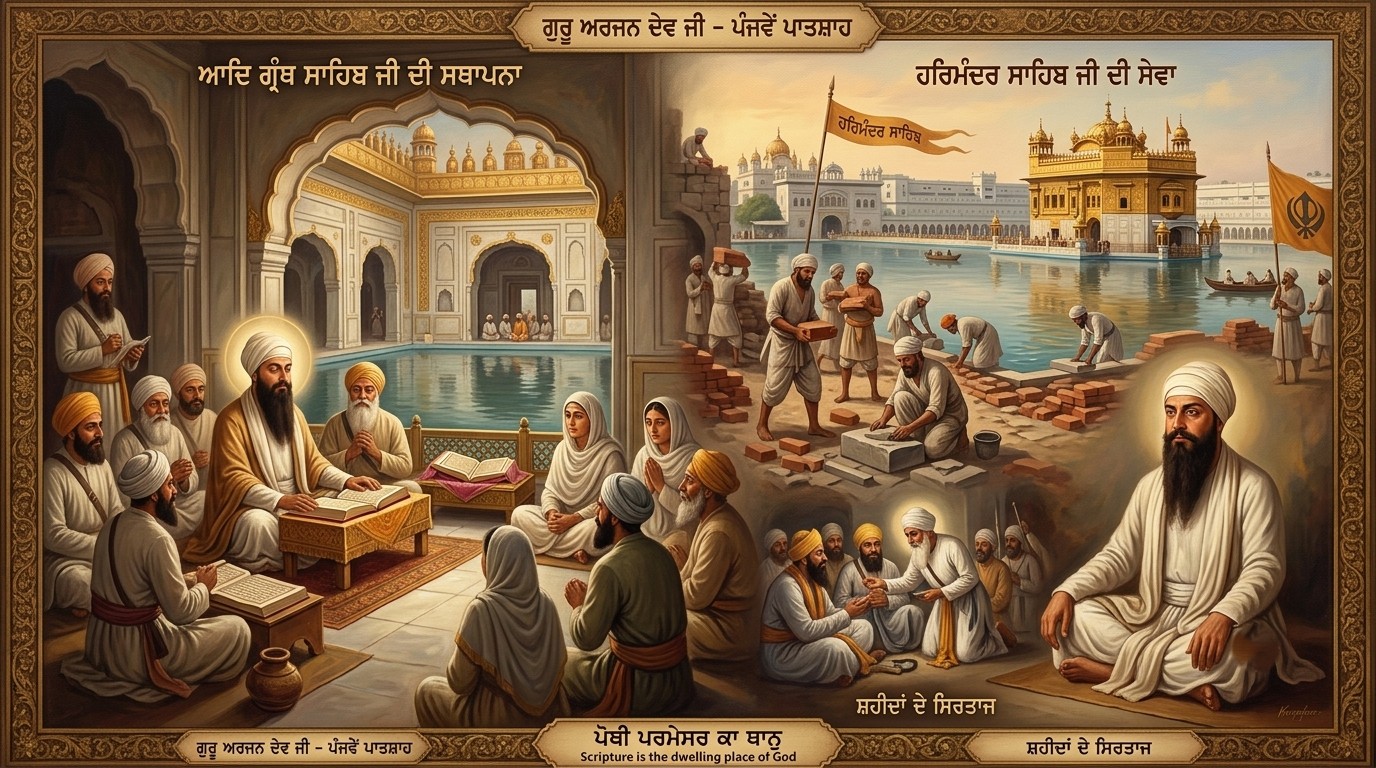
The Foundation of Harmandir Sahib
In 1588, Guru Arjan planned the construction of the Harmandir Sahib (The Golden Temple). In a revolutionary move for interfaith harmony, tradition tells us he invited his close friend, the Sufi Muslim saint Hazrat Mian Mir, to lay the foundation stone.
The Guru’s design was a masterstroke of spiritual symbolism:
- The Lower Level: Harmandir Sahib was built at a lower level than the surrounding land, teaching that one must descend in humility to receive God’s grace.
- The Four Doors: The temple was designed with four entrances, symbolizing that people of all castes and religions from every direction were equally welcome.
4. The Treasury of Truth: Compiling the Adi Granth
As the Sikh community expanded, Guru Arjan noticed that false hymns were being circulated by pretenders to the Guruship. He knew that for the faith to survive, it needed an authentic, unchangeable core.
In 1601, he began the monumental task of compiling the Adi Granth (The First Scripture). He appointed the great scholar Bhai Gurdas as his scribe.
Guru Arjan did something revolutionary: he included the hymns not just of Sikh Gurus, but also of Hindu Bhaktas like Kabir, Namdev, and Ravidas, and Muslim Sufis like Baba Farid.
When the project was completed in 1604, it contained 5,894 hymns, with more than 2,200 composed by Guru Arjan himself.
On August 16, 1604, the Adi Granth was ceremoniously installed in Harmandir Sahib, and Baba Buddha Ji became the first Granthi (reader).
5. Significant People: A Circle of Devotion
- Guru Ram Das Ji: His father and predecessor.
- Bibi Bhani Ji: His mother, remembered for her legendary devotion.
- Baba Buddha Ji: The saint who taught Arjan Gurmukhi and weapon skills.
- Bhai Gurdas Ji: The scholar and scribe of the Adi Granth.
- Mata Ganga Ji: His wife and mother of Guru Hargobind Ji.
- Guru Hargobind Ji: His son, trained to be both saint and soldier.
6. The Heart of Mercy: Tarn Taran and Social Reform
Guru Arjan founded the city of Tarn Taran Sahib in 1590 and constructed a massive Sarovar there, believed to possess healing properties.
He also established a Leper House where he personally cared for those whom society rejected. Through this service, he demonstrated that the Divine spark exists within every human being.
He institutionalized the Masand system and promoted Dasvandh—the practice of donating one-tenth of one’s earnings for community welfare.
7. The Gathering Storm: Jahangir and the Price of Peace
The rapid growth of the Sikh community alarmed Emperor Jahangir and orthodox factions within the Mughal court. The situation worsened when Prince Khusrau, Jahangir’s rebellious son, received hospitality and blessings from the Guru.
Jahangir used this as a pretext for arresting Guru Arjan Dev Ji. At the same time, Chandu Shah, who held a personal grudge against the Guru, fueled the Emperor’s hostility.
8. Martyrdom: The Red-Hot Iron of Faith
In May 1606, Guru Arjan was summoned to Lahore. Jahangir demanded a massive fine and ordered the removal of certain verses from the Adi Granth.
"The money is a trust of the Sangat, and I will not pay a single coin for my own life. And as for the Word of God—not a single letter can be changed."
What followed were five days of unimaginable torture:
- He was denied food and water.
- He was made to sit on a burning iron plate.
- Hot sand was poured over his body.
- He was placed into boiling water.
Throughout the torture, the Guru remained immersed in Divine acceptance.
"Tera Kiya Meetha Lage, Har Naam Padarth Nanak Maange."
(Thy Will is sweet to me, O Lord. Nanak craves only for the wealth of God's Name.)
On May 30, 1606, Guru Arjan Dev Ji entered the waters of the River Ravi, where his soul merged with the Eternal Light.
Significant Teachings & Life Lessons
Teaching Meaning in Action Acceptance of Hukam Living in sweet acceptance of even the hardest circumstances. Universal Inclusion The four doors of Harmandir Sahib and inclusion of diverse saints in Adi Granth. Inner Purity Sukhmani Sahib teaches inner peace through Naam. Service to the Marginalized His compassionate work with lepers at Tarn Taran.Timeline of Guru Arjan Dev Ji’s Life
- 1563: Birth at Goindwal Sahib.
- 1581: Receives Guruship and moves to Amritsar.
- 1588: Foundation of Harmandir Sahib laid.
- 1590: Founding of Tarn Taran Sahib.
- 1595: Birth of Guru Hargobind Ji.
- 1601–1604: Compilation and installation of the Adi Granth.
- 1606: Martyrdom in Lahore.
Why Guru Arjan Dev Ji Still Matters Today
Guru Arjan Dev Ji remains a timeless symbol of resilience through love. He showed that true power lies not in causing suffering, but in enduring it without losing compassion.
In a world divided by religion and identity, his Adi Granth remains a blueprint for harmony, where voices from different faiths stand together in spiritual unity.
He taught humanity that humility, inclusion, and unwavering faith are stronger than oppression.
Frequently Asked Questions (FAQ)
Q1: Why is Guru Arjan Dev Ji called the "Sacha Patshah"?
Sikhs called him the "True King" because he provided spiritual and social leadership rooted in justice and compassion.
Q2: What is the meaning of "Sukhmani Sahib"?
Sukhmani Sahib means "The Pearl of Peace." It is a prayer composed to bring spiritual tranquility and inner peace.
Q3: Did Guru Arjan Dev Ji build the Golden Temple of gold?
He built the original Harmandir Sahib structure. The gold plating was added later by Maharaja Ranjit Singh.
Q4: Who was the first Granthi of the Golden Temple?
Baba Buddha Ji was appointed as the first Granthi of Harmandir Sahib.